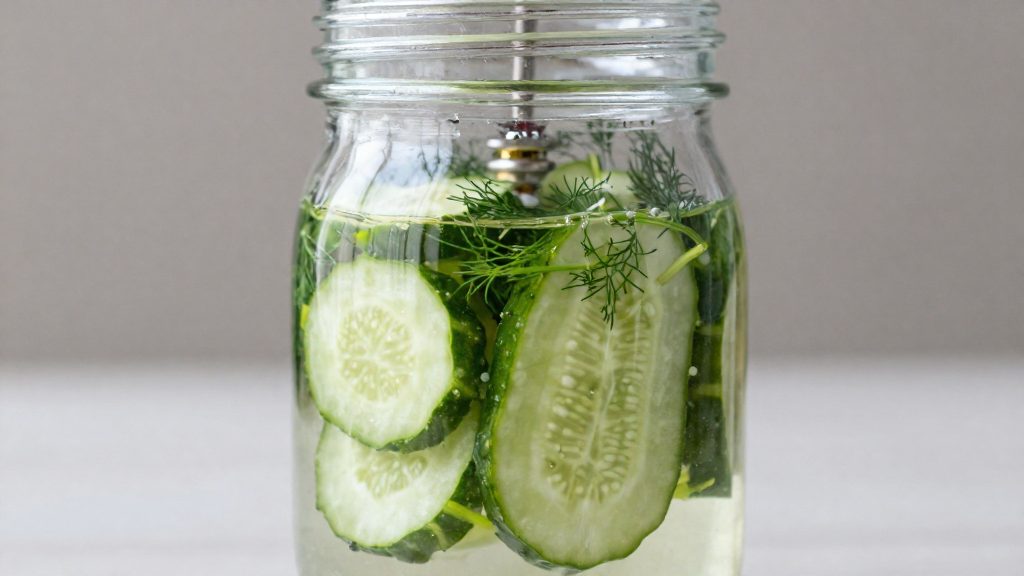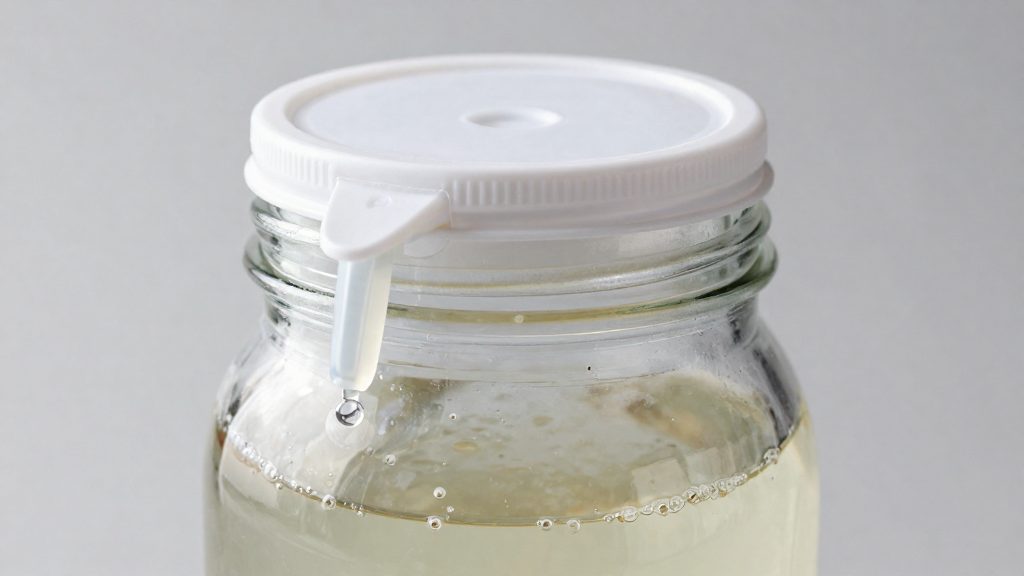
An airlock lid is a one-way valve fitted to a wide-mouth mason jar. It lets the gas produced during fermentation escape while blocking outside air, mold spores and wild yeasts from getting in. Because the flow runs in one direction only, the jar can ferment with its lid on while the contents stay shielded from airborne contaminants.
How does an airlock lid work?
Gas leaves, air does not return
Fermentation produces fermentation gas inside the jar. The airlock gives that gas a path out, so it leaves through the valve rather than building up inside the jar. The one-way design lets gas out and keeps outside air from re-entering. The valve is the only opening in the lid, so the jar’s contents are not exposed each time gas escapes.
What the valve blocks
According to MakeSauerkraut.com, an airlock blocks outside air, mold spores and wild yeasts. A fermenting jar is exposed to these airborne organisms whenever a plain lid is removed or left loose. The airlock blocks room air, mold spores and wild yeasts from entering, but it does not keep the vegetables under the brine.
| Path through the lid | Direction | Status |
|---|---|---|
| Fermentation gas | Jar to outside | Exits through the valve |
| Outside air | Outside to jar | Cannot re-enter |
| Mold spores | Outside to jar | Blocked |
| Wild yeasts | Outside to jar | Blocked |
The lid’s role in a standard setup
A standard two-piece mason lid seals the jar but offers no dedicated outlet for gas. Fitting an airlock into the same wide mouth replaces that plain lid with a valve, so the jar keeps its normal opening and closing footprint while gas has a controlled exit. The lid does not regulate the ferment itself. Its job is limited to gas release and one-way protection.
Do you still need a fermentation weight?
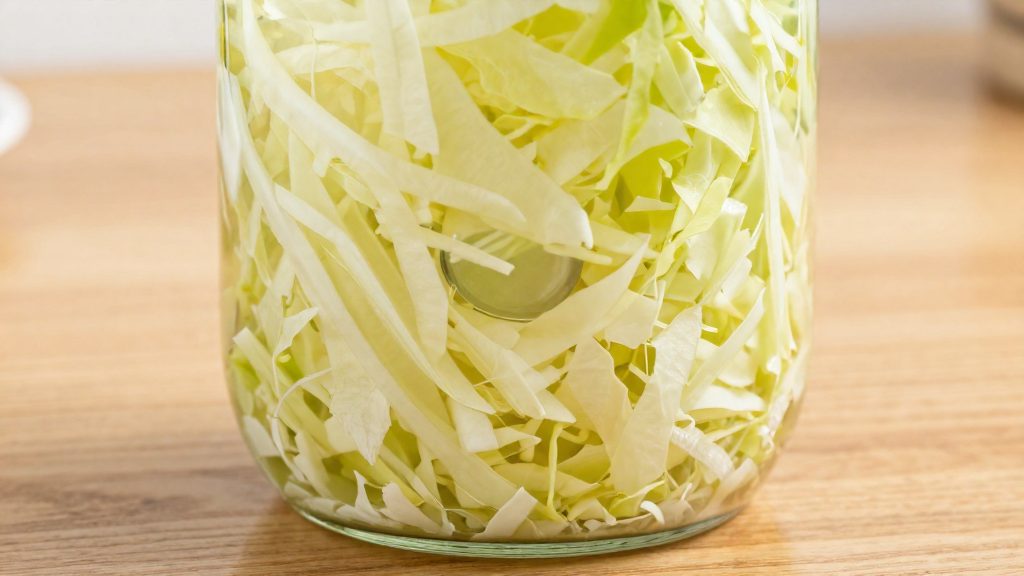
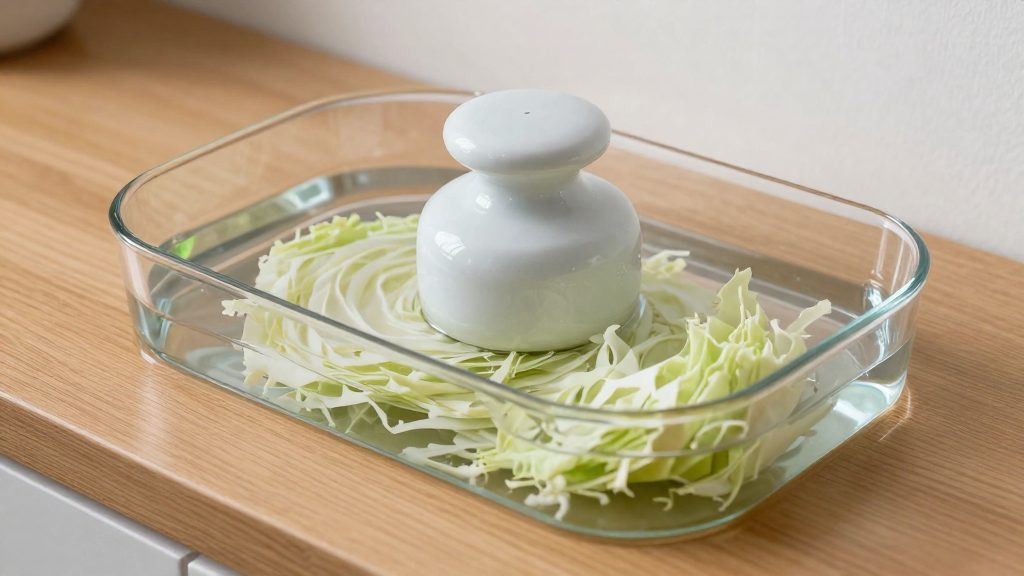
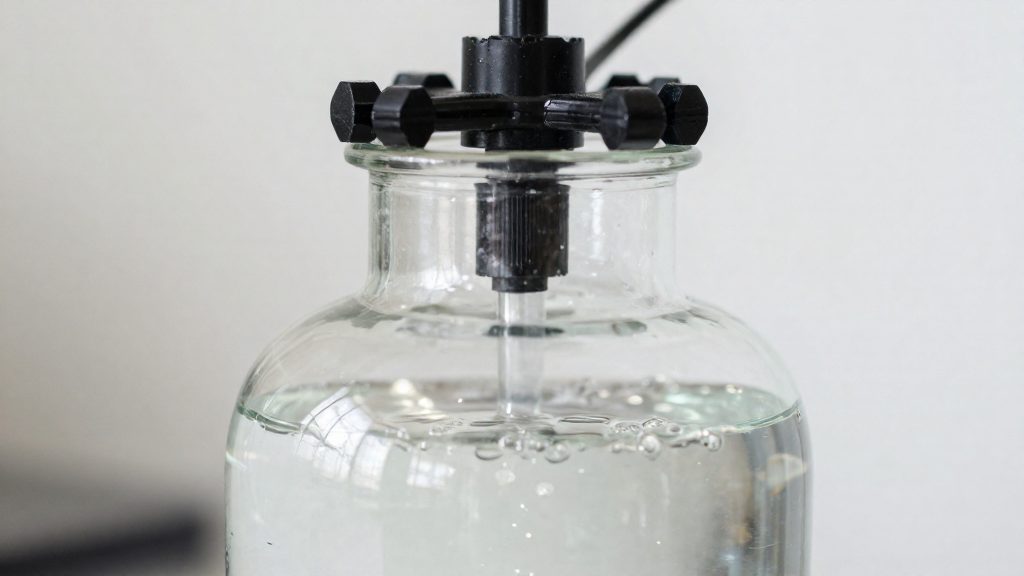
Not always. Whether you need a fermentation weight depends on the vegetable, because the question is whether it stays under the brine. During fermentation, gas bubbles form and push packed cabbage up out of the liquid. According to MakeSauerkraut.com, sauerkraut still needs a weight even under an airlock lid for this reason. Brined vegetables such as carrots usually stay submerged without one.
Density and shape are likely part of the reason. Shredded cabbage packs loosely, traps gas between its strands, and floats once bubbling starts. Carrots are denser and tend to stay below the liquid level, so the brine keeps them covered without help. A practical test is to watch the top layer after fermentation begins. If the vegetable rises out of the brine, it needs a weight. If it stays down, you can usually skip one.
The goal is to keep the cabbage fully covered by brine for the whole ferment, not just during packing. Penn State Extension notes that this is harder to achieve in jars than in other vessels, so the cabbage needs closer attention as it ferments. A weight holds the shreds down so that gas production does not lift them into the air above the liquid, where they are exposed.
| Vegetable | Typical behaviour in brine | Weight needed? |
|---|---|---|
| Shredded cabbage (sauerkraut) | Gas bubbles lift packed cabbage out of brine | Yes |
| Carrots | Usually stay submerged | Usually no |
Which wide mouth lid style fits your jar?
A wide-mouth lid has to match the opening of your jar, so size is the first thing to confirm. According to MakeSauerkraut.com, wide-mouth jars need a wide-mouth lid, and some listings are mislabeled. A lid that is too small will not seat across the rim, and a lid with the wrong fit can leave gaps at the edge. Complete the size check before you add vegetables or brine.
Measure the jar before you shop
Measure the inside width of the jar mouth across its widest point with a ruler or caliper. Then compare that figure with the lid’s stated diameter, which the listing should give. If the listing does not show dimensions, do not assume the lid fits. Ask the seller or choose a product that lists them.
Check the listing wording against the dimensions
Read the title, the description, and the size fields together. MakeSauerkraut.com gives one example: a Pickle Pipe link describes its lid as “Small Mouth.” That label conflicts with the needs of a wide-mouth jar, so the listing should be checked before purchase. When the wording and the dimensions disagree, rely on the measurement you took of your own jar.
| Check | What to confirm before buying |
|---|---|
| Jar opening | Inside width of your wide-mouth jar, measured in advance |
| Listing title | Says “wide mouth” and does not say “small mouth” |
| Lid diameter | A stated diameter appears in the listing and matches your measurement |
| Description | Dimensions are written in the text, not only shown in photos |
Water-filled, waterless or water-sealed: what’s the difference?
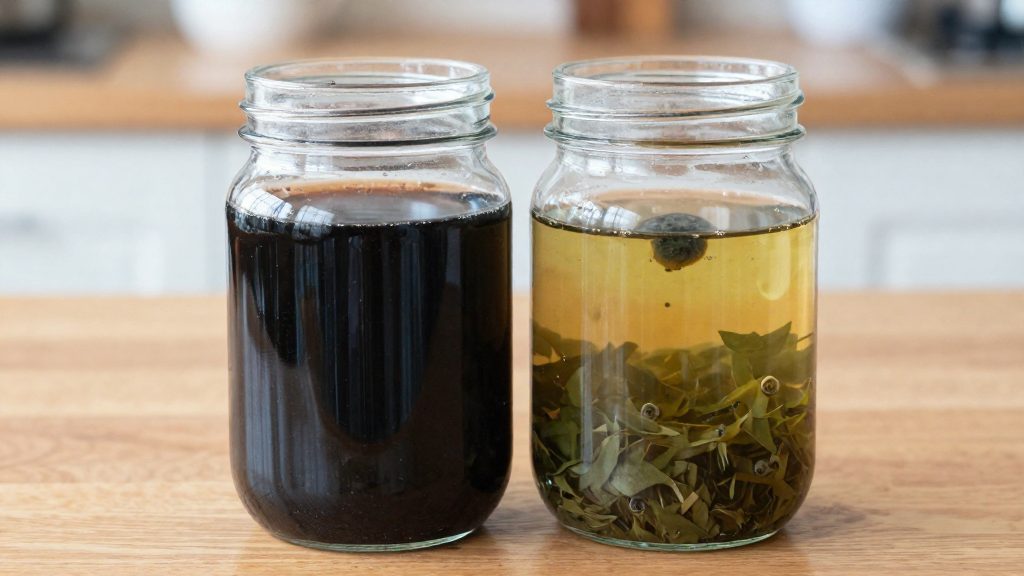
Lid designs for wide-mouth jars fall into three styles: the three-piece water-filled cup airlock, the one-way waterless valve, and the water-sealed lid. They differ in the sealing medium they use, the parts you assemble, and the checks they need during a ferment. The comparison below covers those three points.
| Aspect | Water-filled cup airlock | One-way waterless valve | Water-sealed lid |
|---|---|---|---|
| Sealing medium | Water held in a cup | Valve mechanism, no liquid | Water (per the style name) |
| Parts | Three pieces | Valve fitted to the lid | Not stated |
| Routine check | Water level in the cup | Valve operating in one direction | Not stated |
How the sealing differs
The water-filled cup airlock uses a liquid barrier. Gas bubbles up through the water and leaves, while air from outside cannot pass back in. The waterless valve has no liquid. It relies on a one-way valve, so its performance depends on the valve staying clean and free to move.
Upkeep during fermentation
Whichever lid you choose, keep the vegetables under the brine as described in the weight section.
How much salt and what temperature for sauerkraut?
For sauerkraut, Penn State Extension sets the salt amount by cabbage weight and recommends fermenting at 70–75°F (about 21–24°C). Use 3 level tablespoons of canning or pickling salt per 5 lb of cabbage. If you ferment in jars, use 3½ level tablespoons per 5 lb instead. Weigh the cabbage first and measure the salt carefully, because the ratio depends on weight, not on the size of the head.
| Cabbage weight | Salt for a crock or other vessel | Salt for jars |
|---|---|---|
| 5 lb | 3 level tablespoons | 3½ level tablespoons |
| 10 lb | 6 level tablespoons | 7 level tablespoons |
The 10 lb row is double the 5 lb amounts. For any other weight, scale the same ratio in proportion.
Temperature range to target
Penn State Extension gives three thresholds for the fermentation room:
- 70–75°F (about 21–24°C): the target range for sauerkraut.
- Above 80°F (about 27°C): the sauerkraut is likely to spoil.
- Too cool: a room that is too cool may not ferment at all.
Choose a spot where the room temperature stays inside the target range over the day and night, rather than one that swings above 80°F in the afternoon. Check the temperature with a thermometer placed near the jar or crock, not only on the wall, because a sunny or heated spot can run warmer than the room average.
Is an airlock actually necessary?
An airlock is not required for every ferment. Fermentation releases gas, and the real question is whether the vegetables will stay under brine without extra help. A loose lid, a cloth cover or an airlock can each let gas out, but they differ in protection and in how much checking they demand.
Loose lid or cloth cover
A loose lid or cloth cover costs nothing and still lets gas escape, so it works for many brined vegetables. Its limitation is that it does not block outside air and spores the way a one-way valve does, so the jar needs more frequent inspection.
Cost and effort: buying versus improvising
Buying an airlock lid adds a cost and a sourcing step. Improvising with a loose lid or cloth avoids that expense but shifts the work to the cook.
Small batches versus large crocks
The sources do not give a batch size above which an airlock becomes necessary. In practice, a small jar has less vegetable to hold under brine and fewer surfaces to watch, which makes a loose lid easier to manage. Larger batches leave more cabbage that can float, so a dedicated weight and a reliable cover matter more.
Signs your ferment is safe or spoiled
A healthy vegetable ferment looks cloudy, smells sharply sour and keeps firm vegetables under the brine. According to Penn State Extension, mold, a slimy feel or a bad smell means the batch should not be eaten. Surface scum is a separate case: it can be removed while the rest of the batch is checked.
| Cue | Usually normal | Possible spoilage |
|---|---|---|
| Surface | Cloudy brine, a thin film that lifts off easily | Fuzzy or colored growth, or anything you cannot identify |
| Texture | Firm, crisp vegetables | Slimy or mushy pieces |
| Smell | Sharp, sour, vinegary, fresh-cabbage tang | Rotten, putrid or persistently foul |
Mold, sliminess and bad smell
Any one of these three signs is a reason to discard the batch. Mold often looks fuzzy or colored and may sit in patches. Sliminess shows as a slick coating on the vegetables. A foul odour that does not fade after you lift the lid for a moment points to spoilage rather than normal fermentation.
Surface scum versus mold
Penn State Extension advises removing scum from the surface and checking the vegetables underneath. If you see mold, or the vegetables feel slimy or smell bad, do not taste the sauerkraut and discard the batch. Lift a thin film off with a clean spoon, then inspect the pieces below. If the growth is fuzzy, colored or you cannot tell what it is, treat it as mold and discard the batch. A film that wipes away is not proof the batch is safe. Also check the smell and texture of the vegetables underneath, and discard the batch if anything seems off.
Sour aroma versus off-odour
Normal fermentation smells sharp and acidic, similar to vinegar combined with fresh cabbage. An off-odour is rotten, putrid, sewage-like or ammonia-like. Smell the ferment in the jar, not only the surface, because spoilage can sit under an intact film. If the smell is unfamiliar and unpleasant, discard the batch.
Frequently asked questions
Do I need a weight under an airlock lid for sauerkraut?
Usually yes. According to MakeSauerkraut.com, gas bubbles push packed cabbage up out of the brine, so a weight keeps it submerged. Brined carrots usually stay under the liquid without one.
How do I make sure a lid fits my wide-mouth jar?
Pair a wide-mouth lid with a wide-mouth jar, and check the product listing before you buy. MakeSauerkraut.com notes that some listings are mislabeled, such as a Pickle Pipe link that reads “Small Mouth.”
What should I do if my airlock jar smells bad or shows mold?
Do not taste the contents. Penn State Extension advises discarding sauerkraut that shows mold, feels slimy, or smells bad. Check the jar often during fermentation and remove any scum on the surface, since it can signal a problem early.