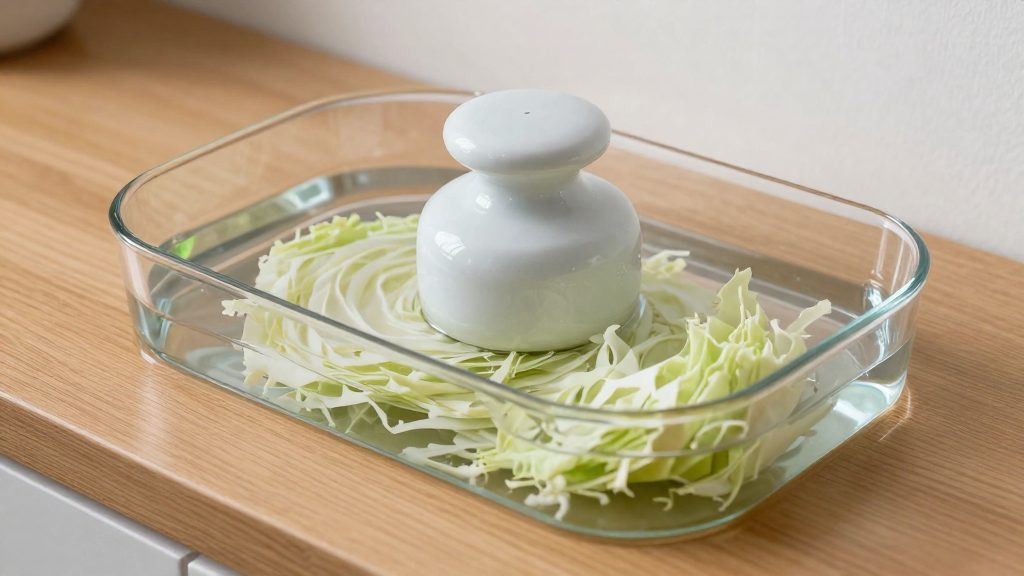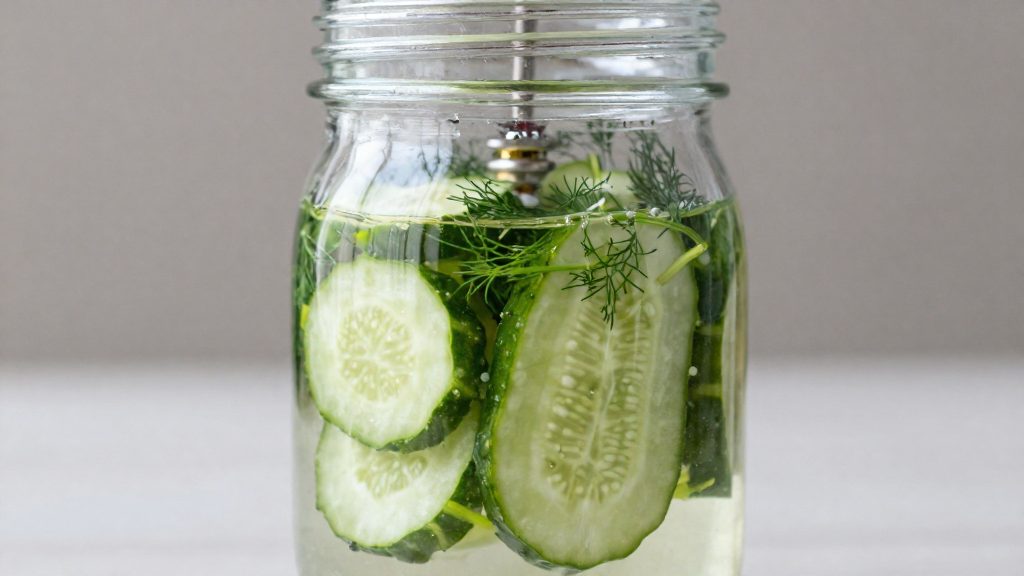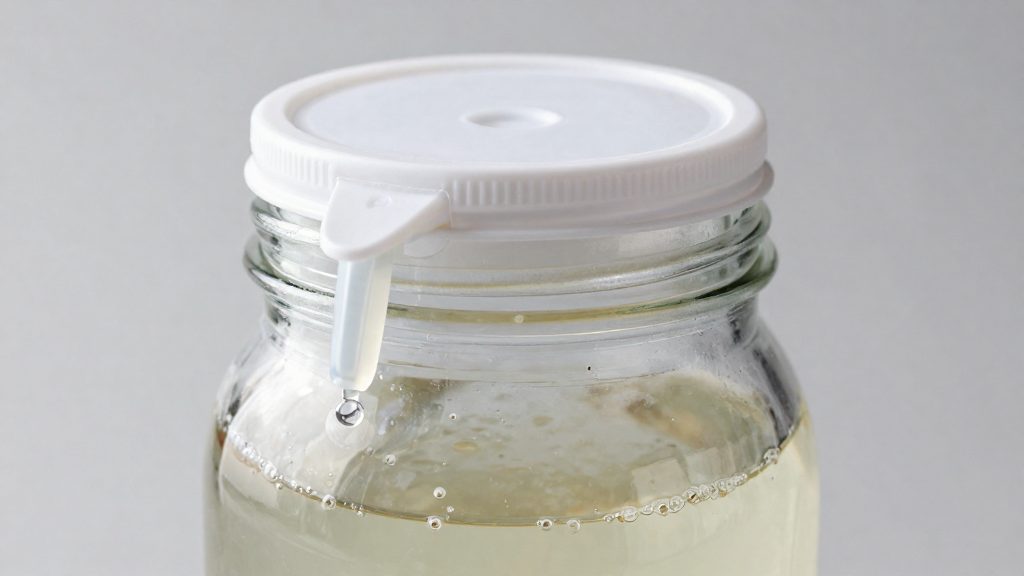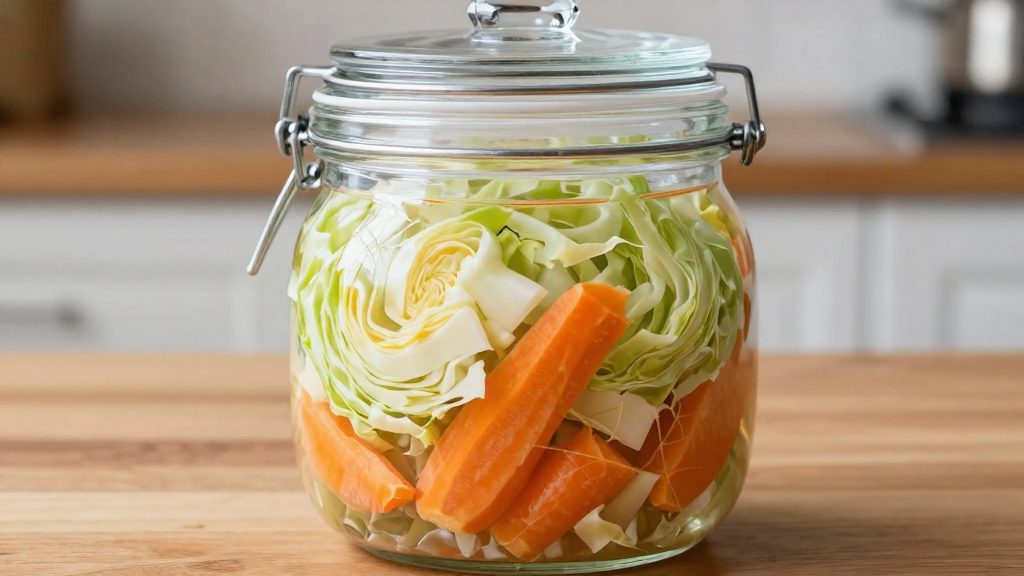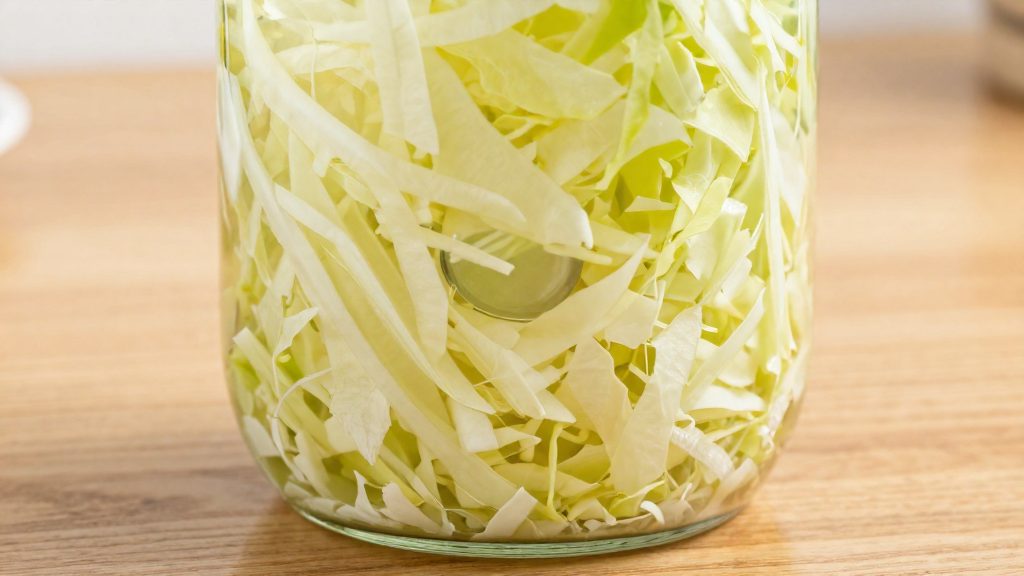
A fermentation weight matters because it keeps shredded vegetables under their brine. Submerged vegetables ferment without oxygen, which favors the lactic acid bacteria that make the ferment safe and sour. Exposed surfaces let air in, which invites mold and rot. Keeping the vegetables submerged matters most in the first week, when lactic acid builds up.
Why does a fermentation weight matter?
Anaerobic conditions and lactic acid production
Lactic acid bacteria already present on cabbage and other vegetables convert sugars into lactic acid. This process happens without oxygen, which makes it anaerobic. Brine blocks air from reaching submerged pieces, so these bacteria can dominate the jar. The acid they produce gives sauerkraut its sour flavor and lowers the pH, which slows the growth of organisms that spoil food.
Surface exposure as the main spoilage route
Vegetables that rise above the brine are the most common point of failure. According to the University of Alaska Fairbanks Cooperative Extension, spoilage and quality problems include mold, softness, a rotten surface where air reached the kraut, and darkening. The difference between the two conditions is clear:
| Condition | Oxygen access | Typical result |
|---|---|---|
| Fully submerged | Blocked by brine | Lactic fermentation proceeds |
| Exposed surface | Open to air | Mold, softening, rot, darkening |
Why submersion matters most in week one
Lactic acid builds up mainly in the first week, so keeping the vegetables covered matters most then. Coverage can still drop later, so keep checking until the ferment is finished.
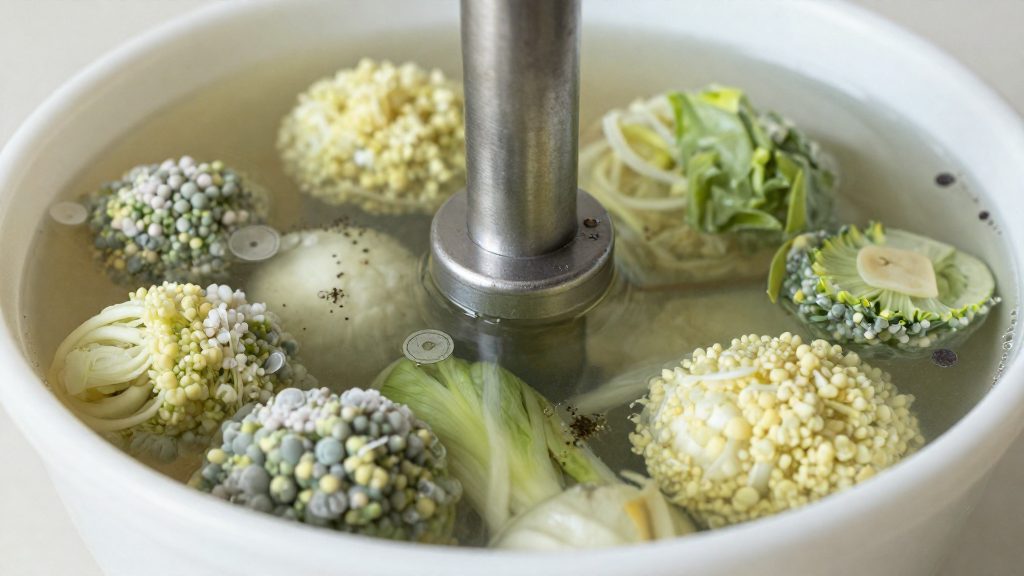
Which weight fits a mason jar?
A fermentation weight has to pass through the jar’s mouth, sit inside the body without wedging, and leave room for brine above the vegetables. Check the fit against the jar you actually use.
Measuring before you buy
Measure the inside diameter of the mouth, then the widest point of the weight. A weight wider than the opening cannot be inserted. A weight that clears the mouth but is wider than the body below the shoulder can become stuck, which makes removal and cleaning harder. Check both measurements before ordering.
Glass weights
Glass is the type the sources name. In a quart-jar test reported by MakeSauerkraut.com (specialist publication), the Pickle Pebble glass weight kept cabbage covered through the first week but lost coverage later. The result comes from one jar size and one test, so it shows how one glass weight performed, not how all glass weights behave.
Plastic and ceramic weights
Weight volume and brine space
A weight occupies part of the space in the jar. Using the 1–2 inch headspace guideline from MakeSauerkraut.com (specialist publication), a bulky weight leaves less room for brine. Brine that has no room can overflow or rise into an airlock, so a compact weight that still covers the cabbage is usually the better fit.
| Check | Why it matters |
|---|---|
| Weight width vs. mouth diameter | Determines whether the weight can be inserted at all |
| Weight width vs. body below the shoulder | Determines whether the weight can be removed after fermentation |
| Space left for brine within the 1–2 inch headspace | Determines whether brine can overflow or rise into an airlock |
How do you use a fermentation weight step by step?
Using a fermentation weight involves three steps: packing the vegetables into the jar, pressing them under their own juice, and setting the weight so the surface stays submerged while the jar ferments at a steady temperature.
Packing and pressing under brine
Add the shredded or sliced vegetables in layers and press each layer down firmly with a clean tool or your fist. Pressing forces air out and draws juice to the surface, which creates the brine the ferment sits in.
Placing the weight and checking coverage
Set the weight on top of the packed vegetables so it sits below the surface of the juice. The University of Alaska Fairbanks Cooperative Extension advises keeping the cabbage 1 to 2 inches below its juice. Check the juice line at each inspection. Top up with brine when the juice does not cover the vegetables.
Fermentation temperature and timing targets
Temperature controls both the speed and the success of the ferment. The table below summarises the targets for sauerkraut in small jars, as reported by the University of Alaska Fairbanks Cooperative Extension.
| Temperature | Outcome |
|---|---|
| 70–75°F | Small jars usually finish in 1 to 3 weeks |
| 60–65°F | Fermentation takes 5 to 6 weeks |
| Below 60°F | The kraut may not ferment |
| Above 75°F | The kraut may soften and spoil |
Choose a spot with a stable temperature, because the timing in the table only holds if the jar stays within its range.
How much headspace and brine do you need?
Sauerkraut depends on three measurements: the salt ratio, the level of the cabbage relative to its juice, and the brine fallback used when the juice runs short. The University of Alaska Fairbanks Cooperative Extension gives a specific salt ratio: 3 tablespoons of non-iodized canning salt per 5 pounds of shredded cabbage.
| Measurement | Target |
|---|---|
| Salt for sauerkraut | 3 tablespoons non-iodized canning salt per 5 pounds shredded cabbage |
| Cabbage depth below juice | Keep cabbage 1 to 2 inches below the juice (UAF Extension) |
| Headspace in the jar | About 1 to 2 inches of empty space above the liquid (MakeSauerkraut.com) |
| Brine fallback | 1½ tablespoons salt per quart of water |
Measuring the salt
Weigh or estimate the shredded cabbage first, then measure the salt against that amount. Use non-iodized canning salt, because the Cooperative Extension specifies this type for sauerkraut. Mix the salt into the cabbage before packing it into the jar so it is distributed evenly.
Using the brine fallback
Brine is a backup, not a default. Pack the cabbage and check whether its juice covers it. If the juice falls short, add brine at 1½ tablespoons of salt per quart of water until the cabbage is submerged. Make the brine by dissolving the salt fully in the water before pouring it in.
Keeping headspace clear
Leave the 1 to 2 inches of space above the liquid line empty.
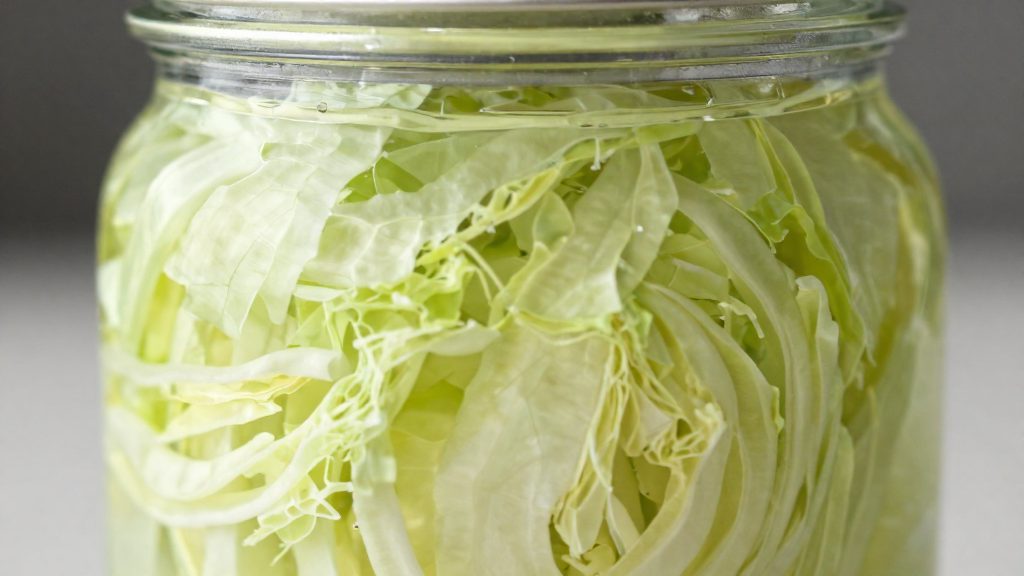
What if the ferment floats or the brine drops?
When vegetables rise above the liquid or the brine level falls, the cause is usually gas pressure, a weight that doesn’t hold, or too little headspace. Fermentation releases gas, and the fermentation weight is the only thing keeping the pieces under the brine. Diagnose the problem by checking three things: how far the weight sits from the surface, how much space it takes up in the jar, and whether the liquid is still reaching the vegetables.
Why pieces float and gas builds pressure
Gas produced during fermentation lifts loose shreds or chunks toward the surface. Floating is more likely when the weight is too small to press the pieces down or when it sits loosely in the jar. Keep the jar within 70–75°F, because above 75°F the kraut may soften and spoil.
MakeSauerkraut.com reports that brine coverage can fall after the first week, because brine is drawn back into the cabbage. A jar that looked fully covered on day seven may need topping up later.
| Symptom | Likely cause | Corrective action |
|---|---|---|
| Pieces floating above the juice | Weight too small or not seated flat | Replace with a weight that fits the jar and press it under the brine |
| Juice level dropping over time | Brine drawn into the vegetables | Check coverage and top up with brine |
| Brine rising into the airlock | Too little headspace | If your jar has an airlock lid, remove the airlock, clear it, and check the weight size |
| Liquid overflowing the rim | Weight or vegetables filling the headspace | Wipe the rim and place the jar on a tray to catch spills |
Topping up with fresh brine safely
Remove the weight, check the level, and pour in brine until the vegetables are submerged again. Reseat the weight so it lies flat on the vegetables.
If the weight is a glass piece that has stopped holding the vegetables down, check coverage more often. Make the top-up brine at the strength used for the batch rather than a stronger or weaker solution.
Clearing overflow and blocked airlocks
Overflow usually means the jar was too full or the brine rose faster than the headspace allowed. Lift out the weight, wipe the jar rim and threads, and clean the outside of the jar so the seal is not contaminated.
For a blocked airlock, remove the airlock, rinse it, and refill it with water to its fill line before reattaching it. Check that brine has not risen into the airlock body or the lid.
Can you ferment without a weight?
Yes, if something else keeps the vegetables below their brine. According to the University of Alaska Fairbanks Cooperative Extension, a clean plate topped with a weight, or a brine-filled food-grade bag, can hold the cabbage down.
Clean plate with a weight
A plate spreads downward pressure across the surface of the cabbage. The Extension pairs it with a weight placed on top, so the plate is not presented as a complete solution on its own. The trade-off is headspace. A plate occupies that space too.
Brine-filled food-grade bag
A food-grade bag filled with brine rests on the cabbage and holds it under the liquid. Because the bag contains brine, it can also help keep the level stable. The sources do not give a separate salt strength for the bag.
| Method | Use described in the sources | Main trade-off |
|---|---|---|
| Clean plate with a weight | Holds cabbage under the juice | Takes up headspace |
| Brine-filled food-grade bag | Holds cabbage under the juice | Brine strength not specified |
Cabbage leaves and lids
Based on the principle of keeping the vegetables submerged, a loose leaf is unlikely to stay in place as the brine level changes, and a tightly closed lid traps gas rather than releasing it, which is why fermentation jars use airlocks. Treat them as untested.
Safety checks: mold, film and when to toss
Opening a ferment to check it means looking for signs of spoilage and removing any white film. The University of Alaska Fairbanks Cooperative Extension says a white film should be skimmed off during checks, but its presence alone does not settle the question. What matters is what lies beneath it and whether any other sign is present.
Mold versus white film
Mold is a spoilage sign. If you cannot tell mold from white film, or have any doubt, throw the batch out. Inspect closely whenever the surface looks unusual.
Pink yeast
Pink color on the surface comes from yeasts. According to the University of Alaska Fairbanks Cooperative Extension, pink color from yeasts is not considered harmful. A pink surface does not, on its own, justify discarding the batch. Judge the ferment by the other signs in the table.
Checking the rest of the batch
| Sign | Status in the sources | Practical check |
|---|---|---|
| Mold | Listed as a spoilage sign | Look for fuzzy or colored patches, including under any film |
| White film | Should be removed during checks | Skim it off, then inspect the layer below |
| Pink color | Attributed to yeasts, not considered harmful | Confirm no other sign is present |
| Softness | Listed as a spoilage sign | Press the cabbage: firm pieces are normal, mushy pieces are not |
| Rotten surface | Listed as a spoilage sign where air reached the kraut | Check the top layer and any exposed edges |
| Darkening | Listed as a spoilage sign | Compare the affected area with the rest of the batch |
Deciding whether to discard
A ferment with mold, a rotten surface, or both should be discarded. A ferment with mold, a rotten surface, or both should be discarded. Pink color from yeasts is not considered harmful, and a white film is removed during checks. Keep the batch only if you are sure the surface is film and not mold, and the cabbage underneath shows none of the other signs. If you cannot tell them apart or have any doubt about its safety, throw it out, as the University of Alaska Fairbanks Cooperative Extension advises. Decide based on the presence of any sign rather than on a size threshold.
Frequently asked questions
What should I do when the brine drops below the vegetables?
Top up with brine made from 1½ tablespoons of salt per quart of water, as the University of Alaska Fairbanks Cooperative Extension advises, until the cabbage sits again about 1 to 2 inches below the juice surface.
How do I tell a harmless surface film from mold?
Pink color from yeasts is not considered harmful, and a white film is removed during checks. Mold is a spoilage sign. If you cannot tell it apart from film, discard the batch.
How long does the weight need to keep the vegetables covered?
Lactic acid builds up mostly in the first week, so the weight does the most work then. Coverage can still slip later as brine is drawn back into the cabbage, so keep checking until the ferment is finished. Small jars held at 70–75°F usually take 1–3 weeks, according to the University of Alaska Fairbanks Cooperative Extension.