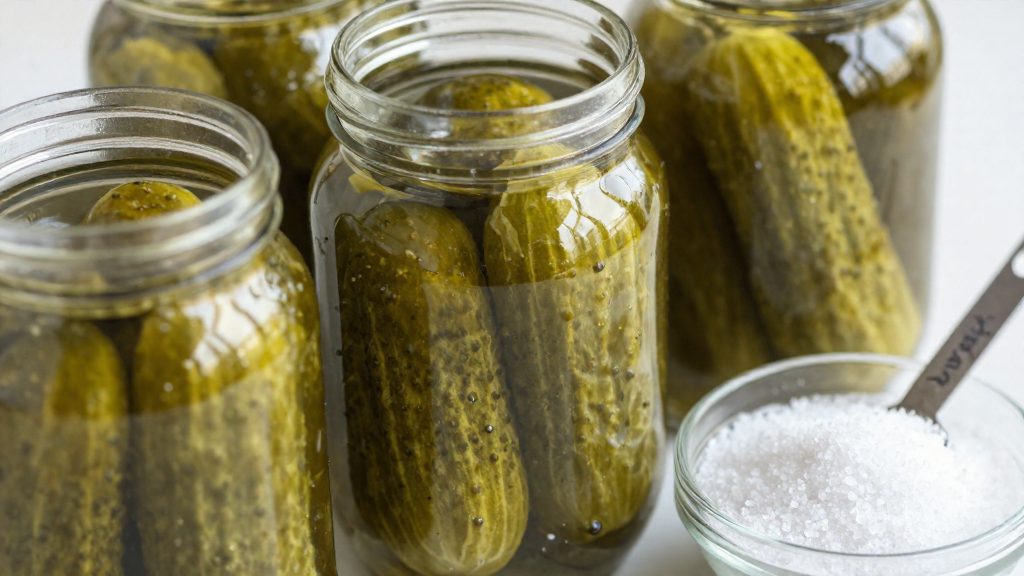
Yes. Salt type affects the finished brine and the colour of the vegetables, not only the flavour. Oregon State University Extension (2024) recommends canning or pickling salt, which is pure granulated salt with no anti-caking agents or iodine. The University of Nebraska–Lincoln Extension (2024) states that iodized or non-iodized table salt can still be used for fermented pickles, so the deciding factor is what the label says.
Does salt type matter for fermented pickles?
Reading the label before you buy
Salt packaging often highlights branding rather than composition, so the ingredient list is the most reliable check. Two points matter:
- Additives: a salt that lists only salt matches the pure, granulated product Oregon State University Extension (2024) recommends. Anti-caking agents and iodine are the additives the same source names.
- Form: flake salt is not recommended for pickling because its density varies, according to the University of Nebraska–Lincoln Extension (2024). Granulated salt gives more consistent measurements.
| Label type | Verdict for fermentation | Source |
|---|---|---|
| Canning or pickling salt (pure granulated) | Recommended | Oregon State University Extension (2024) |
| Plain table salt, iodized or non-iodized | Can be used for fermented pickles; check the label for anti-caking agents and iodine | University of Nebraska–Lincoln Extension (2024) |
| Flake salt | Not recommended; density varies | University of Nebraska–Lincoln Extension (2024) |
Origin matters less than additive content
The sources consulted do not address whether the geographic origin of salt (sea, rock, or lake) affects fermentation. The recommendation is defined by purity: pure granulated salt without anti-caking agents or iodine. Two products from different origins can therefore be equally suitable, or equally unsuitable, depending only on their ingredient lists. Origin should not be used as a proxy for suitability.
Brine clarity and vegetable colour as quality signals
A cloudy brine or a darkened vegetable colour is one reason to check the salt label used for that batch, but other causes are possible. These signs indicate a possible cause, not a confirmed one. The sources consulted do not provide a method for distinguishing salt-related cloudiness or darkening from other causes.
To isolate the salt as the variable, prepare two small batches with the same vegetables, the same brine weight, and the same container, changing only the salt. Differences in brine clarity and colour between the batches then point to the salt.
Pickling salt: the safe default
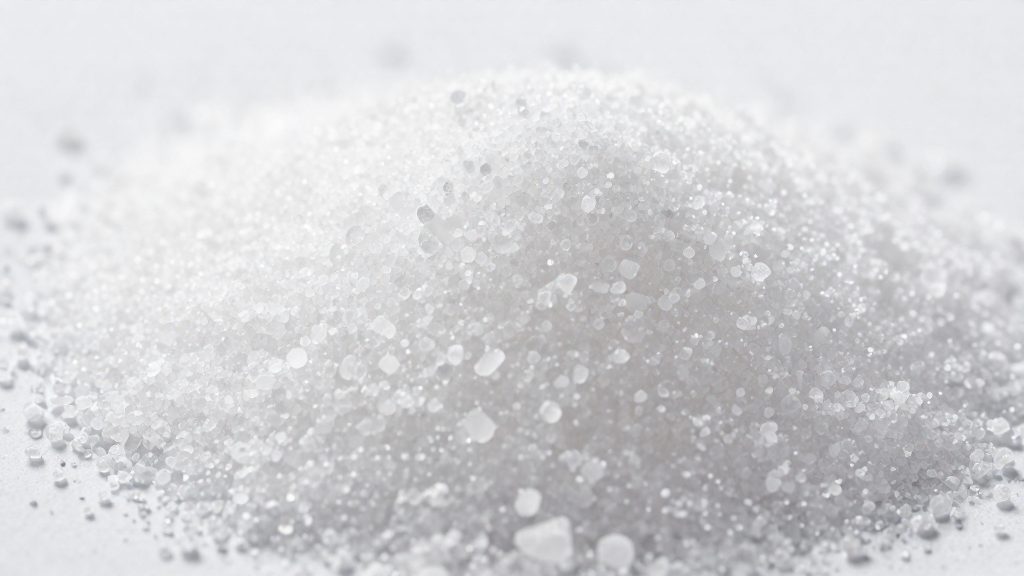
Canning or pickling salt is the reference choice for lacto-fermented pickles because it is pure granulated salt with no anti-caking agents. Because the only ingredient is salt, nothing else enters the brine that could affect clarity or flavour, so it serves as the baseline against which other salts are judged.
The practical approach is to choose pickling salt first, then keep the same salt and the same ratio across batches so that results stay comparable from one ferment to the next.
Setting up the default
- Check the label. Look for a product sold as canning or pickling salt and confirm that it lists no anti-caking agent.
- Weigh it. Oregon State University Extension (2024) notes that one cup of granulated salt weighs 10.2 oz (289 g).
- Keep one salt in the kitchen for ferments. Switching salts mid-project makes it harder to tell whether a change in texture or brine came from the salt or from the process.
Can you use iodized table salt?
Yes. The University of Nebraska–Lincoln Extension (2024) states that fermented and quick pickles may be made safely with either iodized or non-iodized table salt. The salt is safe to use, but it is not neutral. Table salt may contain additives that change the appearance of the finished ferment. The two that matter most are anti-caking agents, which keep salt free-flowing, and iodine, which iodized salt adds on purpose.
How each additive changes the result
- Anti-caking agents can cloud the brine. The University of Nebraska–Lincoln Extension (2024) notes that these additives can make the brine cloudy.
- Iodine can darken pickles. The same source notes that iodine can darken the pickles themselves, which affects the colour of cucumbers and other vegetables.
Anti-caking agents and iodine can change the look of a ferment, but cloudy brine or darker vegetables cannot be used alone to judge whether a batch is safe or spoiled. The sources do not say how to tell salt-related changes from spoilage, so discard any batch that smells off, shows mold or feels slimy, and when in doubt, throw it out.
Choosing the right salt
Canning or pickling salt has neither additive, which removes both effects. Check the label of any table salt before use. If it lists an anti-caking agent or iodine, expect cloudier brine or darker vegetables.
| Salt type | Anti-caking agents | Iodine | Effect on fermented pickles |
|---|---|---|---|
| Canning or pickling salt | None | None | No additive effect |
| Iodized table salt | Check label | Yes | Iodine can darken pickles; anti-caking agents can cloud brine |
| Non-iodized table salt | Check label | None | Can be used; anti-caking agents can cloud brine |
Switching salts does not change the brine ratio you calculate. It only changes what the salt adds besides sodium chloride.
Kosher and sea salt: what to know
Kosher and sea salts cannot be assumed to match canning or pickling salt, because their grain size, density and additive content are not standardized. The consulted sources address flake and granulated salts directly. For kosher salt, they do not give grain dimensions or crystal shape, and for sea salt, they do not list typical additives or processing methods.
Grain size changes how much salt fits in a measured volume. Two products labeled with the same salt type can therefore differ in weight per spoonful.
Sea salt is the least predictable category. Its processing and additive content differ by product, so the label is the only reliable reference. Check the ingredient list before use, and confirm that the product contains only salt.
| Salt type | Documented characteristic | Pickling guidance |
|---|---|---|
| Kosher salt | Grain size and crystal shape not specified in the consulted sources | No specific guidance |
What about Himalayan and unrefined salts?
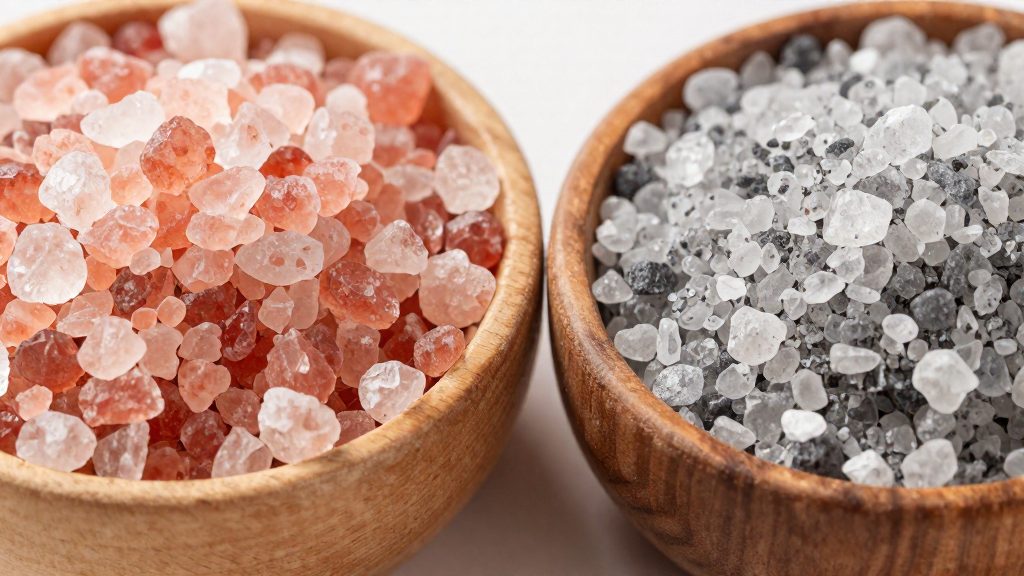
Himalayan and other unrefined salts are not named in the official sources consulted for this guide, so there is no published pickling recommendation for them. The guidance that does exist covers canning or pickling salt, table salt, flake salt, and reduced-sodium salt. Because unrefined salts can differ from those products in mineral content and physical form, the closest applicable rules are the ones on grain size and density.
Trace minerals in Himalayan salt
The official sources consulted do not specify the trace mineral content of Himalayan salt. They also do not say whether trace minerals affect fermentation, brine clarity, or the flavor of the finished pickles. Without that information, the sources provide no basis for treating Himalayan salt as equivalent to pickling salt. Use the product that the cited extension guidance describes, and treat any unrefined salt as untested for this purpose unless its own manufacturer documents it for fermentation.
Grain size and density
Physical form changes how a salt measures out and how it dissolves.
The sources do not document the grain size of unrefined salts, so a volume measurement of one salt cannot be assumed to match another. Weigh them.
| Salt type | Source | Guidance on grain size or density |
|---|---|---|
| Himalayan or unrefined salt | Official sources consulted | No specific guidance |
Why salt by weight beats measuring spoons
Measuring salt by volume gives an unreliable brine because a spoon or cup records space, not mass. Oregon State University Extension (2024) gives the reference point that one cup of granulated salt weighs 10.2 oz (289 g). Even so, a cup is still a volume, and the amount of salt it holds depends on how the crystals pack. Weighing removes that variable, so the same number of grams gives the same salt content in every batch.
Grain size is the main source of drift. MakeSauerkraut.com (2015) states that weighing is more accurate than measuring by volume because grain size changes how much salt fits in a tablespoon. Fine salt packs densely, while coarse salt leaves more air between crystals. Two levelled tablespoons can therefore hold different masses. A change of brand or grind can shift the brine strength with no change to the recipe.
| Measure | Consistency | Reason |
|---|---|---|
| Tablespoon (volume) | Varies with grain size | Mass per spoon depends on crystal size and packing |
| Cup of granulated salt (volume) | Varies with packing | Reference value: 289 g per cup (Oregon State University Extension, 2024) |
| Grams on a scale | Same for every batch | Mass does not change with grain size |
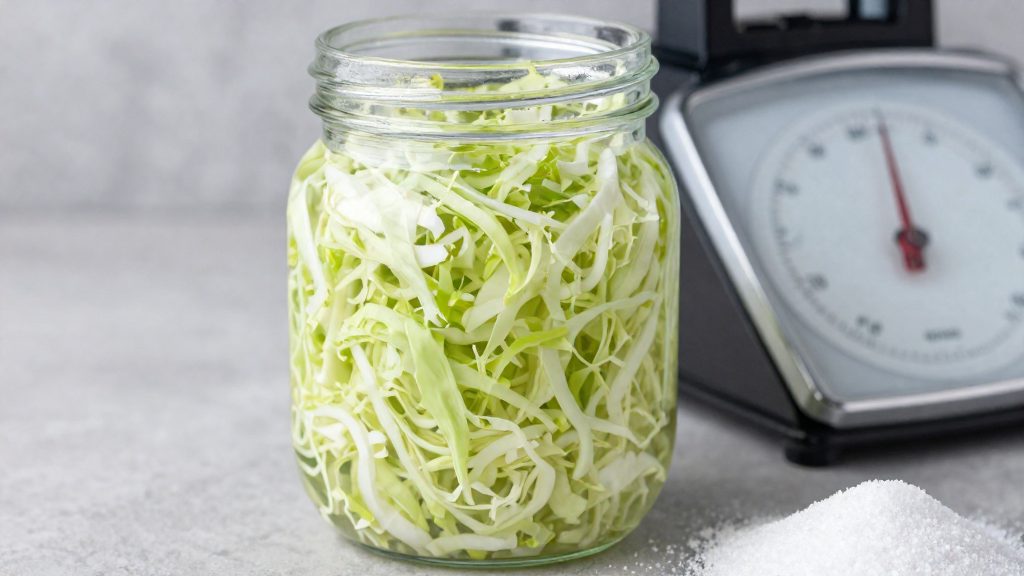
Weighing the salt for a batch
- Set a container on the scale and press tare so the display reads zero.
- Add salt slowly until the display reaches the target mass from your recipe.
- Dissolve the salt in the measured water. Weigh the water separately if your recipe is written by weight.
- Record the grams used so the next batch can match it exactly.
Which salts should you avoid?
Reduced-sodium salts are the main type to avoid in fermentation. The University of Nebraska–Lincoln Extension (2024) states that these salts can be used in quick pickles but should not be used in fermented products, because safety could be compromised. Quick pickles and fermented products follow different rules, so a recipe written for one should not be copied for the other without checking the salt.
Lowering salt to cut sodium is the same as changing the brine strength. Halving the salt in a recipe to suit a low-sodium diet therefore changes the process itself, not just the flavor.
Salt substitutes are not covered by the sources consulted. Because the reduced-sodium guidance warns that safety could be compromised, the cautious choice is to keep them out of fermentation. The sources consulted do not give measurements for how substitutes behave in brine, so the practical rule is to avoid them in fermentation entirely rather than adjust the quantity.
To stay within the correct proportions:
- Check the label before buying. Terms such as “reduced sodium” or “low sodium” indicate a product to keep out of fermentation jars.
How much salt should a brine have?
Brine strength should follow a tested recipe rather than taste. The author of MakeSauerkraut.com (2015) uses a 2% brine for her own sauerkraut recipes. The extension sources consulted give no percentage, so treat 2% as one practitioner’s example, not a standard for every pickle. Because the salt amount depends on the water weight, you calculate it before packing the jar, using a kitchen scale.
The calculation works as follows:
- Water weight × 0.02 = salt grams
- Weigh the water you will add to the jar, multiply that weight by 0.02, then weigh out the result.
- Scale the recipe by changing the water, and recalculate the salt each time.
| Water weight | Salt at 2% |
|---|---|
| 500 g | 10 g |
| 1,000 g | 20 g |
| 1,500 g | 30 g |
| 2,000 g | 40 g |
For ferments made with a measured brine, the percentage refers to the water, so the amount of vegetables in the jar does not change the salt calculation. Two jars with the same water weight need the same salt, even if one is packed more tightly.
Do not alter the concentration. According to Oregon State University Extension (2024), the salt concentration in fermented pickles or sauerkraut should not be changed, because proper fermentation depends on correct proportions. Adding extra salt for flavor, or cutting it back without changing the recipe, moves the brine away from the proportion the process relies on.
Salt type matters too. Substituting a lower-sodium product changes the mineral content of the brine, even if the weight is correct, and is not a way to lower the salt level of a ferment.
Frequently asked questions
Which salt should I buy for lacto-fermented pickles ?
Look for canning or pickling salt, which the Oregon State University Extension (2024) recommends. Its ingredient list should show only salt, since anti-caking agents and iodine fall outside that recommendation.
Can I use regular iodized table salt for pickles ?
Yes. The University of Nebraska–Lincoln Extension (2024) states that iodized or non-iodized table salt can be used for fermented pickles, but anti-caking agents may cloud the brine and iodine may darken the vegetables. Neither change proves a batch is safe or unsafe, so judge the jar by smell, mold, and texture, and discard it if you are unsure.
Why should I weigh salt instead of using a tablespoon ?
Volume depends on grain size, so the same spoon can hold different weights of salt. Oregon State University Extension (2024) gives one cup of granulated salt as 10.2 oz (289 g), and weighing in grams keeps the salt proportion consistent from batch to batch.