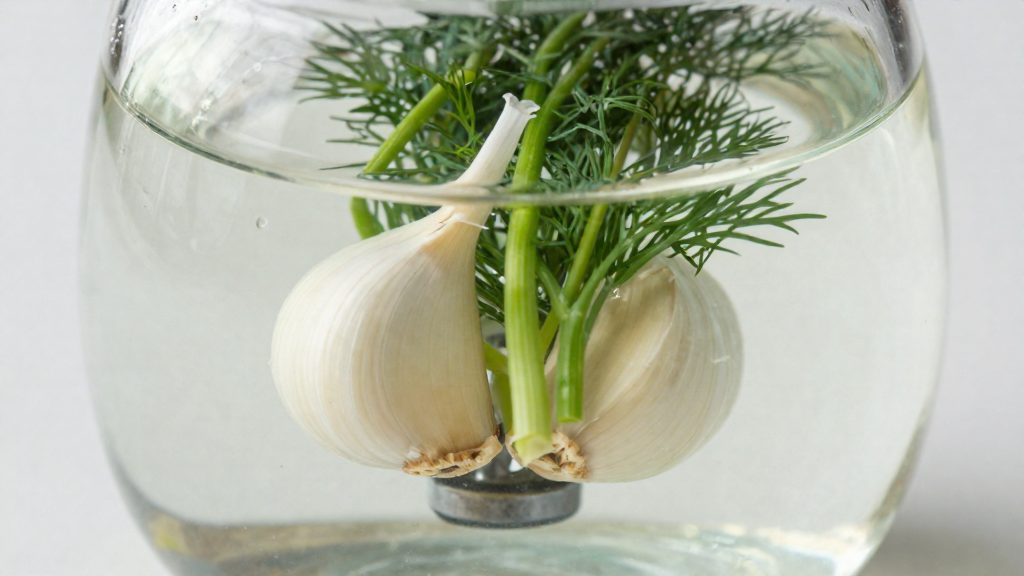
Brine is salt dissolved in water, and its salinity, the salt mass divided by the total mass, sets the conditions the ferment grows in. Fermenting for Foodies reports that fermentation can occur at salt levels from 0% to 5%, but that levels below 2% risk spoilage and levels above 5% risk stopping fermentation, which leaves 2% to 5% as the practical working range. It recommends a target of about 2.2% of the combined weight of vegetables and water.
What is the salt to water ratio for brine?
Salinity is a mass percentage
Salinity is calculated as salt mass ÷ total mass × 100. In a brine alone, the total mass is the salt plus the water. In a ferment, the total mass also includes the vegetables, which is why Fermenting for Foodies calculates its 2.2% target on the combined weight of vegetables and water. A salt-to-water ratio therefore describes only the liquid, while the percentage describes the whole batch.
| Salinity level | What the source reports |
|---|---|
| 0% to 5% | Range in which fermentation can work (Fermenting for Foodies) |
| Below 2% | Risk of spoilage (Fermenting for Foodies) |
| Above 5% | Risk of fermentation stopping (Fermenting for Foodies) |
| About 2.2% | Recommended target on combined weight of vegetables and water (Fermenting for Foodies) |
How salt shapes the microbial environment
Salt works as a selective filter. Many spoilage organisms tolerate salt poorly, while lactic acid bacteria tolerate it well enough to keep growing and produce the acid that preserves the ferment. This selectivity works only within a band of concentrations. Below about 2%, the filter is too weak to suppress spoilage. Above 5%, it becomes strong enough to inhibit the lactic acid bacteria themselves.
Why the percentage is the metric that matters
Tested recipes fix salt proportions for a reason. Penn State Extension (2023) warns that changing the proportions of tested recipes could result in an unsafe product. The percentage also stays valid when batch size changes, because it scales with total mass.
A top-up brine also has to be measured to the same salinity to keep the environment consistent.
Brine percentage by weight vs. by volume
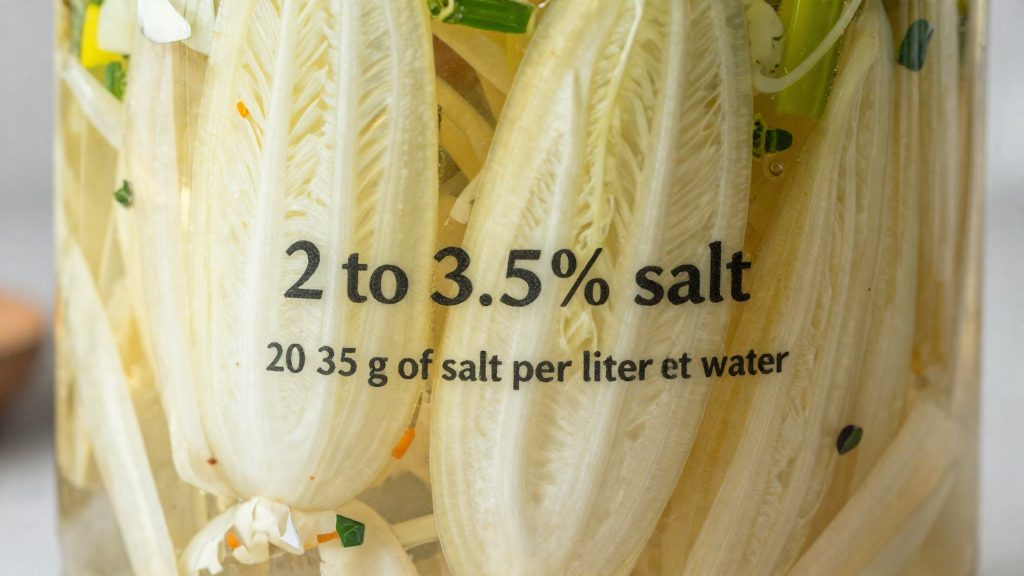
Brine strength can be stated by weight or by volume. A weight percentage is grams of salt divided by total grams of the mixture, multiplied by 100. A volume measure uses cups or tablespoons, and its result shifts with how loosely the salt packs and how coarse the grains are. The tested recipes in the published sources are written in volume: the National Center for Home Food Preservation (NCHFP) lists about 3 tablespoons of canning or pickling salt per 5 lb of shredded cabbage for sauerkraut (2026), and Penn State Extension gives tablespoon and cup measures in the same way (2023). Volume measures are therefore the format of the tested recipes, but they give the least consistent control over the final salinity.
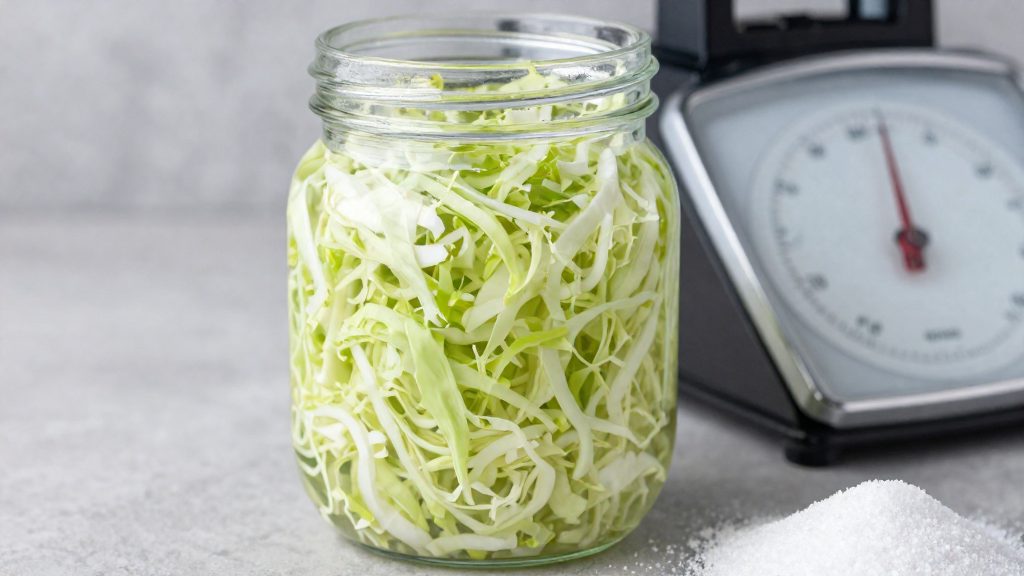
For vegetable ferments, weighing the jar gives a more repeatable target. Fermenting for Foodies recommends a salt level of about 2.2% of the combined weight of vegetables and water, and calculates it as follows:
- Weigh the empty jar.
- Pack the vegetables into the jar, add the water, and weigh the filled jar.
- Subtract the empty jar’s weight from the filled jar’s weight. The result is the net weight of vegetables and water.
- Multiply the net weight by 0.022 to get the grams of salt.
The multiplier applies to the vegetables as well as the water, so both must be in the jar before weighing. The salt is added after the weighing. The table below shows the result for three batch sizes:
| Net weight of vegetables + water | Salt at 0.022 multiplier |
|---|---|
| 500 g | 11 g |
| 1,000 g | 22 g |
| 1,500 g | 33 g |
Choosing a kitchen scale
The method depends on subtracting a container weight, so the scale needs a tare function. Tare sets the display to zero with the container on the platform, which lets you read the net weight directly.
Salt charges are small, between 11 g and 33 g in the batch sizes above, so the scale must read reliably to the gram when you weigh the salt itself. A 1 g error in the net weight changes the salt charge by only 0.022 g, so the vegetable and water weight needs less precision than the salt.
How much salt per quart, gallon or pound of cabbage?
Tested recipes state salt amounts by cabbage weight or by water volume, so there is no single ratio that fits every container. The figures below convert the published amounts into common kitchen units. The consulted sources do not give liter equivalents, so measure in the units your recipe uses.
Dry salt for shredded cabbage
| Cabbage weight | Salt amount | Source |
|---|---|---|
| 5 lb | 3 tablespoons | NCHFP (University of Georgia), 2026; Penn State Extension, 2023-05-22 |
| 5 lb, small jar batch | 3½ tablespoons | Penn State Extension, 2023-05-22 |
| 25 lb | ¾ cup (12 tablespoons) | NCHFP (University of Georgia), 2026 |
The 5 lb figure works out to 0.6 tablespoon of salt per pound of cabbage, while the 25 lb figure works out to 0.48 tablespoon per pound (12 tablespoons ÷ 25 lb). The tested amounts are not strictly proportional, so use the published amount for the batch size closest to yours.
Brine per quart of water
NCHFP’s tested recipe calls for 1½ tablespoons of salt per quart of boiled, cooled water (National Center for Home Food Preservation, 2026). The sources do not give a gallon figure for this brine. Scaling the quart amount by four (a gallon holds four quarts) gives 6 tablespoons per gallon, but this is simple arithmetic, not a tested value.
Penn State gallon pickle brine
Penn State Extension’s fermented pickle recipe uses ½ cup of canning or pickling salt per gallon container, dissolved in 8 cups of water with ¼ cup of 5% vinegar (Penn State Extension, 2023-05-22). The listed water volume is half a gallon, so compare the recipe’s yield with your container before you scale it.
Does the salt type matter?
Yes. The tested recipes from the National Center for Home Food Preservation (University of Georgia, 2026) and Penn State Extension (2023-05-22) both specify canning or pickling salt.
Salt type affects brine results in two ways: its additives and its physical form.
- Anticaking agents: Table salt is often treated with additives that keep it free-flowing. The consulted sources do not describe their effect on brine clarity or fermentation, so their impact is unverified.
- Iodine: Iodized table salt contains added iodine. The consulted sources do not address whether iodine changes results.
- Crystal size: Fine and coarse salts have different densities. Because the tested recipes measure salt by the tablespoon, a salt with a different crystal size gives a different weight per spoonful. The amount of salt actually added then differs from the amount the recipe intends.
| Salt type | Named in consulted tested recipes | Practical check |
|---|---|---|
| Canning or pickling salt | Yes (NCHFP sauerkraut recipe; Penn State Extension pickle recipe) | Use as written in the recipe |
| Table salt | Not named in the consulted tested recipes | Read the label for iodine and anticaking agents |
Because the consulted sources do not test other salt types, a substitution is untested. Follow the named salt for any recipe you intend to rely on.
Is too little or too much salt a problem?
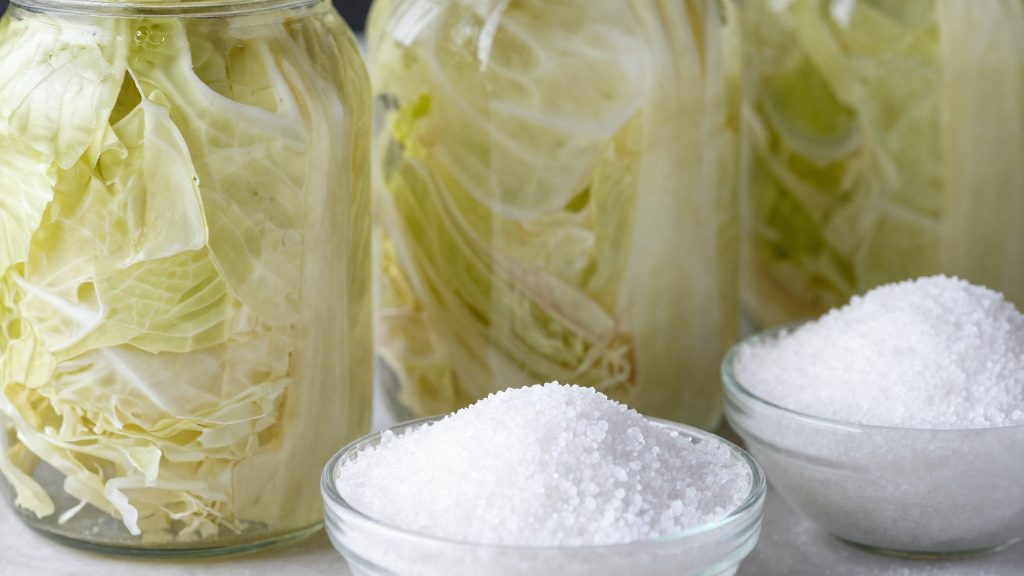
Yes, in both directions. Salt concentration controls which microbes win the early contest in a ferment, so it determines whether the outcome is safe, slow, or stalled. The two failure modes are different. Too little salt raises the spoilage risk. Too much salt can halt fermentation altogether.
| Salt level (by weight) | What the sources report |
|---|---|
| Below 2% | Spoilage risk. The low salt level gives spoilage organisms room to compete with the lactic acid bacteria that should dominate. |
| 2% to 5% | Practical working range: above the 2% level the source gives as the spoilage threshold and below the 5% level it gives as the stalling threshold (Fermenting for Foodies). |
| Above 5% | Fermentation may stop entirely. Fermenting for Foodies notes that this risks a fermentation stall. |
Below 2%, the concern is microbial imbalance. Salt slows undesirable organisms, so a ferment with too little of it can spoil before lactic acid bacteria produce enough acid to protect it. Fermenting for Foodies gives 2% as the threshold below which spoilage becomes the risk.
Above 5%, the problem is the opposite. The brine suppresses the lactic acid bacteria themselves, so acid production slows or stops. The lactic acid bacteria are suppressed, so the ferment may not sour as expected. Fermenting for Foodies places this threshold at 5%.
Recipe proportions are a separate issue. Halving or doubling the salt by estimate, rather than following a tested ratio, removes the margin the recipe was validated with.
How to make and use a fermentation brine
Penn State Extension’s vinegar-based pickle brine is a different recipe from the cabbage brine, so do not swap one for the other.
Step 1: Boil and cool the water
Bring the water to a boil, as the NCHFP recipe specifies, then let it cool fully before adding salt or vegetables. Measure the water after cooling, since the NCHFP ratio is written per quart of cooled water.
Step 2: Dissolve the salt
Add the measured salt to the cooled water and stir until no grains remain on the bottom.
Step 3: Use the cabbage juice first
Pack the shredded cabbage into the container and press it down so it releases juice. Check the level of that juice against the cabbage before adding any brine. If the juice covers the cabbage, no added brine is needed. If it does not, pour in the prepared brine until the cabbage is covered.
Step 4: Weigh the vegetables under the liquid
Place a clean weight on top of the vegetables so they stay below the liquid line. Penn State Extension (2023-05-22) advises keeping vegetables fully submerged. A small jar or plate that fits inside the crock works well, as long as it sits flat and can be lifted out without disturbing the vegetables.
What are the food safety rules for fermenting?
Food safety for home sauerkraut depends on three checks: the room temperature, the fermentation time, and the condition of the vegetables when you open the lid. The National Center for Home Food Preservation (University of Georgia) (2026) and Penn State Extension (2023) both use these signals to judge whether a batch is still fit to eat. Temperature sets the pace of fermentation, so it also determines how long you should wait before checking.
Fermentation timing at 60 to 75 degrees Fahrenheit
Within the 60 to 75°F window, the NCHFP gives these expected fermentation times for sauerkraut:
| Room temperature | Expected fermentation time |
|---|---|
| 70–75°F | About 3–4 weeks |
| 60–65°F | About 5–6 weeks |
Below 60°F, according to the NCHFP, the kraut may not ferment at all. Above 75°F, it may turn soft. Treat the figures above as a range. Inspect the vegetables before you rely on the calendar.
Discard signs
Penn State Extension states that pickles which turn soft, slimy or foul-smelling should be discarded. The same three signs apply to sauerkraut. Check the texture and smell of the vegetables under the brine, not only the top layer, before you decide to keep a batch.
Surface mold: causes and when to discard
Penn State Extension links surface mold to vegetables that are not fully submerged in the brine. Exposed pieces are in contact with air, which is the condition that allows mold to form. When in doubt, discard the batch, and do the same if the vegetables are also soft, slimy or foul-smelling.
Frequently asked questions
Should I weigh the salt or measure it by volume?
Weigh it. The National Center for Home Food Preservation (2026) lists 3 tablespoons of canning salt per 5 lb of cabbage and ¾ cup per 25 lb, which is not a strictly proportional scale-up, so volume measures drift as batches grow. Weighing the vegetables and water on a kitchen scale and applying a fixed percentage keeps the ratio consistent.
What if my brine ends up weaker than 2%?
A lighter mix gives spoilage organisms more room to compete with the lactic acid bacteria you want. Penn State Extension (2023) advises keeping vegetables fully submerged to limit surface mold, and says to discard any batch that turns soft, slimy or foul-smelling.
How long does sauerkraut take to ferment at my room temperature?
At fermentation temperature between 70 and 75°F, the National Center for Home Food Preservation (2026) reports about 3 to 4 weeks, while 60 to 65°F stretches that to about 5 to 6 weeks. Below 60°F the kraut may not ferment at all, and above 75°F it may turn soft.