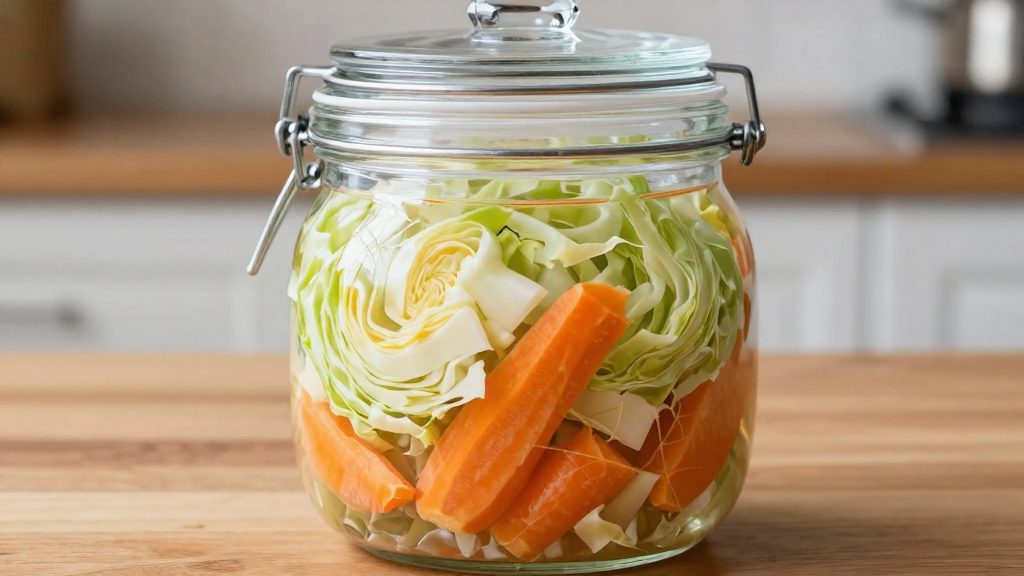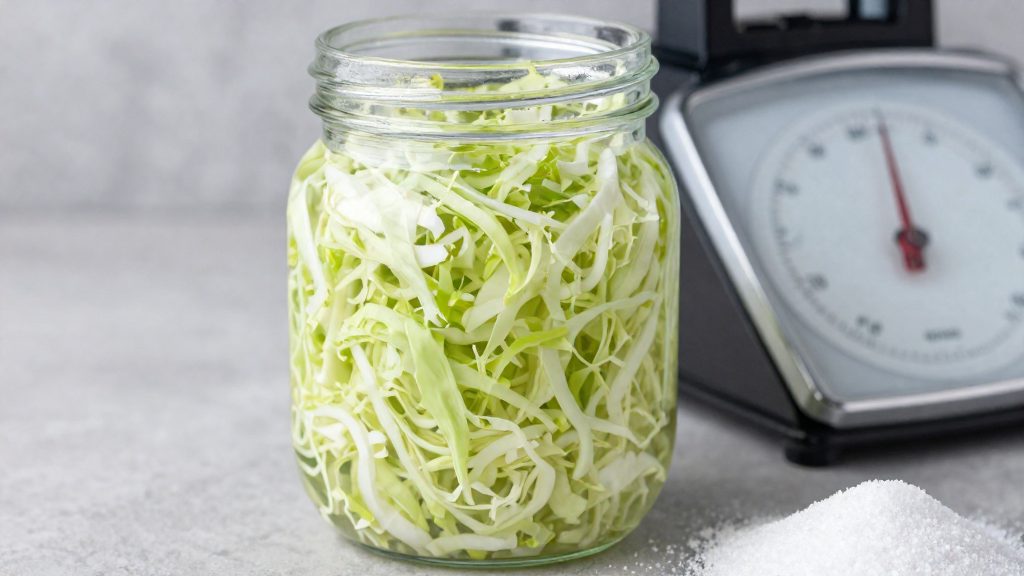
For a wide-mouth one-quart jar holding about 800 g (about 1.75 lb) of cabbage, the University of Vermont Extension (2026) method calls for 16 g of salt. The figure is tied to the cabbage’s weight, not the jar’s volume, so weigh the cabbage before adding salt. Measure the salt in grams for this result, and rely on the weight basis rather than an estimated amount.
How much salt for sauerkraut in a quart jar?
Figure and basis
| Item | Value |
|---|---|
| Salt | 16 g |
| Cabbage | about 800 g |
| Jar | 1-quart wide-mouth jar |
| Method | University of Vermont Extension (2026) |
For other cabbage weights, scale the salt amount to match the cabbage before starting.
Steps tied to this basis
- Pack the cabbage into the jar, pressing it down so brine rises over the cabbage.
The 2% salt rule
Salt for sauerkraut is set as a percentage of the cabbage’s weight, not as a fixed amount. According to the University of Vermont Extension (2026), the target range is 1.5–2.5% of cabbage weight, with 2% as the reference point.
The formula is cabbage weight in grams × 0.02 for 2%. For the lower and upper ends of the range, use × 0.015 and × 0.025.
| Cabbage weight (g) | 1.5% salt (g) | 2% salt (g) | 2.5% salt (g) |
|---|---|---|---|
| 500 | 7.5 | 10 | 12.5 |
| 1,000 | 15 | 20 | 25 |
| 1,500 | 22.5 | 30 | 37.5 |
The percentage scales across batch sizes because salt concentration depends on the mass of vegetable it is mixed with. Doubling the cabbage doubles the salt, which keeps the proportion the same whether you ferment a small jar or a large crock. A fixed gram amount would produce a saltier batch from a small quantity of cabbage and a weaker one from a larger quantity.
Salt by weight vs. by teaspoon
A teaspoon measures volume, not mass, so the same spoon can hold different amounts of salt depending on the salt’s grain size and how tightly it is packed. Weighing salt in grams removes that variable, so each batch receives the same amount relative to the cabbage. Consistent results require a scale, because a spoon cannot reproduce a fixed mass from one batch to the next.
Why volume measures drift
- Grain size: Fine, coarse and flaky salts occupy space differently. Fine crystals settle closely in a spoon, while coarse crystals leave more air between them.
- Density: Equal volumes of different salts hold unequal masses, so a spoonful that is correct for one salt can be off for another.
- Packing: Scooping, tapping or leveling changes how much salt sits in the spoon, even with the same product.
- Flakes: Flaky salt can bridge across a spoon and stack irregularly, which makes each scoop inconsistent.
Two cooks using identical spoons and identical salt can add noticeably different amounts. The UVM guidance expresses salt as a percentage of cabbage weight, and that approach works only when the salt is weighed as well.
Weighing salt on a kitchen scale
- Place an empty bowl on the scale and tare it to zero.
- Add salt slowly until the display shows the target mass in grams.
- Pour the salt over the cabbage and mix thoroughly before resting.
- Record the salt mass and cabbage weight in a notebook so future batches can be repeated.
| Method | Repeatability | Practical use |
|---|---|---|
| Level teaspoon | Changes with grain size and packing | Rough estimates only |
| Kitchen scale in grams | Same mass each time | Batches matched to cabbage weight |
How much cabbage fits in a quart jar?
A medium cabbage head of about 900 g (roughly 2 lb) yields about 800 g of prepared cabbage, which is the amount the University of Vermont Extension method (2026) uses for a 1-quart wide-mouth jar. Weigh the head before you start. If it differs noticeably from 900 g, the prepared weight will differ too, so choose the jar size and the amount you pack based on the weight you actually have.
From whole head to 800 g
| Stage | Action | Figure from UVM method (2026) |
|---|---|---|
| Starting head | Medium cabbage, weighed whole | About 900 g (about 2 lb) |
| Prepared cabbage | Outer leaves and core removed, thinly sliced | About 800 g |
Thin slicing before packing
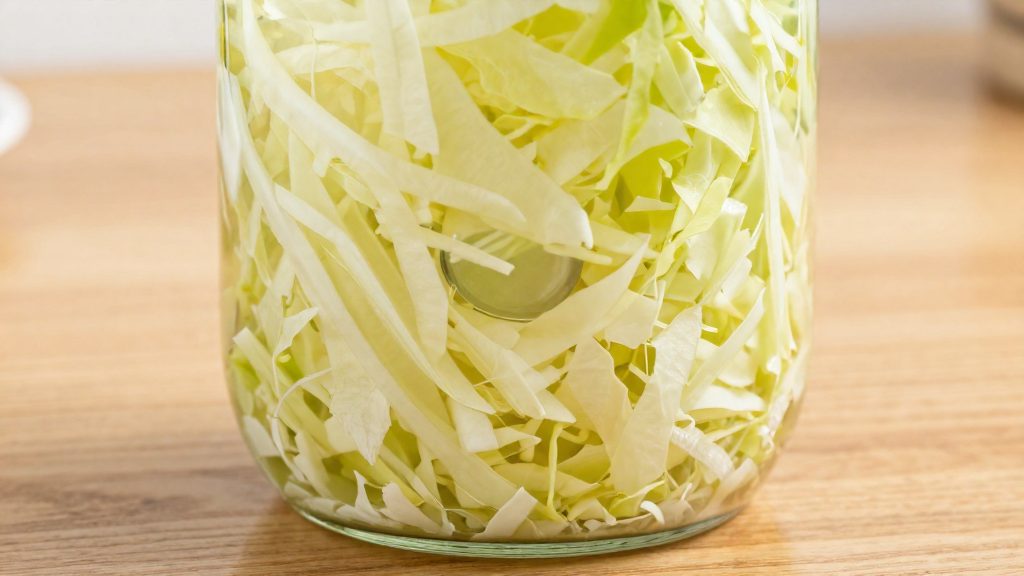
Thin slicing is the step that makes the weight of the head translate into a usable quantity. Cut the cabbage into thin shreds rather than thick wedges. Thin pieces pack more tightly, leave fewer air gaps, and release their juice more evenly once salted. Because the 800 g figure assumes thinly sliced cabbage, a coarse cut will not give you the same packing density, so check the jar visually as you go.
Thirty-minute rest
After slicing and salting, the UVM method calls for a 30-minute rest before packing. During this time the cabbage softens and begins to release liquid, which makes it easier to press into the jar. Use this window to prepare the jar and the weight rather than adding more cabbage, since the rest period is part of the method’s timing.
Packing under a non-metal weight
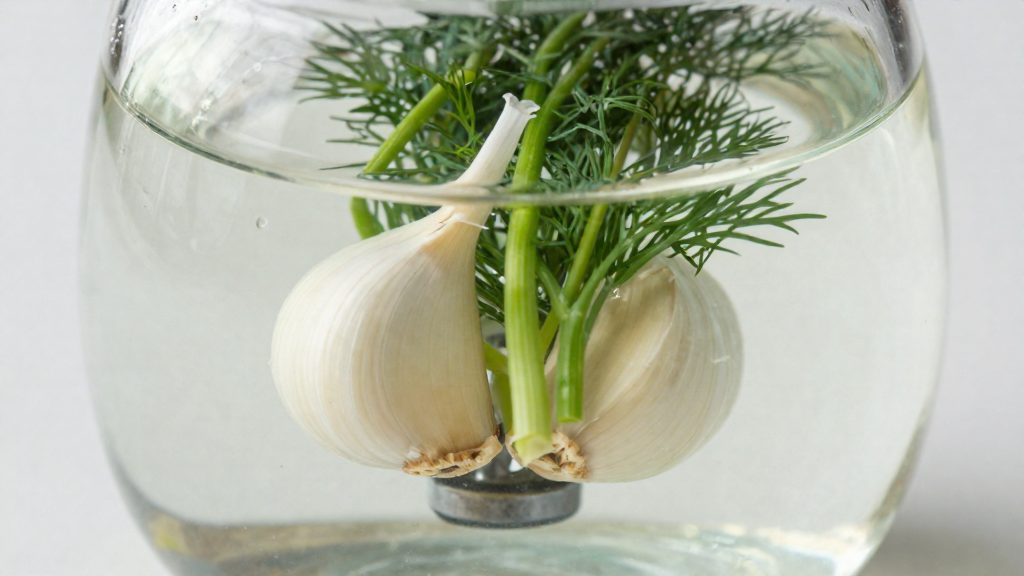
Pack the rested cabbage into the jar in layers, pressing down as you add each portion. Then place a non-metal weight on top so the cabbage stays submerged under its brine. According to University of Vermont Extension (2026), this keeps the shreds below the liquid line, which is the condition the method relies on during fermentation.
Which salt should you use?
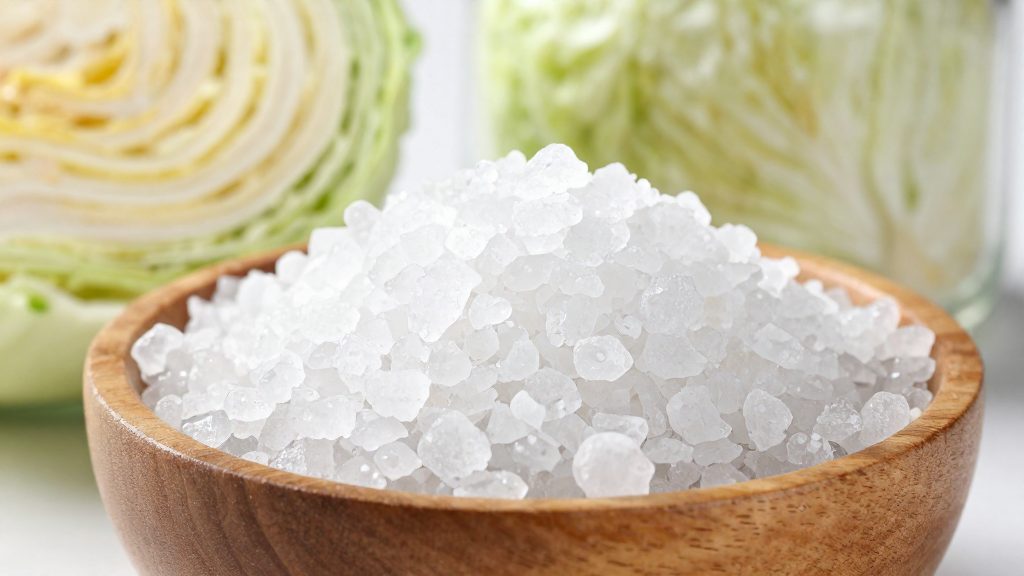
For sauerkraut, the salt should contain only sodium chloride. According to University of Vermont Extension (2026), the salt must be free of additives. Any ingredient other than salt changes what goes into the brine, so the ingredient list on the package is the most reliable check before you buy.
Salt types compared
| Salt type | Added ingredients | Suitable for sauerkraut |
|---|---|---|
| Iodized table salt | Iodine is added | No |
| Table salt with anti-caking agents | Anti-caking agents are added | No |
| Pickling salt | No anti-caking agents; sold as pure sodium chloride | Yes |
Iodized table salt has iodine added on purpose, so it does not meet the no-additives requirement. Anti-caking agents are added to many table salts to keep the grains from clumping in the shaker. A ferment does not need them, so any table salt that lists them should be set aside for cooking.
Pickling salt is the simplest option for this job. It is sold as plain sodium chloride without anti-caking agents, which matches the UVM requirement. Pickling salt grains also dissolve easily in cabbage juice, so you can work it into the shredded cabbage without leaving undissolved crystals in the jar.
Before you buy, read the ingredient list, not just the product name. Brands and packaging vary, so a box labelled “pickling” or “canning” should still be checked for added ingredients.
Fermentation temperature and timing
Temperature sets how fast the ferment moves, so it also sets when the kraut is ready to eat. The University of Vermont Extension (2026) recommends keeping the ferment at 65–72°F (about 18–22°C) and letting it go for up to about four weeks. Within that window, adjust the timing to reach the flavor you want.
Temperature sets the pace. Warmer rooms ferment faster, so the kraut will taste sour sooner. A jar kept near the top of the range can reach a pleasant tartness well before the four-week ceiling, while a jar kept near the bottom will need more of the available time. Check the jar on a regular schedule rather than relying on a fixed day count.
Taste is the endpoint. Begin tasting well before the four-week mark, using a clean utensil each time, and continue until the sourness suits you.
Practical checks during the wait:
- Taste at intervals rather than only at the end, since a warm room can change the flavor within a few days.
- If the room is cooler than 65°F, expect a longer wait. If it is warmer than 72°F, start checking earlier.
How do you know your sauerkraut is safe?
Four finished-product checks confirm that homemade sauerkraut has reached a safe acidity, looks right, tastes and feels right, and can be stored properly. According to the University of Vermont Extension (2026), USDA guidelines call for a finished sauerkraut pH of 4.6 or lower.
| Check | Target | How to check |
|---|---|---|
| Acidity | pH 4.6 or lower | pH test strips on the finished kraut |
| Appearance | Free of mold | Visual inspection of the whole surface and jar |
| Taste and texture | Slightly tart, crunchy | Taste a small portion |
| Storage | Refrigerated, up to one year | Keep the jar in the refrigerator |
Acidity is the only check that cannot be judged by eye or taste. The UVM Extension specifies a pH threshold, and pH test strips are the method it names for checking it at home. Test the finished kraut itself, not only the liquid, and compare the strip color against the scale that comes with the strips. A result above 4.6 means the kraut does not meet the USDA guideline cited by UVM, so do not eat it. Discard the batch and start again with weighed salt.
Appearance is checked by looking at the surface and the jar before eating. Mold is the defect the source names specifically. Any mold means the batch fails this check.
Taste and texture are the sensory markers of a finished product. The expected result is a mild, slightly sour flavor and a crisp bite. A soft, flat texture or an absence of tartness is a sign to recheck the other two criteria before eating.
Storage is the final step. Once the kraut is ready, move it to the refrigerator.
Common salt mistakes to avoid
Salt errors are one of the main reasons a jar of sauerkraut fails, and they run in two directions. Too much salt and too little salt each push the ferment away from safe, productive conditions, and each leaves different signs in the jar.
Too much salt
When the brine is too salty, the fermentation can stop fermentation entirely. The cabbage stays in the jar without souring, and the brine shows little or no bubbling. Cabbage that tastes salty but not tart is a common sign that the ferment never got going. If the ferment never starts souring, the practical option is to begin again with a correctly measured brine. The UVM source says only that too much salt can stop fermentation.
Too little salt
Salt also limits which microbes can thrive. With too little, harmful pathogens can grow, which makes salt a food safety issue as well as a flavour issue. A jar that looks normal is not proof that it is safe. Mold on the surface is a clear warning sign.
Comparing the two errors
| Error | Documented consequence | What to look for in the jar |
|---|---|---|
| Too much salt | Fermentation can stop entirely | Little or no bubbling; no sour development |
| Too little salt | Harmful pathogens can grow | Pathogen growth is not reliably visible; mold is a warning sign |