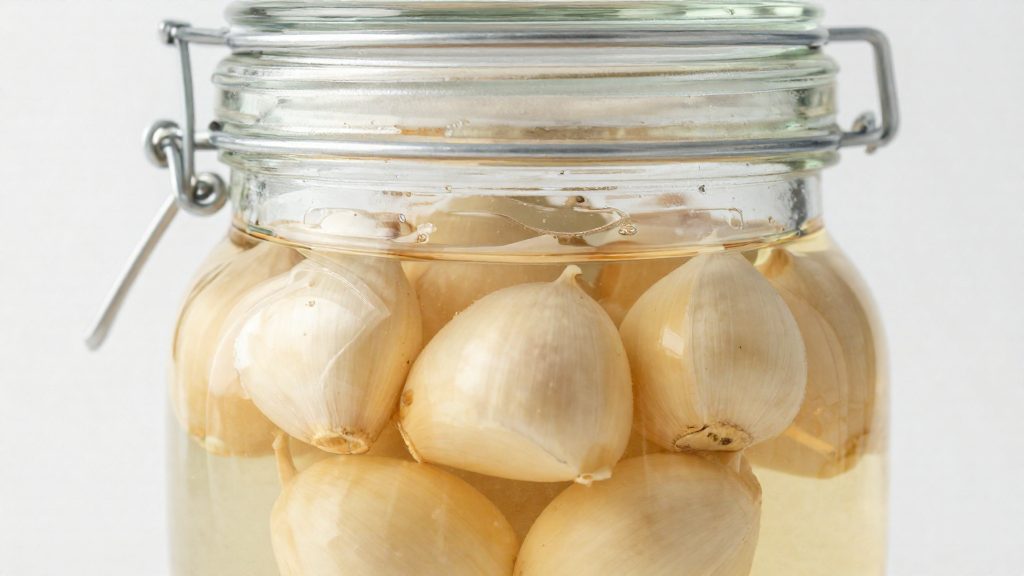
Garlic fermentation is not considered an officially safe preservation method. In May 2026, a university extension expert answering through Ask Extension (eXtension, Cooperative Extension), dated 8 May 2026, stated that fermentation is not an approved, safe way to preserve garlic and that no validated garlic fermentation recipes currently exist. The safety question therefore starts from a negative answer, not from a conditional one.
Is fermented garlic officially considered safe?
What the extension service said
The Ask Extension answer, dated 8 May 2026, addresses the method itself. It does not approve a particular salt level, container, or holding time for garlic. It also does not state that any brine concentration makes fermented garlic safe. The official sources consulted do not specify whether other extension services have issued the same position.
What a missing validated recipe means
A validated recipe is a documented procedure that has been reviewed against a defined safety outcome. Without one, no official body has set the parameters a home cook would need to control, including salt, time, and temperature. A home fermenter can follow a recipe exactly and still have no official standard to confirm the result is safe.
Traditional practice versus official validation
Garlic ferments are common in home kitchens, but common practice and official validation are different things:
- Traditional practice: passed between cooks through family habits and shared recipes, with methods that vary from one household to the next.
- Official validation: a method reviewed and published by an extension service or comparable body, with stated conditions for a specific food.
- Key distinction: a practice can be widely repeated without ever having been checked against official criteria.
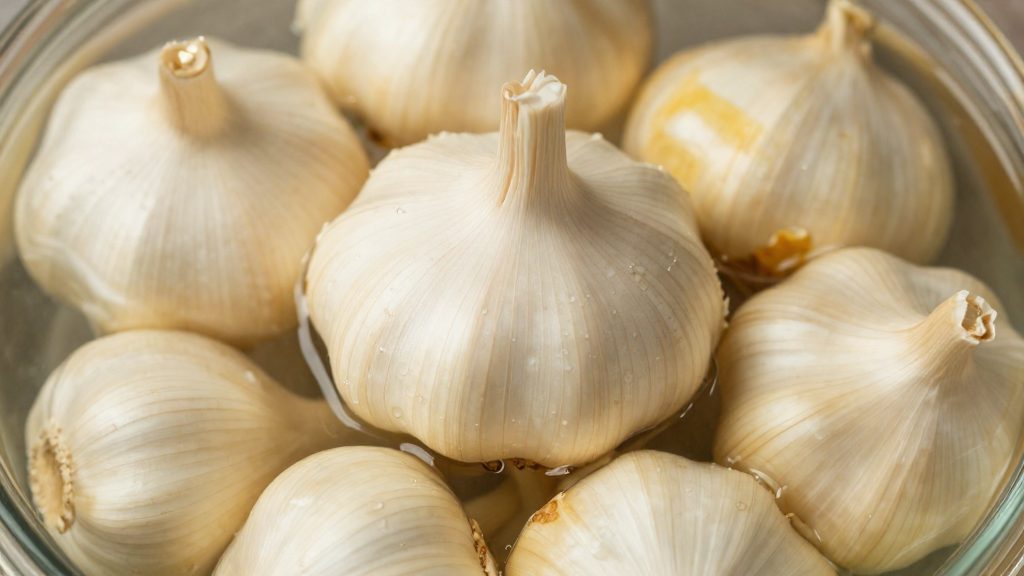
What brine strength do home fermenters use for garlic?
Home fermentation guides usually express brine as a percentage of salt by weight of water. For garlic, the figure used in this article comes from NW Edible (2026), which gives 2–3% brine (20–30 g of salt per liter of water) and lists garlic among the firm vegetables that ferment well in that range. This is unvalidated community practice. It describes what some home guides recommend, not a method that has been tested for safe preservation.
Brine ranges cited in the same guide
| Item | Cited brine range | Source | Status for garlic |
|---|---|---|---|
| Garlic (listed among firm vegetables) | 2–3% (20–30 g per litre) | NW Edible (2026) | Unvalidated community practice |
| Cucumbers | Up to 5% | NW Edible (2026) | Cucumber range, not transferable to garlic |
| Whole peppers | Up to 5% | NW Edible (2026) | Pepper range, not transferable to garlic |
Why firm-vegetable ranges do not transfer to garlic
The guide lists garlic among firm vegetables at 2–3%, and separately gives up to 5% for cucumbers and whole peppers. Firmness describes texture, though, not how safely a food can be preserved.
A range published for cucumbers or peppers therefore describes those vegetables only. It cannot be applied to garlic by analogy.
Practical reading of the figure
- Treat 2–3% as a number reported by one guide, not as a tested target.
- Do not apply the 5% upper limit used for cucumbers and peppers to garlic.
- When citing the figure, attribute the range to NW Edible (2026) and the safety position to Ask Extension (2026-05-08).
Why does garlic raise botulism concerns?
Garlic is classified as a low-acid food, and that classification is the root of the botulism concern. According to Ask Extension (eXtension, Cooperative Extension, 2026-05-08), garlic must be preserved by safe, validated methods or there is a risk of botulism. The official sources consulted do not give the exact acidity cutoff that defines low-acid foods, so this section does not state a numeric value.
Low-acid classification and anaerobic conditions
Low-acid foods lack enough natural acidity to prevent growth of Clostridium botulinum, the bacterium that produces botulinum toxin. The risk rises in conditions with little oxygen, such as a submerged or tightly sealed container, because the bacterium is anaerobic. Garlic cloves submerged in brine in a sealed container can combine both conditions: they are low in acid and can be enclosed with little air exchange.
Why acidification matters more than salt
Salt is often assumed to protect a ferment, but the sources do not support that assumption for garlic. Ask Extension does not say that a 3% salt level makes garlic safe, and it does not approve any brine concentration for fermented garlic. NW Edible (2026) discusses salt mainly in terms of texture and mold: too little salt raises the risk of spoilage, and too much can inhibit beneficial microbes. Neither source treats salt as a botulism control. The extension answer points to validated preservation methods, not to a salt level, as the way to manage the botulism risk.
What the sources conclude
| Source | Position on garlic |
|---|---|
| Ask Extension (eXtension, 2026-05-08) | Low-acid food; fermentation is not an approved, safe preservation method |
| NW Edible (2026) | Lists garlic among firm vegetables that ferment in 2–3% brine, with no botulism claim |
How do you weigh salt for an accurate brine?
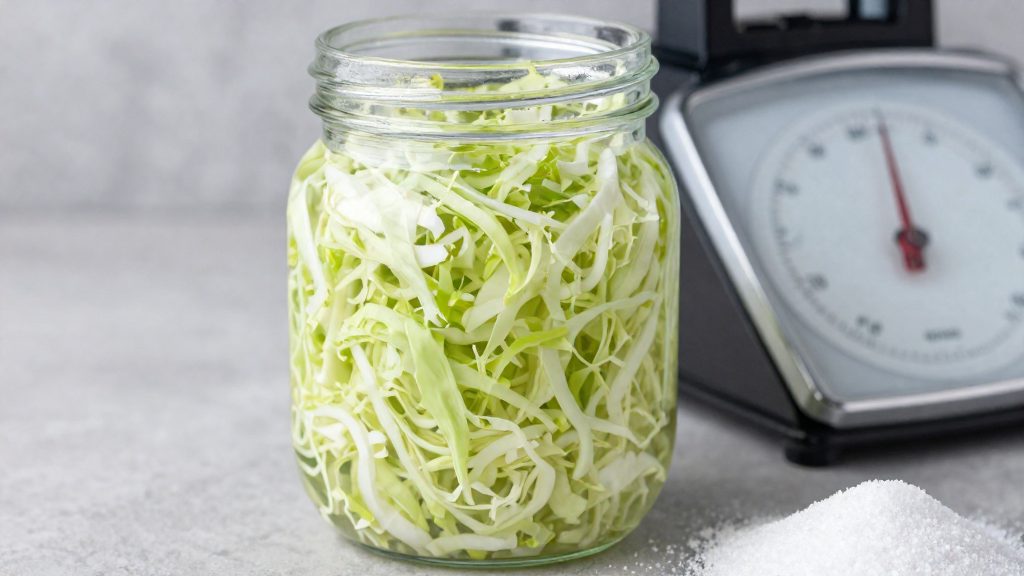
Weighing salt in grams is more reliable than spoon or cup measures, because the same volume of fine and coarse salt can differ noticeably in weight. Brine strength is usually set as a percentage of the water’s weight. Once you have a target percentage, you can calculate the salt weight and measure it on a kitchen scale.
Two ways to express brine strength
Brine strength appears in two forms, and they are not identical:
- Percent by weight: salt weight ÷ total brine weight × 100
- Grams per litre: grams of salt per litre of water
The difference is small but real. Take 20 g of salt in 1,000 g of water. The total brine weighs 1,020 g, so the percent by weight is 20 ÷ 1,020 × 100, or about 1.96%. The grams-per-litre figure uses water weight only. For most home batches the gap is negligible, but if a recipe states a percentage, calculate with the percent formula.
Converting 2–3% into grams
Multiply the water weight by the target percentage, written as a decimal:
- Salt grams = water grams × target percentage (2% = 0.02, 3% = 0.03)
| Water weight | 2% | 2.5% | 3% |
|---|---|---|---|
| 500 g | 10 g | 12.5 g | 15 g |
| 1,000 g (about 1 litre) | 20 g | 25 g | 30 g |
| 1,500 g | 30 g | 37.5 g | 45 g |
Check the 1,000 g row against the NW Edible figure: 20–30 g per litre of water matches the 2% and 3% columns.
Weighing sequence
- Place the empty container on the scale and press tare to zero the display.
- Add the water and note its weight in grams.
- Calculate the salt weight from the target percentage.
- Tare again with the water in the container, then add the calculated salt.
- Stir until fully dissolved before adding vegetables.
Taring after each step keeps the readings separate, so you never need to subtract weights by hand.
Scale resolution and rounding
The official sources consulted do not specify scale resolution or rounding tolerances for brine preparation. The arithmetic shows why resolution matters. At 1,000 g of water, a 1 g error is about 3–5% of the 20–30 g dose. At 500 g of water, the target is 10–15 g, so a 1 g error is roughly 7–10%. For small batches, a scale that reads in 0.1 g makes the target easier to hit. For batches of a litre or more, whole-gram readings are usually sufficient. Round to the nearest gram or tenth of a gram, and keep the rounding consistent from batch to batch.
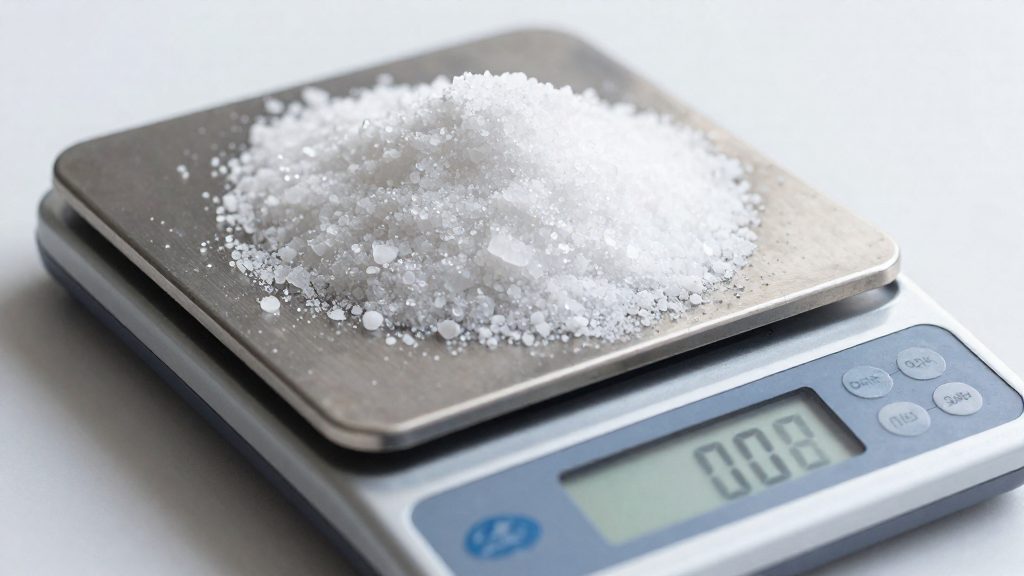
What happens if the brine is too weak or too strong?
Brine strength affects two things at once: how easily mold and spoilage risk develops, and how well the bacteria that drive the ferment can work. Moving outside the 2–3% range in either direction changes the result, and the guide describes the two failure modes differently.
| Condition | Documented effect or response (NW Edible, 2026) |
|---|---|
| Below 2–3% (under 20 g per liter) | Higher risk of mold and spoilage |
| Within 2–3% (20–30 g per liter) | Sweet spot for garlic and most firm vegetables |
| Too much salt (no figure given for garlic) | Can inhibit beneficial microbes and cause the ferment to fail |
| Soft texture, mold, or hot weather | Guide suggests raising salinity |
Too weak: mold and spoilage
Below the 2–3% range, the brine no longer holds back unwanted organisms well. The guide links low salinity directly to a higher chance of mold and spoilage, and its remedy points the same way: raise salinity when mold is a problem. The official sources consulted do not specify how much time a weak brine needs before mold appears, so the risk should be treated as a condition to monitor, not a timeline to rely on.
Too strong: inhibited bacteria
Excess salt works against the microbes the ferment depends on. NW Edible (2026) states that too much salt can inhibit beneficial microbes and cause the ferment to fail. The guide does not describe how fast this happens or how it looks during fermentation. Its 5% upper figure applies to cucumbers and whole peppers, not garlic, so the source gives no basis for pushing garlic brine above 3%.
Texture and flavor changes
The guide ties texture to salinity in one direction: a soft texture is a reason to raise salt, which implies that a brine that is too weak can leave the vegetable limp. The sources consulted do not describe flavor changes caused by excess salt. Any flavor assessment should come from tasting your own batches and recording the results, rather than from a documented rule.
Validated alternatives for preserving garlic
The validated route for preserving garlic at home is the University of California, Davis publication “Garlic: Safe Methods to Store, Preserve, and Enjoy.” Ask Extension (eXtension, Cooperative Extension, 2026-05-08) points to this publication as the reference for approved methods. Readers should start with it rather than with recipes found online.
What the UC Davis publication covers
The official sources consulted do not describe the individual procedures in the UC Davis publication, so this section does not summarise them. The sources do confirm its scope: storing, preserving and enjoying garlic.
| Source | Publisher | Date | Role |
|---|---|---|---|
| Garlic: Safe Methods to Store, Preserve, and Enjoy | UC Davis | Not stated in consulted sources | Reference for validated garlic storage and preservation methods |
| Ask Extension answer | eXtension, Cooperative Extension | 2026-05-08 | Says fermentation is not an approved method and directs readers to the UC Davis publication |
Checking guidance before preserving
Extension guidance can be updated, so confirm it before any preservation step. The Ask Extension answer used here is dated May 2026. Check the publication directly, follow its procedure as written, and do not adapt a recipe from another source.
Storage guidance
The official sources consulted do not specify storage temperatures, durations or container types for garlic. For those details, use the UC Davis publication instead of general online figures.
Signs your garlic ferment should be discarded
Visible spoilage is the clearest reason to throw out a garlic ferment, but a batch that looks clean is not thereby safe, because botulinum toxin can be present without any visible, smell or taste change. If someone develops double vision, drooping eyelids, slurred speech, difficulty swallowing or muscle weakness after eating home-preserved garlic, seek emergency medical care immediately. The signs below are warning signals within a method that has no validated safety standard, so any one of them, or any doubt about a batch, is reason to discard it.
Visible mold, slime or fuzzy growth
- Fuzzy or powdery growth on the brine surface, on the cloves, or on the jar walls, in any color.
- Slimy, ropy or gelatinous film on cloves or in the liquid.
- Any mold or growth, at any stage of the ferment.
Mold is the spoilage sign that NW Edible (2026) names directly, noting that it is more likely when salinity is too low. Adjusting salt after mold appears does not make the batch safe to keep.
Off-odors and unusual discoloration
- A rotten, putrid or foul smell that differs from the sharp, pungent smell of fresh garlic.
- Dark spots or brown, black or grey patches on cloves that were not present when the batch was packed.
- Cloudy or discolored brine that is accompanied by any other sign on this list.
Compare each batch with its appearance and smell on day one. A single change in color is less informative than a change that combines with odor or growth.
Why normal-looking garlic cannot confirm safety
- The extension’s answer does not describe a visual, smell or taste test that confirms a garlic ferment is safe. A batch that looks, smells and tastes normal has not been shown to be safe.
- NW Edible (2026) presents its brine figures as a general fermentation guideline, not a safety validation for garlic.