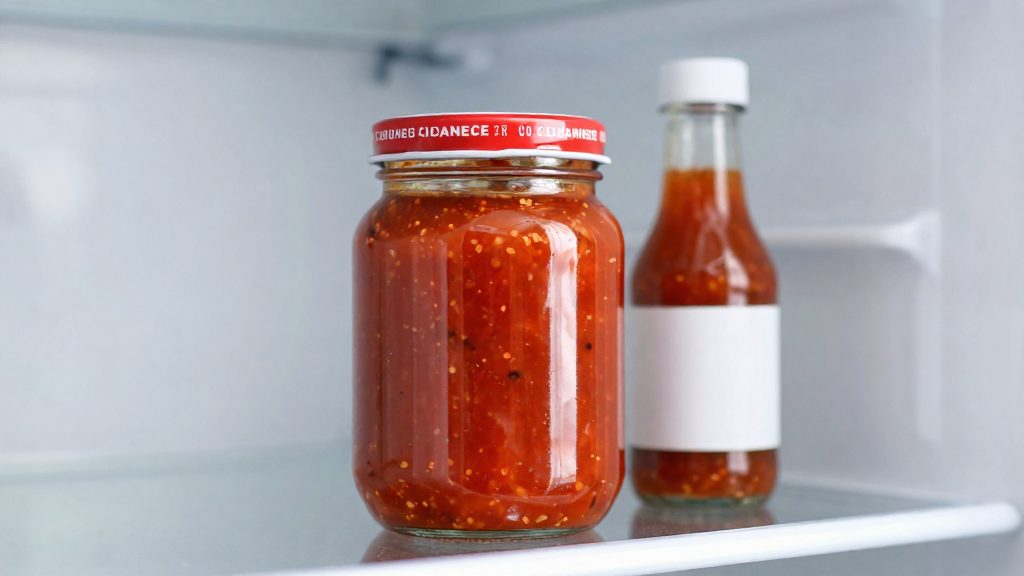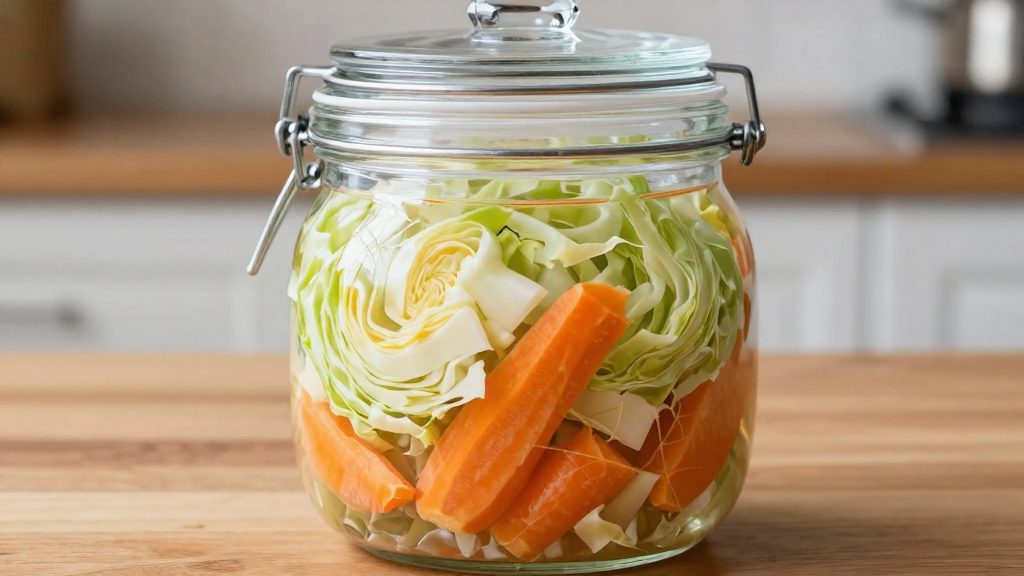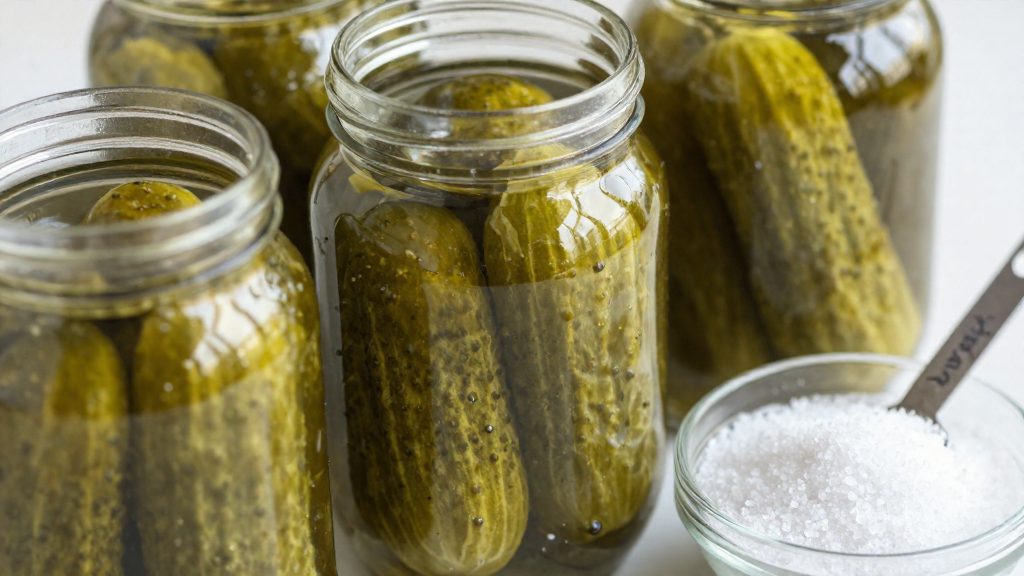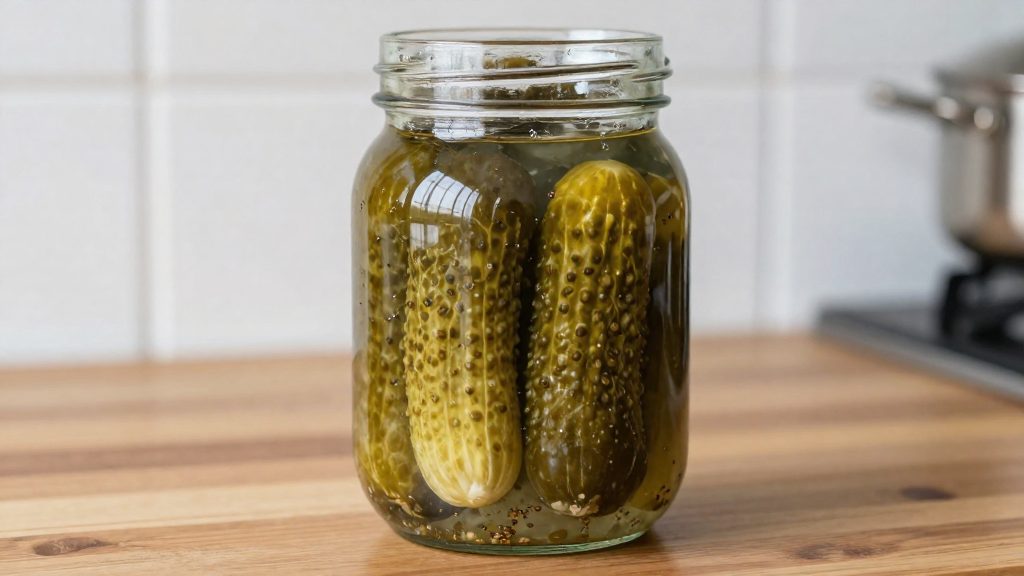
Fully fermented pickles can stay in their original container in the refrigerator for about four to six months, provided surface scum and mold are removed regularly, according to NC State Extension (Food Safety) (2020). Oregon State University Extension gives the same range for fermented dill pickles kept in their brine at temperatures below 55°F. Because the storage window depends on the jar being fully fermented, the time a batch needs to ferment at its temperature matters as much as the storage period itself.
How long do sealed fermented pickles last?
Baseline shelf life in the original container
Treat the four-to-six-month window as an approximate baseline rather than an exact expiry date, and record the date you start counting, such as the day fermentation ends or the day the jar was sealed.
Fermentation timelines by temperature
Before a jar can enter this storage window, it has to finish fermenting. NC State Extension (Food Safety) (2020) gives the following timelines:
| Fermentation temperature | Time to full fermentation |
|---|---|
| 70–75°F | About 3–4 weeks |
| 55–65°F | About 5–6 weeks |
| Above 80°F | Not recommended |
Cooler fermentation takes longer, so a batch kept at 55–65°F needs roughly two extra weeks compared with one at 70–75°F. Jars held above 80°F fall outside the stated guidance, so their timing cannot be read from this table.
Confirming a jar is fully fermented before storage
The practical approach is to count the days at the temperature the jar actually sat at, and to move it into storage only once the matching timeline above has elapsed.
Fridge vs. room temperature storage
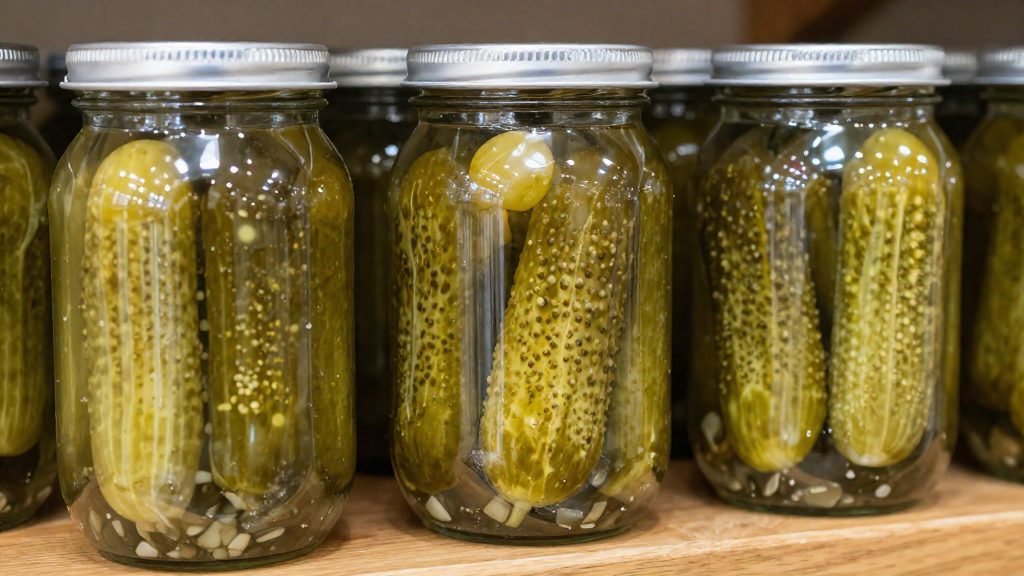
Storage temperature determines how long a sealed jar of fully fermented pickles stays in good condition. The consulted sources cover three options: a cool cellar, a refrigerator, and room temperature. Only the first two come with a stated duration, so the comparison below relies on those figures.
| Storage method | Condition | Stated duration |
|---|---|---|
| Cool basement or root cellar | Below 55°F | Four to six months in the original container, in brine (Oregon State University Extension) |
| Refrigerator | Original container; surface scum and mold removed regularly (NC State Extension (Food Safety), 2020) | About four to six months (NC State Extension (Food Safety), 2020) |
Cool cellar and root cellar storage
The below-55°F threshold is the key condition. A storage area that warms in summer no longer meets that condition, so the duration should not be assumed for it.
Refrigerator storage
Many people refrigerate fully fermented pickles at peak quality. According to Oregon State University Extension, many people refrigerate fermented dill pickles because the cold slows fermentation and keeps them crisp.
Room temperature storage
The consulted sources give no shelf-life figure for fully fermented pickles kept at room temperature, so the cellar and refrigerator durations should not be extended to warmer rooms. For long-term storage without refrigeration, NC State Extension (2020) recommends canning fully fermented pickles instead. Processing times for raw-pack jars in a boiling-water canner depend on altitude; see the canning section below for the full table and headspace.
| Jar size | 0–1,000 ft | 1,001–6,000 ft | Above 6,000 ft |
|---|---|---|---|
| Pint | 10 minutes | 15 minutes | 20 minutes |
| Quart | 15 minutes | 20 minutes | 25 minutes |
Leave 1/2-inch headspace in each jar.
Does canning change shelf life?
Canning is the storage method that NC State Extension (Food Safety, 2020) recommends for fully fermented pickles. The boiling-water canner heats sealed jars for a fixed time, and the required minutes depend on jar size and elevation. The practical difference lies in the process itself: correct timing, correct headspace and a sealed jar.
Raw-pack processing times by altitude
Raw-pack means the cucumbers go into the jars without pre-cooking. According to NC State Extension (Food Safety, 2020), processing times in a boiling-water canner are:
| Jar size | 0–1,000 ft | 1,001–6,000 ft | Above 6,000 ft |
|---|---|---|---|
| Pint | 10 minutes | 15 minutes | 20 minutes |
| Quart | 15 minutes | 20 minutes | 25 minutes |
Altitude is the deciding factor. A pint processed for 10 minutes at 0–1,000 ft needs 15 minutes at 1,001–6,000 ft (quarts go from 15 to 20 minutes), so the same recipe changes its time when the canning location changes.
Headspace
Leave 1/2-inch headspace, the gap between the brine surface and the jar rim.
Low-temperature water-bath pasteurization
For jars that are already fermented, the alternative is low-temperature pasteurization. Hold the water at 180–185°F for 30 minutes. This is below a rolling boil, so it is a gentler heat treatment. Do not assume the boiling-water times apply to this method.
Why do fermented pickles get softer over time?
Fermented pickles soften for two separate reasons. The first is a slow change in the vegetable tissue that continues during storage. The second is heat applied during processing, which can soften pickles in a single step if the temperature is too high.
Slow cell wall breakdown during storage
Cell wall breakdown is the gradual weakening of the plant structure that keeps a cucumber firm. It continues after fermentation ends, while the pickles sit in brine. A jar can gradually lose firmness in storage, but pickles that become soft should be discarded, as the spoilage section explains.
Over-softening from heat above 185°F
Heat is the other main cause. According to NC State Extension (Food Safety) (2020), low-temperature pasteurization of fermented pickles uses water at 180–185°F, and temperatures above 185°F may over-soften the pickles. Unlike gradual breakdown, this softening comes from the heat itself, so a pickle heated above that threshold can be soft as soon as it leaves the water bath.
How starting firmness affects the rate
What matters is that softening is judged against the starting firmness of the batch. A firm batch has more structure to lose, and any change is easier to see against its original texture. Recording how firm the pickles were at the end of fermentation gives a fixed reference point for judging later changes, and it makes it clearer whether a loss of firmness reflects storage time or processing heat.
Signs your pickles have spoiled
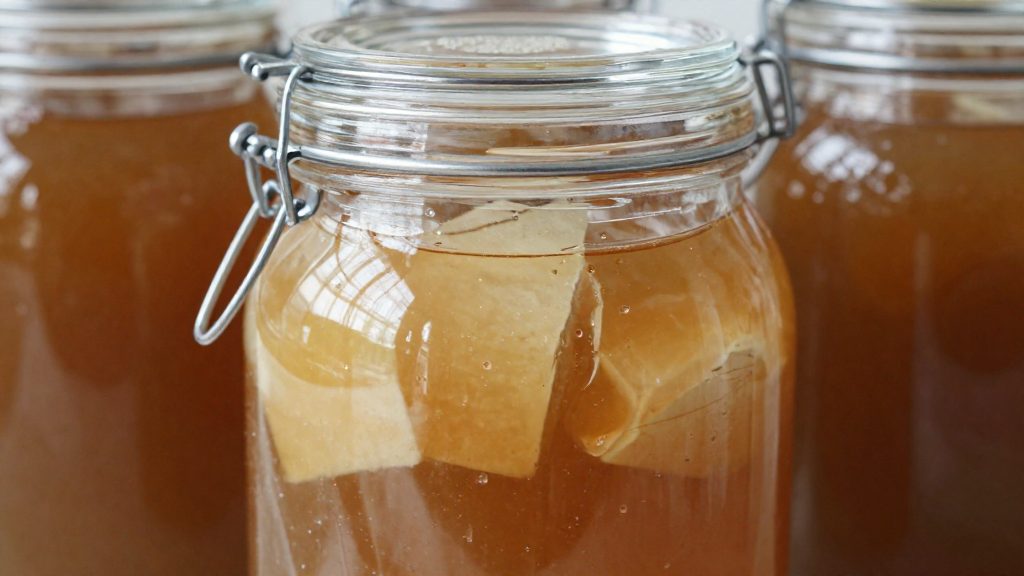
Sensory checks are the main criteria for deciding whether fermented pickles must be thrown out. According to NC State Extension (Food Safety, 2020), pickles that become soft, slimy or develop a disagreeable odor should be discarded. These criteria are qualitative and need no equipment: open the jar, look at the pickles, smell them and touch them with a clean utensil.
| Sign | What the source says |
|---|---|
| Soft texture | Discard pickles that become soft |
| Slimy texture | Discard pickles that become slimy |
| Disagreeable odor | Discard pickles that develop a disagreeable odor |
Where official guidance stops
Softness, sliminess and odor call for a judgment, made by looking, smelling and touching the pickles.
NC State Extension names the signs that make the pickles unfit.
How to store fermented pickles properly
Once fermentation is complete, routine storage depends on three habits: keeping the vegetables under the brine, removing surface film as it forms, and handling the jar with clean tools. The practices below protect the jar during storage.
Keep the vegetables submerged
Submersion is the main barrier against surface growth. Pieces of cucumber, carrot or other vegetables that float above the liquid are exposed to air and are where mold usually starts. Before sealing, press the vegetables down so they sit below the brine line. If pieces rise during storage, push them back under with a clean, food-safe weight, such as a small glass or a plate that fits inside the jar. If the brine level has dropped, top it up with brine made at the same salt ratio as the original batch so the vegetables stay covered.
Remove scum and mold regularly
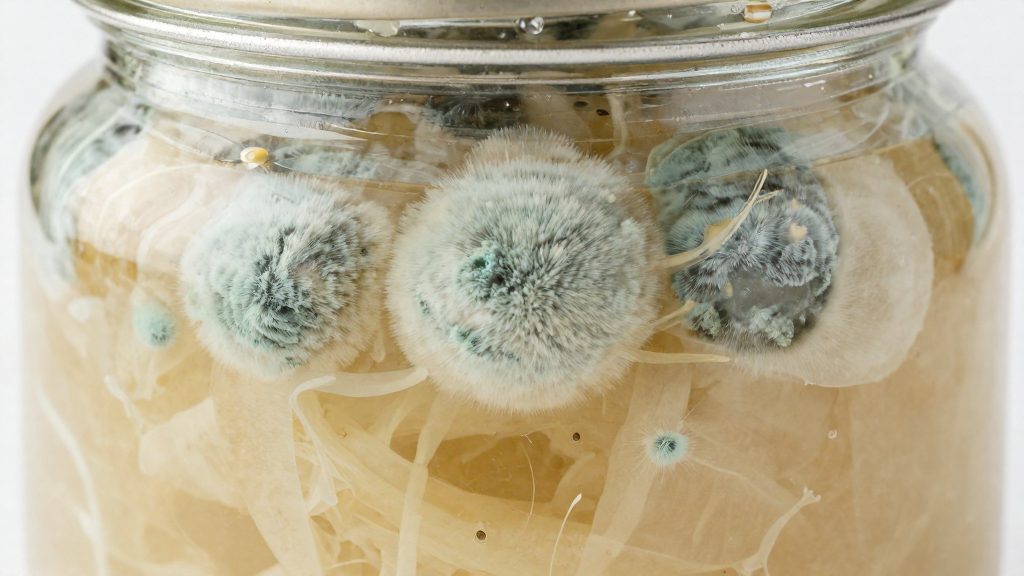
A film often forms on the brine surface during storage. Scum removal is a recurring task rather than a one-time step. NC State Extension (Food Safety) (2020) states that surface scum and mold must be removed regularly. Lift off the film with a clean, dry spoon, and remove any visible mold spots. After skimming, check that the vegetables are still submerged, and note any changes in the jar’s appearance so you can compare them over time.
Use clean tools and hands
Wash your hands before opening the jar and use a clean utensil each time. Dipping fingers or used spoons into the brine introduces microbes from hands and from the kitchen air into the jar. After each use, wipe the jar rim and the inside of the lid before resealing, so brine does not dry and crust around the seal.
Is the listeria risk real for refrigerator pickles?
The risk is real, but the consulted sources tie it to a specific method rather than to refrigerated pickles in general. Oregon State University Extension warns that a “refrigerator adaptation” recipe, which brines at room temperature for about seven days before refrigerating, carries a risk of listeria poisoning. The warning targets the room-temperature brine stage, so the key question is how the pickles were made before they reached the fridge.
The consulted sources do not specify the temperature at which Listeria grows, nor the acidity or salt levels that prevent it. Without those thresholds, a home cook cannot calculate a safe margin from the sources alone, and the fridge cannot be treated as a substitute for a properly acidified brine.
| Question | What the consulted sources say |
|---|---|
| Refrigerated growth temperature for Listeria | Not specified |
| Acidity and salt limits that stop Listeria | Not specified |
| Room-temperature brine for about 7 days, then refrigerated | Carries a listeria poisoning risk (Oregon State University Extension) |
Practical steps that follow from this:
- Do not use a warm, multi-day brine as a shortcut before refrigerating a batch.
- Do not rely on the fridge to make up for a brine that was not fully fermented.
- Treat any batch with unclear history as unverified, even if it looks and smells normal. Sensory checks can show spoilage, but they cannot confirm that a batch is free of listeria.
Listeriosis is most dangerous for pregnant people, newborns, adults 65 and older, and people with weakened immune systems. Do not serve them homemade refrigerated pickles of unclear history, such as a room-temperature brine followed by refrigeration, and ask a doctor or your local public health department if you are unsure.
Frequently asked questions
How can I tell if a stored fermented pickle has gone bad?
Discard pickles that turn soft or slimy or give off a disagreeable odor, according to NC State Extension (Food Safety) (2020). Surface scum and mold should be removed during storage. Check the jar before each use.
Is it safe to refrigerate a batch after only a week of room-temperature brining?
No. Oregon State University Extension warns that a “refrigerator adaptation” recipe, which brines at room temperature for about seven days before refrigeration, carries a listeria risk. A batch needs to finish fermenting at its fermentation temperature before it moves into cold storage.
Can I store fermented dill pickles in a cool basement instead of the fridge?
Yes, according to Oregon State University Extension, which says fermented dill pickles can keep in their brine in the original container for four to six months when the temperature stays below 55°F, such as in a cool basement or root cellar. Many people refrigerate them anyway to slow fermentation and keep them crisp.