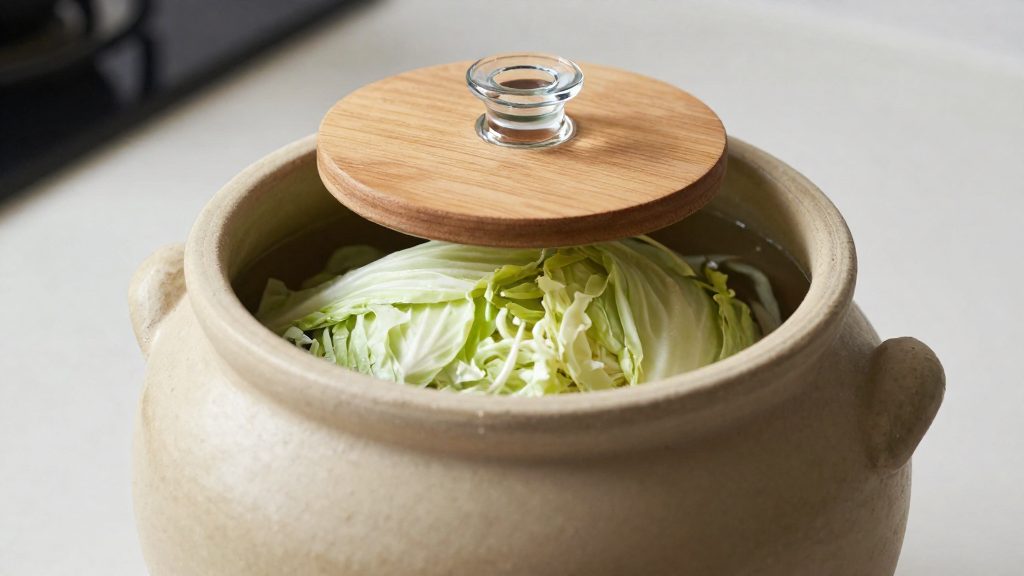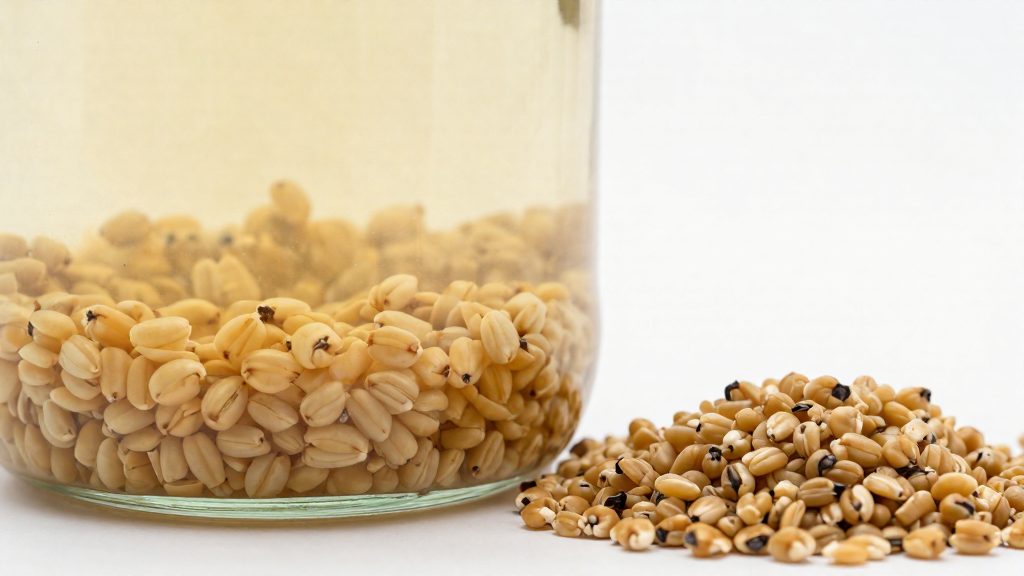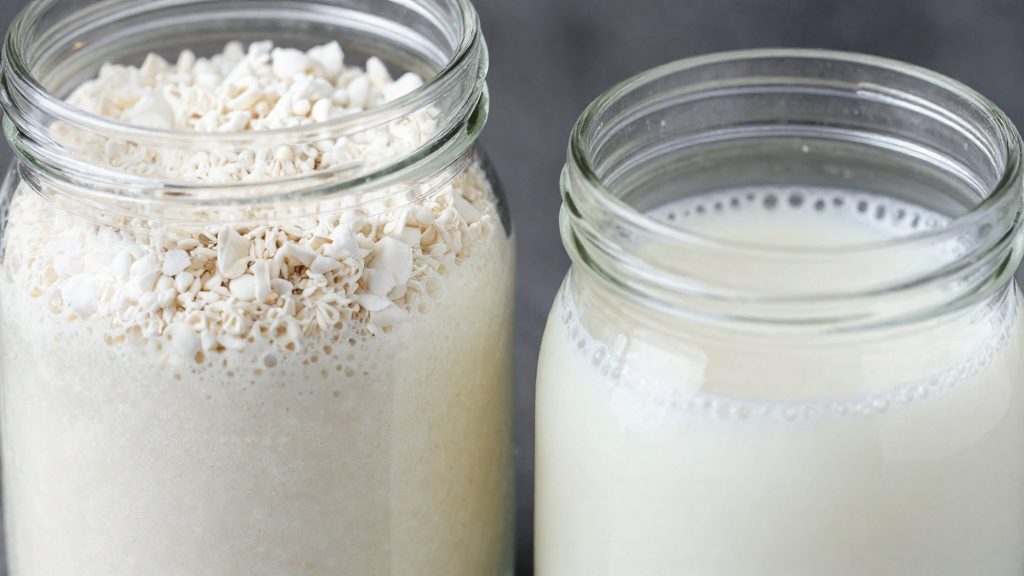
Freeze-dried and fresh starters differ mainly in the physical state of their microbes when fermentation begins. A fresh starter contains living cells that remain metabolically active. A freeze-dried starter has had its moisture removed, so its cells are dormant until they are brought back to an active state. According to Frontiers in Microbiology (2025), a 2025 University of Alberta study freeze-dried a reconstituted 9-species kefir culture using trehalose or milk as protectants, then compared the results with fresh cultures.
Freeze-dried vs fresh starter: what is the difference?
Both forms begin from the same kind of microbial community, but they reach the fermentation vessel in different states. Preparation, cell state and handling are the three points where they diverge.
Freeze-dried starter: moisture removal and dormancy
Freeze-drying removes water from the culture. Without enough moisture, the microbes stop actively metabolising and enter a dormant state, which allows the starter to be stored as a dry product until it is needed.
Drying is hard on living cells, so protectants are added beforehand to help them survive the process. The 2025 study tested two:
- Trehalose, a sugar.
- Milk, used as a protectant in the same way.
The freeze-dried cultures in the study were made from a nine-species kefir community that had been reconstituted before drying, which means the starter is a rebuilt community rather than a sample taken directly from a living batch.
Fresh starter: living, active cells
A fresh starter keeps its microbes alive and metabolically active throughout. Because it has never been dried, its cells never enter the dormant state that drying induces. The fresh cultures in the same study were used as the reference group for comparing the freeze-dried results.
Key differences at a glance
| Feature | Freeze-dried starter | Fresh starter |
|---|---|---|
| Water | Removed during freeze-drying | Retained |
| Cell state | Dormant | Living and metabolically active |
| Step before fermenting | Cells must be brought back to an active state | Living cells are used as they are |
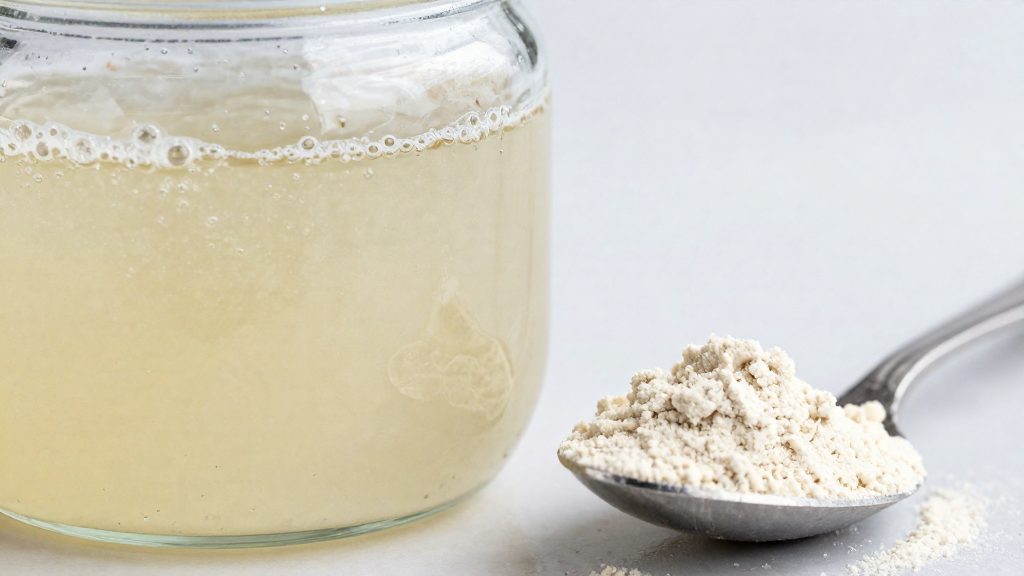
Do freeze-dried cultures ferment as well as fresh ones?
A 2025 University of Alberta study, published in Frontiers in Microbiology (via PubMed Central, 2025-10-10), found that a freeze-dried kefir culture can produce a finished kefir broadly comparable to one made from a fresh culture. The researchers freeze-dried a reconstituted nine-species kefir culture using either trehalose or milk as a protectant, then compared microbial survival and the composition of the finished drink against fresh cultures. The main finding is that the end product was similar, while survival differed between bacteria and yeasts.
Microbial survival after freeze-drying
Freeze-drying reduces the number of living cells, and the losses are not uniform across the culture. The study reported the following viability ranges:
| Microbial group | Viability after freeze-drying |
|---|---|
| Bacteria | About 96–100% |
| Yeasts | About 84–87% |
Bacteria retained nearly all of their viability, while yeasts lost a larger share. Even so, the surviving cells were enough for the cultures to produce a finished kefir in the study.
Microbial counts and community in the finished kefir
Total bacterial counts in the finished kefir were similar for freeze-dried and fresh cultures, at about 9.0–9.2 log CFU/mL. Sequencing showed the same dominant community in both groups, with Lactococcus cremoris making up about 93–95% of the bacteria. On the measures reported, the bacterial profile of the drink was similar for both groups, although the study was small.
Acids, ethanol and final pH
Lactic acid, acetic acid and ethanol levels did not differ between the freeze-dried and fresh groups. The final pH converged across all groups, so the acidity of the finished kefir was similar regardless of how the starter was prepared.
What the comparison means for home fermenters
For a home fermenter, the practical result is that a properly freeze-dried kefir starter can yield a finished drink with bacterial counts, dominant organisms and final acid and ethanol levels similar to those from a fresh culture. The study’s yeast viability figure was lower than the bacterial one. The finished kefir was similar on the measures reported (bacterial counts, organic acids, ethanol, community), but the study does not show what the lower yeast survival meant for the drink.
How fast do freeze-dried starters work?
Freeze-dried kefir cultures protected with trehalose finished fermenting as quickly as fresh ones, while milk-protected cultures took about six hours longer. The study compared a reconstituted nine-species kefir culture in three forms: fresh, freeze-dried with trehalose, and freeze-dried with milk. The timing and pH values below come from that laboratory work, so they describe those specific cultures under the study’s conditions, not every commercial starter.
Time to finish fermenting
Fresh and trehalose-protected cultures finished fermenting in 24 hours. Milk-protected freeze-dried cultures took about 30 hours, roughly six hours longer.
| Culture form | Time to finish fermenting | pH at 24 hours |
|---|---|---|
| Fresh | 24 hours | 4.35 |
| Freeze-dried, trehalose-protected | 24 hours | 4.37 |
| Freeze-dried, milk-protected | About 30 hours | 4.76 |
Early acidity at 24 hours
The 24-hour checkpoint shows the clearest difference. A higher pH means less acid, so at 24 hours the milk-protected kefir was less acidic than both other groups. The fresh and trehalose-protected batches sat close together at 4.35 and 4.37. In practice, the milk-protected batch was still behind the others at the same clock time, even though it was on its way to finishing.
Using the checkpoints at home
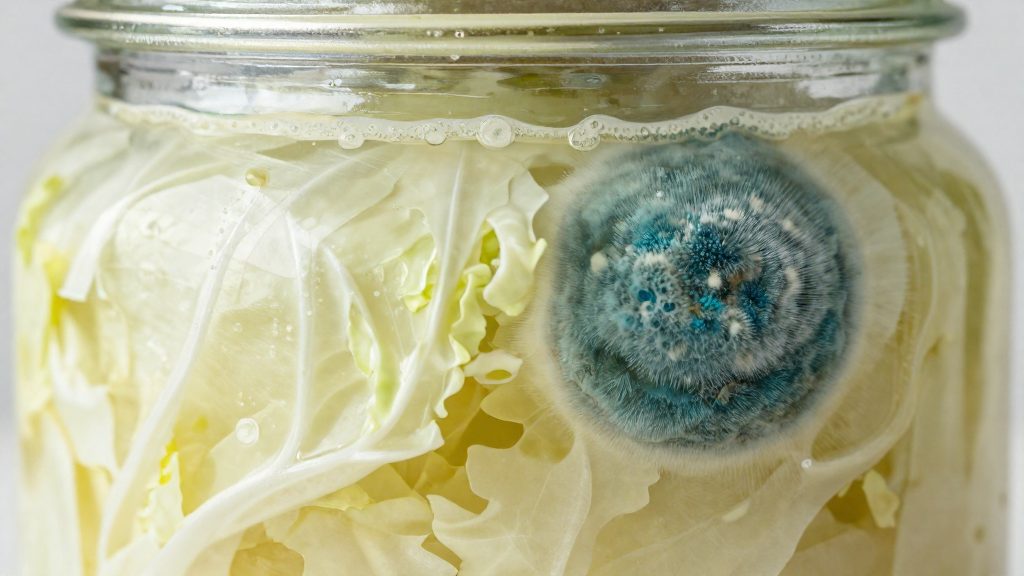
Judge readiness by pH readings, not by hours alone. Start the timer when you add the culture to the milk, then take a reading at 24 hours with a calibrated pH meter or pH strips. If the reading is well above the fresh-culture values in this study, give the batch a little more time, but discard it if it shows mold, pink or orange discoloration, or an off or putrid smell, or if it still has not soured or thickened after a substantially longer time. When in doubt, throw it out. Keep the milk volume, temperature and handling consistent between batches, so that differences in timing reflect the culture rather than your setup. Timing for other starter types may differ, so follow their own instructions.
Which starter suits kefir, kombucha or vegetables?
Freeze-dried and fresh starters cannot be treated as interchangeable across all home ferments. The only comparative evidence consulted concerns kefir. The study freeze-dried a reconstituted nine-species kefir culture, protected with either trehalose or milk, and compared the result with the fresh culture.
Kefir: the only dairy culture with freeze-dried data
The study is limited in several ways that affect how far its results apply:
- It tested one dairy culture. It does not extend to other ferments.
- The authors did not assess sensory qualities, batch-to-batch consistency or shelf life.
- Two authors hold a patent related to the fresh culture method used.
Kombucha and vegetable ferments
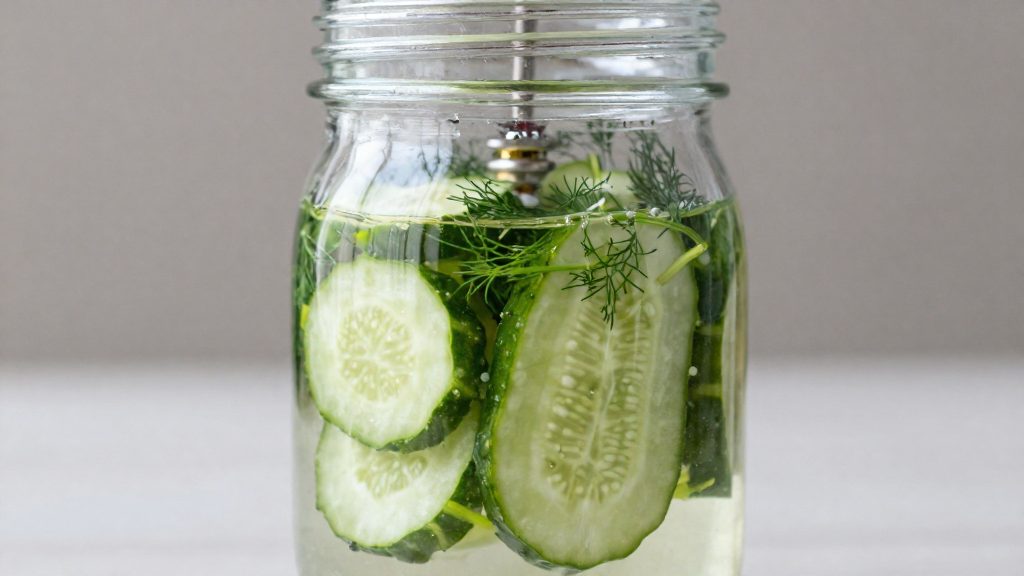
The findings here apply to kefir. Kombucha and lacto-fermented vegetables such as sauerkraut and kimchi are different ferments, so follow guidance specific to each.
Choosing by use
Match the starter form to the job, using the kefir findings as the only evidence-based reference point:
| Use case | Suggested form | Basis |
|---|---|---|
| Regular, repeated kefir batches | Fresh culture | The study’s reference culture; it did not test repeated propagation from dried stock |
| Backup culture (storage life not tested in the study) | Freeze-dried kefir culture, if the label gives storage guidance | Finished-kefir counts and acid profile were similar to fresh in the study, but shelf life and storage stability were not assessed |
| Kombucha or vegetable ferments | Fresh, by default | No freeze-dried comparison was found |
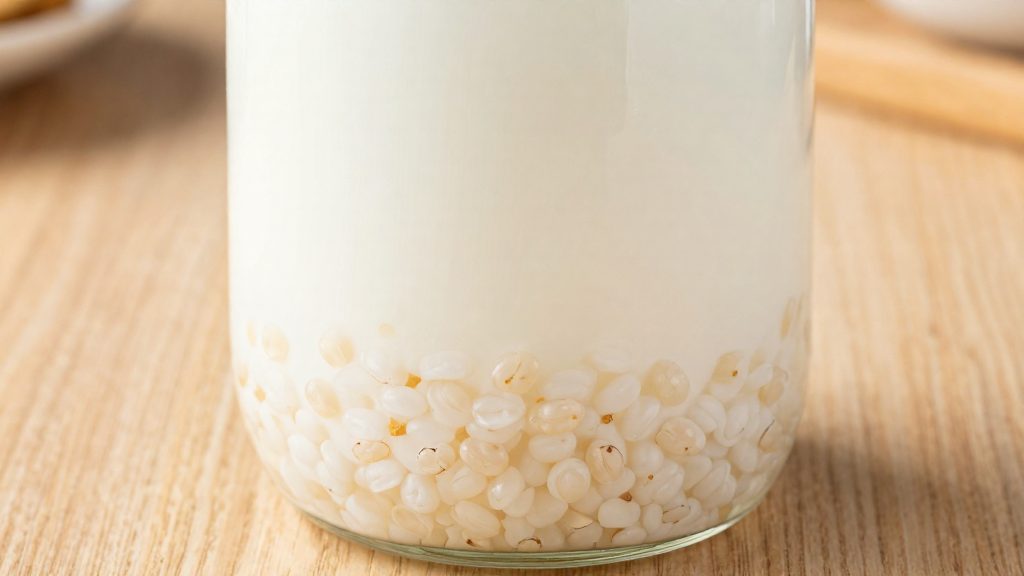
Is a powdered starter safer or more consistent?
The published evidence does not settle either question. The study freeze-dried a reconstituted 9-species kefir culture and compared the finished kefir with kefir made from a fresh culture. It measured the end product and the fermentation process, not batch-to-batch reliability or contamination risk. Home fermenters therefore need to separate what the study measured from what it left open.
What the comparison showed
Once fermentation finished, kefir from freeze-dried and fresh cultures looked alike on the measures reported. These are the strongest points of similarity in the study, but they describe one set of fermentations, not a series of batches made over time.
Timing did differ. The table below shows the two measurements where the groups diverged.
| Culture | Time to finish | pH at 24 h |
|---|---|---|
| Fresh | 24 h | 4.35 |
| Freeze-dried, trehalose-protected | 24 h | 4.37 |
| Freeze-dried, milk-protected | about 30 h | 4.76 |
By 24 hours, the milk-protected kefir was clearly less acidic than the other two. All three groups reached similar final pH, but a fermenter working to a fixed schedule would need to allow about six extra hours for the milk-protected culture.
Batch-to-batch consistency
The authors did not assess batch-to-batch consistency. The study tested one comparison between fresh and freeze-dried cultures, so it does not show whether successive packets of powder, or repeated reconstitutions of the same packet, give comparable kefir. A home fermenter who wants that answer has to test it directly. Keep a log for each run that records the culture form, the protectant, the reconstitution steps, the time to finish and the final pH, then compare the runs.
Contamination and pathogen risk
The study reports viability, bacterial counts and community composition. Whatever the starter form, keep equipment clean, measure reconstitution carefully, and discard any batch that shows signs of spoilage.
For home use, this gap means the study cannot be used as evidence that a powdered starter is safer. Apply the same hygiene to both forms: clean equipment, measured reconstitution, and discard of any batch that shows signs of spoilage.
How to rehydrate and store starter cultures
Dried and fresh starters need different handling because they fail in different ways. A freeze-dried packet is a dormant culture that must be brought back to an active state before use. A fresh culture is a living population that stays productive only when it is fed on a regular schedule. The study is the most detailed recent work on freeze-drying a home kefir culture. Its scope is laboratory-scale, so the steps below are general practice, not a validated home protocol.
Reactivating a dried culture
Start with the manufacturer’s label, since its packet instructions take precedence over any general method.
- Rehydrate in the medium the label names.
- Test a small volume before committing a full batch. This shows whether the culture is active without risking a large quantity of milk.
- Judge activity by the batch, not the clock. Thickening, a clean sour smell and gas formation are the signs to look for.
Expect the first one or two batches from a rehydrated packet to be less predictable than an established culture.
Storing dried packets
Dried starters depend on moisture control. The general principle is to keep the packet sealed, dry and away from heat and humidity, and to reseal it promptly after opening.
The study used trehalose or milk as protectants during freeze-drying. Check the label for the protectant it lists. The study did not assess how either protectant affects storage stability over time.
Keeping fresh cultures between batches
Fresh cultures are maintained through subculturing, which means transferring a portion of an active culture into fresh medium on a regular schedule. In practice, the interval depends on ambient temperature and how quickly the culture consumes its medium, so the batch behaviour is a more reliable guide than a fixed calendar. If you are not feeding daily, keep the culture refrigerated between feedings.
Quick reference
| Form | Reactivation | Storage | Gap in sources |
|---|---|---|---|
| Freeze-dried packet | Rehydrate in the label’s medium | Sealed, dry, away from heat and moisture | — |
| Fresh culture | No rehydration; resume regular feeding | Refrigerate when not fed daily | Subculturing interval not specified |
What does the research not yet tell us?
The study compared a freeze-dried kefir culture with a fresh one, and it answers a narrow question: whether the two routes produce similar microbial counts, acidity at completion and community makeup. Several gaps limit how far those results carry into a home kitchen. Three gaps limit how far those results carry: unassessed sensory quality and shelf life, uneven group sizes, and the authors’ patent interest.
Sensory quality and shelf life were not assessed
The authors did not evaluate taste, aroma, texture or how long finished kefir stays acceptable in storage. The study shows that finished kefir from both routes had similar bacterial counts and organic acid profiles, but it does not show whether the two products taste or feel the same. A home fermenter switching to freeze-dried starter needs those answers, because matching chemistry does not guarantee matching flavour.
Unequal group sizes
The fresh culture group contained three samples and the freeze-dried group contained six. Small and unequal groups reduce the confidence that can be placed in any finding of similarity, and they make it harder to judge how much variation exists within the fresh method. A larger, balanced design would be needed to test whether the two routes behave the same across a wider range of conditions.
Conflict of interest in the fresh method
Two authors hold a patent related to the fresh culture method used in the study. This does not invalidate the results, but it is a financial interest in one of the two methods being compared. Readers should weigh that when judging the comparison, and independent replication by researchers without a stake in either method would strengthen confidence in the conclusions.
| Gap | What it limits |
|---|---|
| Sensory quality not assessed | Taste and texture equivalence |
| Shelf life not assessed | Storage guidance for finished kefir |
| Uneven sample sizes (fresh n=3, freeze-dried n=6) | Confidence in similarity or difference |
| Patent held by two authors | Neutrality of the fresh-method comparison |
Frequently asked questions
Will a freeze-dried kefir starter take longer to ferment than a fresh one?
Possibly. According to Frontiers in Microbiology (2025), milk-protected freeze-dried cultures needed about 30 hours to finish, while fresh and trehalose-protected cultures finished in 24 hours. Plan for a longer first fermentation when you start from a dried kefir starter protected with milk.
Does freeze-drying change the final kefir’s bacterial count or acidity?
Not in the measured results. Frontiers in Microbiology (2025) reported similar total bacterial counts of about 9.0–9.2 log CFU/mL in finished kefir from both forms. Lactic acid, acetic acid and ethanol levels did not differ, and the microbial community was the same. The same study did not assess taste, texture or shelf life, so those differences remain unknown.
How much weight should I give this research before switching to freeze-dried cultures?
Treat the findings as early evidence from one kefir study. Frontiers in Microbiology (2025) used uneven groups, with three fresh cultures and six freeze-dried ones, which limits statistical confidence. Two authors also hold a patent related to the fresh culture method, a disclosure that matters when comparing the two forms. Test a dried starter culture against your usual batch in small, side-by-side ferments before relying on it.