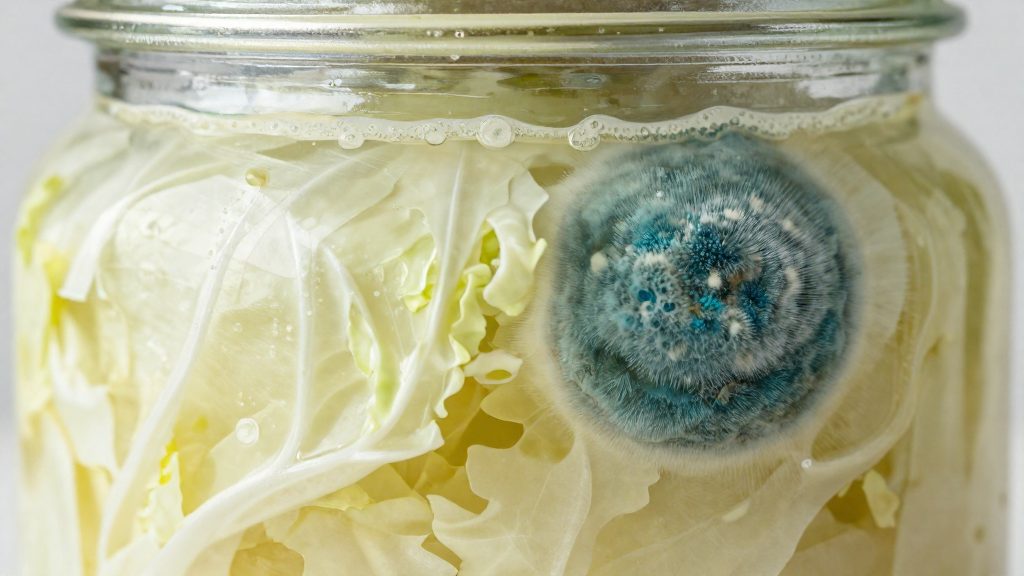
Kahm yeast and mold both form a film on the surface of a ferment, which is why home fermenters often mix them up. The core difference is risk. Mold is a contamination that calls for discarding the affected layers, and in some cases the whole batch.
Kahm yeast vs mold: the quick answer
Kahm yeast is a yeast film. Mold comes from airborne spores landing on exposed, wet cabbage. Remove it right away and discard any soft or discolored layers beneath it. If the mold is black, pink or orange, or the batch smells off, discard the whole batch.
Color alone does not separate the two. Both can appear white, both sit on the brine surface, and kahm yeast can thicken into a velvet-like layer that looks close to mold. Mold can also be white, so the first check is whether the growth is flat or raised and fuzzy, followed by smell.
| Question | Kahm yeast | Mold |
|---|---|---|
| Nature | Surface yeast, harmless but affects flavor | Contamination from airborne spores |
For home fermenters, the bottom line is to treat any surface film as a reason to inspect, not to panic. The flat-versus-raised profile and the smell are the deciding factors.
What does kahm yeast look like?
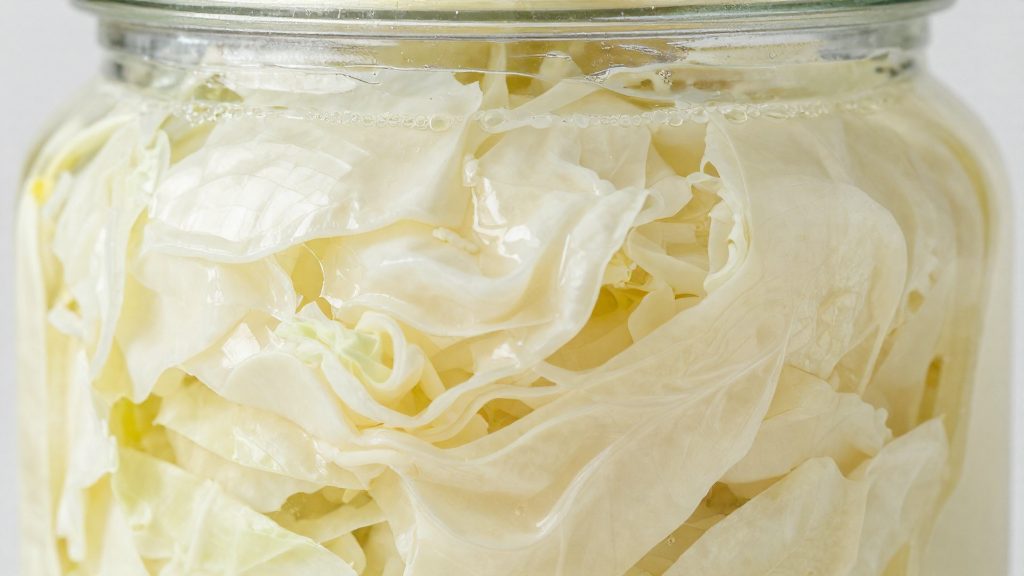
Kahm yeast forms a flat, thin film on the surface of the brine. In its early stage it appears as a white to cream powder that lies on the liquid or on top of the vegetables without rising above them. Because the layer is so thin, it often shows up first as a faint dusting rather than a distinct coat. Looking at the top of the jar in good light makes it easier to spot.
The film’s texture can change over time. If it thickens, its surface can take on a velvet-like texture. The change is gradual: a powdery dusting becomes a more even, soft-looking coat. Because texture is the feature that shifts most as the film grows, it is worth checking the surface again after a few days rather than relying on a single look.
Kahm yeast also has a distinct smell, which helps confirm what you are seeing. It is described as yeasty, cheesy or alcohol-like. Checking the odour together with the appearance gives a more reliable picture than either check alone.
| Feature | Kahm yeast |
|---|---|
| Form | Flat, thin film |
| Colour | White to cream |
| Texture | Powdery; velvet-like when thicker |
| Odour | Yeasty, cheesy or alcohol-like |
How can you recognize mold on a ferment?
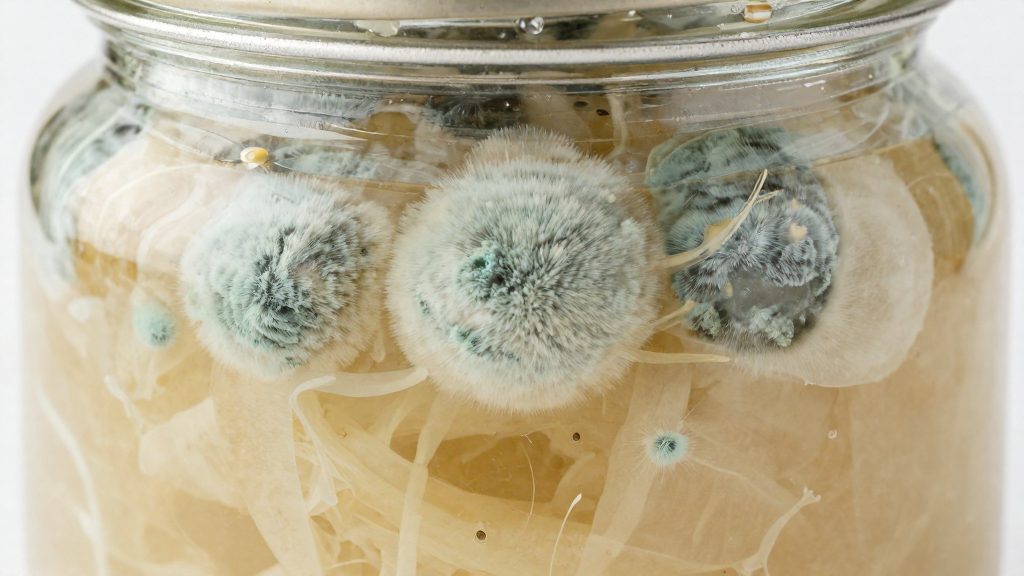
Mold on a ferment appears as raised, fuzzy growth that stands up from the surface of the vegetables. It does not lie flat. Growth that rises above the surface in soft, tuft-like form points to mold, while a flat layer points to something else. Check the cabbage pieces that sit above the brine line, along with the top leaves and the rim of the jar.
Mold tends to form defined colonies, which are separate patches with visible edges, rather than an even sheet spread across the whole surface. Each patch has its own shape and height, so you can see where one colony stops and the next begins.
Mold can be white, black, blue, green or pink. White mold is the variant most easily confused with a surface film, so the raised, fuzzy profile is the distinguishing feature to check first. The colored variants are easier to spot, but they are still judged by the same shape: a raised, fuzzy patch.
Mold starts from airborne spores that land on exposed, wet cabbage. Because the spores settle from the air, growth is most likely where cabbage is in contact with the air rather than submerged, so that is where to look first.
| Feature | Kahm yeast | Mold |
|---|---|---|
| Surface profile | Flat, thin layer | Raised, fuzzy growth |
| Appearance | White to cream powder | White, black, blue, green or pink |
Is kahm yeast safe to eat?
Make Sauerkraut describes kahm yeast as harmless but flavor-altering. Because mold can look similar, confirm what you have by checking the surface profile and smell before deciding the batch is fine. The problem is its effect on taste and what it signals about exposure to air. Mold is a different case.
Harmlessness and effect on flavor
Kahm yeast is a yeast film that forms on the brine surface. Make Sauerkraut describes it as harmless but flavor-altering, which is why it should not be left to spread. The odour is the main sensory sign that a batch has been exposed to air.
Why overgrowth still degrades taste
Even a harmless film affects the ferment’s flavor, so a batch left to overgrow tastes worse over time.
Health concerns from mold and mycotoxins
Mold should be treated as a food-safety concern, not just a flavor issue: remove it right away, discard any soft or discolored layers beneath it, and discard the whole batch if the mold is black, pink or orange or the batch smells off.
| Aspect | Kahm yeast | Mold |
|---|---|---|
| Health risk (per Make Sauerkraut) | Harmless | Not stated |
Skim or toss: what should you do?
Identify the growth first, then follow a fixed sequence. Kahm yeast is removed until the kraut tastes right. Mold is removed along with any soft or discolored layers beneath it, and the batch is discarded if the mold is black, pink or orange or if it smells off.
Skimming kahm yeast
- Remove all of the film from the surface, including any velvet-like patches.
- Taste the top layer of the kraut.
- If the flavor is still yeasty, cheesy or alcoholic, remove another layer and taste again.
- Once the kraut tastes fine, repack it into a clean jar and press it back under the brine.
Clearing mold
- Remove the mold immediately, before it spreads through the cabbage.
- Discard the soft or discolored layers directly beneath it.
- Smell the batch. If it smells off, or the mold was black, pink or orange, discard the whole batch.
After clearing, keep the cabbage submerged.
Discard rules
| Finding | Action |
|---|---|
| Kahm yeast, flavor returns after removal | Keep the batch |
| White, blue or green mold, batch smells normal after removal | Remove the mold and the soft or discolored layers beneath it, then smell the batch again; discard if the smell is off |
| Black, pink or orange mold | Discard the batch |
| Any mold with an off smell | Discard the batch |
How do you prevent film and mold?
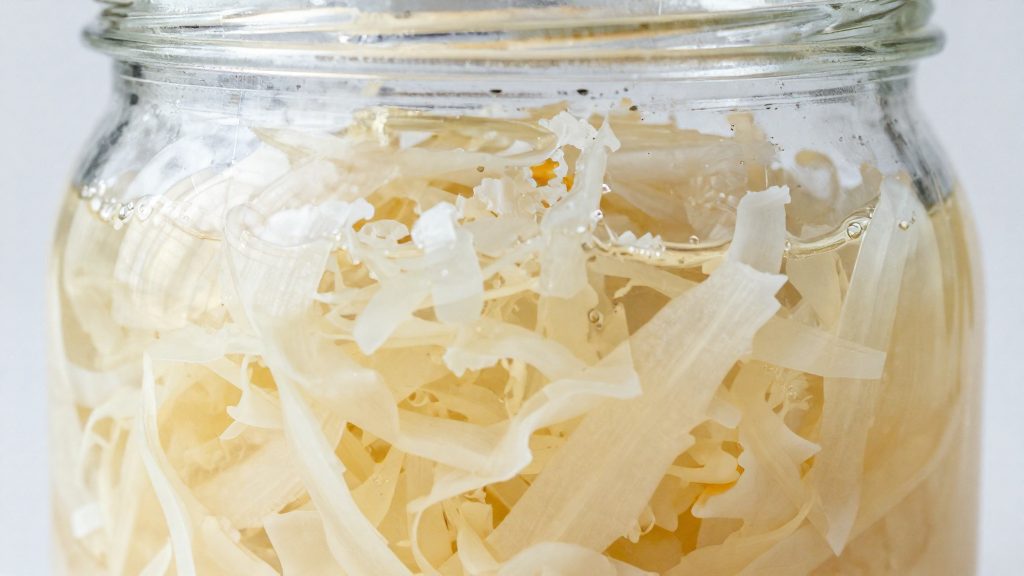
Prevention works by limiting what reaches the surface of a ferment. Kahm yeast and mold both form on the top layer, so the goal is to keep that layer clean, covered and under regular observation. The steps below cover how the jar is closed, what touches the ferment before it starts, and how often you check it while it works.
Cover the jar to limit airborne exposure
Keep the ferment covered for the whole process. A cover that keeps dust and debris out of the jar reduces the number of particles that can settle on the surface. Store the jar in a clean area, away from open flour, crumbs and other food residue that can drift onto the top layer.
Clean tools and jars before fermenting
Wash jars, weights, lids and utensils before each batch. Residue left from a previous ferment can carry microbes into a new batch, and clean equipment gives you a known starting point. Handle the vegetables with clean hands or utensils so that the surface is not contaminated during packing.
Check weighted jars on a fixed schedule
Set a regular inspection routine rather than checking only when something looks wrong. The National Center for Home Food Preservation (University of Georgia) advises that, when jars are used as weights, you check the kraut 2 to 3 times a week and remove any scum that forms.
| Routine task | Frequency | Purpose |
|---|---|---|
| Look at the surface for scum, film or fuzz | 2 to 3 times a week | Spot kahm yeast or mold early |
| Remove scum that has formed | At each check | Stop the layer from spreading |
| Confirm the vegetables are still covered by juice | At each check | Catch exposed areas before they develop growth |
Brine ratios and submersion basics
Lacto-fermented vegetables depend on salt and on keeping the vegetables under their brine. For sauerkraut, a standard brine is about 2% salt, which equals 16 g (1 tbsp) per 800 g of vegetables. In warm weather, raise the salt to about 2.5%. Because the ratio is based on vegetable weight, weigh the cabbage and the salt rather than relying on volume. Weighing also makes the ratio repeatable from batch to batch.
Ratios at a glance
| Situation | Salt ratio | Measured against |
|---|---|---|
| Standard sauerkraut | About 2% (16 g or 1 tbsp per 800 g) | Vegetable weight |
| Warm weather | About 2.5% | Vegetable weight |
| Recipe reference (cabbage) | 3 tbsp per roughly 5 lb | Vegetable weight |
Keeping vegetables submerged
The submersion of the vegetables is what keeps the surface of the batch in the brine. Pack the shredded or sliced vegetables firmly into the jar or crock so that their own juice rises and covers them. Pressing down helps release liquid. If the juice doesn’t cover the cabbage, the batch needs more brine, not a looser pack. Exposed vegetable tissue is the part that becomes vulnerable to surface growth, so the goal is to keep every piece below the liquid line.
Topping-up brine
According to the National Center for Home Food Preservation (University of Georgia), if the juice doesn’t cover the cabbage, add a brine of 1.5 tbsp salt per quart of water. Boil the water and let it cool before adding it. Pour the cooled brine in slowly until the vegetables are covered, then recheck the level at the next opening of the jar.
When in doubt, throw it out
Most batches fall clearly into one category. The hard calls come when the surface is partly kahm-like, the smell sits between normal sourness and something unpleasant, or the signs contradict each other. For an uncertain batch, work through a fixed order instead of judging the whole jar at once.
- Identify the surface. Anything raised or fuzzy is treated as mold, not kahm yeast.
- Remove the surface layer and check what lies beneath.
- Check the smell of the kraut itself, not just the surface.
| Signal after removing the surface | Reading | Decision |
|---|---|---|
| Yeasty, cheesy or alcohol-like smell, clean sour taste | Normal ferment with kahm yeast present | Keep the batch |
| Smell is off, whether or not it persists after the top layer is removed | Spoilage | Discard |
| Kraut itself smells off, even below the surface | Spoilage beyond the surface | Discard |
Bad smells rarely appear suddenly, so repeated checks catch the change before doubt builds.
Smells that go beyond yeasty
Any note that falls outside the kahm profile, especially one that stays after the surface is removed, is a reason to discard. Trust the smell over appearance when they disagree.
Cost-benefit of discarding
In practice, a discard loses the ingredients and the fermentation period. Keeping a doubtful batch risks a full jar of unpleasant or unsafe kraut. Discard the batch if the mold is black, pink or orange or if it smells off. Neither a look nor a smell alone confirms that a batch is safe, so remove any mold and soft or discolored layers every time.
Frequently asked questions
How can I tell kahm yeast from mold if both look white?
Check the surface profile first: kahm yeast lies flat as a thin powder, while mold stands up as a raised, fuzzy growth. Then smell the batch. Kahm yeast smells yeasty, cheesy or like alcohol, and a sour or otherwise wrong odor points toward spoilage.
If I find kahm yeast on my kraut, is it still safe to eat?
Kahm yeast is harmless, but it dulls flavor, so remove all of it. Taste the top layer after each removal and keep skimming until it tastes normal, then repack the vegetables into a clean jar with the brine covering them.
What should I do if the brine doesn’t cover the cabbage during fermentation?
According to the National Center for Home Food Preservation (University of Georgia), add a brine made from 1.5 tbsp salt per quart of water, boiled and cooled before use. If you use a jar as a weight, check the ferment two to three times a week and remove any scum that forms on the surface.