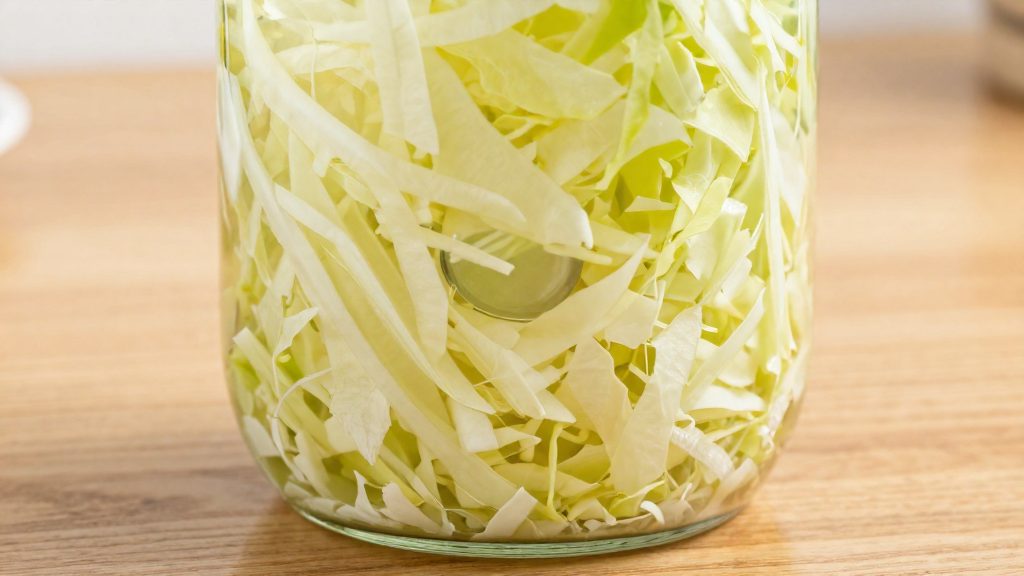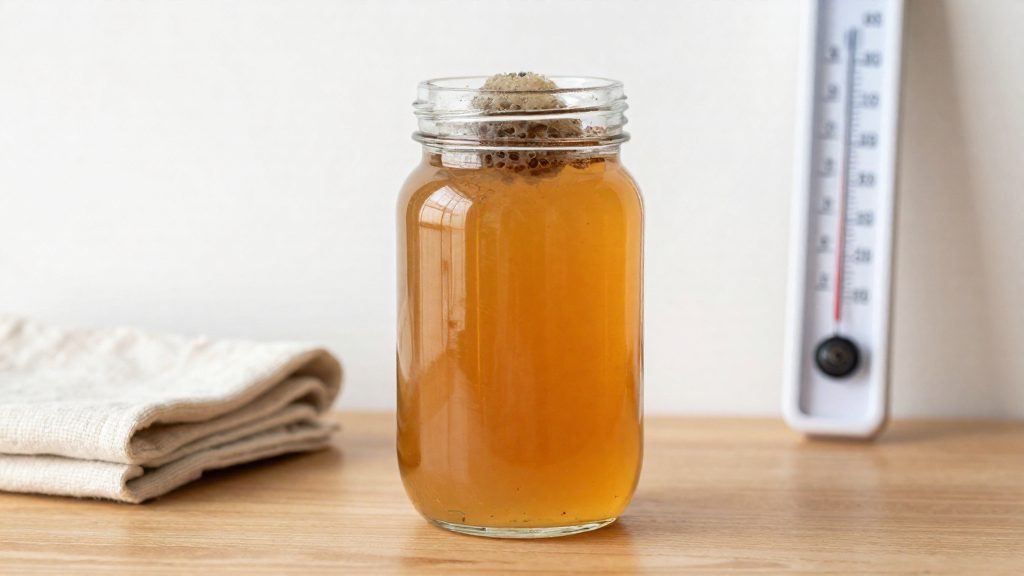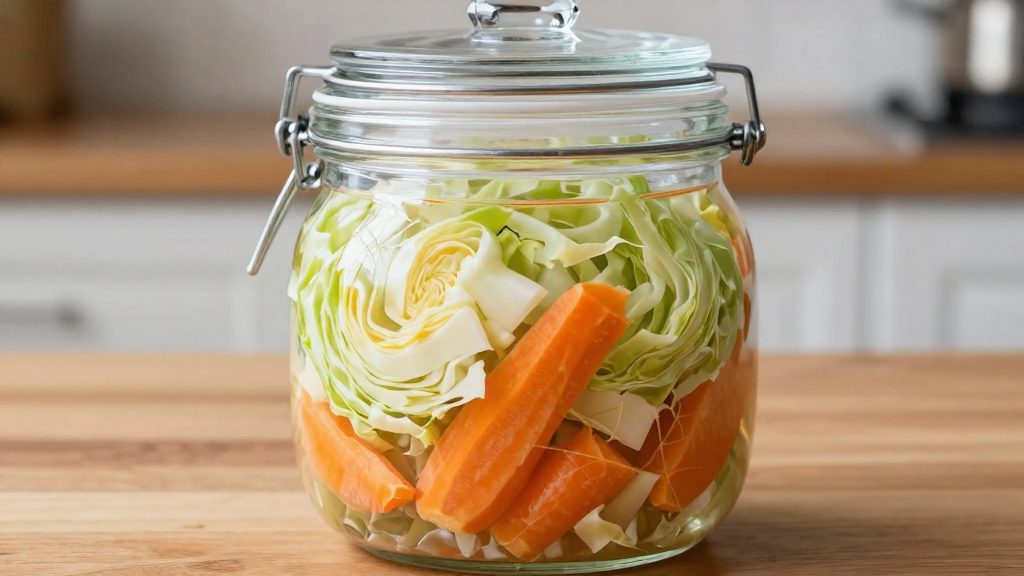
Sauerkraut is typically fully fermented in about 3 to 4 weeks at 70–75°F and in about 5 to 6 weeks at 60–65°F, according to Ohio State University Extension (CFAES) (2024-09-12). University of New Hampshire Extension gives the same two ranges. Temperature sets the pace, so the cooler tested band needs roughly two more weeks.
How long does sauerkraut take to ferment?
The two tested temperature bands produce the following timelines:
| Tested temperature | Approximate time to full fermentation |
|---|---|
| 70–75°F | About 3 to 4 weeks |
| 60–65°F | About 5 to 6 weeks |
Using the timeline as a checkpoint
These ranges show when fermentation is typically complete under the tested conditions. They are not a deadline for finishing or discarding a batch. Count the days from the start of fermentation, then compare the batch against the window for its room temperature.
How temperature changes fermentation time
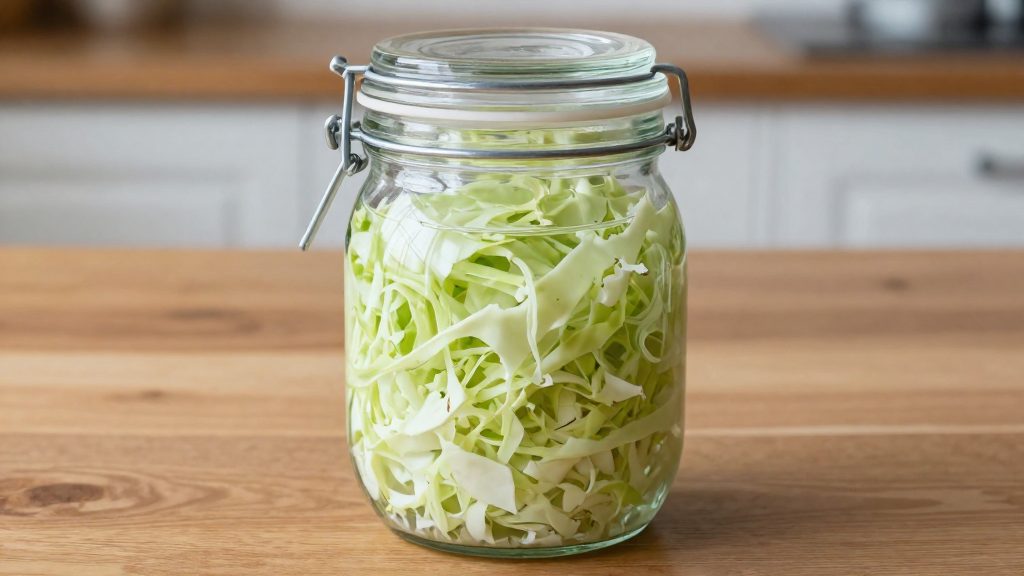
Room temperature sets the pace of lactic acid fermentation in vegetables and shapes the final texture and flavor. For sauerkraut, Ohio State University Extension (CFAES) (2024-09-12) and University of New Hampshire Extension both describe a working range of 60–75°F, with distinct problems at each end. Inside that range the batch ferments as expected. Outside it, the results differ in kind: a cold batch is slow and underdeveloped, while a warm batch loses quality.
Below 60°F: slow pace and underdeveloped acidity
Below 60°F, sauerkraut fermentation may be sluggish and proper acidity may not develop, according to Ohio State University Extension (CFAES) (2024-09-12). University of New Hampshire Extension says kraut may not ferment below 60°F. The lactic acid bacteria still work, but more slowly, so the batch shows fewer signs of activity for longer. Acidity matters beyond taste. The vegetables and brine need enough acid to keep the product stable.
A cold batch may look quiet and taste flat rather than tangy. The only published cool-end timing is about 5 to 6 weeks at 60–65°F; the sources give no timing below 60°F. If the kitchen or storage area is cold, move the crock to a warmer spot within the 60–75°F range. The sources give no completion time below 60°F, and University of New Hampshire Extension says kraut may not ferment there, so do not count on a cold batch finishing.
Above 75°F: soft texture and flat flavor
Above 75°F, sauerkraut may turn soft and lack flavor. Ohio State University Extension (CFAES) (2024-09-12) presents this as a quality issue, not as spoilage. The distinction matters. A soft, flat batch has failed on texture and taste, but the sources do not describe it as a safety problem.
Warm rooms also change the rhythm of the batch. Temperatures above 75°F are outside the tested range, and the source describes the result as softness and lack of flavor. Treat 75°F as the upper edge of the recommended range.
Temperature bands at a glance
| Room temperature | Fermentation behavior | Outcome described by the sources |
|---|---|---|
| Below 60°F | Slow, sluggish activity | Proper acidity may not develop |
| 60–75°F | Recommended range; published timings cover 60–65°F and 70–75°F | Acceptable fermentation, no stated problem |
| Above 75°F | Not described by the sources | Soft texture and flat flavor (a quality issue) |
How much salt for safe vegetable fermentation?
For sauerkraut, the tested salt ratio is 3 tablespoons of canning salt per 5 lb of cabbage, or ¾ cup of canning salt per 25 lb of cabbage, according to Ohio State University Extension (CFAES, 2024-09-12). Both amounts come from the same tested recipe. The source does not present them as a rule to scale up or down.
| Cabbage weight | Canning salt (tested amount) |
|---|---|
| 5 lb | 3 tablespoons |
| 25 lb | ¾ cup |
The salt is not a flavour choice that you can adjust to taste. Ohio State University Extension (CFAES, 2024-09-12) states that the amount of salt is critical to food safety and should not be adjusted.
Do not estimate salt for intermediate weights by interpolation. Use the tested amount that matches your cabbage weight.
The salt is also part of the brine if the cabbage does not release enough juice to cover itself. Ohio State University Extension (CFAES, 2024-09-12) gives a top-up brine of 1½ tablespoons of canning or pickling salt per quart of water, boiled and cooled, and says to keep the cabbage under 1–2 inches of brine. Use this only to cover shortfall, not to replace the initial salting.
Signs your vegetables are done
A batch of sauerkraut is generally ready when the timeline for its temperature has passed. With a brine-filled bag, leave the crock undisturbed until bubbling stops, as Ohio State University Extension (CFAES) advises. Taste is a practical check but not a verified safety test.
Bubbling stops in brine-filled bag crocks
In a crock sealed with a brine-filled bag, the cabbage is hidden under the bag, so bubbling is the main signal you can observe. Ohio State University Extension (CFAES) (2024-09-12) advises leaving the crock undisturbed until bubbling stops. Repeated lifting of the bag to look is not part of that guidance. Ohio State University Extension (CFAES) advises leaving the crock undisturbed until bubbling stops.
Routine checks with plate or jar weights
When the cabbage is held down with a plate or jars, the surface is visible and needs regular attention. Ohio State University Extension (CFAES) (2024-09-12) recommends checking 2–3 times a week and skimming off scum.
| Check | Frequency | What to look for | Action |
|---|---|---|---|
| Scum on surface | 2–3 times a week | Foam or film on the brine | Skim scum off |
| Cabbage submerged | 2–3 times a week | Pieces above the liquid | Keep under 1–2 inches of brine |
Covered cabbage and a skimmed surface are good practice, but they do not on their own confirm that a batch is safe.
Acidity and sour taste as the final check
The consulted sources do not give a pH value or a home test method for judging a finished batch. A clearly sour taste, assessed once the timeline has passed and any bubbling has stopped, is a practical sign but not a verified safety test.
What about pickles, kimchi and other vegetables?
For dill pickles, the only firm statement is that they are one of two home recipes for fermented vegetables tested by the USDA, the other being sauerkraut, according to University of New Hampshire Extension. That testing confirms the method.
Dill pickles
Dill pickles are a tested home recipe, but the consulted sources do not state how long the ferment takes. Cucumbers are low-acid vegetables, and the acid level must be sufficient throughout the product. Follow the tested proportions as written and do not adjust them to speed up or soften the process.
Kimchi
Keep records of the temperature and duration of each batch so you can repeat your results.
Other vegetables
For any vegetable ferment, Ohio State University Extension (2024) recommends stone, glass or food-grade plastic containers. It advises avoiding aluminum, copper, brass, iron and galvanized metal, which can react with the acidic brine.
Do you need a crock or an airlock?
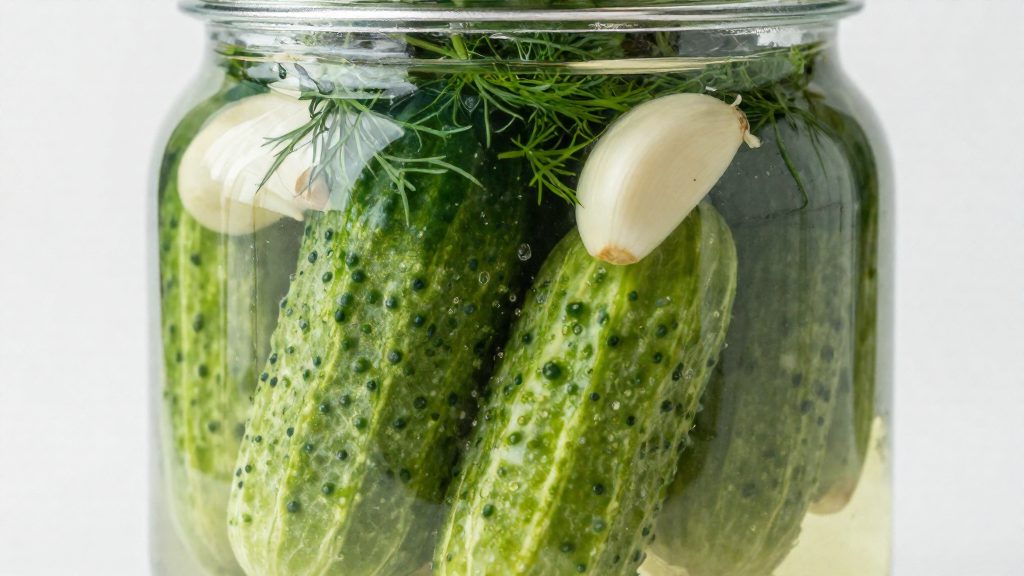
Weighted open containers and brine-filled bags are the methods described by the Ohio State source. Airlocks and water-seal lids are common alternatives, but they are not covered by the consulted sources. The right choice depends on batch size and how much you want the container to handle on its own. Each method below works by a different mechanism.
Crock with weights
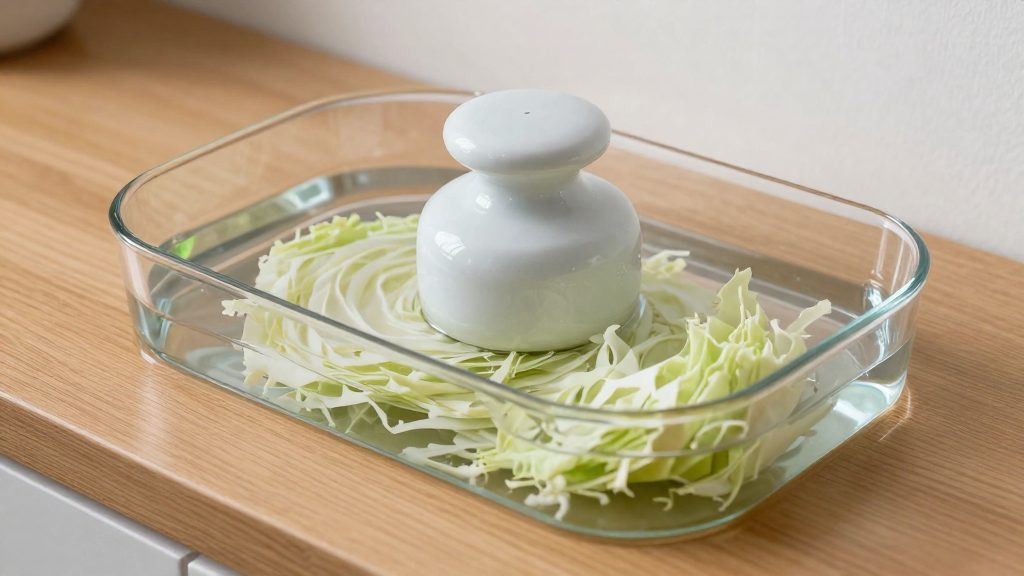
A crock suits larger batches. A weight, such as a plate or a jar filled with water, sits on the shredded cabbage and holds it under the liquid.
Wide-mouth jars with airlocks
A wide-mouth jar fitted with an airlock lid lets the gas produced during fermentation escape while blocking outside air from entering. The airlock lid lets gas escape while limiting the air that enters. The cabbage must still stay under the brine inside the jar, so pack it firmly and add a weight to keep the shreds down. Each jar is sealed separately, which makes it easy to run several small batches side by side.
Water-seal lids and brine-filled bags
A water-seal lid forms a channel of water around the rim. Gas escapes through the water while outside air is kept out. A brine-filled bag is an alternative weight: it sits on top of the cabbage, fills the space above it, and presses the shreds under the liquid.
| Method | Keeps cabbage under brine by | Limits air contact by |
|---|---|---|
| Crock with weights | Plate or jar pressing the shreds down | Weight covering the surface |
| Jar with airlock | Packing and a weight inside the jar | Sealed lid that lets gas out only |
| Water-seal lid | Weight or packing inside the vessel | Water barrier at the rim |
| Brine-filled bag | Bag pressing on the cabbage | Bag filling the space above the cabbage |
How to store fermented vegetables
Once a batch has finished fermenting, move it from the crock or jar into the refrigerator. According to University of New Hampshire Extension, refrigerated sauerkraut keeps several months. Cold storage slows further fermentation, though the batch may still change slowly.
Keep the vegetables submerged in brine for the entire storage period. Any piece that rises above the liquid is exposed to air.
Use a lid or cover that keeps the batch clean while it sits in the refrigerator. Store the container in a stable spot inside the refrigerator, and keep the vegetables in their original brine rather than transferring them to a new liquid.
When should you throw a batch out?
Discard decisions depend on what grows on the surface and how the batch smells and feels, not on a change in color alone. A thin, flat film is different from raised, fuzzy growth, and a slimy texture or foul smell is a separate warning. Read this general guidance alongside the tested ratios and brine depth.
Mold, fuzzy or colored growth as discard signals
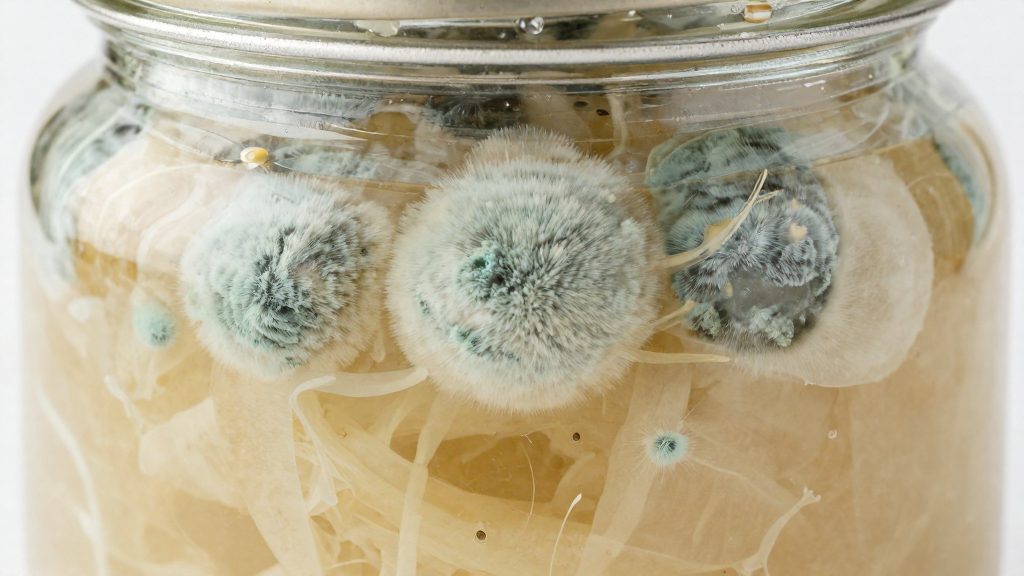
As general practice, mold is treated as the clearest reason to discard. Raised or fuzzy growth is the main visual sign. The consulted sources do not describe mold colors or how far its threads extend below the surface, so the cautious approach is to discard the whole batch rather than remove only the visible patch.
Slimy texture and rotten or putrid odors
A slimy texture that is ropy, slippery or mushy throughout the vegetables, not only on the surface, shows that the batch has broken down. As general practice, discard it.
A sour, sharp smell is expected during fermentation. A putrid odor is different: rotten, sewage-like or chemical smells that persist after rinsing the affected area indicate spoilage. Do not taste a batch to test it.
Surface yeast versus mold
A flat, thin, white or cream film with a yeasty smell is usually surface yeast, often called kahm yeast, and is not the same as mold. Remove the film and assess the batch underneath. The consulted sources do not cover kahm yeast, so this is general practice only. If the batch shows any other sign of spoilage, or you are unsure, discard it.
| Signal | Usually points to | Action |
|---|---|---|
| Thin, flat, white or cream film with a yeasty smell | Surface yeast | Remove the film, then check the batch underneath |
| Raised or fuzzy patches, any color | Mold | Discard the batch, as general practice |
| Ropy, slippery texture throughout | Breakdown | Discard the batch, as general practice |
| Rotten, sewage-like or chemical smell | Spoilage | Discard the batch, as general practice |
| Sharp sour smell, firm texture under any film | May be normal fermentation (not covered by the sources) | Inspect closely for mold; discard if in doubt |
Doubtful batches: reasons to discard versus keep
As general practice, discard when mold is present anywhere, the texture is slimy, or the smell is putrid.
A thin surface film over firm, submerged vegetables with a sour smell may be harmless surface yeast, but appearance alone cannot confirm safety. Inspect closely and discard the batch if you are unsure.
Cold storage slows change but does not reverse mold or slime, so time in the refrigerator does not rescue a batch that shows discard signs.
Frequently asked questions
How long does sauerkraut take to ferment at home?
At 70–75°F, sauerkraut is typically fully fermented in about 3 to 4 weeks. At 60–65°F, the same process takes about 5 to 6 weeks, according to Ohio State University Extension (CFAES) (2024-09-12). University of New Hampshire Extension gives identical ranges, so the room temperature you can hold steady determines which window applies.
Do kimchi and other vegetables follow the same timeline?
Sauerkraut ranges should not be transferred to kimchi or other vegetables. Record the start date and room temperature of each batch, so you can compare your own batch records across attempts.
What happens if my kitchen is colder than 60°F or warmer than 75°F?
Below 60°F, the official sources give no completion time, and University of New Hampshire Extension notes that kraut may not ferment there, so proper acidity may not develop. Above 75°F, Ohio State University Extension (CFAES) (2024-09-12) describes a quality problem rather than spoilage: the sauerkraut may turn soft and lack flavor. Moving the crock to a spot within 60–75°F is general practice, not a sourced instruction.