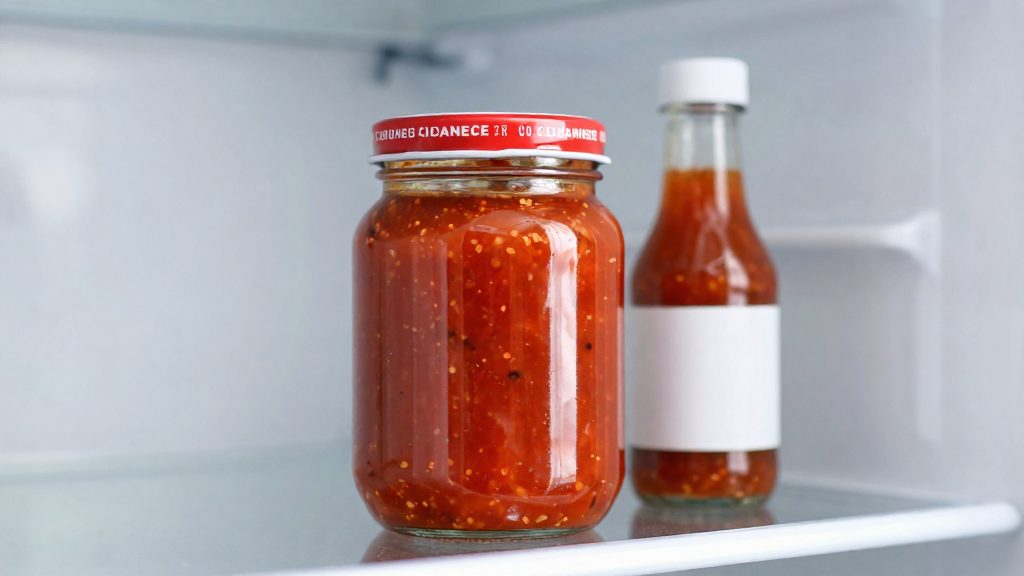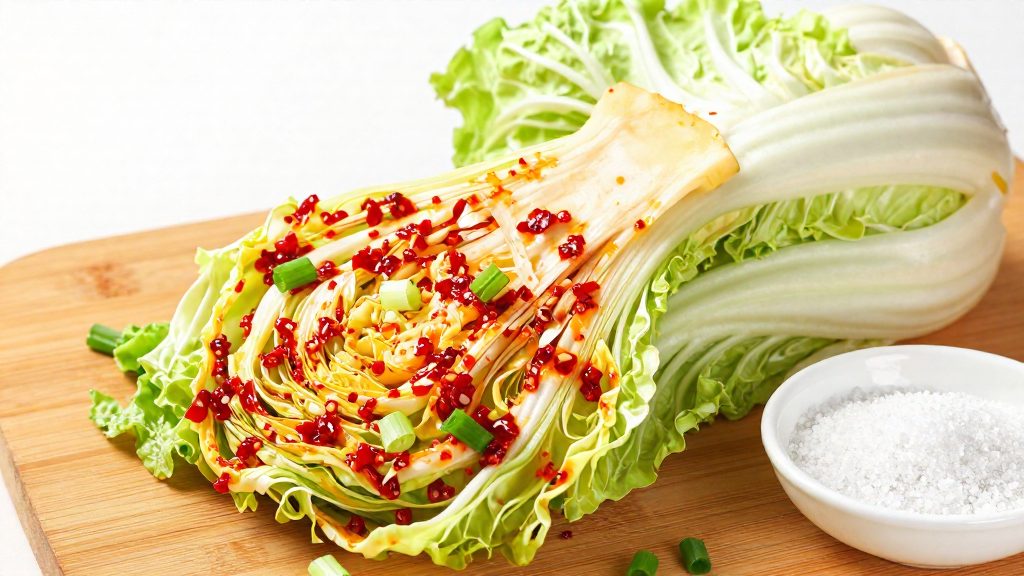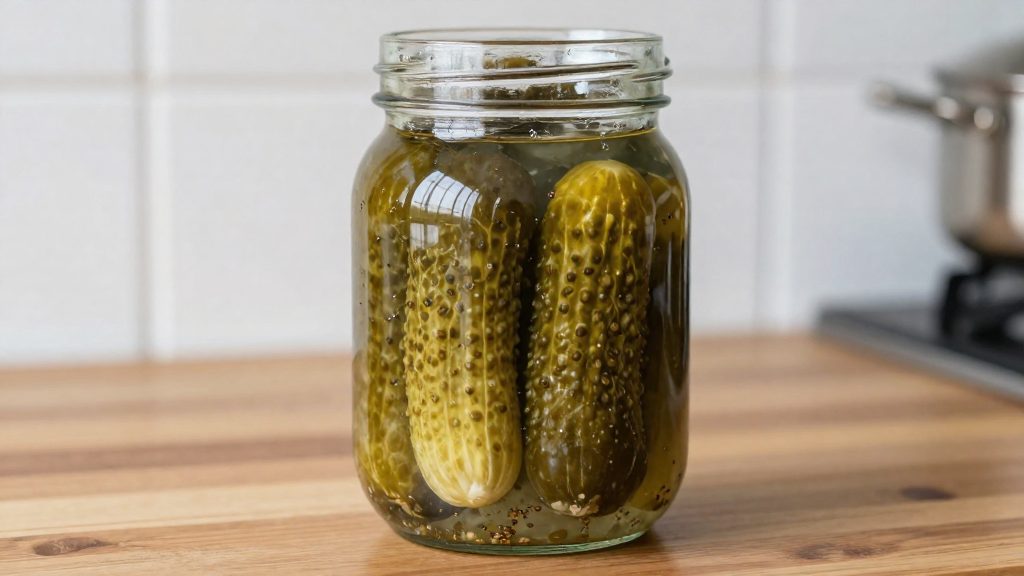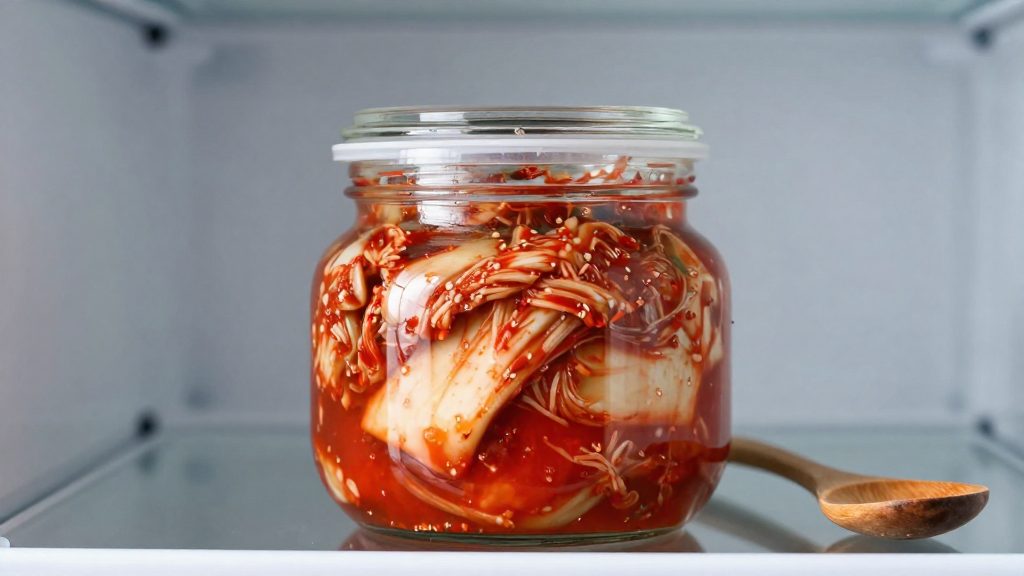
Opened kimchi keeps in the fridge for roughly two weeks to six months, according to Food Republic (2026) and Chowhound (2026). The upper end of that range assumes careful storage after opening. Poor storage can cut the window to about one month, so the same jar can last very different lengths depending on how it is kept.
How long does kimchi last in the fridge?
Lifespan by storage scenario
| Storage condition | Expected duration | Source |
|---|---|---|
| Opened store-bought, refrigerated, stored properly | Up to about six months | Chowhound (2026) |
| Opened, refrigerated (general range) | Roughly a couple of weeks to half a year | Food Republic (2026) |
| Opened, poorly stored | About one month | Chowhound (2026) |
| Opened, left at room temperature | About one week | Food Republic (2026) |
What the figures do and do not establish
The three-month check point comes from the author of the Chowhound article, who suggests inspecting the jar from about three months onward. That is the author’s own figure and is not attributed to an expert or study, so treat it as a practical reminder rather than a deadline.
The Takeout (2026) gives no fixed number of days or months. It describes kimchi as changing over time: it turns orangey, loses crispness and becomes more sour. Those changes are normal ageing and do not by themselves mean the kimchi has gone bad.
Why the window varies
The gap between one month and six months is mostly a matter of storage discipline after the jar is opened. Each time the lid comes off, the kimchi is exposed to air and to whatever is on the utensils, so a jar opened daily plausibly reaches the end of its useful life sooner than one opened only occasionally (a general inference, not a figure from the sources). The published ranges describe opened jars only; an unopened jar is not covered by these figures.
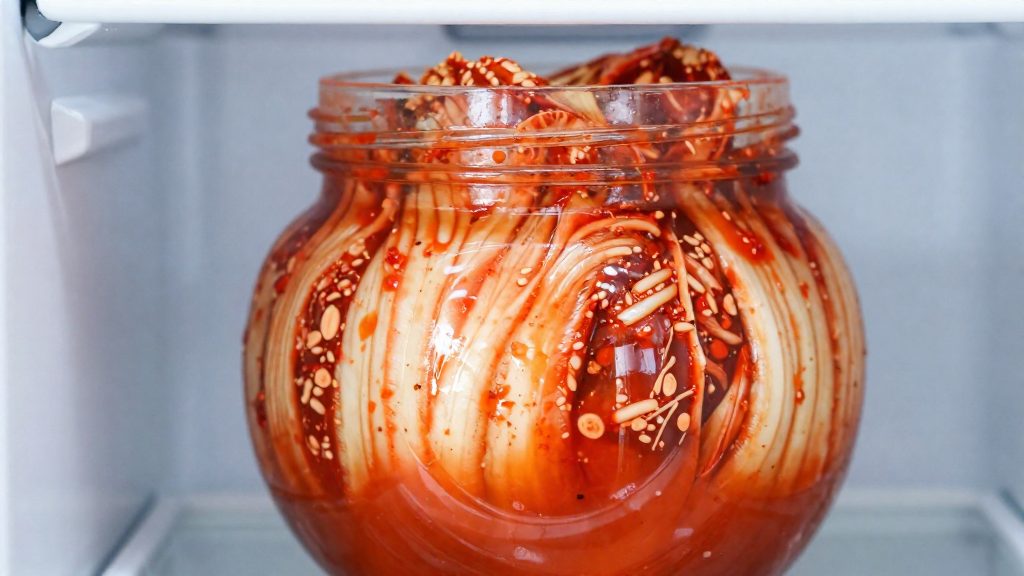
Store-bought vs homemade kimchi shelf life
Store-bought and homemade kimchi start from different reference points, so they are tracked differently. A commercial jar carries a printed date, while a homemade batch has no label and its start date is whatever you record. Check the printed date on a commercial jar before opening it, and note the opening date as well, because the printed date does not track time after the seal is broken.
| Factor | Store-bought jar | Homemade batch |
|---|---|---|
| Date reference | Printed date on the label, checked before opening | The day you sealed the jar, recorded by you |
| Salt and acidity | Set by the manufacturer’s process | Set by your recipe and fermentation time |
| Batch consistency | Not covered by the sources consulted | Varies from batch to batch, even with the same recipe (general observation, not from the sources) |
| Heat treatment | The sources consulted do not specify the process | The sources consulted do not specify the process |
The main difference is batch-to-batch variation. Homemade kimchi has no printed expiry date because no manufacturer produced it in a dated run, so no label can state its condition. The sources consulted do not give a shelf life for homemade kimchi, and the Chowhound figures concern opened store-bought jars. Keep a dated record, but decide whether a batch is still good by checking for the discard signs (mold, rancid smell, slimy texture, dull color).
Both types change as they age. For both types, the date is only a reference. Visible and sensory signs of spoilage (mold, rancid smell, slimy texture, dull color) always take priority, whatever the date.
What fridge temperature is best for kimchi?
For kimchi, the best fridge temperature is about 39°F, according to Chowhound (2026). Food Republic (2026) gives the fridge range for opened kimchi as 32–39°F, so 39°F sits at the top of that band. Setting the fridge so the interior stays near 39°F follows the figure Chowhound gives and falls within the 32–39°F band Food Republic cites. Kimchi is a fermented food that keeps changing while cold, and a setpoint inside this band slows that change without freezing the vegetables.
The table below summarises the guidance from the two sources.
| Condition | Guidance | Source |
|---|---|---|
| Best fridge setpoint | About 39°F | Chowhound (2026) |
| Acceptable fridge range for opened kimchi | 32–39°F | Food Republic (2026) |
| Opened kimchi at room temperature | Fresh for about one week | Food Republic (2026) |
Room temperature is the main reason the setpoint matters. Once opened, kimchi left on the counter stays fresh for only about a week, while the same jar in the fridge range stays fresh for roughly a couple of weeks to half a year, according to Food Republic (2026). The fridge therefore does more than keep the jar cool; it changes how long the kimchi stays in good condition.
Frequent door opening works against the setpoint. Each time the door opens, warm room air enters the cabinet, and the shelves can rise above the setpoint before the compressor brings them back down. Repeated openings create this effect over the day, so the air around a jar fluctuates more than the thermostat reading suggests. The official sources consulted do not give a figure for how far shelves rise during door openings.
How to store kimchi so it lasts longer
Storage habits after opening affect how long kimchi keeps. According to Chowhound (2026), the core method has three parts: keep the kimchi in an airtight container, keep the vegetables fully submerged in brine, and use clean utensils. Each part guards against a different way the jar deteriorates: air reaching the surface, cabbage floating above the liquid, or microbes carried in on a dirty spoon.
| Step | Action | Stated purpose |
|---|---|---|
| Container | Store in an airtight container | Limits air exposure |
| Brine | Keep the cabbage under the liquid | Keeps vegetables submerged |
| Utensils | Use clean utensils at every opening | Limits contamination |
| Portioning | Move small amounts to a second container | Limits air exposure of the main batch |
Portioning is the step that changes how often the main batch is exposed. Food Republic (2026) describes a master jar approach: the full batch stays sealed and undisturbed, while small portions are scooped into a second container for daily use. The Takeout (2026) makes the same point, recommending that cabbage be pushed under the brine and portions scooped into a separate container to help the kimchi keep longer.
The sources consulted do not quantify how much each step extends shelf life, so the benefit cannot be stated in days or weeks. What they do agree on is the direction: less air, less handling and vegetables kept under brine all slow the decline in quality.
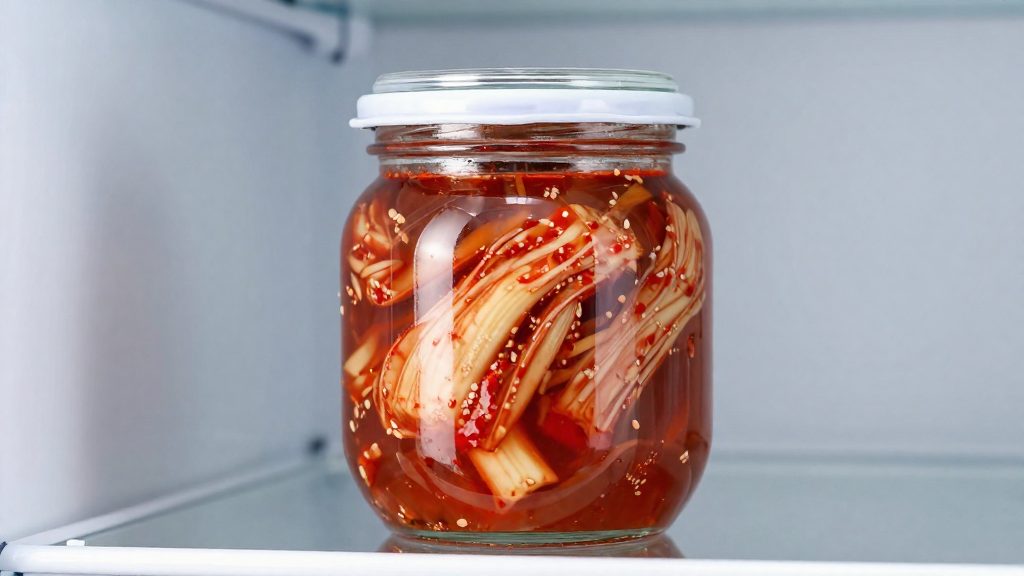
How can you tell if kimchi has gone bad?
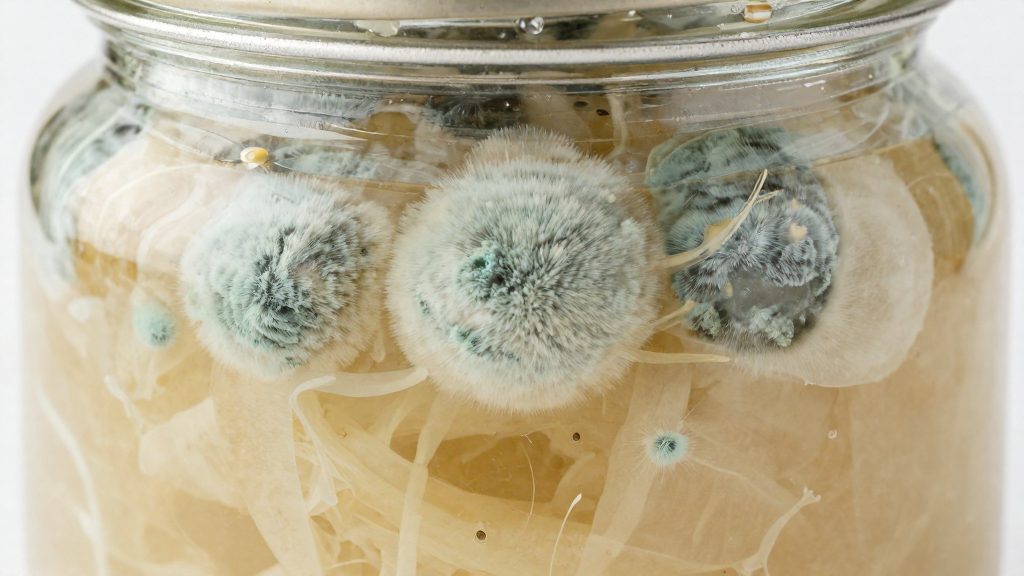
Kimchi changes as it ages, so not every change means it has spoiled. According to Food Republic (2026), fuzzy patches, a rancid smell, a slimy texture, or a dull color mean the kimchi should be discarded.
Signs that mean discard
Any of the following means the kimchi should be thrown out:
- Mold: fuzzy black, white, or green patches on the surface.
- Rancid smell: an off, unpleasant odor that differs from kimchi’s usual sour, garlicky aroma.
- Slimy texture: a slick or slippery feel on the vegetables.
- Dull color: listed by Food Republic as a discard sign. The sources do not clearly separate it from the normal orangey shift, so discard if in doubt.
Where the distinction gets difficult
Orangey color and dull color are not clearly separated in the guidance consulted. Food Republic (2026) and The Takeout (2026) do not explain how to tell a normal orange shift from a dull, spoiled appearance. Because of this gap, the safer rule is to discard kimchi whenever you cannot tell which change you are seeing.
Is sour or fizzy kimchi still safe to eat?
Rising sourness is an expected part of kimchi ageing, not a sign of spoilage on its own. According to The Takeout (2026), fizziness means the kimchi is still fermenting. Fizziness therefore indicates ongoing fermentation, while the signs that call for disposal are different in kind.
| Observation | Source | Practical reading |
|---|---|---|
| Fizz or bubbles | The Takeout (2026) | Fermentation is still active |
| Dull color | Food Republic (2026) | Discard indicator |
Telling orange from dull
Because the difference is not defined, a doubtful color should be treated as a reason to discard. Judge color together with sourness and aroma, not sourness alone.
Fizziness in a sealed jar
The sources consulted do not specify how much gas is normal, nor give a venting procedure. The Takeout (2026) links fizziness to continued fermentation, so a jar that has been closed for some time may hold pressure. As general handling practice, loosen the lid slowly over a sink, with the jar tilted and your face away from the opening, so the gas escapes gradually and brine does not spray out. This is a precaution, not a figure from the sources.
Sourness is not a date
Sourness indicates age and activity, not a safety limit. The Takeout (2026) gives no fixed number of days or months after which a jar must be discarded, so acidity cannot replace a check of appearance and smell. Use the sourness level to decide how a jar is best used, for example in cooking, and use the other signs to decide whether it is still safe.
Can you use up old kimchi?
Yes. Kimchi that has passed its best but shows no sign of spoilage can usually be cooked. According to Food Republic (2026), kimchi that is only very sour can still be cooked, and kimchi jjigae is the dish it names. Cooking suits aged kimchi well. Once the cabbage is simmered or fried, its softness matters less, and its sharp, acidic flavour adds depth instead of harshness.
Stews and jjigae
Jjigae is the most direct use for very sour kimchi. The sourness flavours the broth, and the softened leaves absorb it. A simple method:
- Cut the kimchi into bite-sized pieces, discarding any tough stem cores.
- Fry the pieces briefly in a little oil so their flavour spreads through the pot.
- Add stock or water, then simmer until the cabbage is soft and the broth has taken on the sour, savoury taste.
Fried rice and pancakes
Less sour or softer kimchi works well in fried rice and pancakes, where it is mixed into other ingredients rather than served as a crisp side. Both dishes hide loss of crunch, so they suit kimchi that is no longer crisp.
| Dish | Kimchi condition suited | Method |
|---|---|---|
| Kimchi jjigae | Very sour, still unspoiled | Simmer chopped kimchi in broth until soft |
| Kimchi fried rice | Softened or aged, less crisp | Stir-fry chopped kimchi with oil and cooked rice |
| Kimchi pancakes | Aged, less crisp | Fold chopped kimchi into a flour batter and fry |
What cooking cannot fix
Cooking does not make mouldy or rancid kimchi safe to eat. Heat changes texture and flavour, but it does not reverse spoilage. If fuzzy patches or a rancid smell are present, discard the kimchi rather than cooking it, as Food Republic (2026) advises.