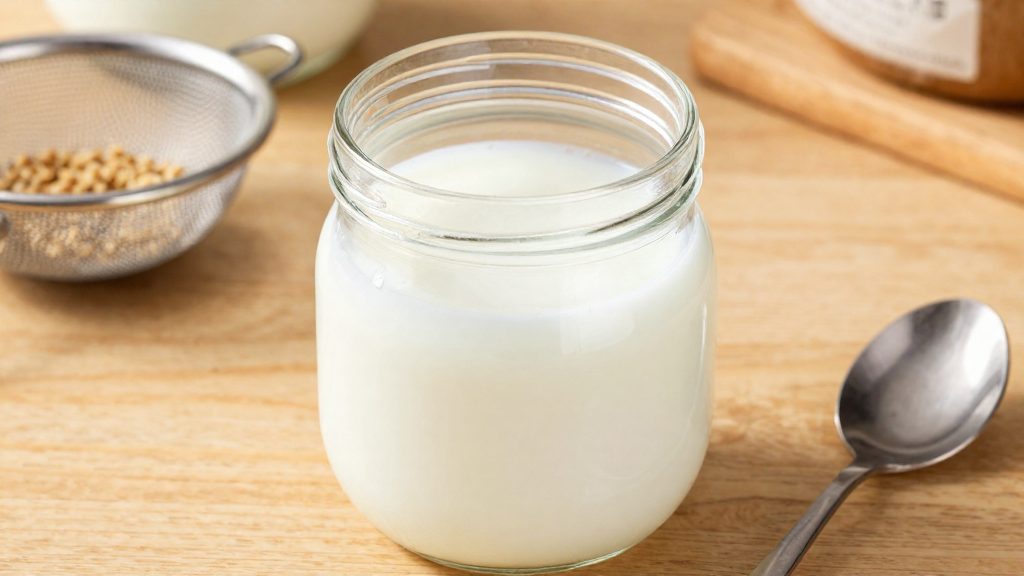
Milk kefir grains should be separated from the finished kefir and given fresh milk every 24 hours, or more often if needed, according to Cultures for Health (undated). The 24-hour mark is the longest interval that source recommends, so shorter cycles are acceptable when conditions call for them. Feeding on a fixed daily rhythm keeps the grains active, and the timing applies to the cycle as a whole, not to a specific clock time.
How often should you feed milk kefir grains?
The 24-hour default
The 24-hour interval is the baseline. Each cycle has two parts: removing the grains from the finished kefir, then placing them in fresh milk. Both steps need to happen within that window. Cultures for Health (undated) describes this as essential for keeping the grains healthy, and its wording, “or more often if needed,” makes clear that 24 hours is the maximum, not a target to stretch toward.
Conditions that justify more frequent feeding
A larger grain mass means more milk per day, which is the closest the sources come to a trigger for shorter cycles. The sources do not give a grain-to-milk threshold at which feeding must become more frequent; treat the 24-hour limit as the reference and watch the kefir’s condition as your cue.
Separating grains before refeeding
Grains must be removed from the finished kefir before they go into fresh milk. The sources recommend separating the grains and refeeding with fresh milk. They do not describe what happens if grains stay in spent kefir. The separation step is the point where the separate the grains rule is applied, so the interval runs from one separation to the next.

Daily feeding routine step by step
The daily routine for milk kefir grains has three parts: separate the grains from the finished kefir, place them in fresh milk, and let them culture overnight. One home-user routine described by New England Cheesemaking Supply Co. follows this order every morning, so the same steps can be repeated each day.
Step 1: Strain the finished kefir
Pour the fermented milk through a non-metal strainer, such as one with a plastic or nylon mesh. Set a clean bowl or jar underneath to catch the liquid. Stir gently with a non-metal spoon so the liquid passes through while the grains stay in the strainer.
Step 2: Transfer the grains into fresh milk
Move the strained grains into a clean glass jar and cover them with fresh milk. Work quickly so the grains are not left exposed to air longer than needed. Keep the grains in the jar as the only culture; the strained kefir is set aside as the finished drink.
Step 3: Seal the jar and culture overnight
Close the jar with its lid and place it where the temperature stays within the recommended range. Keep the jar at 68°F to 85°F. Warmer temperatures shorten the time needed, so check the jar earlier in a warm room.
Step 4: Reuse the strained kefir
The strained liquid is the finished kefir, ready to drink or store. It is separate from the grains, which are the only part carried into the next cycle.
How much milk do kefir grains need?
The core rule is the grain-to-milk ratio. Cultures for Health recommends 1 to 2 teaspoons of milk kefir grains to culture 1 quart of milk. Adjust within the range based on how each batch turns out.
A home-user example from New England Cheesemaking Supply Co. uses about 2 tablespoons of grains for 1/2 gallon of milk. With 3 teaspoons in a tablespoon and 4 quarts in a gallon, 2 tablespoons (6 teaspoons) in 1/2 gallon (2 quarts) works out to about 3 teaspoons per quart. That is above the Cultures for Health range of 1 to 2 teaspoons per quart. This source describes its advice as anecdotal, coming from a cheesemaking supplier’s blog, so treat it as one practitioner’s routine rather than a standard.
| Source | Grains | Milk | Notes |
|---|---|---|---|
| Cultures for Health | 1 to 2 teaspoons | 1 quart | Baseline ratio |
| New England Cheesemaking Supply Co. (home-user example) | About 2 tablespoons | 1/2 gallon | Anecdotal; equals about 3 teaspoons per quart, above the Cultures for Health range |
Scaling milk as the grain colony grows
Milk kefir grains multiply over time, so the milk volume has to rise with them. Cultures for Health advises increasing the milk incrementally as the grains multiply, and notes that the more grains you have, the more milk you need each day. Let that ratio guide how large each increase should be.
To scale up, measure the grains and keep the ratio of 1 to 2 teaspoons per quart. When the grain volume grows past that ratio, increase the milk in small steps. Then recalculate the ratio at each new volume and continue feeding on the schedule Cultures for Health describes: every 24 hours, or more often if needed.
What temperature is best for feeding kefir grains?
Milk kefir grains work best when the culturing environment stays between 68°F and 85°F, according to Cultures for Health. Within this band, the grains ferment milk at a steady pace and produce a consistent kefir. Set the jar in a spot with stable air temperature, away from drafts and direct sunlight, which Cultures for Health specifically advises avoiding. Open windows, air vents, and exterior doors create the drafts to watch for. A shelf or counter that stays at room temperature through the day is usually a reliable choice.
Room temperature also controls how long each batch takes. Warmer rooms generally speed up fermentation. The two examples below come from different setups, so they are not directly comparable. Cooler rooms slow the process, so the same batch needs longer. Two home-user examples from New England Cheesemaking Supply Co. show this relationship:
| Room temperature | Reported fermentation time | Source context |
|---|---|---|
| 75°F | About 12 hours | Home-user example using about 2 tablespoons of grains per 1/2 gallon of milk |
| 80–85°F | 10 to 24+ hours | Contributor cited by New England Cheesemaking Supply Co. |
Use these times as starting points. Check the milk’s thickness and smell in your own kitchen, since a batch in a warm room can be ready well before one in a cool room.
Can you feed kefir grains less often?
The consulted sources do not document a method for stretching the feeding interval for milk kefir grains at room temperature. The sources also do not say whether a longer wait is harmful, neutral, or acceptable.
What the sources leave undocumented
- Whether grains tolerate remaining in spent milk beyond the 24-hour reference point at room temperature.
- Whether adjusting the grain-to-milk ratio or the temperature can lengthen the interval. The sources give a ratio of 1 to 2 teaspoons of grains per quart of milk and a culturing range of 68°F to 85°F, but they do not connect either figure to how long the grains can wait.
Risks of leaving grains in spent milk longer
The consulted sources do not describe the effects of prolonged contact with spent milk.
Practical approach
If a feeding is missed, the documented guidance points toward feeding sooner rather than later. Separate the grains from the finished kefir and add fresh milk (Cultures for Health, undated).
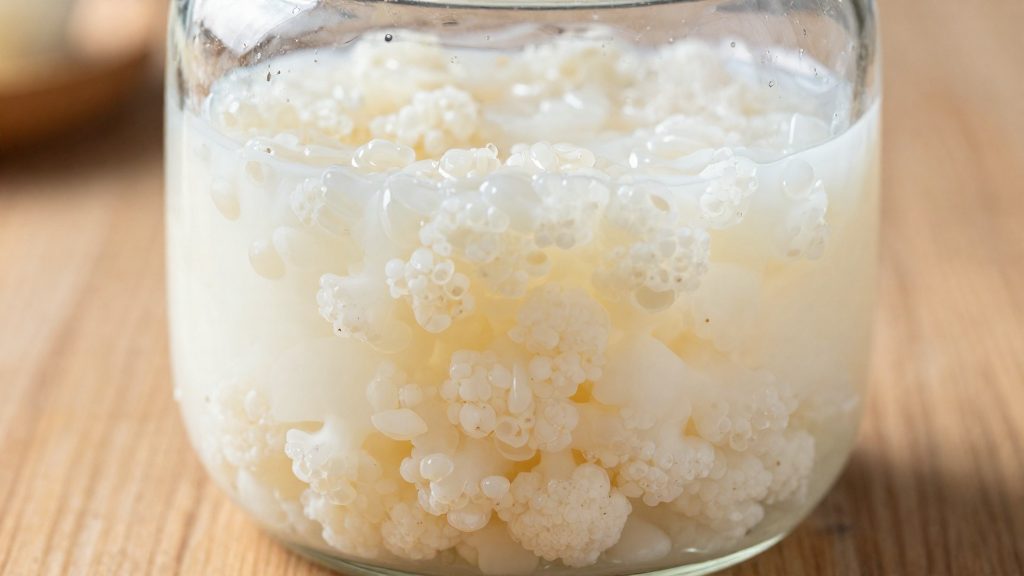
Taking a break: fridge storage tips
Milk kefir grains can be stored in the refrigerator during a short break by keeping them in a jar of milk. The main reference for this is a home-user routine published by New England Cheesemaking Supply Co., which says grains can sit in a jar of milk in the fridge for up to a week or so before going back into fresh milk at room temperature. The one-week figure is an anecdotal approximation for a short pause, not a tested limit.
Storing the grains in a jar of milk
- Separate the grains from the finished kefir first.
- Cover the grains with fresh milk in a clean jar.
- Close the jar and place it in the refrigerator.
The jar-of-milk method is intended for a short break only.
How long the grains can stay cold
| Stage | Guidance | Source |
|---|---|---|
| Cold pause | Grains in a jar of milk in the fridge for up to about a week | New England Cheesemaking Supply Co. |
| Return to feeding | Move grains into fresh milk at room temperature | New England Cheesemaking Supply Co. |
Resuming daily feeding after cold storage
When the break ends, take the grains out of the fridge and place them in fresh milk at room temperature, as the New England Cheesemaking Supply Co. routine describes. The same source says the grains are strained each morning and placed into a fresh jar of milk to ferment overnight, which gives a practical sense of the routine to restart. After that, return to a regular schedule.
Signs your grains are underfed or overfed
The clearest documented warning sign of overfed milk kefir grains is flavor. Cultures for Health (undated) states that using too many grains can give the kefir a stronger yeast flavor or other unwanted changes. Cultures for Health links the stronger yeast flavor to using too many grains. It does not explain the mechanism.
Watch for these changes in the finished kefir:
- A yeast-forward taste that is stronger than in your earlier batches.
- Other unwanted changes, which the consulted sources name but do not describe in detail.
Grain growth is the usual route to this imbalance. A batch that tasted balanced at one grain mass can turn yeasty after the grains expand without a matching increase in milk. Because the sources give no numeric taste benchmark, the most practical comparison is your own previous batches, judged on the same jar, milk, and handling.
What the sources do not document
A sour or flat batch should not be read as a sign of underfeeding on its own. The table below compares the signs of too many grains with signs of underfeeding.
| Observation | Status in the consulted sources |
|---|---|
| Stronger yeast flavor | Named as a sign of too many grains |
| Other unwanted changes in finished kefir | Named as a sign of too many grains, not specified |
| Symptoms of underfed grains | Not documented |
What if you miss a feeding?
The sources do not say what a skipped 24-hour feeding does to the grains. The steps below are general practice, not documented guidance. Inspect the batch before reusing the grains.
Checking grains and kefir after a skipped day
Inspect the batch in three steps before reusing the grains:
- Grain condition: Look for firm, intact grains. Visible mould means the batch should be discarded, not rescued.
- Smell and taste: A sour, mildly tangy kefir is expected. A sharp or yeasty smell points to over-fermented kefir.
- Texture: Note whether the kefir has separated into thin liquid and curds. This can happen with extended fermentation, but the sources do not document it. Judge it together with smell, mould and grain condition.
Using over-fermented kefir after a delay
A delayed batch is often more sour and thicker than usual. Choose the use based on what the batch shows:
| Batch condition | Action |
|---|---|
| Grains intact, kefir sour, no off smell | Strain and drink, or use as usual |
| Grains intact, kefir sharp or yeasty | The sources do not document a use for this kefir. Smell and taste alone cannot confirm it is safe, so discard it if in doubt. Yeasty flavour is also the documented sign of too many grains. |
| Visible mould or rotten smell | Discard the batch and start with fresh grains |
Restarting after one missed feeding
- Strain the grains from the finished kefir.
- Add them to fresh milk.
- Cover the jar and let it ferment at room temperature.
- Treat the first batch as a test batch. If it tastes right and the grains look normal, return to the regular schedule. If it tastes off, check the grain condition again before continuing.
Frequently asked questions
What if I miss the 24-hour feeding window?
A missed 24-hour window should not become a routine. For a planned break, New England Cheesemaking Supply Co. (undated) describes, as anecdotal advice, storing grains in fresh milk in the refrigerator for up to about a week, then returning them to fresh milk at room temperature.
How many grains should I use for one quart of milk?
Cultures for Health (undated) recommends 1 to 2 teaspoons of grains per quart of milk. A home-user example of 2 tablespoons for a half gallon works out to about 3 teaspoons per quart, which is above that range, so scale up the milk in small steps as your grain colony grows.
How does room temperature change the feeding timing?
Cultures for Health (undated) gives a culturing range of 68°F to 85°F, kept away from drafts and direct sunlight. Fermentation time shifts with warmth: a New England Cheesemaking Supply Co. example ran about 12 hours at 75°F, while another contributor reported 10 to 24+ hours at 80–85°F, so check the kefir’s thickness and taste rather than relying on a fixed clock.