Why vegetables must stay under the brine
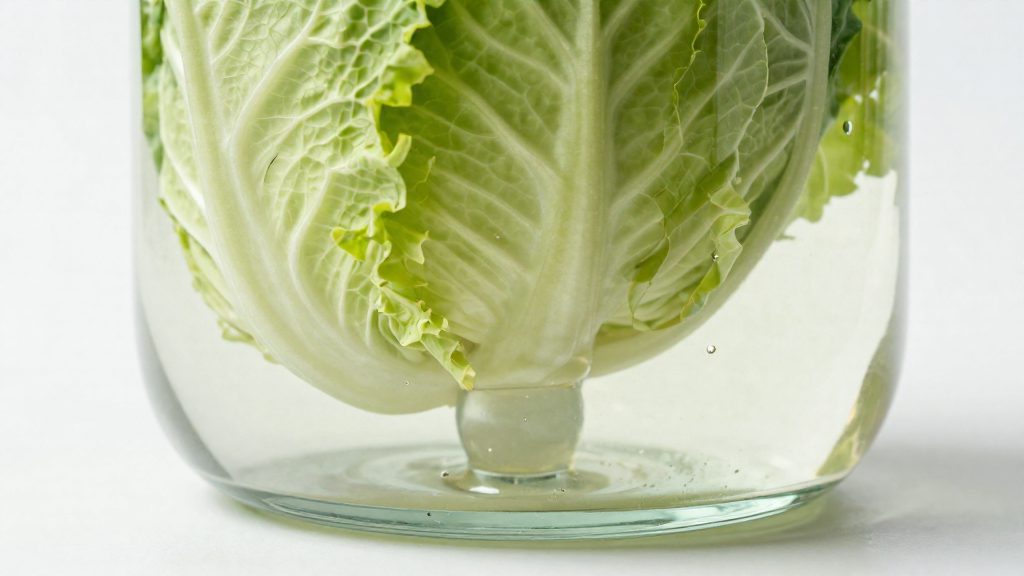
Vegetables must stay under the brine because exposed surfaces are where oxygen, aerobic spoilage organisms, and softening take hold, while the submerged mass is where a healthy ferment develops. A piece that rises above the liquid loses that protection, and the change can show within days. The sections below cover the mechanisms behind this, from oxygen and mold to bacterial competition and the texture and smell changes that follow.
Oxygen exposure and aerobic mold growth
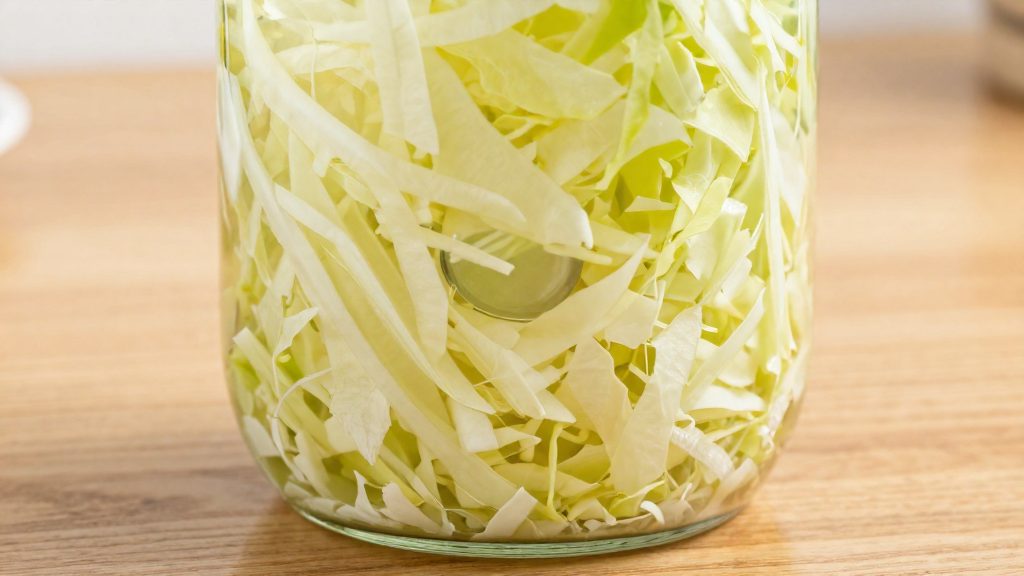
Air is the main route for spoilage in a fermentation crock. Pieces that sit above the liquid are in contact with oxygen exposure, which lets aerobic organisms, including mold, grow on the surface. Most molds need oxygen to develop, so keeping vegetables submerged limits the surface available to them. The brine displaces air around each piece and keeps the surface below the level where those organisms can settle.
Any piece that lifts out of the liquid is left in the air layer, where mold can start even though the rest of the batch is fermenting normally.
Lactic acid bacteria and competition with spoilage
The organisms that drive sauerkraut, kimchi, and most lacto-fermented vegetables are lactic acid bacteria. They tolerate low oxygen and produce lactic acid, which lowers pH and makes conditions harder for many spoilage microbes. Once the vegetables are fully submerged, these bacteria can dominate early and keep the ferment in a low-oxygen state.
Exposed pieces fall outside that protected zone. They can be colonized by aerobic organisms before enough acid has built up to suppress them. The result is often a batch that tastes sour and clean in the brine but has spoiled material at the top. Keeping every piece below the liquid keeps the whole batch on the fermentation side of this competition.
Softening, off-odors, and discoloration
Temperature controls how fast the ferment moves and how firm the vegetables stay. The National Center for Home Food Preservation (USDA-funded, University of Georgia) gives the following guidance for sauerkraut:
| Condition | Documented effect |
|---|---|
| Below 60°F | May not ferment |
| 70–75°F | Ferments in about 3–4 weeks |
| Above 75°F | May turn soft |
Exposed pieces are the most likely to show these effects first, because they are already outside the protected brine. Softening, changes in smell, and discoloration at the cut edges are the visible signs. Treat any unexpected change at the surface as a sign that the piece was not protected by the brine.
How do you keep vegetables submerged in a jar?
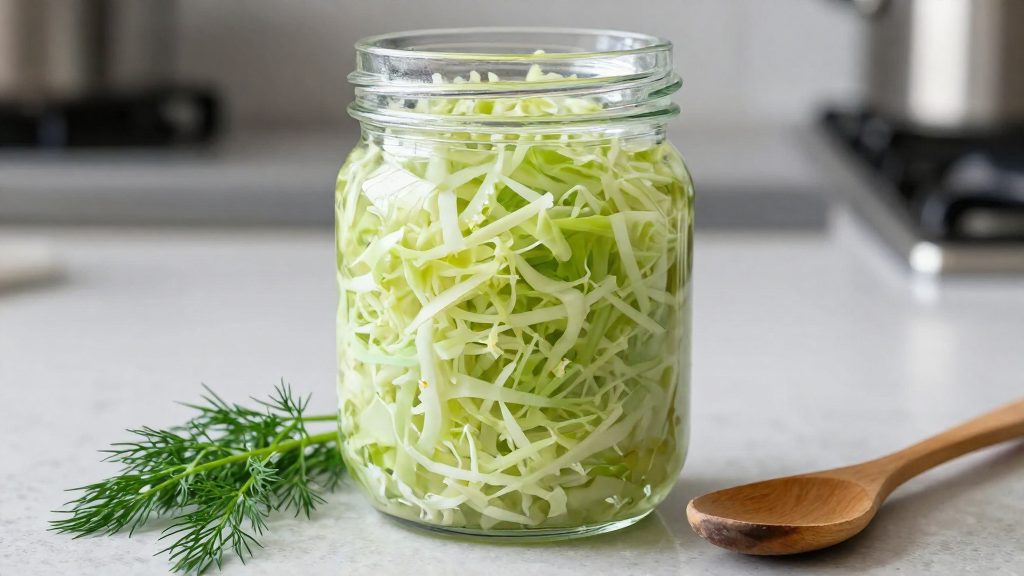
Keeping vegetables under their own liquid starts with how you pack them. Add the shredded or sliced vegetables in small handfuls and press each layer down firmly with a clean fist or a wooden tamper until juice rises over the surface. The aim is to drive out trapped air between pieces and bring the juice up over the surface. Air pockets in the mass let the top layer dry out and rise above the liquid. Build the jar in thin layers rather than dropping everything in at once, so the pressure stays even from bottom to top.
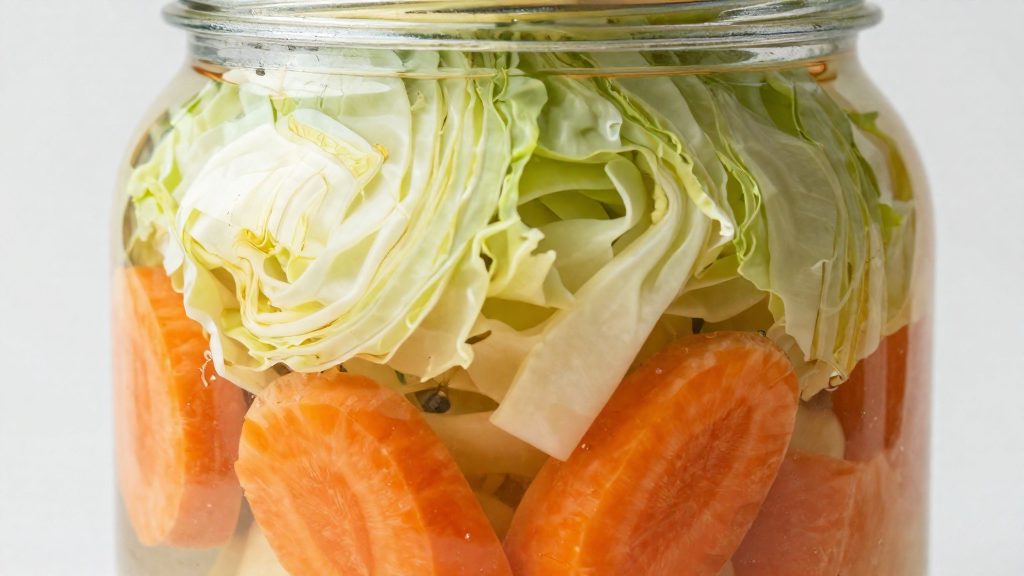
Cabbage can also serve as a cover. After the shredded cabbage is packed, set aside a few of the tough outer leaves, which are usually the largest and least damaged. Lay one leaf flat over the surface and tuck its edges down against the inner wall of the jar, so it covers gaps where pieces would otherwise sit exposed. Keep the outer leaf whole rather than tearing it into patches. A single full sheet covers more area and is easier to remove when you check the jar.
Leave headspace at the top of the jar. MakeSauerkraut (2024-10-14) recommends 1 to 2 inches, which gives the liquid room to rise as the vegetables release juice during fermentation. A jar packed to the rim leaves no space for that rise, so the surface can sit above the liquid almost from the start. Measure headspace from the top of the packed vegetables, not from the jar rim, and recheck it after packing is complete.
What can you use as a fermentation weight?
Weights keep shredded vegetables below the brine, but they do not perform equally over a full ferment. The options compared here are glass weights, spring-loaded weights such as the Pickle Helix, brine-filled bags, and an undisturbed crock. The useful test is whether a weight still holds the vegetables under the liquid at the end of the ferment, not just during the first few days.
Glass weights over 28 days
Glass weights are the most common choice, but they are often too light for the whole process. According to MakeSauerkraut (2024-10-14), in a 28-day test glass weights generally held the ferment under the brine in week 1 but not for the full 28 days.
Spring-loaded weights
Spring-loaded weights apply continuous pressure, which helps them keep brine coverage more consistent. In the same MakeSauerkraut test, the Pickle Helix spring still had 12 mm of brine coverage on day 28. The Kraut Source had 1 mm on day 28, and the Easy Weight had none by day 16.
Brine-filled bags and undisturbed fermentation
The National Center for Home Food Preservation recommends a brine-filled bag as the weight for sauerkraut. Its guidance is to leave the crock undisturbed until fermentation finishes. The consulted sources do not give a coverage measurement for brine bags, so their performance over 28 days cannot be compared with the other options on the same basis.
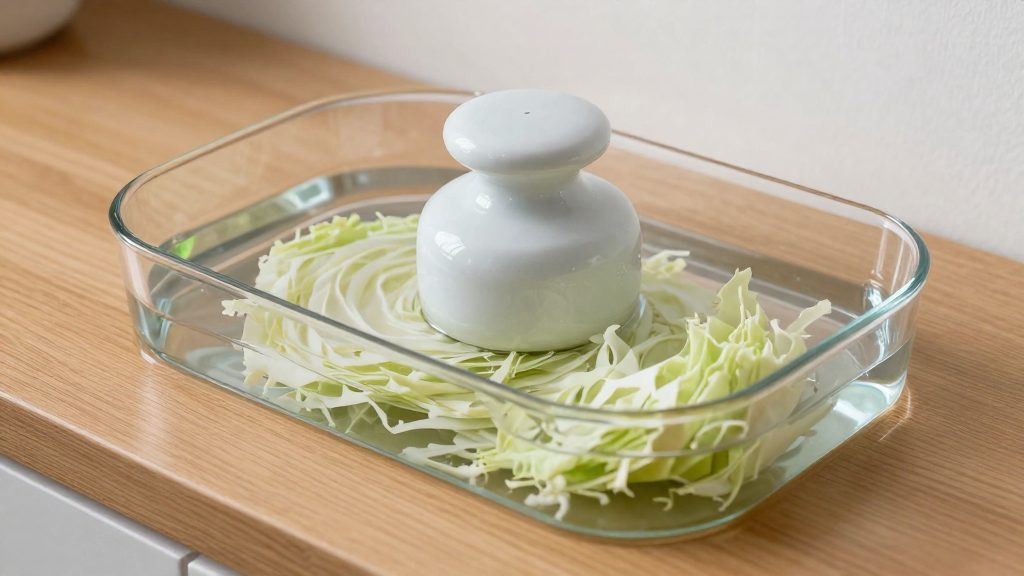
The same guidance calls for placing a plate and weights on top of the cabbage and covering the container with a towel.
Comparison of weight types
| Weight | Reported result | Source |
|---|---|---|
| Glass weight (generic) | Held brine in week 1, not for the full 28 days | MakeSauerkraut (2024-10-14) |
| Pickle Helix spring | 12 mm of brine coverage on day 28 | MakeSauerkraut (2024-10-14) |
| Kraut Source | 1 mm of brine coverage on day 28 | MakeSauerkraut (2024-10-14) |
| Easy Weight | 0 mm of brine coverage by day 16 | MakeSauerkraut (2024-10-14) |
| Brine-filled bag | No coverage measurement in consulted sources | National Center for Home Food Preservation |
What if the brine drops or vegetables float?
When the brine level falls or pieces rise above the liquid, the exposed vegetables are at risk, so correct the problem at the next check. For sauerkraut, the National Center for Home Food Preservation (USDA-funded, University of Georgia) gives a direct fix when the juice no longer covers the cabbage. Inspect the level each time you check the crock.
| Problem | Likely cause | Corrective action |
|---|---|---|
| Liquid below the cabbage | Brine has dropped or absorbed into the vegetables | Top up with cooled brine |
| Pieces floating up | Gas from active fermentation pushes them up | Press pieces back under the liquid |
| Scum on the surface | Film forms during fermentation | Skim it off with a clean spoon at each check only if you are certain it is kahm yeast; if it is fuzzy, coloured or you cannot identify it with certainty, treat it as mold and discard the batch |
Topping up with cooled brine
Prepare the brine in advance so it is ready when the level drops. Boil water with salt at 1½ tablespoons per quart, then let it cool completely before adding it. Pour it in slowly and stop once the vegetables are covered. Use boiled and cooled brine made with 1½ tablespoons of salt per quart of water, as the National Center for Home Food Preservation directs.
Gas-driven displacement in week one
Gas production is heaviest in the first week, according to MakeSauerkraut. Gas bubbles can push small pieces up out of the brine during this period. Reposition any floating pieces under the liquid.
Skimming scum at inspections
The National Center for Home Food Preservation advises checking the crock two to three times a week when weighting with jars and removing any scum that forms. Lift the cover, skim the surface, and confirm that all vegetables remain under the brine before you close the container again. Scum removal should be a routine step at every check, not a one-time fix.
Crock or jar: how do the setups differ for keeping vegetables submerged?
The three setups differ mainly in brine retention, gas release and daily handling.
Crock with a plate and weight
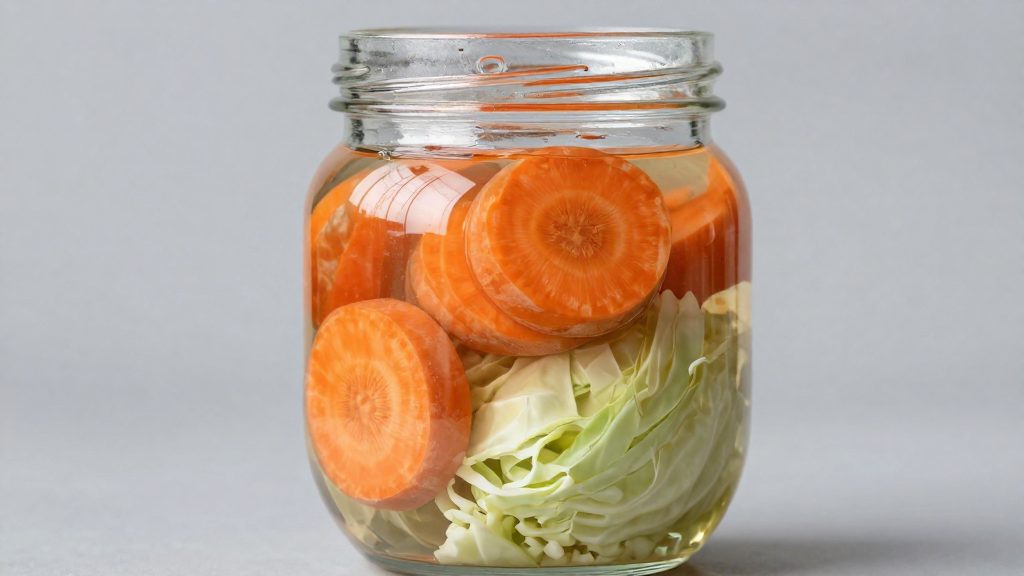
A crock suits the plate-and-weight method. According to the National Center for Home Food Preservation (USDA-funded, University of Georgia), you place a plate and weights on top of the cabbage, cover the container with a towel, and, if you use a brine-filled bag as the weight, leave the crock undisturbed until fermentation finishes. With a brine-filled bag as the weight, the National Center for Home Food Preservation advises leaving the crock undisturbed until fermentation finishes, which limits the chance of disturbing the brine. The sources do not describe a built-in water seal on crock lids, so that feature is not assessed here.
Jar with a weight
Jars are weighted individually, so each one needs its own attention. This makes jars the more hands-on option for daily handling.
Airlock lid
Access, cleaning and volume
The sources do not specify cleaning routines or volume trade-offs for any of the three setups. The clearest difference they describe is access frequency: a crock with a brine bag stays closed, while jars need regular checks and scum removal.
Is white film on top mold or kahm yeast?
Kahm yeast and mold can both appear as a pale layer on the surface of a ferment, but they look and behave differently. Check the film by sight, touch and smell before deciding what to do with the batch. Kahm yeast forms a thin, flat layer and is generally considered harmless, but appearance alone can be misleading. If you are not certain the film is kahm yeast, treat it as mold and discard the batch. Mold usually forms raised, fuzzy or coloured growth, though it can also look white, and a batch with mold, or with any film you cannot identify with certainty, should be discarded.
Before you judge the film, lift a small section with a clean, dry spoon and look at its edges and underside. Use the same check each time so you can compare what you see over several days.
| Feature | Kahm yeast | Mold |
|---|---|---|
| Surface | Flat, thin and smooth, spreading across the brine | Raised, fuzzy or powdery in patches |
| Colour | White or cream, sometimes slightly wrinkled | Distinct coloured spots, such as green, blue, black or pink |
| Pattern | Continuous sheet across the surface | Separate spots that grow outward from a point |
| Smell | Yeasty or mildly sour, close to the brine | Musty, stale or rotten, and often noticeable when you lift the lid |
Kahm yeast is a flat layer that is generally skimmed off, but only if you are certain it is not mold. If there is any doubt, or the ferment smells off, discard the batch. Mold is raised and coloured, and it often has a stronger smell. If you see any coloured spot, treat it as mold even if most of the surface looks white.
Discard rules when mold is confirmed
Once you have confirmed mold, do not try to cut or scrape away the affected area and keep the rest. Soft or discoloured vegetables near the spot may have been colonised as well. Discard the whole batch, including any vegetables that sat beneath the mold, and clean the vessel before starting again. Keep the weights, lids and containers you used out of the next batch until they have been washed in hot, soapy water.
How much brine should cover the vegetables?
The vegetables and the weight must stay under the liquid for the whole ferment. According to the National Center for Home Food Preservation (USDA-funded, University of Georgia), cabbage that is not covered by its juice is a problem to correct, not a state to accept.
To estimate how much brine a container needs, use the brine volume formula: internal cross-section area × liquid height, with both measurements in the same unit. For a round crock, the cross-section area is π × radius². Measure the inside diameter at the level where the brine will sit, not at the rim, because crocks often narrow toward the top. The vegetables displace part of the volume, so the actual liquid needed is lower than the empty-container estimate. Measure the final level directly rather than relying only on the calculation.
Measuring coverage over time matters as much as the first reading.
Common coverage mistakes:
- Checking once at setup. In the MakeSauerkraut 28-day test, coverage changed over time, so a single reading at setup does not confirm the level later.
- Ignoring floating pieces. Small pieces that rise out of the brine are exposed to air.
Frequently asked questions
Which weight keeps vegetables under the brine best?
Glass weights may be too light to hold the ferment under the brine for the whole process. In a 28-day test published by MakeSauerkraut (2024-10-14), they held in the first week but not until the end, so check the brine coverage during fermentation rather than relying on the reading at setup. The same test recommends leaving 1–2 inches of headspace so the brine has room to rise.
What should I do if the brine drops below the cabbage?
Top up with boiled and cooled brine, not plain water. The National Center for Home Food Preservation specifies 1½ tablespoons of salt per quart of water, and you add it only when the juice no longer covers the cabbage.
Is a white film on my ferment safe to eat?
It is only safe to skim if you can identify it with certainty as kahm yeast, which is generally considered harmless. Fuzzy, coloured or unidentifiable film, including white growth, may be mold, and in that case the whole batch should be discarded.