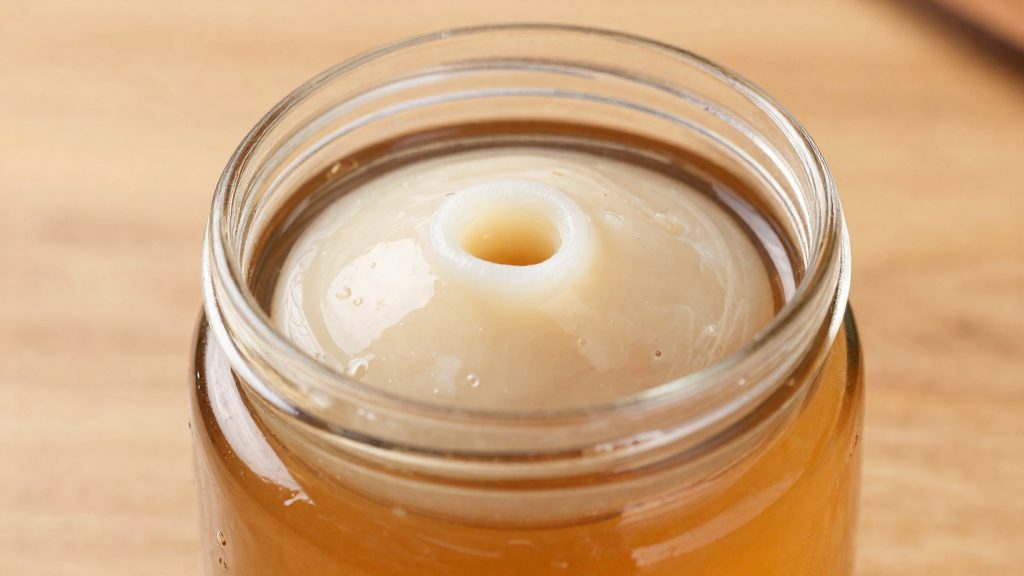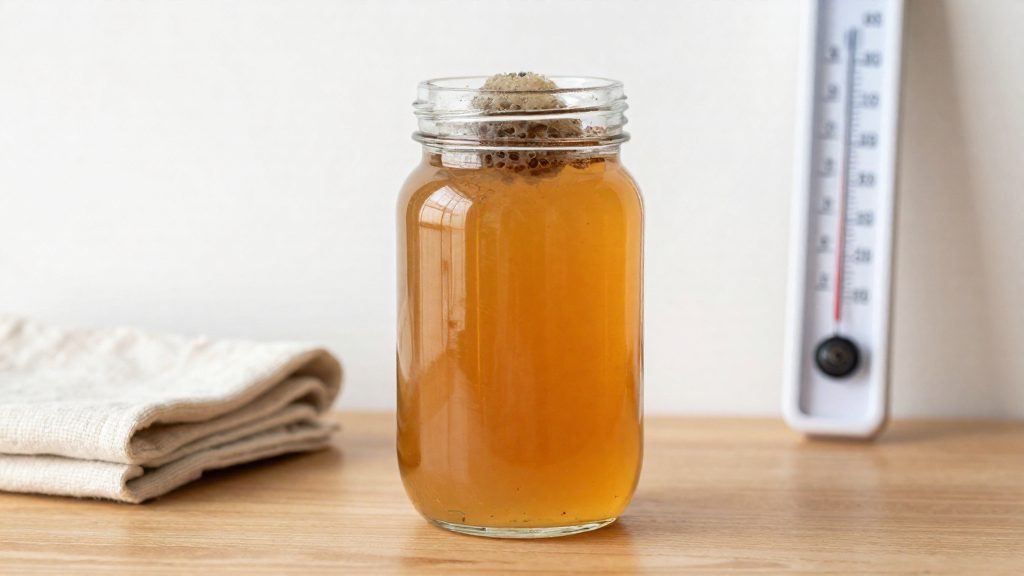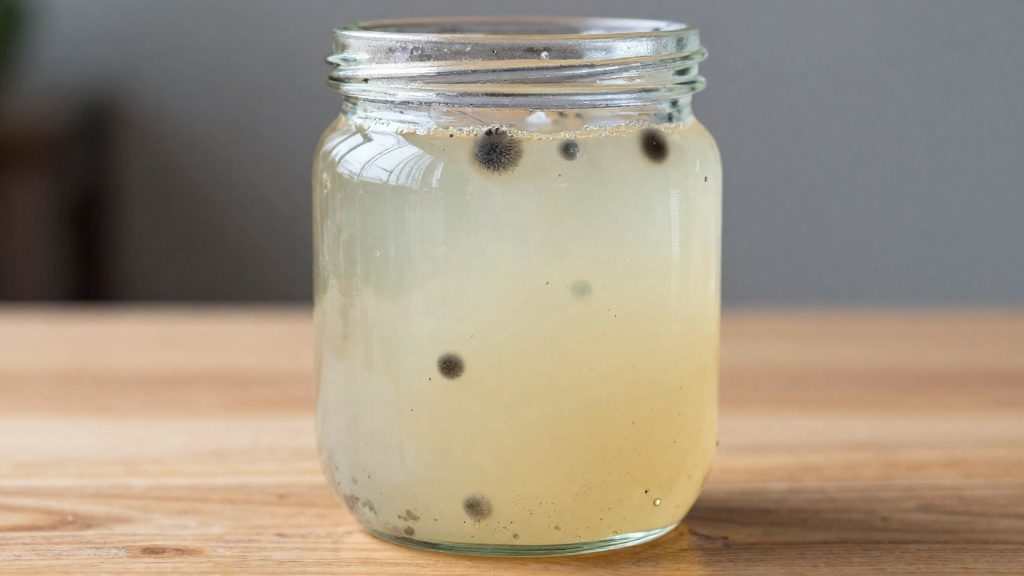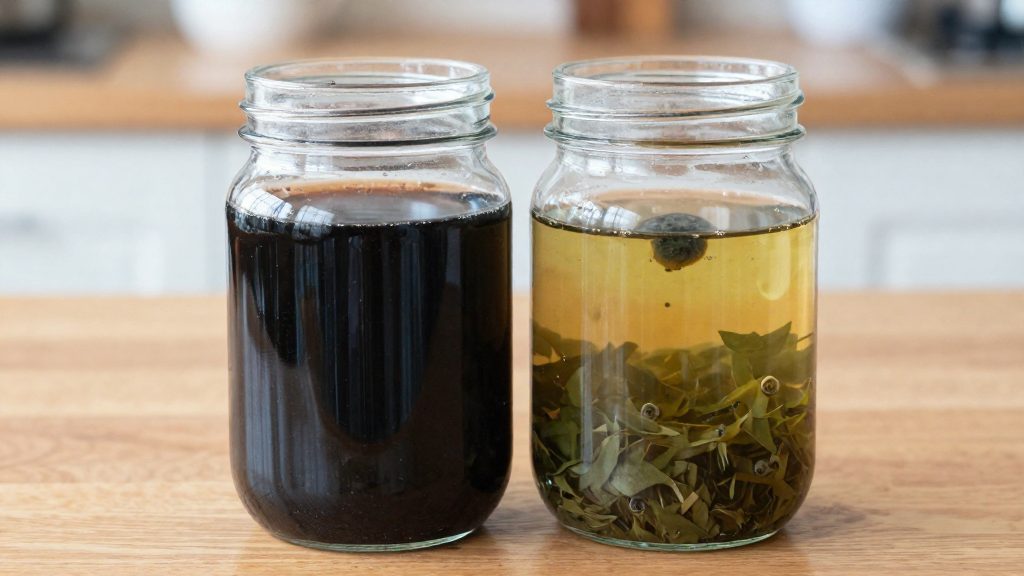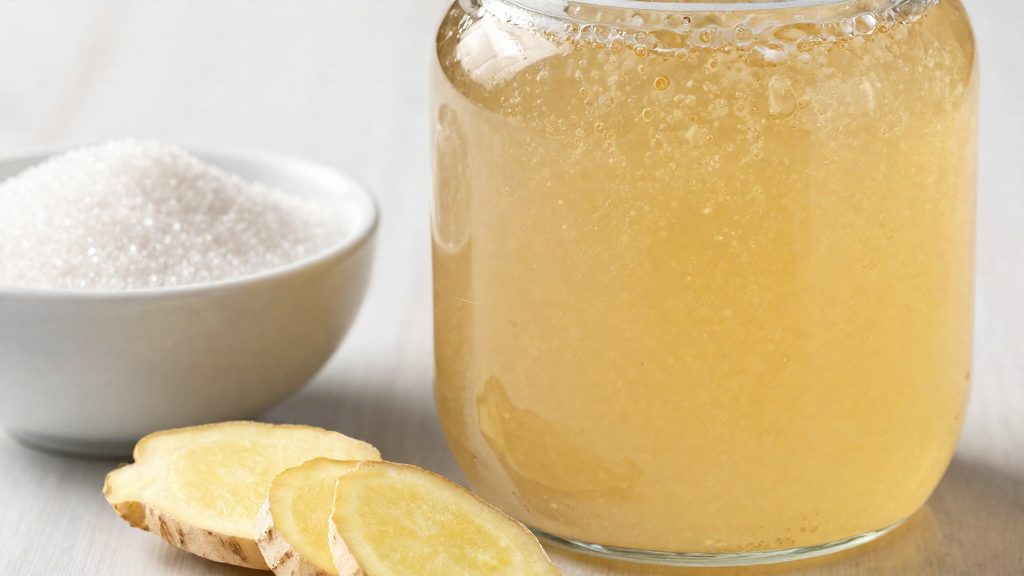
A ginger bug is a live starter culture made from fresh ginger, sugar and filtered water. According to The Things We’ll Make (2026), it is started with 2 cups of filtered water, then 1 tablespoon of sugar and 1 tablespoon of finely grated ginger are added every day, and it typically becomes active in 4 to 8 days. Its role in soda making is to supply the wild microorganisms that ferment sugar into carbon dioxide, which carbonates the drink.
What is a ginger bug?
A ginger bug is not a single cultivated strain. It is a mixed community that forms when microorganisms from the ginger skin and the surrounding environment grow in a sugary liquid. Its function is to carry out fermentation in a soda, so understanding its components clarifies why each ingredient matters.
Wild yeasts and lactic acid bacteria on ginger skin
Ginger root carries wild yeast and bacteria on its surface, picked up from soil and handling. Those organisms are the starting population of the culture. The yeasts consume sugar, while lactic acid bacteria produce acids that increase the acidity (lower the pH) of the liquid.
| Ingredient | Role in the culture |
|---|---|
| Fresh ginger | Source of wild yeast and bacteria, plus flavor |
| Sugar | Food that the yeast and bacteria ferment |
| Filtered water | Growth medium |
How yeast produces carbon dioxide
Yeast converts sugar into carbon dioxide and ethanol. The jar is covered with a cloth, not sealed, to keep dust and insects out while the bug is active. The gas forms bubbles that rise through the liquid, and when carbon dioxide is trapped in a sealed container it dissolves into the liquid, producing carbonation. The sugar is the fuel for this process, so the amount of sugar available directly affects how much gas the culture can generate.
Ginger bug versus ginger beer plant
The ginger beer plant is the traditional name for a similar ginger-based culture used to make ginger beer. This article describes only the ginger bug, built from fresh ginger, sugar and filtered water.
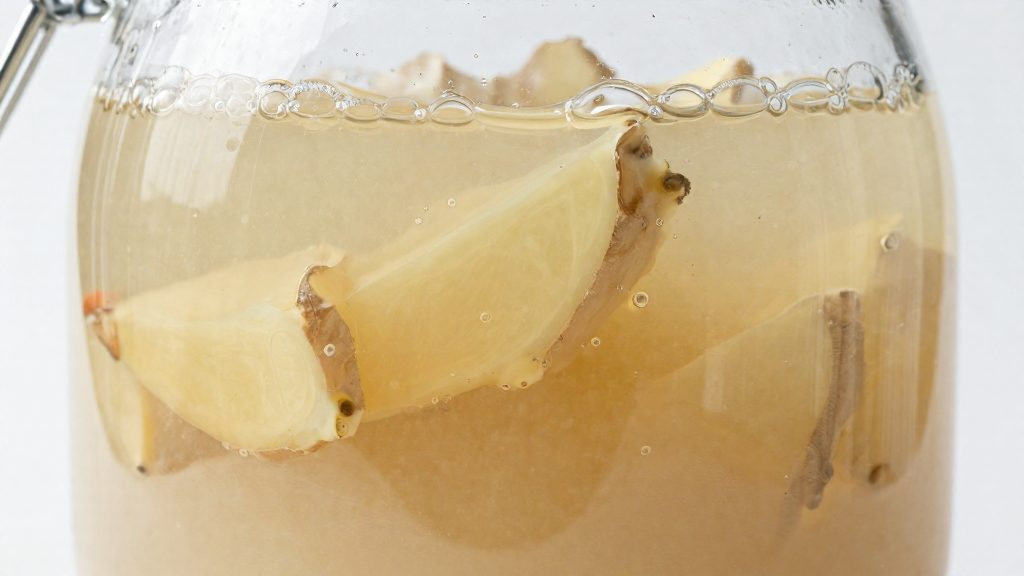
What you need to start a ginger bug
A ginger bug needs only a few inputs: filtered water, sugar, fresh ginger, a jar and a cloth cover. According to The Things We’ll Make (2026), the starter begins with 2 cups of filtered water. Water is the input to check first, because the source names chlorine and other contaminants as factors that can interfere with fermentation.
| Item | What the source specifies | Why it matters |
|---|---|---|
| Water | 2 cups of filtered water | Chlorine and other contaminants can interfere with fermentation |
| Ginger | Finely grated, with moldy or dirty areas cut away | Removes contaminated parts before they enter the jar |
| Jar and cover | Kept at room temperature, covered with a cloth | Keeps the jar covered without sealing it |
Water: filtered versus chlorinated tap
Chlorinated tap water is the input to avoid. Chlorine is a disinfectant, and it can work against the wild microbes that a ginger bug relies on. Filtered water is the source’s recommendation. The source does not specify a filter type or say whether boiled or chlorinated tap water can be used after treatment, so filtered water is the only option it describes.
Ginger: choosing and trimming
Choose ginger that is firm and free of visible damage. Before grating, cut away any moldy or dirty sections. Removing these areas at the start keeps visible contamination out of the jar. The source calls for finely grated ginger, which exposes more surface to the starter.
Jar and cloth covering
The source specifies a jar covered with a cloth at room temperature, but it does not give a jar size or material. The cloth keeps dust and insects out while leaving the jar open to air. Avoid a lid that closes tightly, since the jar needs to stay ventilated while the bug is active.
How do you feed a ginger bug day by day?
A ginger bug is fed on a fixed schedule: one feeding every 24 hours. The start uses 2 cups of filtered water, then 1 tablespoon of sugar and 1 tablespoon of finely grated ginger are added. From that point, the sugar and ginger are added every day, and the water is not topped up again in the daily routine.
| Item | Amount |
|---|---|
| Starting filtered water | 2 cups |
| Starting sugar | 1 tablespoon |
| Starting ginger | 1 tablespoon, finely grated |
| Daily sugar | 1 tablespoon |
| Daily ginger | 1 tablespoon, finely grated |
| Feeding interval | Every 24 hours |
Keep the feeding time consistent. Choosing one time of day and sticking to it means each feed lands roughly 24 hours after the previous one, which matches the schedule the source describes. Measure the sugar and ginger each time rather than estimating, so the amounts stay the same from one day to the next.
How do you know your ginger bug is ready?
A ginger bug is considered active when it shows visible bubbles at the top of the liquid and a white sediment settled at the bottom of the jar. According to The Things We’ll Make (2026), these two signs together define an active culture, so bubbles alone or sediment alone is not a complete test.
The bubbles usually rise through the liquid and collect near the surface. They are a sign of carbon dioxide produced by yeast and bacteria as they consume the sugar. The white sediment is the layer of microbial and ginger material that drops to the bottom of the jar as the culture develops. Look at the jar from the side in good light, because the sediment can be hard to see if the liquid is cloudy.
Timing varies. A ginger bug typically becomes active in 4 to 8 days, according to The Things We’ll Make (2026). Use this range as a guide, not a deadline. Temperature is the main reason for variation: cooler temperatures can slow the process, so a bug kept in a cold room may take longer than the typical window to show both signs.
Judge readiness by the signs themselves rather than by the calendar. If the bug has passed day 8 without bubbles and sediment, a cool environment is one possible cause, since cooler temperatures can slow the process, and it is worth keeping it covered at room temperature and checking again rather than discarding it on the basis of the date alone.
Turning a ginger bug into soda
For soda, use about ¼ cup of active ginger bug per liter of fruit juice, according to The Things We’ll Make (2026). The bug supplies the wild yeasts and bacteria that consume the juice sugars and produce carbon dioxide, so the dose sets how quickly the drink carbonates.
Stir the bug into the juice, cover the container, and let it ferment overnight. The next morning, check for gas. If carbonation is still low, ferment for a few more hours, then check again. The source describes this as a loop of fermenting and testing rather than a fixed timer, so the total time depends on how quickly your batch builds gas.
Once carbonation is where you want it, refrigerate the soda. Cold storage slows fermentation, but it does not stop it, so the bottles can still build some pressure and should be opened carefully. The source gives no specific temperature for this step, so use your refrigerator’s normal setting.
| Stage | Action | Timing |
|---|---|---|
| Dosing | Add about ¼ cup active ginger bug per liter of juice | Before fermenting |
| Overnight ferment | Ferment, then check for gas | Overnight |
| Extended ferment | Ferment a few more hours if carbonation is low | As needed |
| Chilling | Refrigerate once carbonation is right | When the desired level is reached |
For a gas check, look for bubbles rising in the liquid and pressure when you open the lid or cap. Repeat the check before deciding whether to extend fermentation. Keep the ratio consistent from batch to batch, because a weaker or more diluted bug changes how fast the soda carbonates. Using an active bug at the stated ratio is the most reliable way to get predictable results.
How do you carbonate safely without bursting bottles?
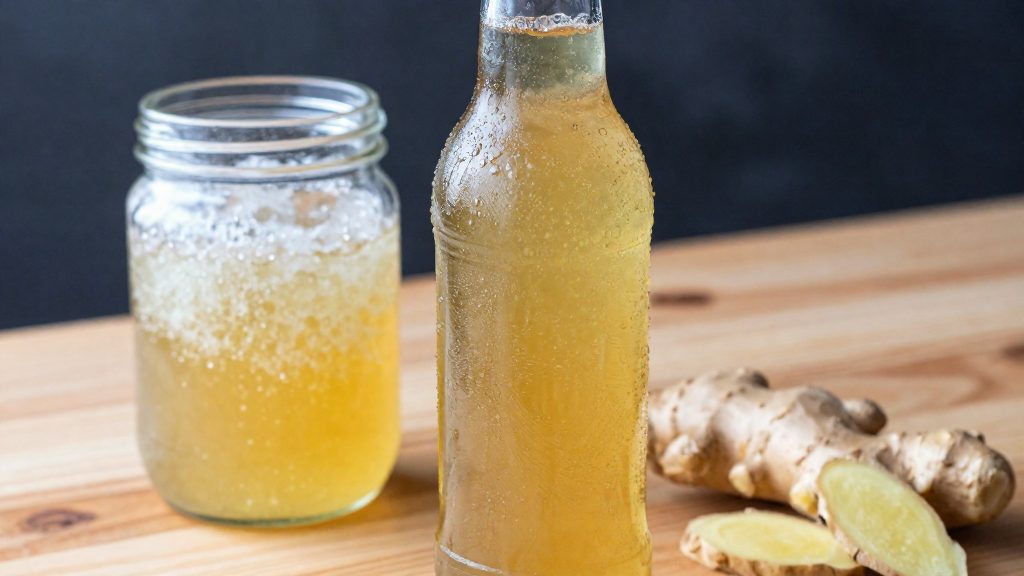
Carbonating soda with ginger bug works because the active culture keeps producing gas once the soda is in a closed container, where the gas cannot escape. The ginger bug jar itself stays cloth-covered. According to The Things We’ll Make (2026), glass bottles can burst if gas builds up unattended, so carbonation is a process to monitor rather than leave alone. Safe carbonation depends on three things: scheduled checks on each bottle, a clear point at which you stop fermenting, and bottle selection suited to sealed use.
Why unattended gas is the main risk
Once the juice is mixed with active ginger bug and sealed, pressure rises as the culture releases gas. A closed bottle gives no visible warning of how much pressure is inside, so the risk is highest when a bottle is left without checks. The ginger bug itself is what drives this, so the state of the bug matters before you seal anything.
Scheduled checks during carbonation
The source does not give a fixed checking interval. It does name the moments when a check matters, which are listed below.
| Stage | What to check | Action |
|---|---|---|
| After overnight fermentation | Whether gas has formed in the bottle | Confirm gas is present |
| Carbonation not yet right | Gas level still too low | Ferment a few more hours, then check again |
| Carbonation right | Gas present at the level you want | Refrigerate the bottle |
| Throughout | Bottles for signs of gas build-up | Check regularly |
Choosing bottle types
The source does not specify bottle types or pressure ratings. Choose bottles made for sealed storage, and inspect each one for chips, cracks and damaged seals before filling. Glass bottles can burst if gas builds up unattended, so check them regularly, keep them away from where people could be hurt, and open them slowly. Swing-top (flip-top) glass bottles are a common choice in home soda making. For any bottle, check the manufacturer’s stated pressure limit, because the source gives no figure to compare against.
Storing and reviving your ginger bug
A ginger bug can be paused in the refrigerator between batches of soda. According to The Things We’ll Make (2026), the bug can rest refrigerated for about a week, and up to roughly 10 days, before it needs to be revived. The cold slows the culture, so it stays in a dormant state without being used. Once you want to make soda again, it needs a short period of daily feeding before it is ready.
Refrigerated resting
Refrigeration is the refrigerated resting phase. Place the jar in the fridge when you have finished a batch and do not plan to brew again within a few days. The source gives a window of about a week, extending to roughly 10 days. The source gives no guidance beyond that window.
Weekly feeding during rest
While the bug is in the fridge, it still needs weekly feeding to stay alive. The Things We’ll Make (2026) recommends feeding it about once a week. The source does not specify a fixed amount of sugar or ginger for these resting feeds, so the quantity is not stated here.
Reactivating for soda
Before the next batch, the bug needs a reactivation period of daily feeding for 2 to 3 days. Take the jar out of the fridge, let it warm up, and feed it once every 24 hours for that period. This gives the culture time to rebuild before you add it to juice.
| Phase | Duration | Action |
|---|---|---|
| Refrigerated rest | About a week, up to roughly 10 days | Keep the bug refrigerated |
| Resting feed | About once a week | Feed the bug while it rests |
| Reactivation | 2 to 3 days | Feed daily before using it for soda |
Troubleshooting mold and no bubbles
A ginger bug usually fails in one of two ways: growth that looks like contamination, or a culture that stays quiet. Separating the two problems matters because a quiet culture is usually a feeding or timing issue, while mold means the batch should not be used.
Telling mold from harmless surface yeast
Judge any surface growth cautiously, and work from what is normal:
- Normal growth is the white sediment that settles at the bottom of the jar.
- Anything else on the surface, the rim, or the jar walls deserves a closer look before you use the culture.
- Do not skim or scrape a questionable layer and continue. Using a doubtful culture is the main risk.
Diagnosing a ginger bug with no bubbles
Check the two activity signs separately. Bubbles at the top and sediment at the bottom are the reference points, and each one tells you something different:
| Sign | Healthy reading | If absent |
|---|---|---|
| Bubbles at the top | Culture is gassing | Culture is not yet active or has weakened |
| White sediment at the bottom | Yeast and bacteria are settling | Culture is not yet active |
If sediment is present but there are no bubbles, the culture is still forming. Confirm that you have been feeding it every 24 hours, as the feeding routine in The Things We’ll Make (2026) describes, and recheck the jar over the following days. If neither sign appears despite consistent daily feeding, the problem is not a single missed feed, and it is time to decide whether to keep going or start over.
Deciding between discard and restart
The right action depends on the cause:
| Situation | Action |
|---|---|
| Growth that is not normal sediment | Discard the culture and start a new one |
| No bubbles and no sediment after daily feeding | Keep feeding daily and recheck |
| Healthy bug you want to keep between batches | Refrigerate for about a week (up to roughly 10 days), feed about weekly, then feed daily for 2 to 3 days before using it for soda, per The Things We’ll Make (2026) |
Refrigerated resting is a way to pause a healthy culture between batches, not a fix for a weak one. Mold is not something to rescue, so discard the culture when in doubt. Treat any doubt about the growth as a reason to discard.
Frequently asked questions
How much active ginger bug should I add to a liter of juice?
According to The Things We’ll Make (2026), use about ¼ cup of active ginger bug per liter of fruit juice. Let it ferment overnight, check for gas, and add a few more hours if carbonation is still weak before refrigerating.
How do I store a ginger bug between batches?
Keep it in the refrigerator for about a week, up to roughly 10 days, and feed it about once a week to slow fermentation. Before using it again, feed it daily for 2 to 3 days so the culture becomes fully active.
How can I tell when my ginger bug is ready to use?
It is active when bubbles rise to the top and a white sediment settles at the bottom. This usually takes 4 to 8 days, and cooler room temperatures can slow the process.