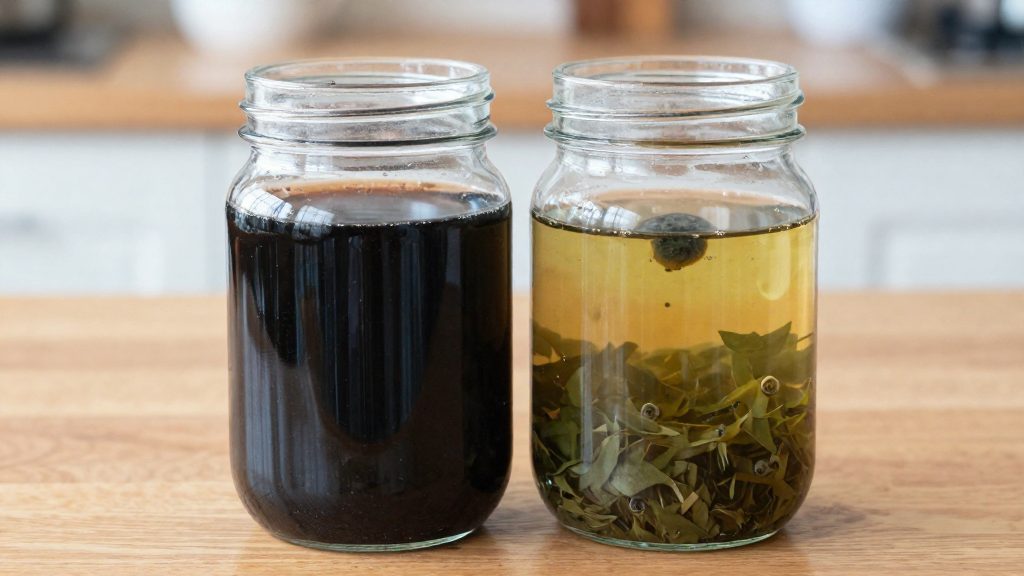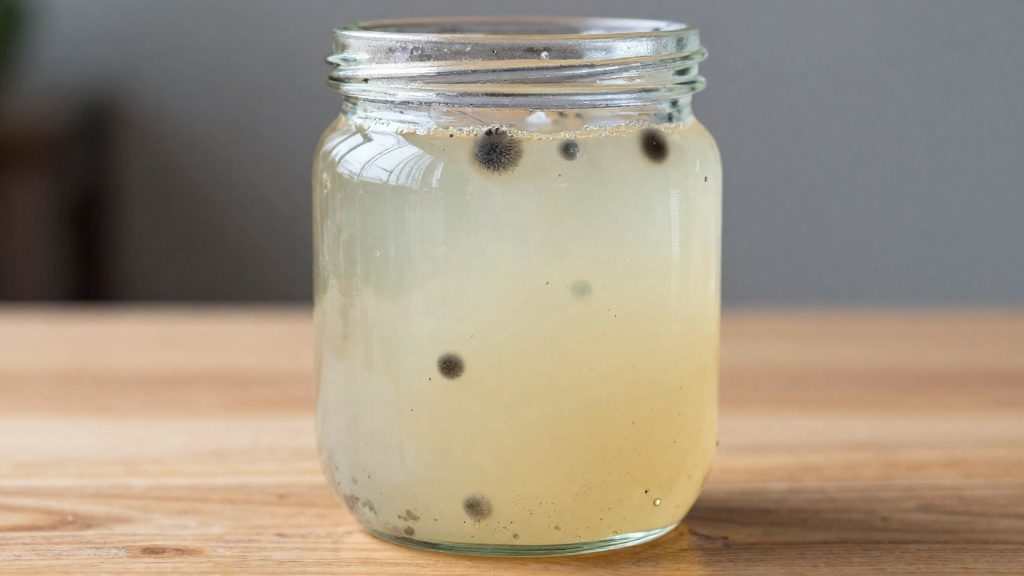
How can you tell if kombucha has gone bad?
How to tell whether kombucha has gone bad comes down to one question: is there a clear spoilage sign, or only the normal byproducts of fermentation? Discard the batch when mold appears, when a rotten or putrid smell is present, or when you are unsure. Keep brewing when bubbles, a sour or vinegary aroma and a layered SCOBY are present. The National Center for Home Food Preservation (NCHFP) at the University of Georgia lists mold growth, lack of carbonation and slow fermentation as common problems.
How can you tell if kombucha has gone bad?
Triage order
Run the checks in a fixed sequence so that a visible problem is never overlooked:
| Step | Check | Action if it fails |
|---|---|---|
| 1 | Inspect the surface for mold | Discard the whole batch, sanitize all equipment, restart with a new SCOBY and fresh starter tea |
| 2 | Smell the brew for rot | Discard if the smell is rotten-egg, rancid or putrid, or if you are unsure. If the smell is only harshly sulfuric with no rot, troubleshoot the batch (Kombucha Kamp) and discard if the smell does not clearly improve |
| 3 | Confirm fermentation activity (bubbles, sour aroma) | If absent, check the stalled-fermentation causes below |
| 4 | Decide | Keep brewing if steps 1 and 2 are clear and step 3 shows activity |
Why batches stall or fail to acidify
A batch that does not progress may simply be slow to acidify, but a stall does not rule out contamination, so keep checking for mold and off-smells.
- Temperature: According to Tasting Table, the brew should be kept around 70°F, because temperatures below 64°F slow acidification.
- Starter volume: Tasting Table’s source gives about 2 cups of starter liquid per gallon of new tea. Less starter leaves less acid in the batch to start with.
- Starter acidity: The NCHFP states that starter liquid should be at pH 4.0 or lower to provide the initial acidity needed for safety. A weak starter does not meet this threshold, and the brew will acidify slowly.
- Slow fermentation: The NCHFP identifies it as a common problem. Judge a slow batch by the other checks in the triage order.
What does kombucha mold look like?
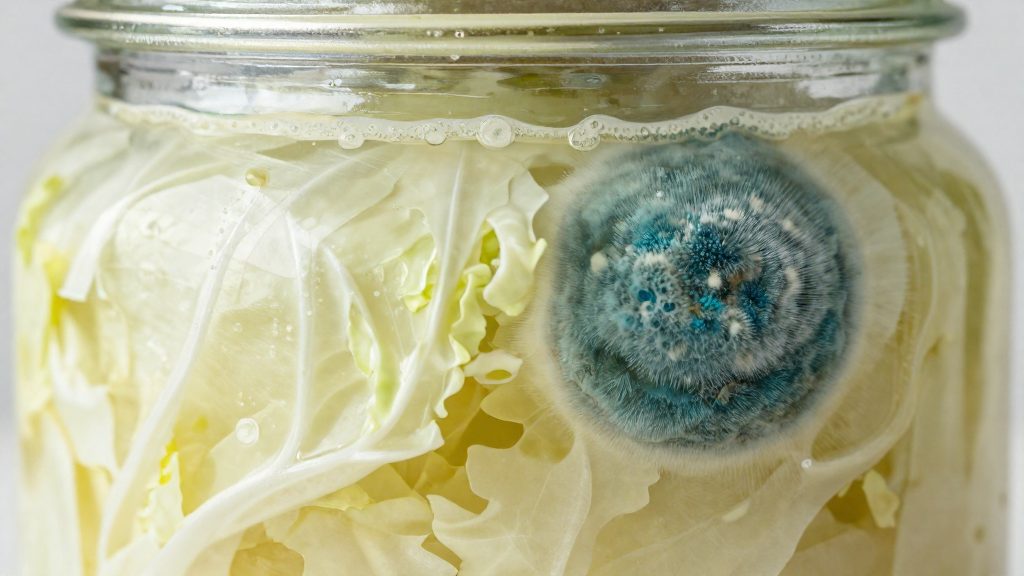
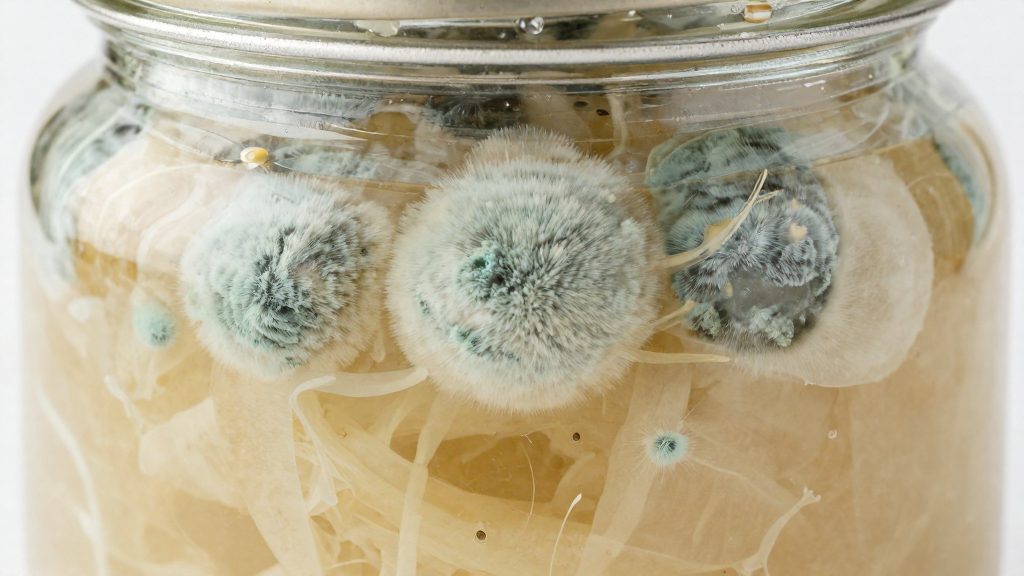
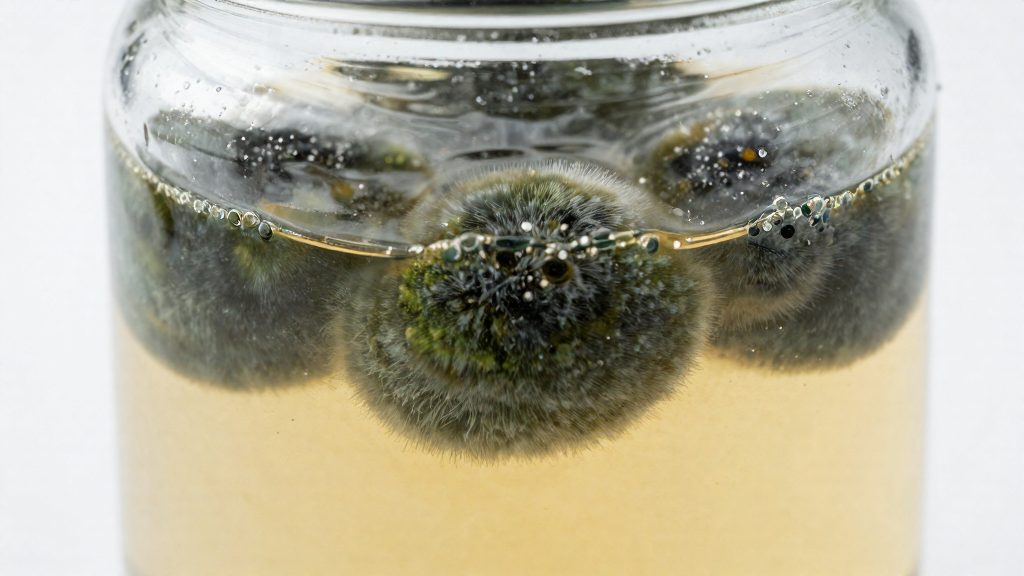
Kombucha mold grows on the surface of the SCOBY, the cellulose disc that floats on top of the brew. According to Tasting Table, it appears as fuzzy or dry growth that sits on the surface, not as part of the disc itself. According to Kombucha Kamp, it forms distinct raised or dry patches, which makes it look like a separate deposit on top of the culture.
Fuzzy or dry growth is the most consistent visual feature. The texture is the first thing to check. A healthy SCOBY is smooth, wet and waxy, so a patch that looks fibrous, powdery or dry stands out against that surface.
Concentric circles are the second pattern to recognise. Tasting Table notes that mold can spread across the surface in rings, and that these rings can show vivid colours. Ring patterns are a visual cue that the growth is spreading in a defined pattern rather than sitting as a single spot.
The colours reported by the two sources overlap but are not identical:
| Colour | Where it is named |
|---|---|
| White-green | Tasting Table, in concentric-circle patterns |
| White | Kombucha Kamp |
| Green | Kombucha Kamp |
| Blue | Tasting Table and Kombucha Kamp |
| Black | Tasting Table and Kombucha Kamp |
| Red | Tasting Table |
Colour alone does not confirm mold. The most reliable checks are the texture of the patch, whether it sits on the surface in raised or dry spots, and whether it forms rings. Taken together, these features describe what mold physically looks like on a SCOBY.
What looks scary but is normal?
Several features that appear on a kombucha brew look alarming but are part of healthy fermentation. Most of them sit on the surface or drift through the liquid, which is where people tend to spot mold. The difference is that these features are yeast, bacteria or gas, not fungal growth. Knowing what they look like helps you avoid discarding a good batch.
Kahm yeast is the most common surface feature that gets confused with mold. It usually forms a thin white film across the top of the liquid. Tasting Table states that kahm yeast is not mold.
Carbonation bubbles are a positive sign. They rise through the liquid or cling to the sides of the vessel. The University of Georgia lists bubbles, a tangy aroma and a slightly sour taste as signs of proper fermentation.
SCOBY layering is the other normal feature. Kombucha Kamp notes that a new layer usually forms within 3–10 days. Layers can be uneven in thickness or texture. Food Republic (2013-06-28) reports that holes, clear jelly layers and dried or dark patches that are part of the SCOBY itself are usually normal. Mold is different: it is fuzzy or raised and sits on top of the culture as a separate deposit. If a dry or dark patch is fuzzy or raised, treat it as mold. If you are unsure, discard the batch.
Sediment is also expected. Kombucha Kamp classifies brown strings, sediment and floaty bits as yeast, and states they are normal.
| Feature | Typical appearance | Status |
|---|---|---|
| Kahm yeast | Thin white film on the surface | Yeast, not mold |
| Carbonation bubbles | Rising through liquid or clinging to sides | Sign of active fermentation |
| New SCOBY layer | Forms in 3–10 days | Normal growth |
| Holes and clear jelly layers | Gaps or translucent sections in the SCOBY | Usually normal |
| Brown strings and sediment | Stringy or settled particles | Yeast, normal |
| Floaty bits | Small particles drifting in the liquid | Yeast, normal |
Smell, taste and pH: what do they tell you?
Smell and taste give the fastest read on a finished batch, and pH gives a measurable check. A healthy kombucha smells sour and vinegary and tastes slightly sour. Off-odors are the clearest warning sign. Rotten-egg, rancid or putrid smells are not normal, and a harshly sulfuric smell is a sign to troubleshoot the batch.
Taste changes are also informative. Repeated mold, extreme yeast buildup and fruit flies around the vessel are further warning signs to troubleshoot. If a batch still tastes like sweet tea after a week, the SCOBY may have a problem. Kombucha Kamp adds that no taste change after 10 or more days is a warning sign too, so a batch that stays sweet well past the expected window needs investigating.
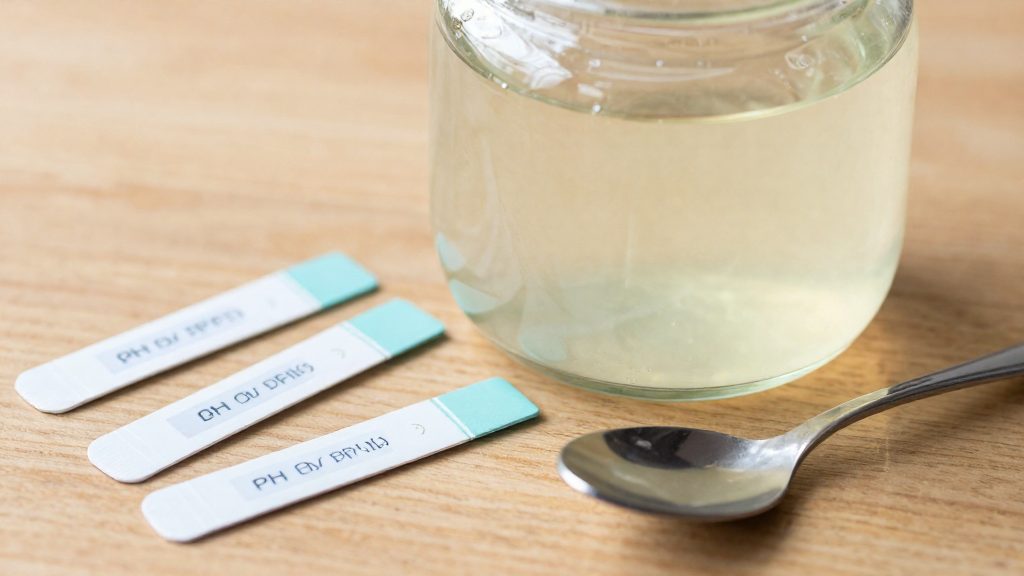
pH tells you whether the brew has acidified. According to Tasting Table, kombucha should start at a pH of 4.5 or lower and fall to about 2.5 to 3.5 after fermentation. A finished pH of 2.5 to 3.5 is the target to check against with a calibrated pH meter or test strips.
Temperature drives how fast that acidification happens. A batch brewed in a cold room can therefore look stalled, with sweet taste and a higher pH, for longer than the same batch brewed near 70°F.
| Reading | Expected value | Source |
|---|---|---|
| Aroma | Sour and vinegary | Food Republic (2013-06-28) |
| Taste | Slightly sour | National Center for Home Food Preservation (University of Georgia) |
| Starting pH | 4.5 or lower | Tasting Table |
| Finished pH | About 2.5 to 3.5 | Tasting Table |
What should you do if your kombucha has mold?
When mold appears, the batch cannot be rescued. Tasting Table (undated in the consulted material) states that a SCOBY infected with mold is unsalvageable, so the response is a full reset: discard the culture and liquid, sanitize everything the brew touched, then start again with a new SCOBY and fresh starter tea.
Step 1: Discard the SCOBY and all the liquid
Remove the SCOBY and throw it out, along with every drop of moldy kombucha. Do not try to skim the mold off and keep the rest, because the SCOBY and the surrounding liquid are treated as one contaminated unit.
Step 2: Sanitize everything that touched the brew
Clean all equipment that contacted the batch: the vessel, lid or cloth cover, rubber band, spigot, bottles and utensils. Tasting Table recommends sanitizing all of it before reuse. Rinse thoroughly so no cleaning residue remains in the vessel.
Step 3: Restart with a new SCOBY and fresh starter tea
Start a new batch with a new SCOBY and fresh starter tea, not with the old culture. Keep the vessel covered during fermentation.
How do you prevent kombucha from spoiling?
Kombucha safety depends on starter acidity, starter volume, cold storage of the finished drink and good sanitation. The National Center for Home Food Preservation at the University of Georgia says finished kombucha should be stored at 40°F or below.
Starter liquid pH at or below 4.0
The starter is the acidic liquid, usually unflavored finished kombucha, that you add to fresh sweet tea. Its acidity is what keeps the new batch from supporting harmful microorganisms in its early stage. Check it with a pH meter or pH test strips before use:
- Starter at pH 4.0 or lower: use it for the new batch.
- Starter above pH 4.0: do not use it as the acidic base. Let the source batch ferment longer, then test again, or obtain a more acidic starter.
Test the starter each time you use it, not only the first time. Starter from a batch that has been stored or handled loosely may have changed.
Starter ratio of about 2 cups per gallon
Use a consistent ratio of starter to tea. Scale the amount with the batch size:
| New tea volume | Starter liquid (approx.) |
|---|---|
| 0.5 gallon | 1 cup |
| 1 gallon | 2 cups |
| 2 gallons | 4 cups |
Too little starter weakens the early acidity. Adding the starter to tea that is still hot can also damage the culture, so let the tea cool before combining.
Finished kombucha stored at 40°F or below
Once the brew reaches the flavor and acidity you want, move it to cold storage. The NCHFP specifies 40°F or below for finished kombucha. Cold storage slows fermentation so the drink does not continue to change in the bottle or jar. Keep the bottles or jars sealed in the refrigerator, and check the refrigerator thermometer, because a door that is opened often can raise the temperature.
Sanitation as a safeguard
The NCHFP notes that home brewing can be safe with good hygiene, a tested recipe and correct fermentation, and that contamination risk rises when sanitation is not observed. Wash hands, use clean vessels and utensils, and keep the brewing area free of pests.
When is homemade kombucha unsafe to drink?
Homemade kombucha is generally considered safe for most people, but it does not suit everyone, and some batches should be discarded rather than tasted. The National Center for Home Food Preservation at the University of Georgia states that kombucha may not suit people with compromised immune systems, pregnant women or children, and recommends that they consult a healthcare professional before drinking it. Safety also depends on how the batch was made, so the risk rises when a brew is started without basic checks.
Higher-risk groups
Three groups should treat homemade kombucha with particular caution:
- Immune-compromised people: anyone whose immune system is weakened by illness or treatment.
- Pregnant women: named in the same guidance as a group that may not suit kombucha.
- Children: also named as a group that may not suit kombucha.
For these groups, the default step is to ask a healthcare professional before the first sip, not after a reaction.
Batch conditions that make drinking inadvisable
Certain batch conditions make drinking the brew inadvisable, regardless of who is drinking it:
| Condition | Why it matters | Action |
|---|---|---|
| No acidity check recorded | The brew’s acidity cannot be confirmed, so its safety margin is unknown | Test the starter and the finished brew with a pH meter or strips. If you are unsure, discard |
| Unknown starter history | A SCOBY or starter liquid of unknown origin may carry contamination | Restart with a SCOBY and starter tea from a batch you can trace |
| Sanitation not observed | The guidance links contamination risk to skipped sanitation | Discard the batch |
Frequently asked questions
Can I drink kombucha if it has fuzzy spots on the surface?
No. Fuzzy or raised growth on top of the brew is mold, and the sources treat any mold as a reason to discard the whole batch and sanitize everything that touched it. Kahm yeast is not mold, according to Tasting Table, so it should not be confused with the fuzzy growth described above.
My kombucha still tastes like sweet tea after a week. Is it spoiled?
Not necessarily, but it needs investigation. Food Republic (2013-06-28) links a lack of sourness after a week to a possible SCOBY problem, while Kombucha Kamp lists no taste change after 10+ days as a warning sign to troubleshoot. Tasting Table notes that temperatures below 64°F slow acidification, so check the room temperature before assuming the fermentation has failed.
How do I check acidity at home, and what pH should I aim for?
Test the starter liquid and the finished brew with a pH meter or test strips. The NCHFP states that starter liquid should be at pH 4.0 or lower, so a starter that reads higher does not meet that guideline. Tasting Table gives a range of about 2.5 to 3.5 for finished kombucha, starting from a pH of 4.5 or lower. If you have no way to measure acidity, discard the batch when unsure.