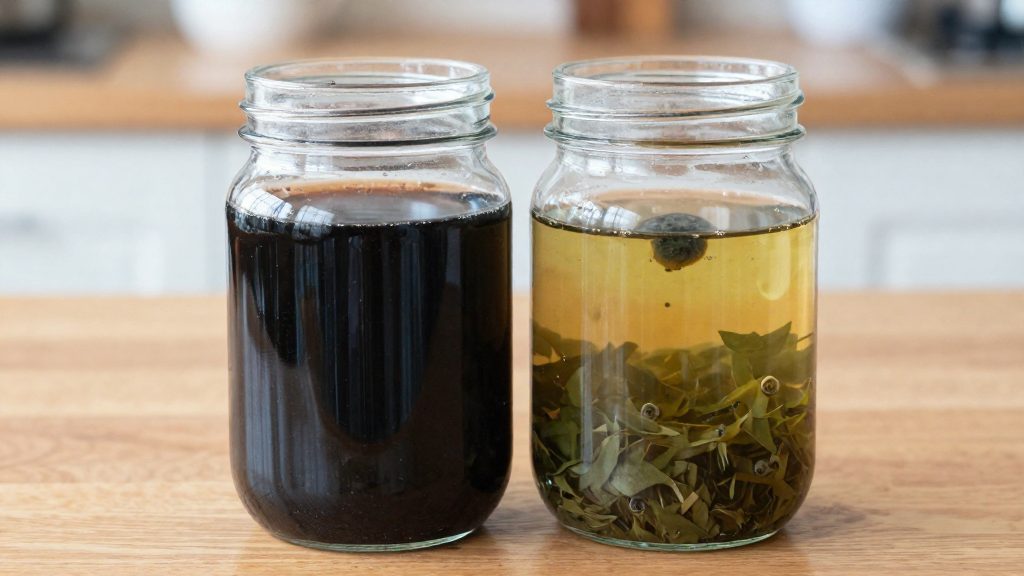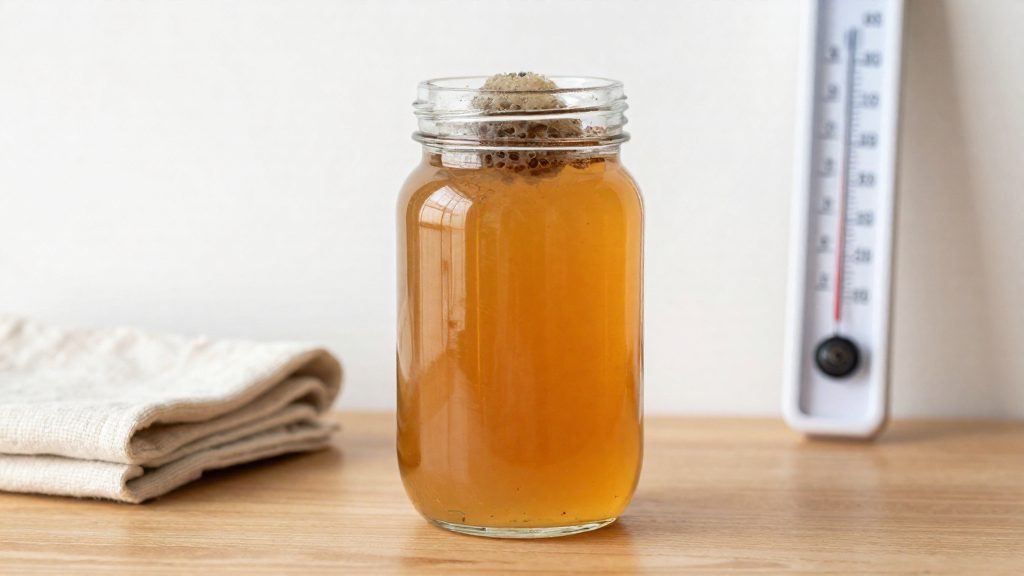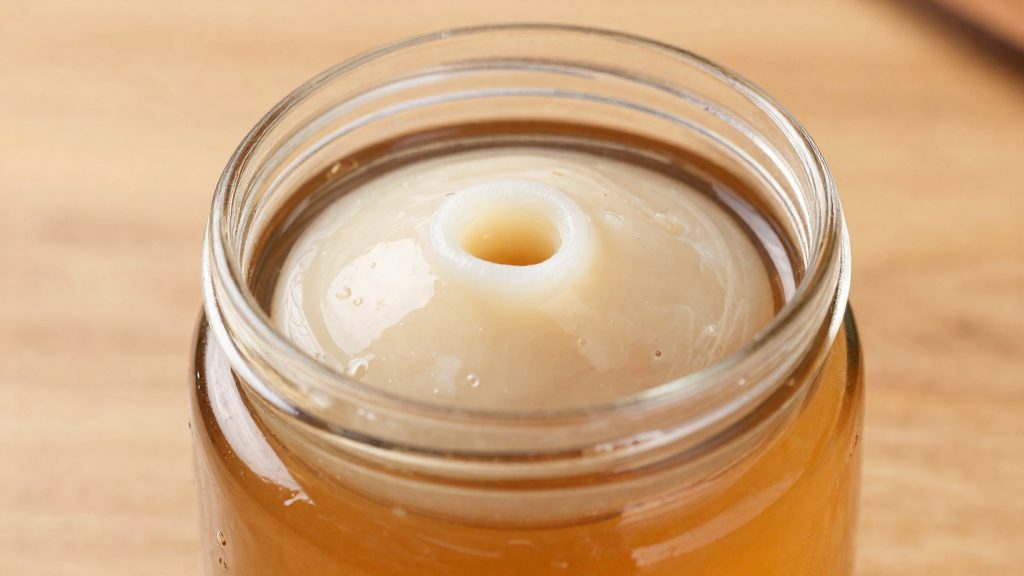
A kombucha SCOBY (symbiotic culture of bacteria and yeast) is a rubbery, pancake-shaped cellulose mat that holds the microbes doing the fermentation. Starter tea is the liquid from a previous batch that you add to fresh sweet tea. Together they form the inoculum: the mat supplies the living culture, and the starter tea supplies acid from the first day, so the new batch begins more acidic than plain sweet tea.
What is a kombucha SCOBY and starter tea?
Structure of the SCOBY
The SCOBY is a cellulose mat produced by acetic acid bacteria, with yeasts embedded in it. The cellulose gives the microbes a physical structure and forms at the liquid surface, where the bacteria have access to oxygen. A new layer usually develops on the existing mat with each batch, so the SCOBY grows thicker over time. Colour and smell are the first checks.
Roles of yeasts and bacteria
Yeasts consume sugar and convert it into ethanol and carbon dioxide. Acetic acid bacteria then oxidise part of that ethanol into acetic acid, the main acid responsible for kombucha’s sour taste and falling pH. Sugar is therefore a shared fuel: yeasts use it first, and the ethanol they produce feeds the bacteria. As the fermentation progresses, the balance shifts from sweetness toward acidity.
Starter tea as an acidic inoculum
Starter tea is the starter tea you reserve from a finished batch and add to the next one before fermentation. It already contains acetic acid and other organic acids, which lower the pH of the new batch from the start. This matters for safety because a lower pH creates conditions less favourable to pathogens. In the 2025 Food Protection Trends study, mean reductions of surrogate pathogens over the fermentation period were 5.02 log CFU/mL for E. coli, 5.86 for Salmonella and 4.26 for Listeria. These figures describe surrogate organisms in that study’s conditions and do not replace the pH checks below.
What do you need to brew kombucha as a beginner?
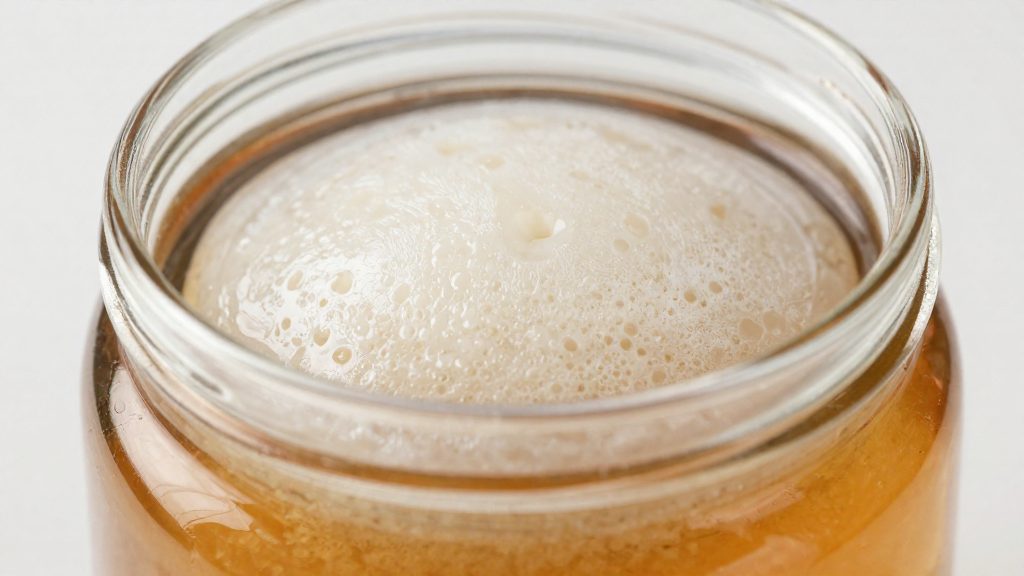
A first batch of kombucha needs four core items: black tea, sugar, a food-grade vessel and a breathable cover. Each one has a specific role, and the wrong choice in any of them can compromise the batch. The sections below cover what to buy and why.
Base ingredients: black tea and sugar
- Black tea: Food Safety Information Council (Australia, 2026) specifies black tea as the tea to use for kombucha.
- Sugar: Sugar is the substrate the culture consumes during fermentation.
The vessel: material matters
The vessel is the part of the setup where material choice is most often overlooked. Food Safety Information Council (Australia, 2026) recommends food-grade glass or stainless steel and advises against three other materials.
| Material | Guidance |
|---|---|
| Food-grade glass | Recommended |
| Food-grade stainless steel | Recommended |
| Plastic | Avoid |
| Lead crystal | Avoid |
| Ceramic | Avoid |
Choose a wide-mouth container so the liquid surface is easy to reach and inspect, and keep the vessel clean before each batch.
The cover: breathable cloth and a band
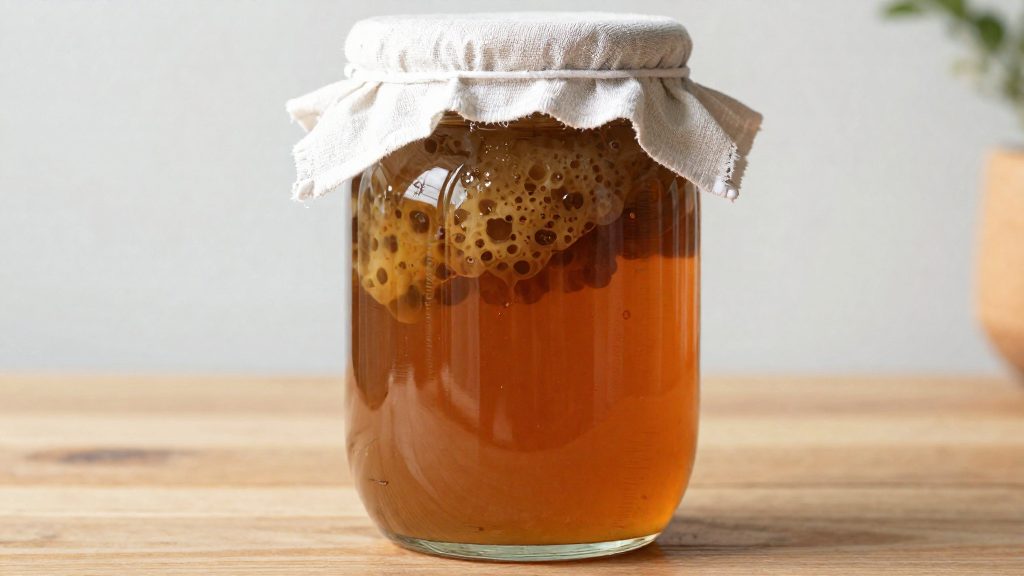
Cover the opening with a breathable cloth and secure it with a band, such as a rubber band or string. The cloth lets air move in and out while keeping dust, insects and debris out of the liquid. Use a tightly woven cloth and pull it taut so no gaps remain around the rim. A lid that seals airtight blocks this exchange, so do not use one in place of the cloth.
Should you buy a SCOBY or grow your own?
Both routes produce a working kombucha culture, but they differ in how much you know about the starting material. A commercial SCOBY arrives with a known origin, while a SCOBY grown from raw kombucha depends on the quality of the kombucha you started with and the conditions you keep.
Commercial SCOBY sourcing and supplier reliability
A purchased SCOBY saves the early stage of the process, but the supplier’s hygiene practices determine its quality, and a label alone does not confirm them. Before buying, check whether the seller states where the culture was propagated, how it was packed and whether it ships with starter liquid. A SCOBY sent with its own tea is easier to judge on arrival, because you can see the mat and smell the liquid before combining them with your batch.
Treat the seller’s information as a starting claim to verify.
Growing a SCOBY from raw kombucha
Growing your own means starting from unpasteurised, plain kombucha and letting a new mat form over several weeks. The main advantage is that you control every step. The main risk is that the raw liquid carries whatever microorganisms it already contains, and you cannot inspect its history.
Time and cost trade-offs
| Factor | Commercial SCOBY | SCOBY grown from raw kombucha |
|---|---|---|
| Starting material | Culture supplied by a seller | Raw kombucha you already have |
| Time to a usable mat | Shortest, since the mat is ready | Longer, as the mat must form first |
| Cost | Price of the culture plus shipping | Ingredients only, but more time spent |
| Main risk | Supplier hygiene is unverified | Unknown microbes in the raw liquid |
| Control over the process | Limited to brewing conditions | Full control from the first day |
How do you brew your first batch step by step?
Brewing a first batch of kombucha means steeping and sweetening black tea, cooling it, adding starter tea and the SCOBY, covering the vessel, fermenting, then refrigerating. Take tea-to-sugar ratios, a starter tea volume and a fixed fermentation length from a separate tested recipe. Use the day-7 pH test described below, together with the SCOBY colour and smell checks, to judge the batch. Use black tea, sweeten it, and let it cool to a set range before the fermentation stage begins. The Food Safety Information Council (Australia) (2026) gives a temperature window for each stage, and following those windows in order keeps the process controlled from start to finish. The three checkpoints below are the core of the method.
| Stage | Target temperature | Timing requirement |
|---|---|---|
| Cooling the sweetened tea | 20–25°C (68–77°F) | Within 2 hours |
| Fermentation | 18–26°C (64–79°F) | Throughout the fermentation period |
| Refrigeration of finished kombucha | At or below 5°C (41°F) | After fermentation ends |
Cooling is the first checkpoint. Once the black tea has been steeped and the sugar has dissolved, the sweetened liquid must come down to 20–25°C (68–77°F) within 2 hours. Cooling only needs to be quick enough to reach that range inside the time limit. The sweetened tea should not be left to stand at room temperature without checking, since the 2-hour limit is the point where the liquid must already be in range.
Fermentation is the second stage. Keep the batch between 18–26°C (64–79°F) for the whole period. This range is wider than the cooling range, so a steady room temperature inside it is sufficient. Temperatures outside it, either colder or warmer, fall outside the guidance and should be corrected.
Refrigeration is the final checkpoint. When fermentation is complete, move the finished kombucha to a fridge set at or below 5°C (41°F). Refrigeration after fermentation is the step that brings the batch to storage temperature.
How do you know when kombucha is safe to drink?
Under the Food Safety Information Council (Australia, 2026) guidance, a finished kombucha batch should reach a pH below 3.0. This is one safety check, not proof that the batch is safe. The batch also needs a clean SCOBY with no discolouration or off-odour, and refrigeration at or below 5°C (41°F) after fermentation. The Food Safety Information Council (Australia, 2026) uses this threshold in its guidance.
Why pH is the measure used
pH measures acidity on a scale where lower numbers mean more acidic. Kombucha becomes more acidic as the SCOBY and yeast convert sugar and tea into acids during fermentation, so a falling pH shows that the batch is progressing. The guidance uses the 3.0 line as its pass-or-discard marker, which makes pH the one reading a home brewer can check directly.
The day-7 and day-10 checkpoints
| Checkpoint | pH reading | Action |
|---|---|---|
| Day 7 | Below 3.0 | Batch meets the threshold |
| Day 7 | Above 3.0 | Keep fermenting and retest |
| Day 10 | Still above 3.0 | Discard the batch |
Take the sample with a clean utensil and measure with a calibrated pH meter or test strips that resolve readings around 3.0. Count the day-7 and day-10 checkpoints from the same start date, so the timeline stays consistent across batches.
What the 2025 pathogen study shows
A 2025 peer-reviewed study in Food Protection Trends, published by the International Association for Food Protection, tested home-brewed kombucha made with a commercial SCOBY at sugar levels of 26, 53 and 80 g/L over 14 days. The study found that pH fell and titratable acidity rose significantly during this period. It also measured the mean reduction of three surrogate pathogens:
| Surrogate organism | Mean reduction (log CFU/mL) |
|---|---|
| E. coli | 5.02 |
| Salmonella | 5.86 |
| Listeria | 4.26 |
These results describe the study’s conditions, not every home batch. Surrogates are non-pathogenic stand-ins used to model pathogen behaviour, so the table does not replace a pH test on your own batch.
What does a moldy SCOBY look like?
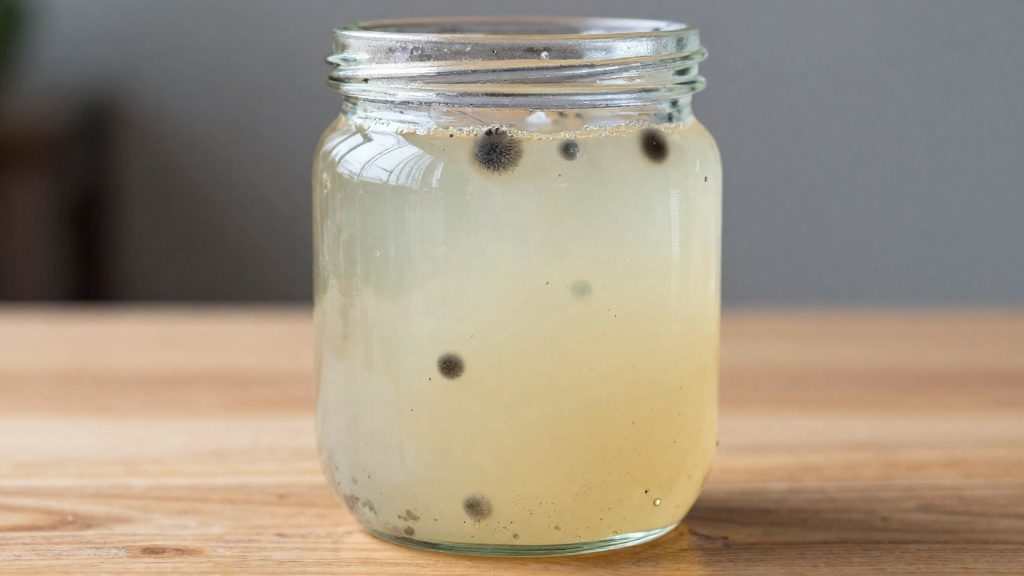
A SCOBY (symbiotic culture of bacteria and yeast) that must be thrown out is identified by its colour and its smell. The Food Safety Information Council (Australia, 2026) gives a simple rule: discard any SCOBY that shows green, white, black or grey discolouration, or that has an off-odour. Any one of these signs is enough, and no other test is needed to make the decision.
Colour is the easiest sign to check. Look at the whole surface and both sides of the culture, and compare each patch with the rest of the mat. A spot of green, white, black or grey means the culture is compromised, even if the rest looks normal. Colour changes can appear on the top, underneath, or along the edges, where the SCOBY meets the liquid, so check all of these areas.
Smell is the second check. A healthy batch has a sharp, vinegary aroma. An off-odour is any smell that is clearly different from that, such as rotten, musty or otherwise foul. Lift the SCOBY out or lean over the open vessel and smell it directly. Do not rely on taste to judge the culture.
Per-sign checklist
| Sign observed | Decision |
|---|---|
| Green discolouration anywhere on the SCOBY | Discard |
| White discolouration anywhere on the SCOBY | Discard |
| Black discolouration anywhere on the SCOBY | Discard |
| Grey discolouration anywhere on the SCOBY | Discard |
| Off-odour from the SCOBY or the liquid | Discard |
| No colour change and no off-odour | No discard sign found; keep checking pH and smell through the batch |
Inspecting before each batch
Make the check part of every brewing cycle, not only when something looks wrong:
- Remove the SCOBY from its vessel and rinse your hands and utensils first.
- Inspect the top, underside and edges under good light.
- Smell the culture and the liquid.
- Work through the checklist above before adding it to new sweetened tea.
How much kombucha is safe to drink?
According to the Food Safety Information Council (Australia, 2026), healthy adults should limit kombucha to about 125 mL (½ cup) per day. The figure is a ceiling for regular intake, not a serving suggestion. Because bottles and mugs often hold more than that, measuring the pour is the simplest way to stay within it.
The same source identifies four groups who should be cautious:
- Immunocompromised people, whose immune systems may respond less effectively to microbes in unpasteurised drinks.
- Pregnant people.
- People with diabetes.
- People with a history of heavy drinking.
For the last group, the alcohol content of home-brewed kombucha is worth checking directly. The Food Safety Information Council (Australia, 2026) notes that a second fermentation with fruit can raise alcohol levels. Fruit-flavoured batches therefore differ from plain ones, and the 125 mL guideline applies to whatever the finished drink contains.
Frequently asked questions
At what pH should kombucha be before I refrigerate it?
According to the Food Safety Information Council (Australia, 2026), finished kombucha should reach a pH below 3.0. Test on day 7, keep fermenting if the reading is still above 3.0, and discard the batch if it has not dropped below 3.0 by day 10. A passing pH reading is one check, so it does not confirm the batch is safe on its own.
Should I throw out a SCOBY that looks discoloured or smells wrong?
Yes. The Food Safety Information Council (Australia, 2026) advises discarding any SCOBY with green, white, black or grey discolouration, or one that has an off-odour. Inspect the mat each time you start a batch, because these signs appear on the surface before any other problem is visible.
Can I rely on the pH test alone, or do I need a recipe for the quantities?
The pH test is only one part of the process. The guidance covers temperature ranges for cooling, fermenting and refrigerating, but it gives no tea-to-sugar ratio, no starter tea volume and no fixed fermentation length. Use a separately tested recipe for those quantities, and check the pH, the SCOBY colour and the smell together.