Yes, you can make kombucha with honey instead of sugar, but the swap changes how the brew behaves. Honey is fermentable, so the microbes in a SCOBY can work on it, yet Craftabrew (2026) notes that honey “behaves very differently than sugar.” Traditional Cooking School (2026) gives a starting point of about 3/4 cup of raw honey per gallon, compared with about 1 cup of sugar per gallon in standard recipes. Expect a slower, less predictable ferment rather than an identical result.
Can you make kombucha with honey instead of sugar?
Why honey is not a direct sugar swap
Honey is not a direct swap for three reasons. Its sugar content varies from batch to batch, so results are less predictable (Craftabrew, 2026). It contains antimicrobial compounds that can slow or change fermentation (Craftabrew, 2026). Raw honey also does not carbonate the way sugar does (Seven Days, 2026). Honey also needs different handling when you mix the brew. Traditional Cooking School (2026) advises cooling the tea before adding honey, because heating raw honey degrades its enzymes. Heating raw honey degrades its enzymes, so cool the tea first.
Blending honey with sugar as a middle option
Some brewers blend honey with sugar instead of replacing it entirely (Craftabrew, 2026). A blend keeps part of the sugar-driven ferment while adding honey to the batch. Treat any honey-to-sugar split as a trial. Brew a small test batch and record the result before scaling up.
Expected outcome of a simple honey-for-sugar switch
Expect a slower, less predictable ferment with less natural carbonation than a sugar batch. The SCOBY may need extra ferment time to adjust to honey (Traditional Cooking School, 2026). A one-to-one replacement by volume is not the recommended starting point; begin with about 3/4 cup of raw honey per gallon.
Honey kombucha vs. Jun: what’s the difference?
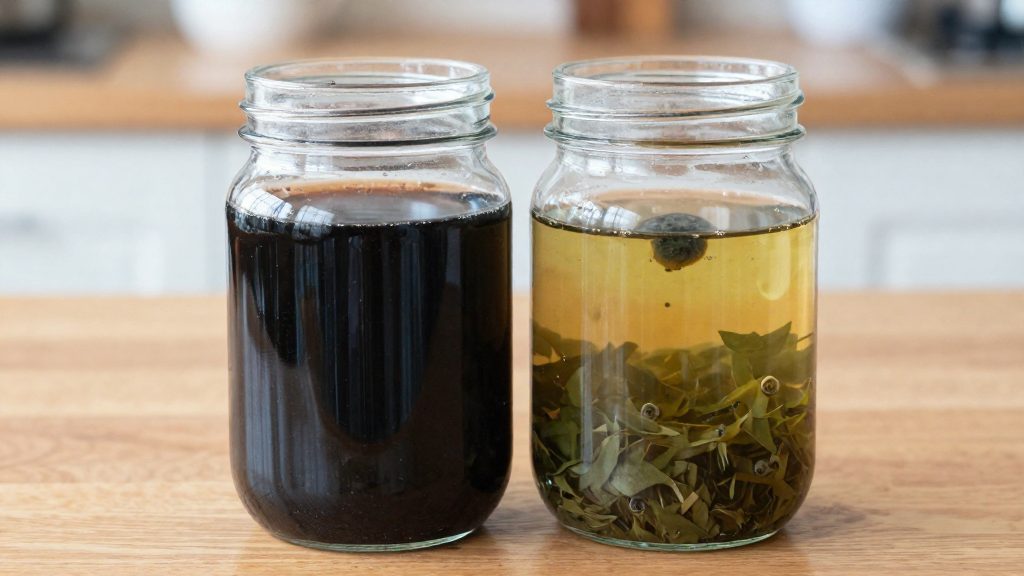
Honey kombucha and Jun are related fermented drinks, but they are not interchangeable. Honey kombucha is a kombucha-style brew in which honey replaces sugar as the food for the culture. Jun is a related fermented tea made with green tea and honey, and it uses a honey-adapted culture (Craftabrew, 2026). Traditional Cooking School (2026) says a regular kombucha SCOBY works with honey and that a Jun SCOBY is needed only for “official” Jun. Jun is defined by both its green tea base and the culture it uses, so it is not simply a green tea version of honey kombucha.
The two drinks differ on three points:
- Tea base: Jun is made with green tea.
- Culture: Jun uses a honey-adapted culture.
- Official Jun: Traditional Cooking School (2026) says a Jun SCOBY is needed only for “official” Jun.
In practice, a brewer making honey kombucha does not need a Jun culture. A brewer who wants “official” Jun needs a Jun SCOBY (Traditional Cooking School, 2026).
How much honey replaces sugar?
A standard kombucha recipe calls for about 1 cup of sugar per gallon of tea. Traditional Cooking School (2026) uses about 3/4 cup of raw honey per gallon instead. That gives a starting point of about 3/4 cup of raw honey per gallon, against about 1 cup of sugar per gallon in a standard recipe. Do not treat it as a fixed conversion formula: honey’s sugar content varies, so scale up only after testing a small batch.
Treat this figure as a starting point, not a fixed rule. Honey is less predictable than sugar because its sugar content changes from one batch to the next. Craftabrew (2026) notes that this variation makes results harder to predict. Sugar is a consistent, known quantity, but two jars of honey with the same label can contain different amounts of fermentable sugar. The same 3/4 cup can therefore produce a different sweetness, acidity, and fermentation pace from one brew to the next.
The practical approach is to compare results over time. Keep the following for each brew:
- The honey’s label, producer, or lot, if known
- The volume of honey used per gallon
- The date you started and the date you first tasted the brew
Comparing these records across batches shows whether a given honey runs sweeter or more tart than your usual sugar brew, and lets you adjust the next dose.
Does honey’s antimicrobial power harm the SCOBY?
Honey is fermentable, but it does not behave like sugar in kombucha. Craftabrew (2026) reports that honey contains antimicrobial compounds that can slow or change fermentation, so the practical question is whether a standard SCOBY can handle honey over repeated batches.
Effect on fermentation
Craftabrew (2026) describes the result as slower or altered fermentation.
Long-term suitability of a standard SCOBY
The sources differ in emphasis:
| Approach | Source |
|---|---|
| A standard kombucha SCOBY is not always suited to long-term honey fermentation | Craftabrew (2026) |
| Blend honey with sugar, or reserve honey for secondary fermentation | Craftabrew (2026) |
| A regular kombucha SCOBY works with honey | Traditional Cooking School (2026) |
Visible signs of SCOBY stress
In general home brewing practice, watch for:
- Acidification that is clearly slower than your usual sugar batches
- A SCOBY that thins, discolours, or fails to form a new layer between batches
- Odours that go beyond the normal vinegar note
How to switch your SCOBY to honey safely
Moving a kombucha culture from sugar to honey is a trial-and-error process, not a one-step swap. The method below keeps your original sugar brew running while you test honey, so a poor result costs you one batch rather than your whole culture.
Step 1: Split the SCOBY
Start with a healthy, established sugar batch. Divide the SCOBY and some of its starter liquid between two clean vessels. Run a parallel batch: one vessel stays on sugar as your control, and the other receives honey. Traditional Cooking School (2026) recommends this split to reduce risk.
Step 2: Cool the tea before adding honey
Brew the tea as usual, then let it cool before adding any honey. Do not pour raw honey into hot tea. Traditional Cooking School (2026) advises cooling the tea first because heating raw honey degrades its enzymes. Add the honey to the test vessel only, once the tea has cooled, so the control stays on sugar.
Step 3: Choose the culture and label the jars
Use your regular kombucha SCOBY unless you specifically want official Jun (see the Jun section above). Label both jars with the sweetener and start date so you can compare them later.
| Element | Control batch | Test batch |
|---|---|---|
| Culture | Split portion of your original SCOBY | Split portion of the same SCOBY |
| Sweetener | Sugar | Raw honey, added to cooled tea |
Step 4: Allow extra ferment time
Taste both batches on the same schedule, but do not judge the honey batch against a fixed timeline. Traditional Cooking School (2026) notes that the SCOBY may need extra ferment time to adjust to honey. Compare the honey batch against the sugar control, and keep the honey batch fermenting until its flavour and acidity match your expectations.
Why honey kombucha is less fizzy
Raw honey does not carbonate the way sugar does (Seven Days, 2026), so a honey batch can finish with less natural fizz than a sugar batch. Craftabrew (2026) notes that honey is fermentable but “behaves very differently than sugar,” which makes the outcome harder to predict. Carbonation depends on the culture converting available sugar into carbon dioxide while the bottled brew is still fermenting, so the sugar the culture can use shapes how much gas stays dissolved.
Seven Days (Vermont, 2026) reports that one Vermont honey kombucha producer finishes its brew with a stream of CO2. The gas is added at the end of production, so the fizz in that drink does not come only from the culture’s own fermentation.
Is honey kombucha safe? Food safety notes
Honey kombucha is less predictable than a sugar batch, so no single check shows that a brew is safe. Combine acidity, surface inspection and bottle-pressure checks. Safety checks depend on observation at each stage: measure acidity, inspect the surface, and watch bottle pressure, rather than relying on a fixed timetable.
Acidity monitoring during fermentation
Acidity is the main indicator of how far a brew has progressed. To track it:
- Test with pH strips or a pH meter at regular intervals and log each reading against the batch date.
- Taste the brew alongside each test. A shift from sweet toward sour shows that fermentation is progressing.
- Compare readings with a batch you have already tested and found acceptable. A personal reference from your own records is the most reliable benchmark.
Mold recognition and discard criteria
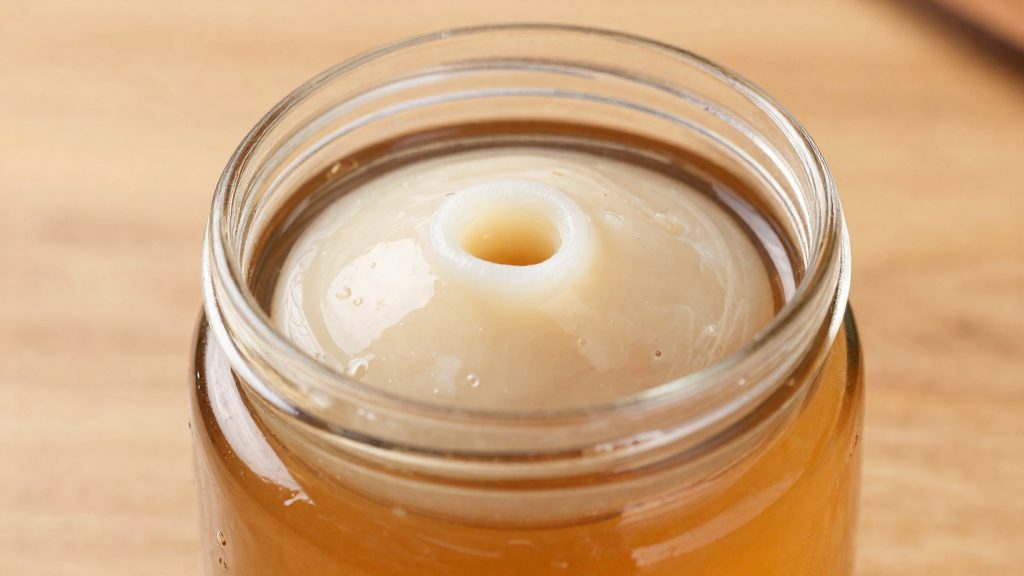
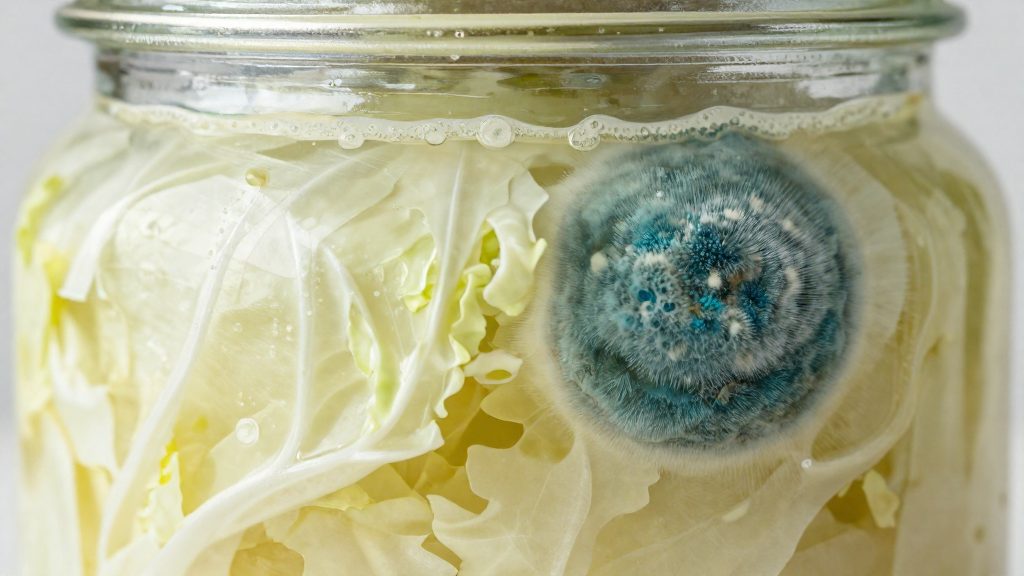
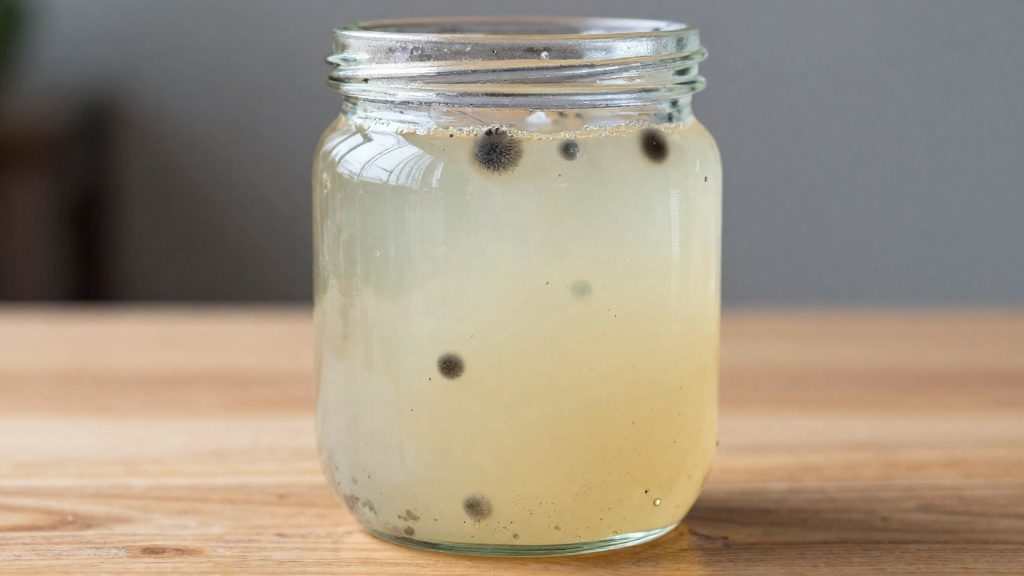
Mold is the clearest reason to discard a batch. Mold usually appears as raised, fuzzy or powdery spots in white, green, blue or black. A healthy SCOBY is a smooth, rubbery layer that is typically cream to tan in colour. Some changes in colour or texture are harmless, but if you are unsure whether a spot is mold, discard the batch rather than risk drinking it.
| Check | Normal sign | Discard sign |
|---|---|---|
| Surface texture | Smooth, rubbery layer | Fuzzy, raised or powdery spots |
| Surface colour | Cream to tan | Any coloured spot (green, blue, black) |
| Smell | Tart, vinegar-like note | Rotten or otherwise off smell (do not taste) |
If mold appears, discard the whole batch, including the SCOBY and the liquid.
Bottle pressure and explosion risk
Sealed bottles with active fermentation can build internal pressure. Pressure can build with active fermentation and is a hazard in its own right, so check sealed bottles regularly.
Handle sealed bottles with these precautions:
- Open bottles slowly over a sink, pointing the cap away from your face and body.
- Chilling bottles before opening can reduce gas release, but it does not remove the pressure, so still open them slowly and with care.
- Check bottles regularly for bulging or hissing.
Frequently asked questions
Can I swap honey for sugar one-to-one in kombucha?
No. Traditional Cooking School (2026) starts from about 3/4 cup of raw honey per gallon, compared with about 1 cup of sugar per gallon in standard recipes, but this is a single starting dose for one gallon, not a ratio to scale. Because honey’s sugar content varies between batches, test a small batch before you change a larger one.
Will honey kombucha be as fizzy as a sugar batch?
Usually not. Seven Days (2026) reports that raw honey does not carbonate the way sugar does, and that one Vermont honey kombucha producer finishes its brew with a stream of CO2.
How can I tell whether a honey batch is safe to drink?
No single check proves a brew is safe. Discard any batch with mold, and never taste a brew that smells rotten. Combine a pH test, a close surface inspection and slow, careful opening of sealed bottles.