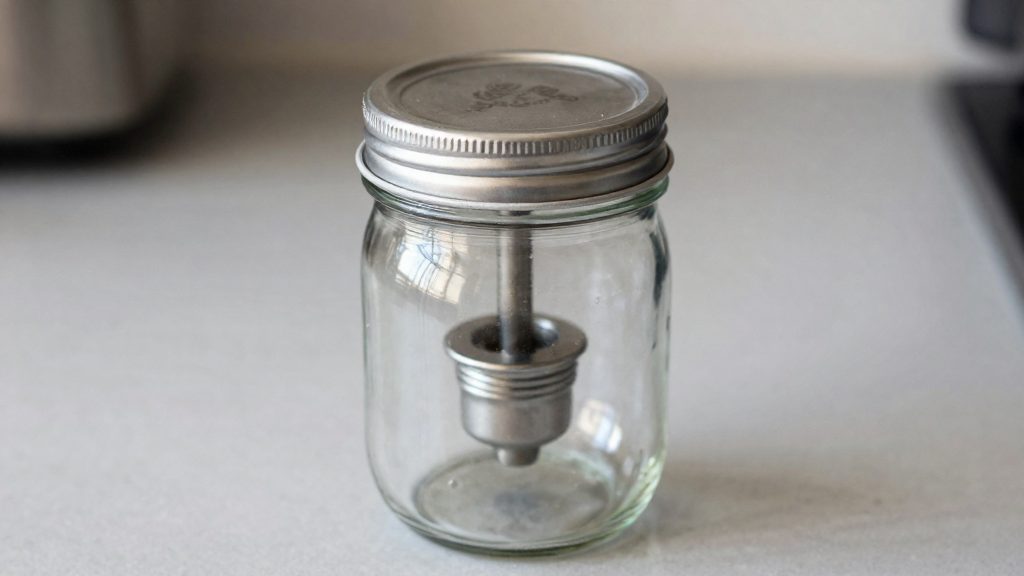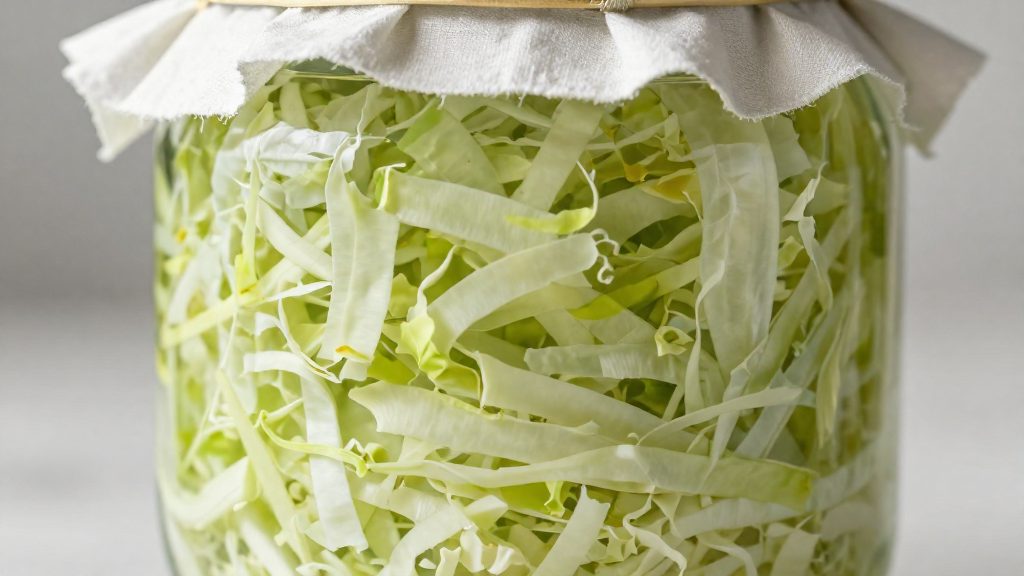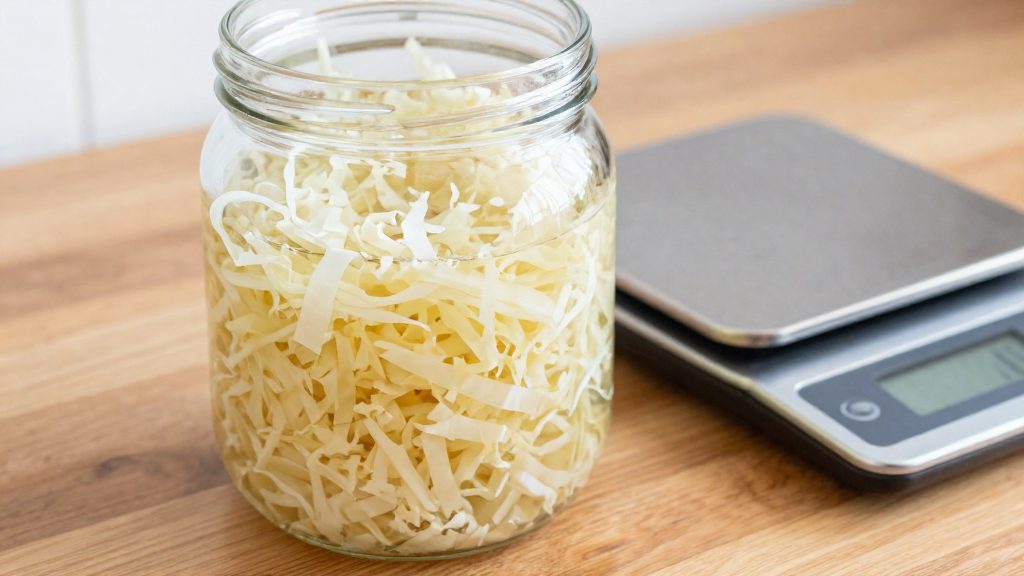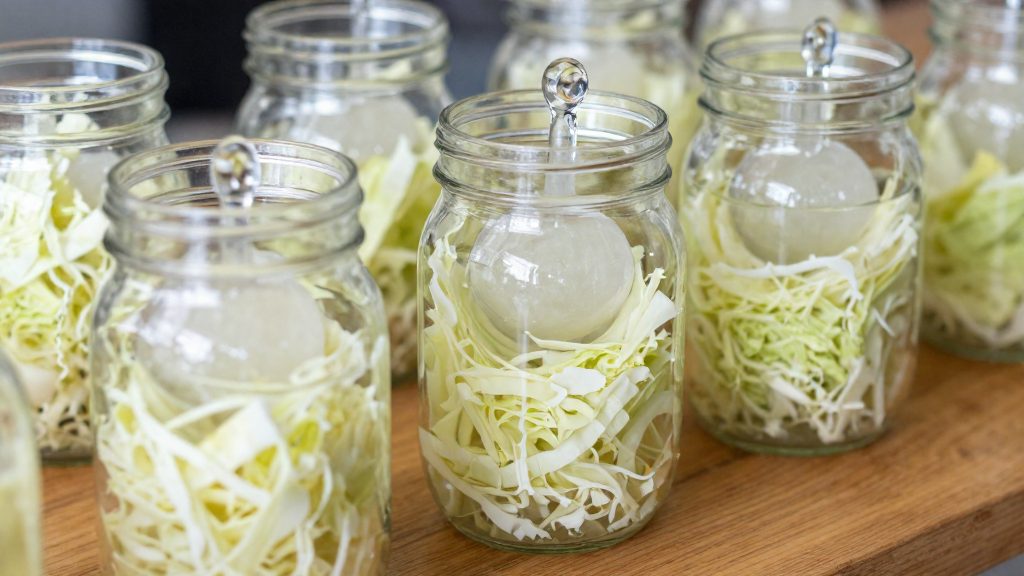
Jar ferments need a weight to keep the vegetables under the brine. Produce that rises above the liquid is exposed to air, and that exposure is what allows mold and spoilage to develop. According to MakeSauerkraut.com (2026), the weight’s job is to keep the vegetables under the brine so they have less contact with air, which reduces both problems.
Why do jar ferments need a weight?
Any piece of cabbage, carrot or pepper that sits above the liquid line loses the protection of the brine and is exposed to the air in the headspace of the jar. The weight holds the batch down so that the surface stays covered. Because the risk comes from exposed pieces, checking the vegetables for floating or partly exposed pieces is part of routine maintenance, not only a step at packing time.
A weight has to keep its position over the whole fermentation, not only at the start. In a 28-day test reported by MakeSauerkraut.com (2026), all of the weights kept the cabbage under brine through week 1. By day 28, the brine cover had changed considerably:
| Weight | Brine over cabbage at day 28 |
|---|---|
| Pickle Helix (spring) | 12 mm |
| Kraut Source | 1 mm |
| Pickle Pebble (glass) | 0 mm |
| Easy Weight (glass) | 0 mm |
The test used dry cabbage and was a single trial, so it shows a trend in one setup rather than a general rule for every jar. Still, it means a weight that worked on day 1 may not keep the vegetables covered by day 28.
Glass, spring or gate: which type works best?
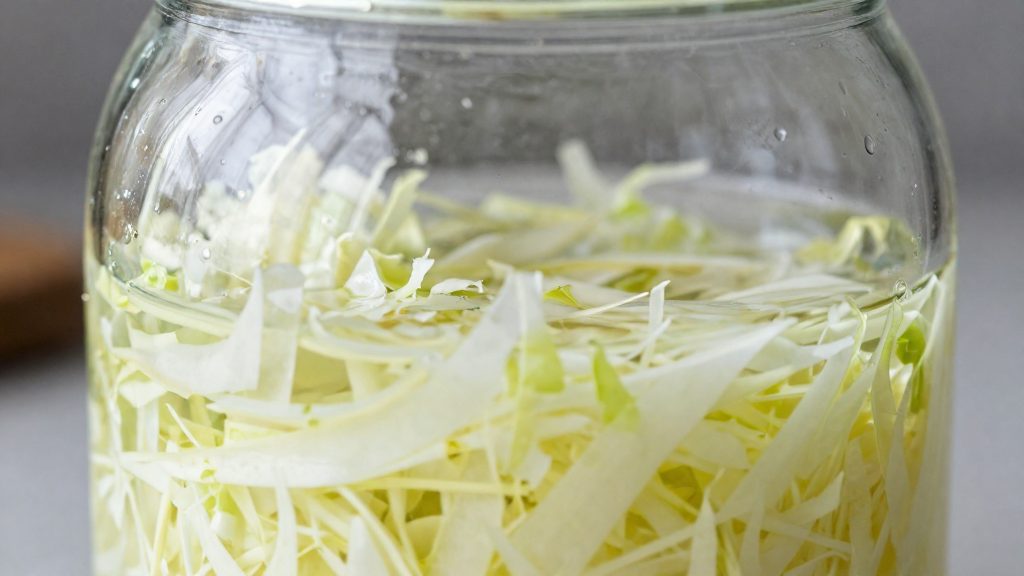
In a 28-day test on dry cabbage, the spring-type weight, the Pickle Helix, kept the most brine over the vegetables. The Pickle Helix spring still had 12 mm of brine above the cabbage on day 28, while the Kraut Source had 1 mm. The two glass weights tested, the Pickle Pebble and the Easy Weight, had 0 mm, meaning the cabbage was no longer covered by brine.
| Weight | Style | Brine over cabbage at day 28 | Listed weight |
|---|---|---|---|
| Pickle Helix | Stainless-steel spring | 12 mm | Not stated |
| Kraut Source | Not stated | 1 mm | Not stated |
| Pickle Pebble | Glass | 0 mm | About 142–159 g |
| Easy Weight | Glass | 0 mm | About 176–182 g |
In the test, the one spring weight kept the most brine over the cabbage at day 28. The sources do not explain why, and a single trial cannot show that the design is the cause. The two glass weights, listed at about 142–159 g and 176–182 g, had 0 mm of brine over the cabbage on day 28. This single test does not establish why. The sources do not state which style the Kraut Source is, so no brine-coverage figure can be attributed to a gate-style weight.
What size fits regular and wide-mouth jars?
A fermentation weight has to match the opening it sits in. According to FermentHive (2025-12-29), wide-mouth jars need weights of about 70 mm, and standard-mouth jars need weights of about 53 mm. A weight that is too large will not pass the opening, and one that is too small will slide down past the vegetables and stop holding them under the brine. These figures are targets, so measure your own jar before ordering.
| Jar opening | Target weight size |
|---|---|
| Wide-mouth | about 70 mm |
| Standard-mouth | about 53 mm |
Measuring your jar
Use a ruler or caliper to measure the inside of the opening from one inner edge to the opposite inner edge. Measure at the narrowest point, not the outer edge of the rim. Compare the result with the diameter listed for each weight. The weight must be slightly smaller than your opening so it passes through. The 53 mm and 70 mm figures are weight sizes, not opening sizes, so check the product’s stated jar compatibility.
Gate-style weights differ from disc or pebble weights because they lock into the jar neck instead of resting across the opening. For this type, the neck dimension matters as much as the overall diameter, so check the product’s stated jar compatibility before purchase.
Setting the headspace
Headspace is the empty gap between the top of the ferment and the rim of the jar. The MakeSauerkraut.com author (2026) recommends headspace of 1 to 2 inches. Converted to metric, that is about 25 to 51 mm (1 inch equals 25.4 mm).
When the weight is placed, the vegetables should sit below the weight, leaving the full 1 to 2 inch gap between the brine line and the rim. A weight that sits too high in the jar reduces this gap and can leave less room for the ferment to expand during active fermentation.
Top weight picks from the MayFair Farms roundup (not tested here)
The three picks named in the MayFair Farms roundup (2026-07-06) are the SOLIGT 4-pack as editor’s choice, the Masontops Pickle Pebbles wide-mouth as best value, and the Luna Glass Crock Weights as the premium option for crocks. Match the weight to your vessel first: the mouth diameter of a jar decides whether a wide-mouth or standard-mouth weight will fit, and the crock option is for larger open vessels.
SOLIGT 4-pack (editor’s choice)
The roundup lists the SOLIGT 4-pack as its editor’s choice and groups it with wide-mouth 4-packs, which are listed at about 6–9 oz per weight, roughly 170–255 g (MayFair Farms, 2026-07-06). Check its material and exact dimensions on the product listing before you order. Its main use case is outfitting several wide-mouth jars at once, since a 4-pack supplies one weight per jar.
Masontops Pickle Pebbles wide-mouth (best value)
The Masontops Pickle Pebbles wide-mouth is the roundup’s best-value pick (MayFair Farms, 2026-07-06). It belongs to the Pickle Pebble family of glass weights (MakeSauerkraut.com, 2026). It suits cooks who want a dependable wide-mouth weight without paying for a premium design, and it works for batches of sauerkraut, kimchi, or pickled vegetables in wide-mouth jars.
Luna Glass Crock Weights (premium crock weight)
The Luna Glass Crock Weights is the roundup’s premium pick and is aimed specifically at fermentation crocks (MayFair Farms, 2026-07-06). Crocks are wider and deeper than jars, so a crock-specific weight is the logical choice when a jar weight would not cover the full surface. Confirm its dimensions and weight against the manufacturer’s specification before buying.
Weight size by jar mouth
| Pick | Roundup role | Target vessel | Data in sources |
|---|---|---|---|
| SOLIGT 4-pack | Editor’s choice | Wide-mouth jars | Wide-mouth 4-packs at about 6–9 oz per weight |
| Masontops Pickle Pebbles wide-mouth | Best value | Wide-mouth jars | Pickle Pebble glass weights at about 142–159 g |
| Luna Glass Crock Weights | Premium | Fermentation crocks | Dimensions not specified in sources |
Are glass weights safe?
Glass weights are typically made from lead-free soda glass according to one source, but the material alone does not settle the question. MakeSauerkraut.com (2026) states that glass weights are typically made from lead-free soda glass. Soda-lime glass is also non-porous, so it does not absorb brine the way unglazed clay does. Even so, confirmation from the seller that a specific weight is food-contact safe is still needed.
The main risks come from the other materials that are sold as weights:
| Weight material | Status stated by the sources | What to verify before use |
|---|---|---|
| Lead-free soda glass | Typical composition for glass weights (MakeSauerkraut.com, 2026) | A written lead-free or food-safe statement from the manufacturer |
| Marbles | May not be food-safe unless confirmed lead-free (MakeSauerkraut.com, 2026) | Written lead-free confirmation for that exact product |
| Unglazed ceramic | Porous; MayFair Farms (July 2026) advises against it, while FermentHive (December 2025) says it suits large crocks | Whether the piece is glazed, and whether it is sold for crock use |
| Plastic | Possible leaching into the ferment (MayFair Farms, July 2026) | Food-contact rating from the manufacturer, if the product claims one |
Why marbles need extra checking
Marbles are often sold as cheap weights, but the sources do not establish that they are made of lead-free glass. MakeSauerkraut.com (2026) says they may not be food-safe unless the manufacturer confirms they are lead-free. A marble with no composition information should not be placed in a batch that will be eaten.
Why porous and plastic weights are a concern
Porous material can hold onto brine and the microorganisms in it, which makes cleaning less reliable. Plastic raises a different concern: MayFair Farms (July 2026) flags leaching as a possible risk. Neither material is a safe default for the jar, so the buyer should choose glass with a clear composition statement, or a weight designed for the intended vessel.
Confirming the material
Check the product listing or packaging for the words “lead-free” or “food-safe,” and for the material name. If the seller does not state the composition, the material should be treated as unverified. This is the step that separates a well-documented glass weight from an unlabeled one.
How do you clean and maintain weights?
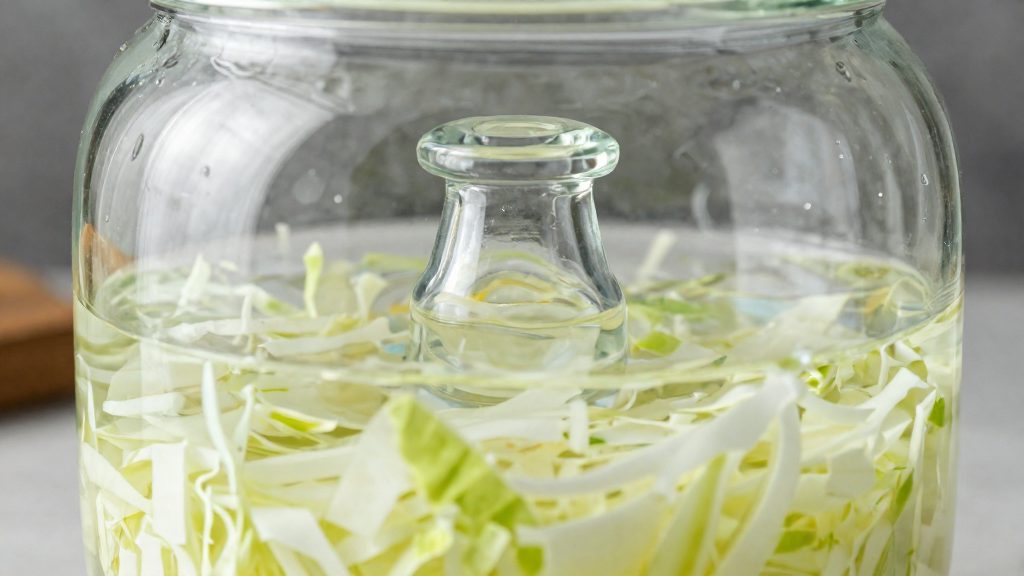
Glass fermentation weights are the simplest type to maintain. According to FermentHive (2025), glass is dishwasher safe, so a weight can be cleaned with the same routine as other kitchen utensils. Maintenance comes down to three habits: wash the weight after every batch, inspect it before the next one, and remove it from service if it is damaged.
Cleaning after each batch
Brine and vegetable residue can cling to the surface and the edges, so clean the weight as soon as you empty the jar.
| Step | When | Action |
|---|---|---|
| Rinse | Immediately after emptying the jar | Remove brine and vegetable residue under running water |
| Wash | After rinsing | Run through the dishwasher, or wash by hand with dish soap |
| Dry | After washing | Let it air-dry fully before storage or reuse |
Inspecting for chips before each batch
Glass can chip, and chips are easy to miss by eye. Before every new batch:
- Run a fingertip around the full circumference, since rough spots reveal chips that are hard to see.
- Check the flat face that rests against the vegetables.
- Hold the weight up to a light source to spot hairline cracks.
When to retire a weight
Retire the weight once any chip appears. Do not file the edge smooth or continue using it for a less demanding batch. A chip leaves a sharp point that can break further, and a damaged weight can shed fragments into the brine. Replace it with an undamaged weight of the same type and size before starting the next ferment.
Can you ferment without a weight?
Produce that rises above the brine is exposed to air. Without a weight you must check brine coverage by hand and press floating pieces down. Treat this as a fallback, not an equivalent. Without a weight, the work shifts from a fixed device to brine coverage checks that you carry out by hand.
Checking whether produce stays submerged
Look at the jar at each routine check and note any pieces that sit above the liquid. Weighted jars are not immune to drift. An unweighted batch has no device holding the vegetables down, so it needs the same attention.
Pressing produce down
Pressing means using a clean, washed utensil or clean hands to push floating pieces back under the liquid. Do this during each check, gently, so that the brine rises over the top layer. Press only what has surfaced and avoid disturbing the rest of the batch.
Topping up with brine
When pressing no longer keeps produce covered, topping up is the next step. Add brine made the same way as the original batch, with the same salt and water proportions. Plain water dilutes the salt in the brine, so it changes the batch’s conditions rather than restoring them.
Routine check sequence
- Confirm all produce is below the liquid surface.
- Press any floating pieces back under the brine.
- If pieces stay exposed after pressing, top up with matching brine.
- If exposed pieces show mold, sliminess or an off smell, do not eat the batch. When in doubt, throw it out.
What can you use in a pinch?
When no dedicated weight is available, the goal stays the same: keep every piece of vegetable below the brine. Cabbage leaves and glass objects are the two most common household substitutes, and each needs a different check before it goes into the jar.
Cabbage leaves as a cover
Outer cabbage leaves laid over shredded vegetables are a common improvised cover. The leaf can itself float or be exposed to air. Use the large, outer leaves, rinse them, and lay them flat across the top of the shreds so they press the layer down. Trim away any bruised or soft areas first, because decaying material under the brine is the spoilage risk the weight is meant to prevent. Since the cover is itself cabbage, it adds no foreign material to the jar.
Verifying any improvised object is food-safe first
Any object that touches the brine must be confirmed as food-safe before use.
Keeping improvised items fully submerged under brine
An improvised object must sit fully under the brine, and the vegetables must stay below it. Choose an object sized to the jar. Improvised items tend to float or shift, so press them down after each opening and recheck the brine level.
| Improvised item | Check before use |
|---|---|
| Outer cabbage leaf | Clean, unbruised, and sized to cover the shreds |
| Glass object | Fits the jar mouth |
Frequently asked questions
Which weight style should I start with for my first batch?
In one 28-day trial on dry cabbage, the spring weight (Pickle Helix) kept the most brine over the vegetables, with 12 mm still covering the cabbage on day 28. The two glass weights in that trial had no brine cover left by then, but a single trial with one spring product cannot show that spring weights work better in general.
How do I tell whether a weight will fit my jar?
Weight sizes are listed for wide-mouth and standard-mouth jars: about 70 mm for wide-mouth and about 53 mm for standard-mouth. These numbers describe the weight, so the weight should be slightly narrower than your jar opening to pass through it. Measure the opening yourself and compare it with the diameter in the product listing.
Are glass weights safe, and which materials should I avoid?
Glass weights are typically made from lead-free soda glass, according to MakeSauerkraut.com (2026). Marbles are not always food-safe, so use them only if the seller confirms they are lead-free. MayFair Farms (2026-07-06) advises against plastic weights because of possible leaching and against unglazed ceramic, which is porous.