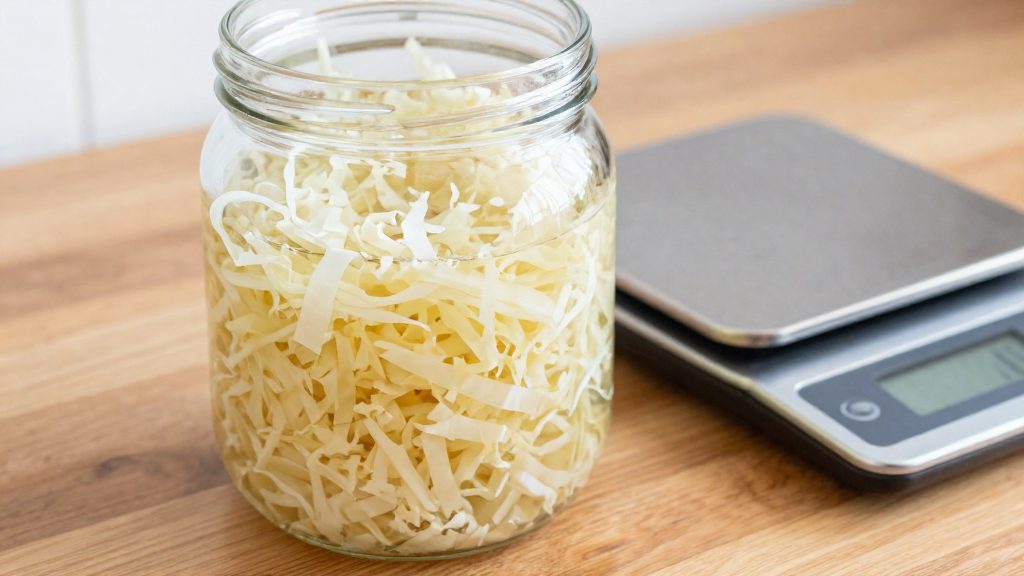
Salt does three jobs in sauerkraut at once. It draws water out of the shredded cabbage to form its own brine, it favors lactic acid bacteria over spoilage microbes, and it helps the shreds stay firm during fermentation. Each job depends on the salt being worked evenly into the cabbage and dissolved in the liquid it releases. That is why the amount matters: too little weakens the selection and the firmness, and it can also leave the cabbage with too little liquid.
Why salt matters in sauerkraut
Osmotic water extraction from shredded cabbage
When salt is massaged into shredded cabbage, it dissolves in the moisture on the leaves and creates a concentrated solution outside the cells. Through osmosis, water moves out of the cabbage cells to balance that concentration, so the cabbage releases its own liquid as it is worked. This liquid becomes the brine the kraut ferments in. Shredding increases the surface area exposed to salt, which speeds up this release.
If the salt is insufficient or unevenly distributed, the cabbage releases less liquid and parts of it stay dry.
Favoring lactic acid bacteria over spoilage microbes
Fresh cabbage carries a mixed population of microorganisms. Salt is a selective pressure rather than a sterilizer: it slows the growth of many spoilage and pathogenic bacteria, while lactic acid bacteria tolerate it far better. These bacteria feed on the sugars in the cabbage and produce lactic acid, which raises acidity and makes the environment hostile to competing microbes.
The selection happens in stages. Early in fermentation, Leuconostoc species typically lead, and as acidity increases, more acid-tolerant Lactobacillus species take over. Salt sets the conditions for this succession. If the salt level is off, the balance can tip toward spoilers before the acid has built up enough to protect the kraut.
Texture: keeping the cabbage crisp
Salt helps the shreds keep their firmness during the weeks of fermentation. It slows the softening of cabbage tissue, partly by limiting the microbial activity that breaks down plant cell walls and partly by reducing the water-loss that leaves cabbage limp. Firmness is a balance: enough salt helps preserve crunch, and the sourced amounts are starting points to adjust.
What is the right salt percentage for sauerkraut?
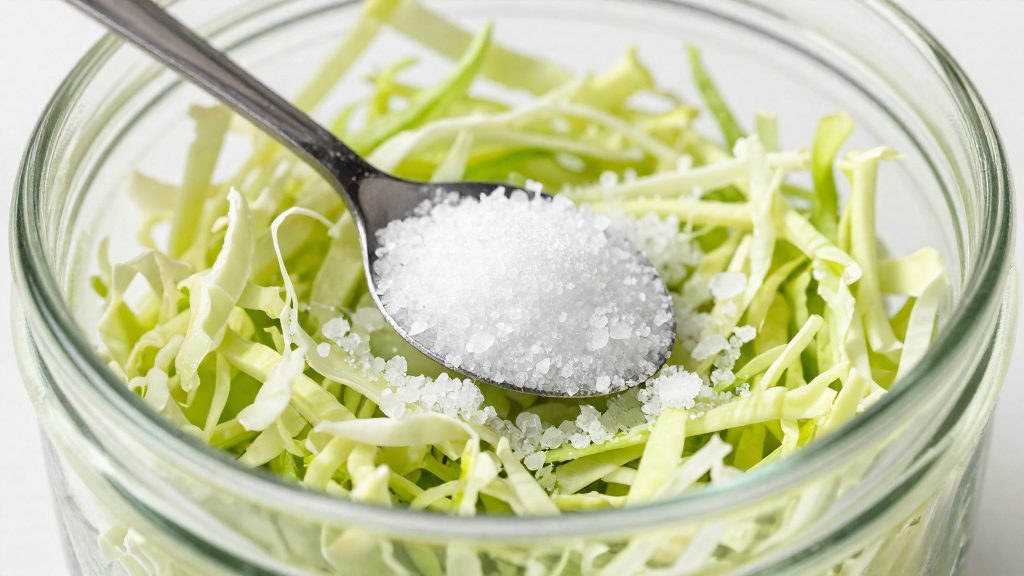
The standard sauerkraut ratio is 2% salt by weight of cabbage, according to Northern Brewer (2022). The salt is calculated from the mass of the vegetables, not from their volume or the size of the jar. The formula is: salt weight = vegetable weight × 0.02. Because 2% equals 1/50, you can also divide the vegetable weight by 50. The result is a fixed amount of salt for each batch, so you can scale a recipe up or down without measuring by volume.
The 2% baseline by total vegetable weight
Northern Brewer states the ratio for cabbage. When a batch includes other vegetables, the practical approach is to use the total vegetable weight as the base, so every ingredient entering the crock is included in the calculation. This keeps the salt proportion consistent across recipes that mix cabbage with other produce.
Worked example: 2,000 g needs 40 g
The following table applies the 2% ratio to three batch sizes:
| Vegetable weight | Salt at 2% |
|---|---|
| 1,000 g | 20 g |
| 2,000 g | 40 g |
| 3,000 g | 60 g |
To use this method, place a container on the scale, tare it to zero, add the cabbage, and record the weight. Multiply that figure by 0.02 to get the salt.
Counting carrots, onions and other add-ins
Weigh each add-in separately and add it to the cabbage weight before calculating the salt. The example below shows a mixed batch:
| Ingredient | Weight |
|---|---|
| Cabbage | 1,800 g |
| Carrot | 150 g |
| Onion | 50 g |
| Total vegetable weight | 2,000 g |
| Salt at 2% | 40 g |
It keeps the salt amount tied to the actual mass of vegetables in the crock.
Weight vs. spoonfuls: how to measure
Weigh the salt whenever you can. Measuring by volume with spoons is a simpler alternative, using a rule of thumb of about 1½ teaspoons per pound of cabbage. Both methods give a starting point, but weighing makes it easier to repeat the same brine strength from batch to batch.
Scale precision: grams versus spoon volume
| Method | Basis | Starting point | Source (date) |
|---|---|---|---|
| Weight | Salt as a percentage of cabbage weight | 2% of cabbage weight | Northern Brewer (2022-11-10) |
| Volume, standard | Teaspoons per pound of cabbage | 1½ teaspoons per pound | Tasting Table (2024-04-03) |
| Volume, saltier | Teaspoons per pound of cabbage | 2 teaspoons per pound | Tasting Table (2024-04-03) |
A kitchen scale that reads in grams lets you match the percentage directly. You weigh the cabbage first, then weigh the salt needed for that weight. Because the ratio is tied to the cabbage, you only need to re-weigh when the cabbage weight changes.
Spoon measurements depend on how the spoon is filled, so they are less consistent than weight. Use them when no scale is available, and level each spoonful the same way every time.
The 1½-teaspoon rule per pound
The volume rule of thumb is 1½ teaspoons per pound of cabbage (about 454 g). Tasting Table (2024-04-03) describes it as a starting point, not a fixed amount. To apply it:
- Weigh or estimate the cabbage in pounds.
- Multiply the pounds by 1½ to get the number of teaspoons.
- Mix the salt into the shredded cabbage and wait until the cabbage releases liquid before adding any more brine.
The 2-teaspoon version for a saltier result
Tasting Table (2024-04-03) also gives 2 teaspoons per pound as the version for a saltier result. Choose this only if you want a stronger salt flavour, since it moves the batch further from the standard 1½-teaspoon starting point.
How much salt for a quart jar or crock?
The USDA-based reference for sauerkraut is 3 tablespoons of salt per 5 lb of cabbage, as set out by the National Center for Home Food Preservation (University of Georgia) (2015). Scaling that ratio to a quart jar or a larger crock is simple arithmetic, but the result depends on the weight of the cabbage you actually put in, not on the size of the container. Two references are worth keeping side by side: the volume rule and the weight rule.
The two reference ratios
| Reference | Basis | Salt rate | Source |
|---|---|---|---|
| USDA-based recipe | Volume, per 5 lb cabbage | 3 tablespoons | NCHFP (2015) |
| Volume rule of thumb | Volume, per lb cabbage | 1½ to 2 teaspoons | Tasting Table (2024-04-03) |
| Weight standard | Weight of cabbage | 2% of cabbage weight | Northern Brewer (2022-11-10) |
The USDA figure works out to 9 teaspoons across 5 lb, or 1.8 teaspoons per lb. That sits inside the 1.5 to 2 teaspoon range from Tasting Table, so the volume references agree with each other. The 2% weight standard is the more precise check, because the same volume of salt can weigh differently depending on grain size.
Scaling down to a quart jar
A quart is a unit of volume, so scale from the weight instead. If you only have volume measures, use the 1.5 to 2 teaspoons per lb range as a cross-check.
A jar filled with 500 g of cabbage needs 10 g of salt at the same 2% rate.
Scaling up for larger crocks
Salt scales linearly with cabbage weight. Doubling the cabbage doubles the salt, and the percentage stays fixed. Work this way to avoid overshooting:
- Keep the target at 2% for the default case.
- Do not round up to the next spoonful. At these small quantities, a rounded spoon can add a noticeable percentage.
Divide the salt into equal portions if you prefer to add it in stages.
Does temperature change the salt you need?
Yes. Room temperature affects both the salt percentage and the time fermentation takes. In a cooler room, the lactic acid bacteria work more slowly, so the batch needs more time. In a warmer room, they work faster, and extra salt helps keep the pace under control. According to Tasting Table (2024), the usual adjustment is about 1.5% salt by weight of cabbage in colder environments and about 2.5% in warmer weather, where the extra salt slows fermentation. These figures adjust the 2% baseline for a room that is clearly colder or warmer than usual.
Temperature also sets the timeline. The National Center for Home Food Preservation (University of Georgia, 2015) gives the following ranges for sauerkraut:
| Room temperature | Expected outcome |
|---|---|
| 70–75°F (about 21–24°C) | Ferments in about 3–4 weeks |
| 60–65°F (about 15.5–18°C) | May take 5–6 weeks |
| Below 60°F (about 15.5°C) | Kraut may not ferment |
| Above 75°F (about 24°C) | Kraut may become soft |
The failure zones matter as much as the timing. A batch held below 60°F can stall without producing the sour flavour you expect. A batch above 75°F can ferment too quickly and lose its texture, so the crunch of the cabbage is gone even though the acidity is present.
Air temperature is not always the temperature of the crock. Corners near windows, exterior walls, or appliances can run several degrees colder or warmer than the rest of the room. Check the spot where the crock sits with a thermometer, and plan for the longer end of the timeline if that spot runs cool.
Which salt should you use?
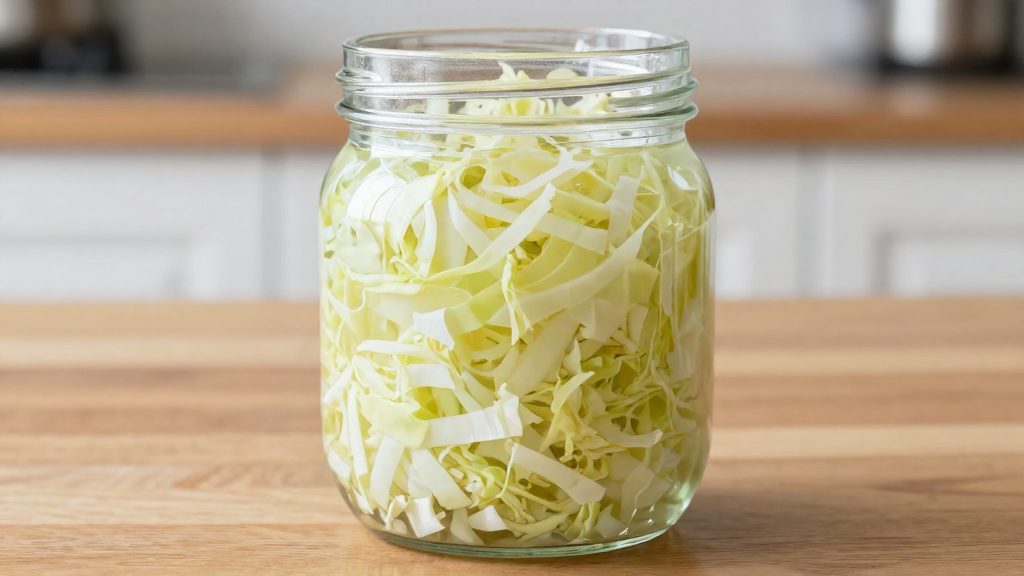
The salt you choose changes how clear the brine stays, how the kraut tastes, and how accurately a volume measure matches the weight you intended. The recipe sources in the reference material call for canning or pickling salt, and that is the safe default. These salts are sold without the additives found in many table salts, so the brine stays clear and the flavour stays clean.
Table salt often contains iodine and an anti-caking agent. Anti-caking agents keep the grains from clumping on the shelf, and they can dissolve differently from pure salt. The consulted sources do not specify how much cloudiness or discolouration these additives cause in sauerkraut, so treat the effect as a risk to check rather than a certainty. Read the ingredient label before you buy. If the only salt you have is iodised, use it, but expect a possibly cloudier brine and do not judge spoilage by cloudiness alone.
| Salt type | Typical additives | Suitability for kraut brine |
|---|---|---|
| Canning or pickling salt | None, per product label | Recommended by the NCHFP recipe |
| Iodised table salt | Iodine, often an anti-caking agent | Usable, may cloud the brine |
| Non-iodised table salt | Check label for anti-caking agent | Usable if free of additives |
Crystal size also matters. Fine grains pack more densely into a measuring spoon than flaky or coarse grains, so one teaspoon of one salt can weigh noticeably more or less than a teaspoon of another. This is why a volume measure can give a different salt content from one brand to the next. The per-pound volume guidance in the reference material is a starting point.
Can you fix a brine that is too salty or too weak?
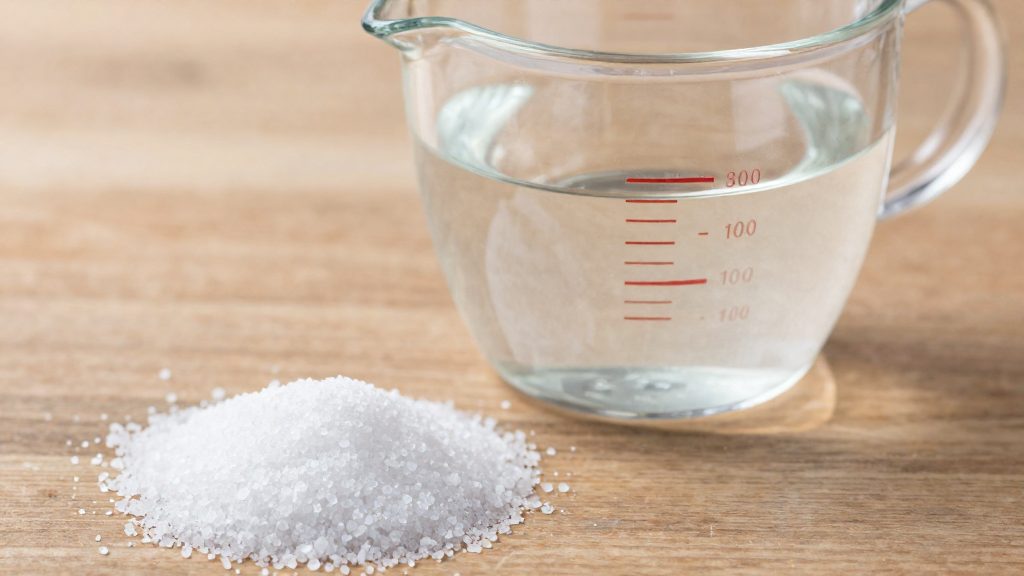
If the cabbage releases too little liquid to cover itself, you can top up the brine during fermentation. The sources give no way to correct a brine that is too salty or too weak in concentration. If the cabbage releases too little liquid to cover itself, the National Center for Home Food Preservation (University of Georgia) (2015) recommends adding a brine top-up of 1½ tablespoons of salt per quart of water. Dissolve the salt completely before pouring, and add only enough to bring the liquid level above the cabbage. Adding salt to the batch directly is not part of this guidance.
Topping up when the cabbage releases too little liquid
Cabbage normally releases its own juice once it is salted and packed, and that juice becomes the working brine. If the level drops well below the cabbage, add the 1½ tablespoons per quart solution gradually and recheck the level after each addition. Stop once the cabbage is covered. Mix the top-up brine in advance so the salt is fully dissolved before it goes into the crock or jar.
Diagnosing a brine that tastes too strong or too weak
Before changing the salt, check the temperature, because the guidance links fermentation speed and texture to it:
| Observation | Likely explanation in the guidance | Action |
|---|---|---|
| Kraut tastes too salty | Not stated | Adjust the salt in the next batch |
Keeping it safe: submerged and monitored
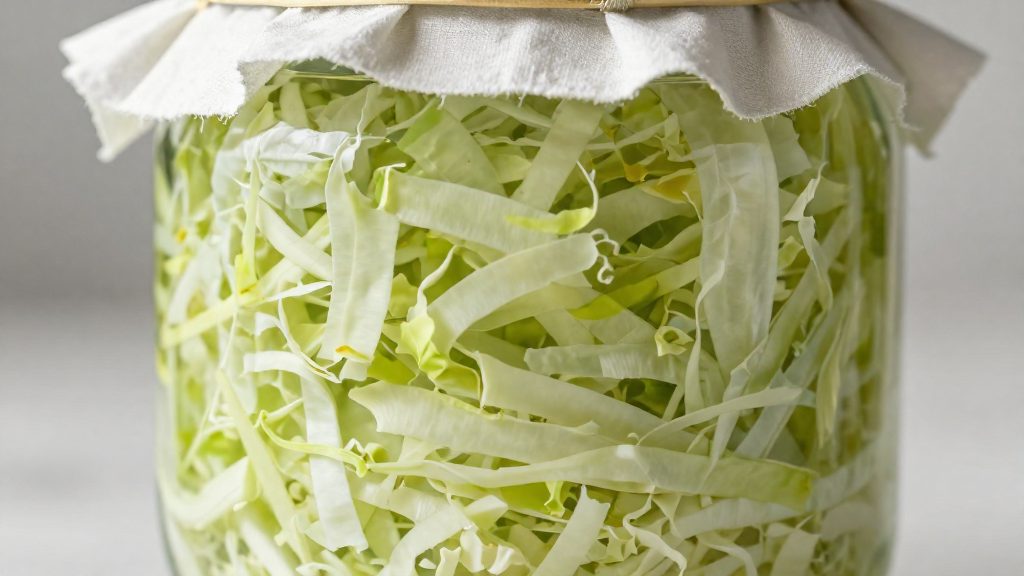
Once the cabbage is salted and packed, the main safety task is keeping every piece submerged in its own brine. Northern Brewer (2022) advises holding the cabbage under the liquid with a leaf or glass weight. Cabbage that rises above the brine is exposed to air, which is why the weight should stay in place for the whole fermentation.
Monitoring is the second task. The National Center for Home Food Preservation (University of Georgia, 2015) recommends checking the crock 2–3 times a week when jars are used as weights. Each check should confirm that the cabbage is still under the brine and that no scum has formed on the surface. Remove any scum as you find it.
| Task | Method | Source |
|---|---|---|
| Keep cabbage submerged | Leaf or glass weight holding cabbage under its own brine | Northern Brewer (2022) |
| Routine check | Inspect 2–3 times a week when jars act as weights | NCHFP (2015) |
| Scum control | Remove any scum on the surface at each check | NCHFP (2015) |
Storing finished kraut
When the kraut has finished fermenting, move it to cold storage. Northern Brewer (2022) states that refrigeration halts fermentation, and that refrigerated kraut keeps for many months. The NCHFP (2015) says refrigerated kraut keeps for several months, which is the more cautious guideline. Fully fermented kraut can also be canned, as the same source notes.
Frequently asked questions
How much salt do I need per kilogram of cabbage?
Northern Brewer (2022) gives a standard sauerkraut ratio of 2% salt by weight of cabbage. That works out to 20 g of salt per kilogram, so 2,000 g of cabbage takes 40 g.
Should I change the salt amount if my kitchen is warm or cold?
Tasting Table (2024) suggests about 1.5% salt in colder conditions and about 2.5% in warmer ones. Extra salt slows a warm-weather ferment, which helps when the room is hot. Keep the temperature in mind too: the NCHFP (2015) recommends 70–75°F (about 21–24°C), which takes roughly 3–4 weeks.
What if the cabbage doesn’t release enough liquid to cover itself?
The NCHFP (2015) recipe allows a top-up brine of 1½ tablespoons of salt per quart of water, added only when the cabbage cannot cover itself. This is not a fix for kraut that tastes too salty or too weak. Keep the shreds fully submerged under their own liquid, using a leaf or glass weight, as Northern Brewer (2022) recommends.