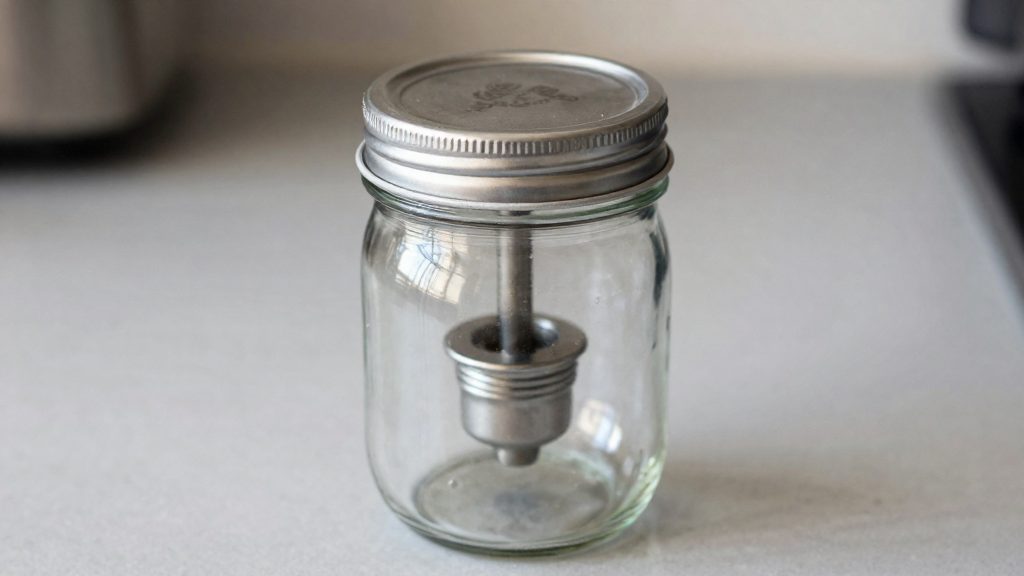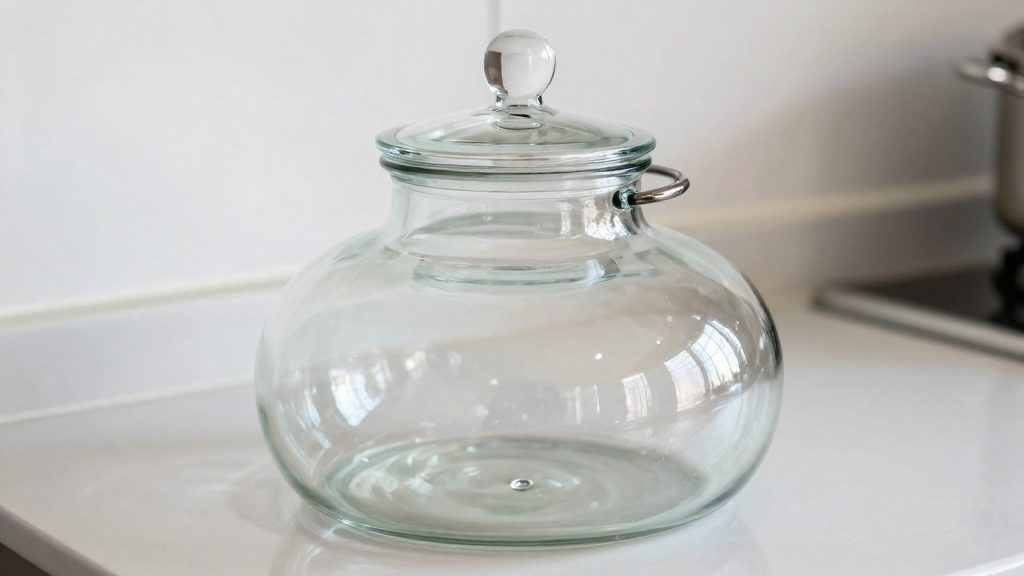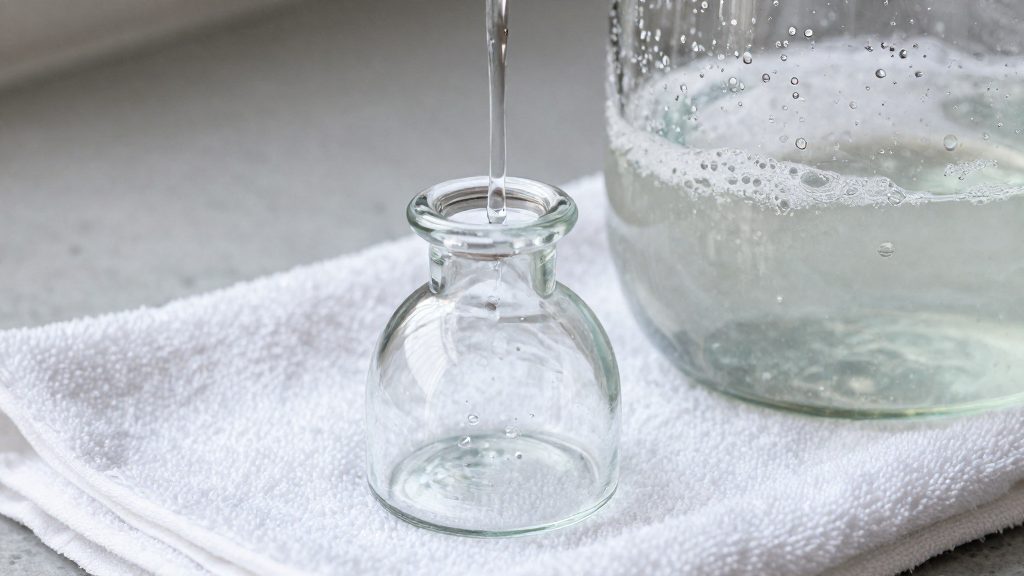
Residue on a glass fermentation weight matters because the weight stays in the ferment for the whole process, so anything left on its surface is in contact with the batch from start to finish. A weight that is not cleaned properly therefore contributes to the next batch as well as the current one. Residue left on a weight can carry over into the next batch, so cleaning between batches matters.
Why clean glass fermentation weights?
Contamination risk from residue
Dried brine, vegetable particles and biofilm left on a weight can transfer to the next batch. Because the weight is submerged or sits at the brine line for the full run, any material on it is in direct contact with the vegetables throughout fermentation. A batch that starts clean can pick up traces from a previous one simply because the weight was reused without being cleaned between uses.
Mold and kahm yeast from neglected weights
Kahm yeast and mold typically grow at the surface of a ferment, where they are exposed to air, and a weight that is left unwashed can provide them with a foothold. Residue that dries on the weight or on the part of it that sits above the brine can give these organisms a foothold near the surface of the ferment. Clean the weight before it goes into a new jar rather than relying on how it looks.
Cleaning between batches
Fairment (2026) describes the sequence as follows: once fermentation is stopped, clean the fermenter tops and the glass weights, then reuse them for the next fermentation. The cleaning step belongs at the end of each batch, not at the start of the next one, so that the weight enters a new jar already clean.
How do you wash glass weights by hand?
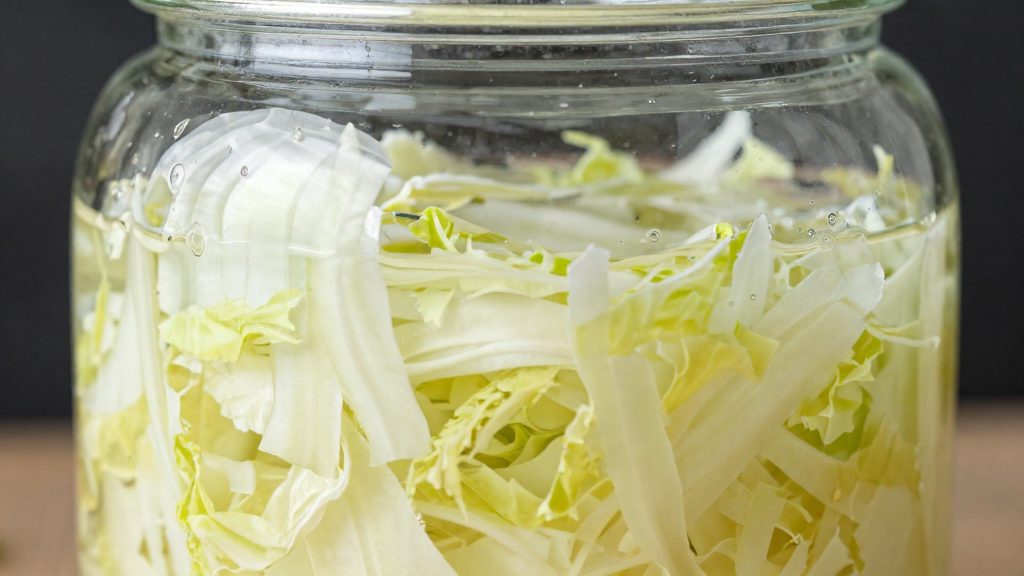
Washing a glass fermentation weight by hand takes three stages: scrubbing with dish soap and a brush, rinsing until no soap remains, and drying and inspecting the weight before it returns to a jar. According to Farmsteady (2026), ordinary dish soap and a brush are the recommended tools for a hand scrub.
| Step | What to do | Check before moving on |
|---|---|---|
| Scrub | Work dish soap over every face, edge and groove with a brush | No visible brine film or food particles |
| Rinse | Run water over all sides until soapy water drains off | Surface no longer feels slick |
| Dry | Dry with a clean towel or air-dry on a rack | Surface is fully dry |
| Inspect | Look and feel for chips and cracks | No damaged edges before reuse |
Scrubbing the weight surface
Use a brush rather than a sponge alone, since a sponge tends to skip the edges and any grooves where residue collects. Treat the top, the sides and the base as separate passes. The goal is to lift the film of brine, vegetable pulp and oils from the surface. A thorough scrub removes visible residue; sanitizing, covered below, is a separate optional step.
Rinsing to remove soap traces
Rinse under running water and turn the weight so that soapy water drains from every face. Keep rinsing until the surface no longer feels slick, then give it one final pass with clean water. Soap left on the glass is the main thing to avoid carrying into the next ferment, so treat rinsing as a separate step rather than a quick finish to scrubbing.
Drying and inspecting before reuse
Dry the weight with a clean towel or let it air-dry on a rack. Drying fully before storage helps keep the weight ready for the next fermentation. Once dry, inspect the glass for chips, cracks and rough edges. Set aside any weight with damage rather than returning it to a jar, because a compromised edge can be difficult to see once the weight is submerged in brine.
Can glass fermentation weights go in the dishwasher?
Farmsteady (2026) states that its glass fermentation weight is dishwasher safe. The dishwasher is an option the manufacturer approves for its own weight, though not the method the brand emphasises. Check the label of your own weight.
What the manufacturer claim covers
The dishwasher-safe claim tells you the glass tolerates a machine cycle. It does not tell you that every dishwasher cycle, rack position or detergent will leave the weight in the same condition.
Loading position
Keep these points in mind when loading:
- Place the weight on a rack where it will not knock against other glassware, bowls or metal items during the spin.
- Keep the weight away from the rim of a wine glass or jar that could sit against it and cause contact damage.
- Avoid wedging the weight between cutlery or stacking it on top of plates, which can shift during the cycle.
- Position it so the weight does not rest against the heating element or the spray arm’s path, where it can move unpredictably.
Detergent and rinse aid
Standard automatic dishwasher detergent is designed for glassware, and that is the general category most users reach for. Avoid abrasive powders or scouring products, which can scratch the surface. Rinse aid is typically used to prevent water spotting on glass; it does not change the weight’s fermentation-related properties.
How to sanitize weights between batches
Sanitizing targets the surviving microbes that washing alone can leave on a glass fermentation weight. A sanitizing step works on the weight’s surface after cleaning.
Sanitizer options
Three approaches are commonly used between batches:
- Hot water: Rinse the weight with hot water after cleaning. Let the glass cool gradually to avoid thermal shock.
- Vinegar: A vinegar rinse can be applied to the weight after washing.
- Diluted sanitizer: A food-safe sanitizer mixed at the dilution printed on its label. Mixing it stronger than the label states is not recommended.
Contact time
For a commercial sanitizer, the contact time on its label is the figure to follow. For hot water and vinegar, the weight should stay wet with the solution for as long as the rinse is applied, then be rinsed clear before reuse.
When to sanitize
The natural sanitizing point is the gap between stopping one ferment and starting the next. Each weight is sanitized once per batch, at that point, rather than at a fixed interval.
Removing residue, film and cloudiness
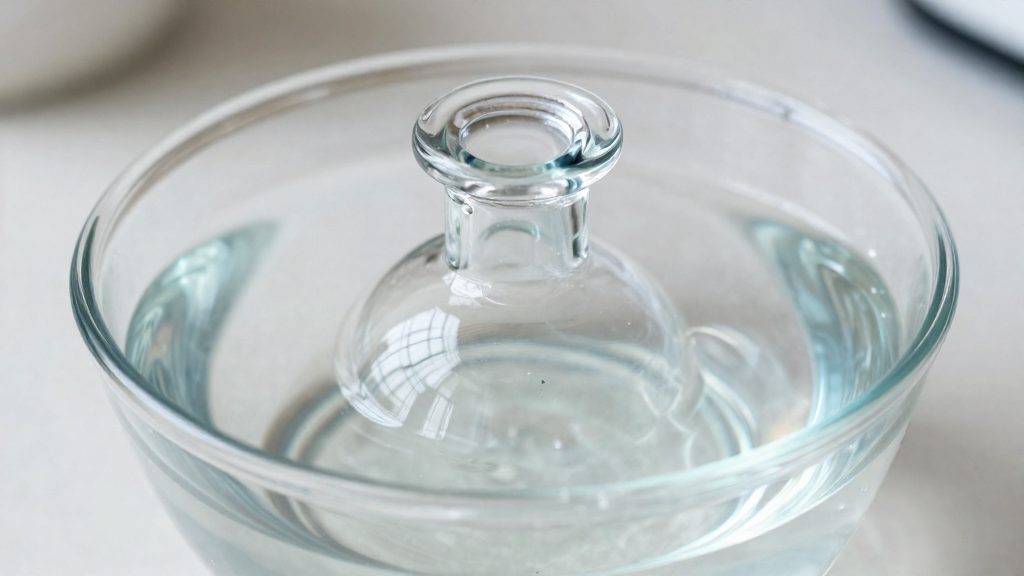
Residue on a glass fermentation weight comes from three sources: mineral deposits from hard water, dried salt from brine, and plant fragments that stick to the surface. Removing it means dissolving or lifting what has built up, and each type calls for a slightly different approach. The acid soak described below is a common approach for mineral deposits.
Hard water mineral film and white haze
A whitish, cloudy film usually consists of mineral deposits left behind as water dries on the glass. It builds up after repeated contact with hard water and is most visible on weights that air-dry on a counter. Inspect the weight after each batch rather than on a fixed schedule.
Acid soaks are the usual approach in home fermentation, because mineral deposits such as calcium carbonate dissolve more readily in acid than in plain water. White vinegar and citric acid are the two options most often used. Begin with a weak solution, soak the weight until the film loosens, and strengthen the mix only if a film remains.
Brine salt crust and dried vegetable residue
Salt crust forms when brine evaporates on the glass and leaves white crystals around the rim and at the brine line. Dried vegetable residue, such as cabbage fragments or spice particles, tends to cling near the top of the jar. Soaking in warm water dissolves the salt more easily than cold water, and the softened plant matter can then be brushed off.
Acid soak sequence and rinsing
Both acid treatments follow the same sequence: soak until the film loosens, scrub any remaining deposits with dish soap and a brush, then rinse until no vinegar or citric acid smell or taste remains. Dry the weight fully with a clean towel or on a rack before it returns to a jar. Appearance alone does not confirm the surface is clean, since a residual acid or soap film may not be visible on glass. Rinsing and drying are the steps that matter before reuse, because any acid left on the surface would otherwise carry into the next batch.
| Residue | Typical appearance | Suggested approach |
|---|---|---|
| Hard water mineral film | White, cloudy haze | Acid soak (vinegar or citric acid), then rinse and dry |
| Brine salt crust | White crystals at rim and brine line | Warm water soak to dissolve salt, then scrub |
| Dried vegetable residue | Clinging plant fragments | Soften in water, then brush |
Safe handling and storage to prevent breakage
Glass fermentation weights are reused across batches, so how they are handled between uses determines whether they stay intact. Each lift out of a jar, rinse, and return to a shelf is a chance for a chip or crack, so the handling steps below apply to every cycle.
Thermal shock from hot-to-cold transitions
Thermal shock occurs when glass undergoes a sudden change in temperature. A weight that has just come out of a hot wash or a hot dishwasher cycle should not go under cold running water or onto a cold surface straight away. Let it cool toward room temperature before rinsing. The reverse applies too: a cold weight taken from a cold rinse or the refrigerator should not be dropped into hot water.
The risk from temperature change is mechanical stress in the glass. Brief, gradual temperature changes are the safer pattern.
Handling weights with wet hands
Wet glass is slippery, and most drops happen while lifting a weight out of a jar or a sink. Work over a folded towel or a rubber mat rather than a hard tile floor or the edge of a steel sink. Grip the weight by its body and keep fingers away from the rim, which is the most exposed part when the weight is knocked against the jar or another object. For larger weights, use both hands.
Keep the weight low over the sink while scrubbing so a slip does not carry it onto a hard edge.
Stacking and storing weights
Stacking glass directly on glass is the most direct way to chip edges. Store each weight separately, or place a clean cloth or towel between weights. Choose a shelf where weights cannot roll or be knocked off by nearby jars, and keep them apart from heavy items such as fermentation crocks. Storing weights in the same place as the fermenter tops keeps the set together and reduces unnecessary handling.
Glass vs ceramic: which is easier to keep clean?
The main difference is porosity. Glass is non-porous, so it does not hold flavours, colours or bacteria from one batch to the next the way ceramic can, according to Farmsteady (2026). Residue sits on a smooth surface, where it can be removed. A porous ceramic body can absorb liquid and whatever that liquid carries, so the weight itself becomes part of the carryover problem.
| Factor | Glass weight | Ceramic weight |
|---|---|---|
| Surface structure | Non-porous, smooth | Porous |
| Flavour, colour and bacteria carryover | Not retained between batches (Farmsteady, 2026) | Can be retained between batches (Farmsteady, 2026) |
Frequently asked questions
When should I clean a glass fermentation weight during a batch?
According to Fairment (2026), glass weights stay in the jar until fermentation is stopped, and only then are they cleaned and reused.
Can I put a glass fermentation weight in the dishwasher?
Farmsteady (2026) states that its own glass weight is dishwasher safe, but it recommends hand-scrubbing with dish soap and a brush. Check the label of your own weight before using a dishwasher, and keep any chipped or cracked weight out of it as a precaution.
Do glass weights need sanitizing between batches?
Scrubbing removes visible residue, and sanitizing is an optional extra step. If you use a sanitizer, follow its label on rinsing, since some food-safe products are no-rinse.