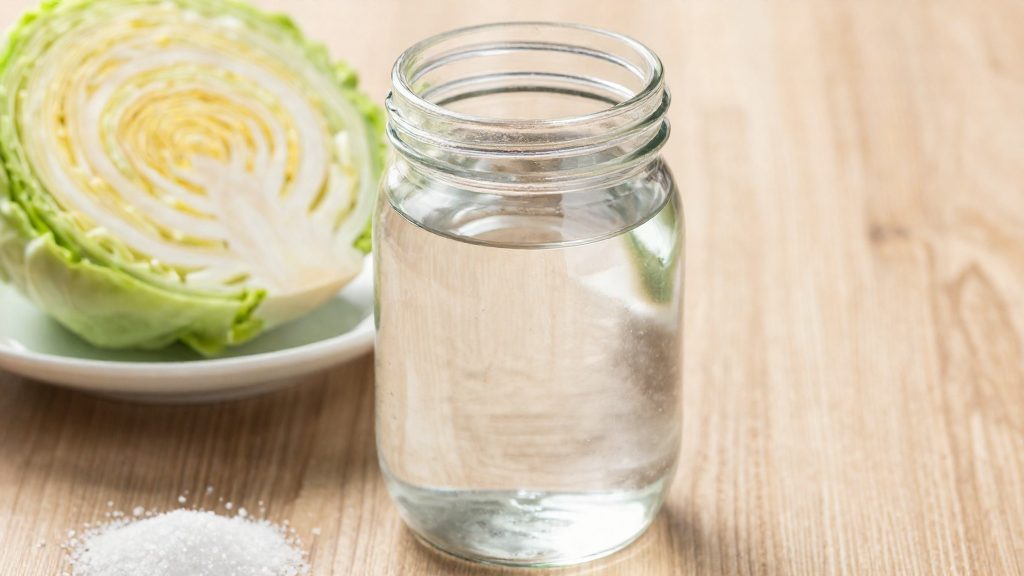
Tap water that is safe to drink is generally acceptable for lacto-fermentation, according to Revolution Fermentation (2026). The main caveat is that water can meet drinking standards and still contain residues that affect a ferment’s microbes and flavour. Drinking safety is the starting baseline, not a guarantee that the water suits fermentation.
Is tap water safe for lacto-fermentation?
Potable tap water as the starting baseline
If your tap water is potable, you can generally use it for brining vegetables and making sauerkraut or kimchi. Treat it as the default, and switch to treated water if a batch shows off flavours or uneven fermentation.
Revolution Fermentation’s general verdict
Revolution Fermentation (2026) takes a middle position: tap water is usually workable, but it is not automatically neutral. The source identifies residual disinfectants as the factor that can change a batch, mainly through effects on the microbes and on flavour. The source does not give a numerical threshold for when a residue becomes a problem.
Why safe-to-drink does not guarantee suitability
Drinking-water safety is judged for human health. It does not measure how a residual disinfectant will behave in a jar of salted vegetables, where beneficial lactic acid bacteria need to become established. Anything that suppresses microbial activity can slow the ferment or change its character. Two supplies that both pass drinking standards can therefore produce different results.
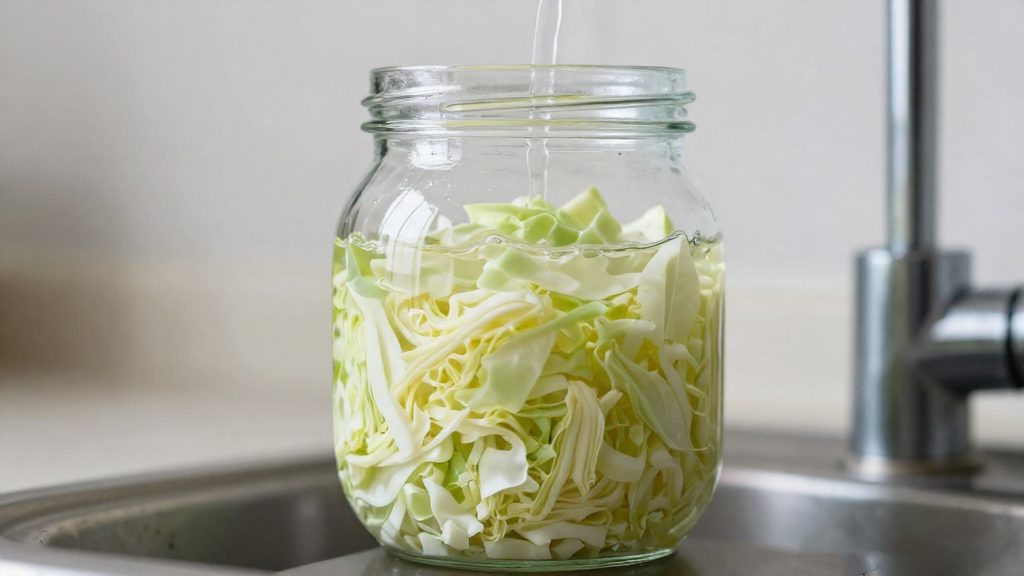
Why chlorine can matter in a ferment
According to Revolution Fermentation (2026), chlorine or fluoride residues can affect both the microbes doing the fermenting and the flavour of the finished product. The concern is therefore twofold: biological and sensory. Because the water becomes the brine, anything dissolved in it ends up in the liquid surrounding the vegetables.
How residues affect the microbes
Lacto-fermentation depends on lactic acid bacteria producing acid that keeps spoilage organisms in check. A residue that suppresses microbial activity can slow or disrupt that process. Revolution Fermentation (2026) names chlorine and fluoride as residues that can affect these microbes. The source does not specify the concentration at which this happens, so no safe threshold can be given.
Off-flavours from disinfectant residue
Chlorine is a disinfectant, and its residue can change how the ferment tastes. Revolution Fermentation (2026) links both chlorine and fluoride residues to flavour changes. This is often the first sign a home fermenter notices, since the brine is tasted directly and the vegetables absorb its flavour over the fermentation period.
Fluoride residues
Fluoride is named alongside chlorine, but the source describes no mechanism for it and no method of removing it. Standing is described only for chlorine.
| Residue | Possible effect on ferment | Mechanism described in the source |
|---|---|---|
| Chlorine | Affects microbes and flavour | — |
| Fluoride | Affects microbes and flavour | Not described |
Chlorine or chloramine: what does your city use?
Tap water can contain either free chlorine or chloramine, a compound formed when ammonia is added to chlorine. Some supplies do not state which one they use on the bottle or the tap, so identifying the disinfectant is the first step. The two behave differently in a fermentation vessel, and that difference determines which treatment is worth considering.
Checking the annual water quality report
Many utilities publish an annual water quality report. Look for the section on disinfectants, which names the residual disinfectant and its level. Search the document for “chlorine” and “chloramine.” If neither appears, contact the utility and ask directly. Keep a copy, since a utility can switch disinfectants, and a report from an earlier year may no longer apply.
Why chloramine does not dissipate during standing
Chloramine is a more stable compound, so it should not be assumed to leave water on standing as chlorine does. A supply that uses chloramine cannot be treated like a chlorine supply.
| Disinfectant | What the sources say about standing | Removal advice |
|---|---|---|
| Chlorine | — | Not addressed for chlorine by Health Canada (2026) |
| Chloramine | Not mentioned in the Revolution Fermentation (2026) source | Removal not recommended (Health Canada, 2026) |
Health Canada advice against removing chloramines
Health Canada (2026) states that removing chloramines from drinking water is not recommended, because it may reduce the quality of the water. The same page says chloramines are not harmful to people but can harm fish and other aquatic life, and that chloraminated water must not be used for dialysis. For fermentation, this makes chloramine a quality question rather than a routine step.
How do you treat tap water before fermenting?
According to Revolution Fermentation (2026), three treatments address chlorine residue: letting the water stand, boiling and cooling it, or filtering it through activated carbon. Each one works differently and takes a different amount of time, so the right choice depends on how much preparation you can plan ahead.
| Method | Procedure | Timing | Fit for chlorine residue |
|---|---|---|---|
| Standing | Fill an open container and leave it so the chlorine evaporates | From 30 minutes to 12 hours | Designed for chlorine, which leaves the water by evaporation |
| Boiling, then cooling | Bring the water to a boil, then let it cool before adding produce | Water must cool fully before use | Removes chlorine by heat; cooling prevents harm to the ferment |
| Activated carbon filtration | Pass the water through an activated carbon filter | Not stated | Listed among the three fixes for residues that affect microbes and flavour |
Standing is the lowest-effort option. It requires no equipment, but the wait is the longest variable. Shorter standing times leave more chlorine in the water, so the upper end of the range is the safer choice when time allows.
Boiling is faster to plan around in terms of residue removal, but it adds a cooling step. Adding produce or starter culture to hot water can stress or kill the microbes you intend to grow, so the water should reach room temperature first.
Activated carbon filtration needs no waiting period, but it depends on the filter itself. Check that the cartridge is rated for the residues you are treating, and replace it according to the manufacturer’s instructions.
Should you use filtered, bottled or distilled water?
The main difference between these waters is how much dissolved mineral they keep. Bottled water varies by brand, and distilled water sits at the mineral-free end of the range. Choosing a water therefore depends on what remains after treatment, not only on whether the water is safe to drink.
| Water type | Mineral content | Note for fermentation |
|---|---|---|
| Tap water | Retains its minerals | Can carry chlorine or fluoride residues that affect microbes and flavour (Revolution Fermentation, 2026) |
| Reverse-osmosis or very fine filtered | Minerals removed | — |
| Bottled water | Varies by brand | Must be checked on the label for each product |
| Distilled water | Essentially none | Mineral-free option |
Reverse-osmosis and very fine filters
Revolution Fermentation (2026) advises against reverse-osmosis or very fine filtration for fermentation because these methods remove minerals. If your tap water is safe to drink but tastes or smells of chlorine, a filter that removes only residues is a better fit than one that removes almost everything. Check the filter’s technical description before buying, since the label should state the removal method.
Reading bottled water labels
Mineral content differs from brand to brand, so two bottles of “spring water” can behave differently in a ferment. Look at the mineral analysis printed on the label and compare products from the same brand line. Avoid switching brands mid-batch, because a change in water composition makes results harder to repeat.
Distilled water as a mineral-free option
Distilled water contains essentially no minerals, so it is free of chlorine or fluoride residue. Revolution Fermentation (2026) does not discuss distilled water, but it advises against mineral-stripping methods such as reverse osmosis, so treat distilled water with the same caution., and keep a record of the water type for each batch so that differences can be traced back to the source.
How to calculate the brine with tap water
Tap water can be used at the same brine ratio as any other water, provided you calculate the salt from the water’s weight and handle the water correctly before mixing. Take the target salt percentage for vegetables from your recipe or your fermentation guide. Once you have the target percentage, the calculation is the same whatever the water source.
Calculating salt by water weight
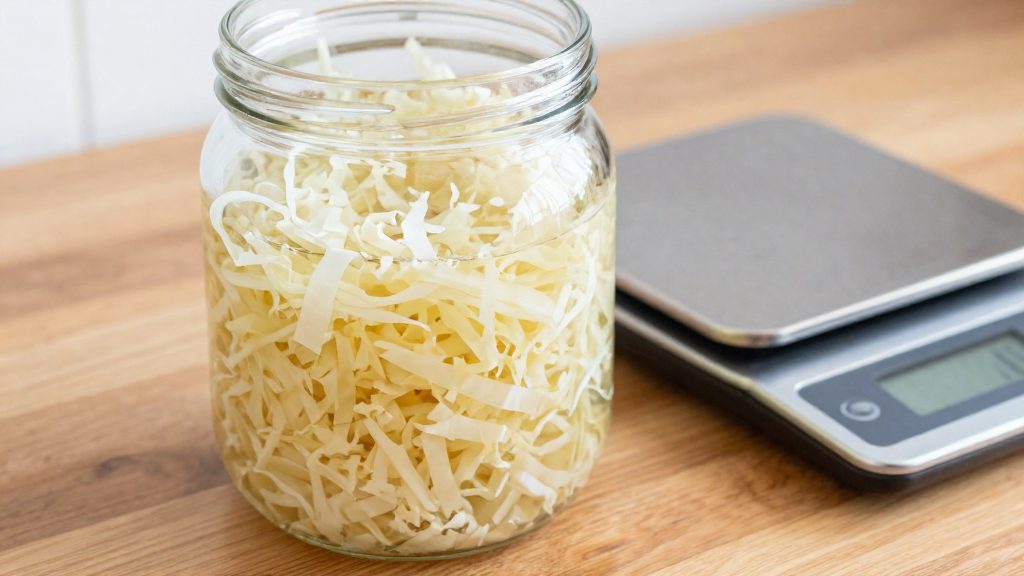
Weigh the water in grams rather than measuring it by volume. Then apply this formula:
water weight × target salt percentage = salt weight
Using weight keeps the brine consistent from batch to batch, because volume measurements do not account for the water’s mass.
Dissolving salt fully before submerging
Salt must dissolve completely before the vegetables go in. Undissolved crystals mean the brine’s concentration is uneven, and the produce near the bottom or top of the jar may not sit in the strength you calculated. Stir the brine until no grains remain on the bottom of the container, then pour it over the produce.
Recalculating after boiling
Boiling reduces the water’s weight through evaporation. Salt calculated from the pre-boil weight would give a brine that is too strong, so weigh the water after it has cooled:
| Water state | Weight to use | Salt calculation |
|---|---|---|
| Untreated tap water | Original weight | Water weight × target percentage |
| Boiled and cooled, not topped up | Weight measured after boiling | Water weight × target percentage, using the weight after boiling |
| Boiled, cooled, and topped up to original weight | Original weight | Water weight × target percentage |
Common tap-water problems and when to discard a batch
Tap-water problems in lacto-fermentation usually appear on the brine surface or in the smell of the jar, not as an obvious failure. Residual disinfectant in the water can affect both the flavour and the bacteria that drive the ferment, so the first task at each opening is to separate harmless surface growth from spoilage.
Off smells traced to disinfectant residues
A faint chlorine-like or medicinal note in young brine can come from the water. Health Canada (2026) states that chloramines are not harmful to people, but that statement concerns drinking water and does not tell you whether a ferment is safe. Smell alone cannot show that a ferment is safe, so check it against all the signs and discard criteria listed below, and discard the batch if in doubt. A batch that smells of bleach or chemicals and does not turn to the normal sour, vegetal aroma as it ferments is a reason to discard it, because the water or a spoilage organism is the likely cause.
Kahm yeast versus mould on the brine surface
The two most common surface growths look different and need different responses.
| Sign | Typical appearance | Likely cause | Action |
|---|---|---|---|
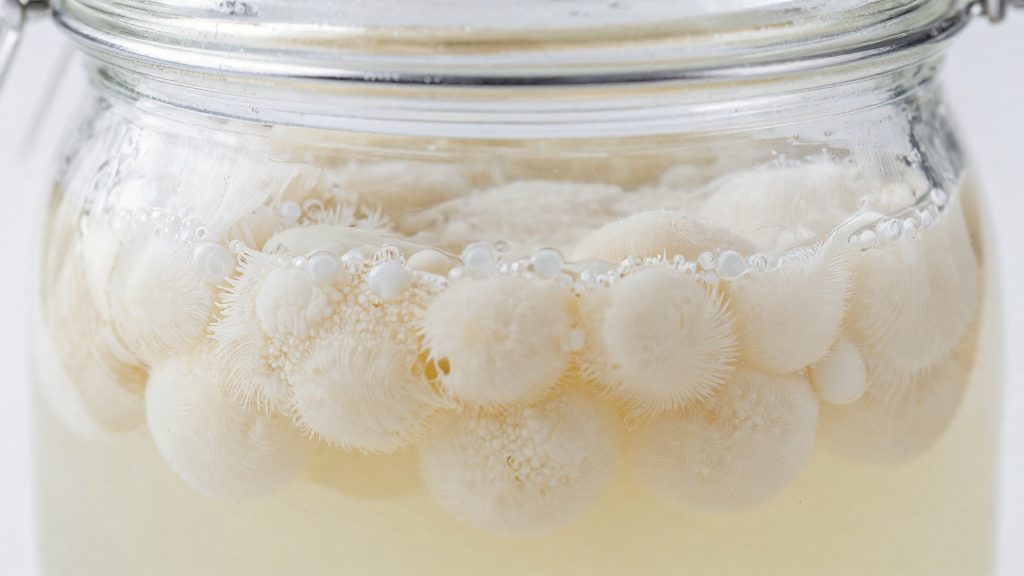
| Kahm yeast | Thin, flat, cream to white film that wrinkles and spreads | Surface yeast exposed to air | Skim it off, keep vegetables fully submerged, then taste |
| Fuzzy mould | Raised, fuzzy tufts, often green, black, blue, grey or orange | Airborne spores on exposed produce | Discard the whole batch |
| Pink film | Pink or reddish film or patches | Bacterial or mould growth | Discard the whole batch |
| Slimy texture | Vegetables feel soft, slick or mucilaginous | Spoilage | Discard the whole batch |
Kahm yeast is flat and can be scraped away. Mould grows into the produce, so skimming does not remove it. If you cannot clearly identify a surface growth, treat it as mould.
Discard criteria
Discard the entire batch when any of these appear:
- Fuzzy mould of any colour, even on a small patch
- Pink or reddish film or patches
- Slimy or mucilaginous vegetables below the brine line
- A chemical smell that persists as the batch sours
Frequently asked questions
Can I use tap water for lacto-fermentation?
Yes, water that is safe to drink is generally workable for brining vegetables. Residual disinfectants left in the supply can still slow the culture or change the flavour, so a drinking-water check alone does not confirm that your supply suits a jar.
How do I remove chlorine from tap water before brining?
Revolution Fermentation (2026) describes three methods: let the water stand for 30 minutes to 12 hours so the chlorine evaporates, boil it and let it cool, or pass it through an activated carbon filter. The same source advises against reverse-osmosis or very fine filtration because those methods strip out minerals.
Does letting water stand also remove chloramine?
Health Canada (2026) states that chloramines are not harmful to people, but that statement concerns drinking water, not whether a ferment made with it is safe. If your utility adds chloramine, compare a small test batch against one made with water of a known type before committing a full crock.