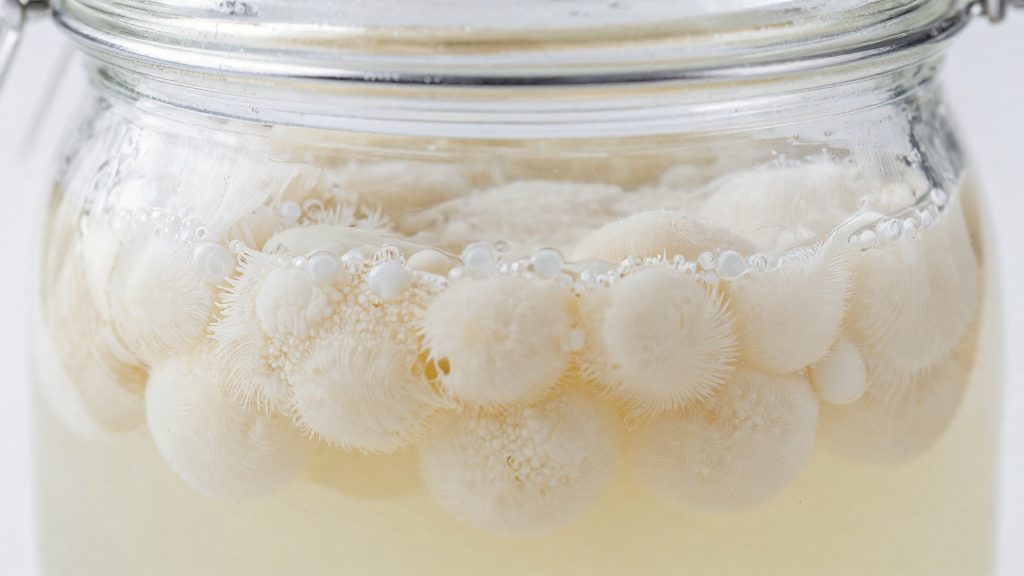
Kahm yeast is a thin, white, matte film that forms across the whole surface of a home ferment, most often a vegetable brine. University of Illinois Extension notes that a white film that is not fuzzy and does not sit in round patches is kahm yeast, which is common on vegetables. Because the film is yeast growing at the surface, it is treated as a separate case from mold.
What is kahm yeast on a ferment?
Appearance and extent
Kahm yeast forms a white, matte layer over the entire surface of the liquid rather than a set of isolated spots.
Yeast identity
The sources classify kahm yeast as a yeast, not a bacterium or a mold.
Why it forms
Norris (2023) lists the conditions that keep the surface protected:
| Condition | Stated by | Role described in the source |
|---|---|---|
| At least 2% salt brine | Melissa Norris (2023) | Prevention |
| Cool spot, 68°F (20°C) or below | Melissa Norris (2023) | Prevention |
| Airlock lid | Melissa Norris (2023) | Prevention |
| Clean vessels and utensils | Melissa Norris (2023) | Prevention |
Vegetables and kefir
Kahm yeast is documented on vegetable ferments, which is where University of Illinois Extension places it.
Is kahm yeast on a ferment safe to eat?
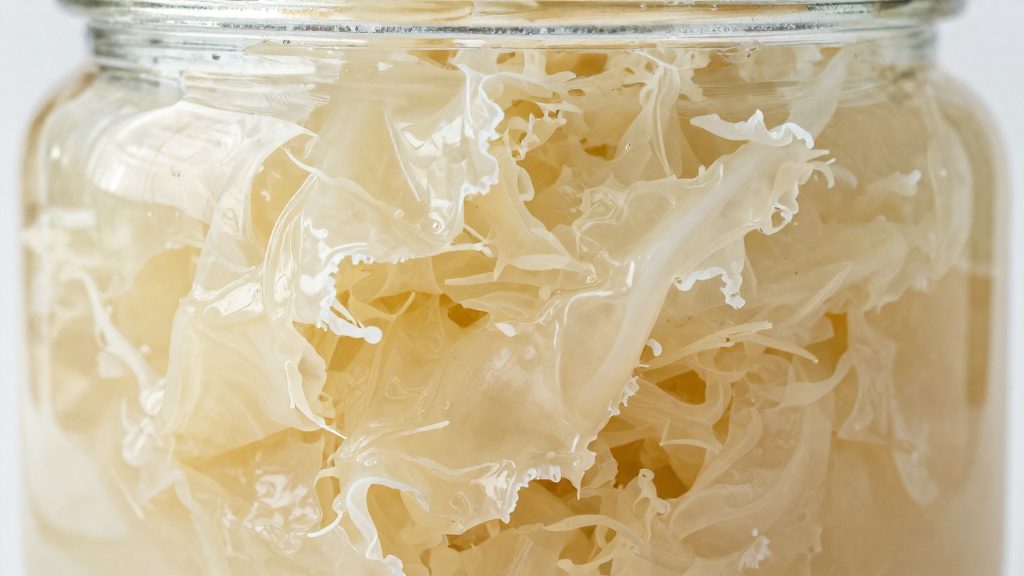
Kahm yeast is generally considered edible, but only under specific conditions. According to University of Illinois Extension, a white film on vegetable ferments that is neither fuzzy nor arranged in round patches is kahm yeast, which is common on vegetables and safe to eat. Mountain Feed & Farm Supply adds that it is safe only if no mold is present and the ferment tests at pH 4 or lower. Edibility rests on two checks: whether mold is present, and whether the ferment is sufficiently acidic. Both conditions must be met, and a clean-looking surface does not confirm either one on its own.
Identifying the film before tasting
Identification comes first. These visual differences are the working test:
| Feature | Kahm yeast | Mold |
|---|---|---|
| Texture | Matte, not fuzzy | Fuzzy |
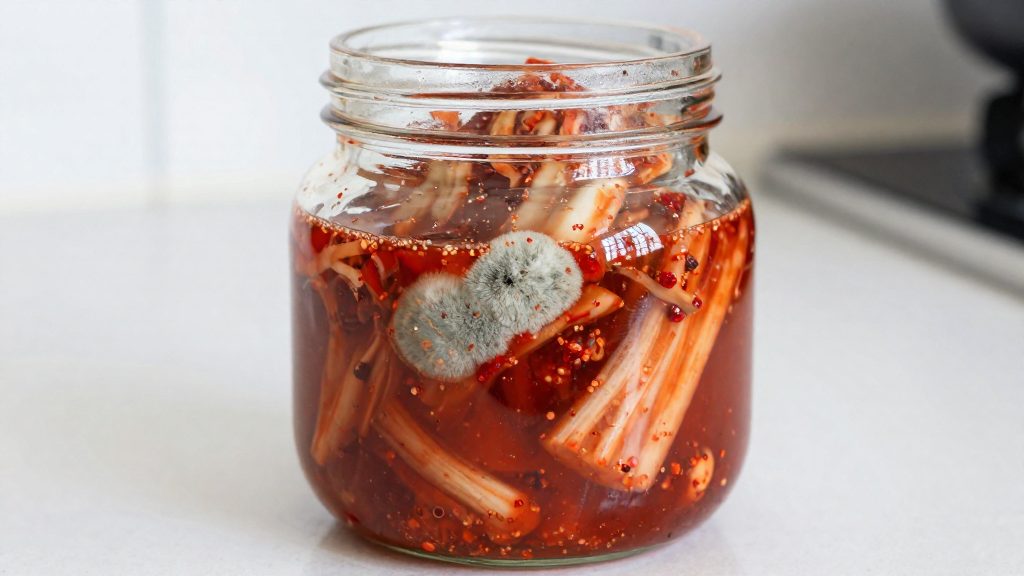
| Pattern | Layer across the whole surface | Round patches |
| Edibility | Edible when mold-free and acidic | Not treated as edible when mold is present |
If the surface shows fuzz or round patches, the ferment does not fall into the kahm category. If you cannot tell which it is, Melissa Norris advises discarding the ferment.
Acidity as the second check
Fermenting for Foodies (Emillie Parrish, 2026-01-26) reports that on vinegar, kahm yeast dies off as the ferment acidifies. For salt-brined vegetables, apply the pH 4 benchmark. A ferment that tests above pH 4 does not meet the stated condition for eating, even when no mold is visible.
Off-flavors and aromas as warning signs
Fermenting for Foodies (Emillie Parrish, 2026-01-26) describes kahm yeast as not harmful but not ideal, and Mountain Feed & Farm Supply notes that it can cause off flavors or aromas. University of Illinois Extension advises discarding fermented foods that look slimy or smell spoiled or rotten. An unpleasant smell or texture is a reason to discard the batch, not a reason to taste it.
Position across the sources
Across the sources, edibility depends on the absence of mold and adequate acidity, and uncertainty favours disposal.
Kahm yeast or mold: how to tell the difference
The most reliable visual test is the difference between a flat matte film and fuzzy growth. Mold is usually fuzzy. Texture and layout are the main cues, so the check is made by examining the surface closely rather than judging from a quick glance.
Texture: flat versus raised
Kahm yeast forms a white, matte layer that covers the whole surface and lies flat. Mold is usually fuzzy. Melissa Norris (2023-11-27) draws the same contrast: a matte layer over the entire surface versus white, fuzzy growth.
Pattern: uniform coverage versus round colonies
Kahm yeast spreads evenly across the surface. Mold tends to form round colonies, which appear as separate patches with gaps between them. Both University of Illinois Extension and Norris use this layout as a deciding cue.
| Cue | Kahm yeast | Mold |
|---|---|---|
| Texture | Flat, matte film | Fuzzy, raised growth |
| Pattern | Uniform over the whole surface | Round patches or colonies |
Pigmentation
Both kahm yeast and mold are described as white, so colour cannot confirm either one. Any coloured growth falls outside the kahm yeast description given in the sources: when in doubt, throw it out.
Why the distinction matters
Kahm yeast and mold are both described as white, so misreading the surface changes whether the batch can be eaten. Mountain Feed & Farm Supply makes the absence of mold a condition for eating kahm yeast.
What should you do when kahm yeast appears?
Once a white, matte film is confirmed as kahm yeast, the response is to remove the film, refrigerate the ferment, and keep checking the surface. Fermenting for Foodies (Emillie Parrish, 2026-01-26) advises skimming and refrigerating. Confirm the identification first, since mold requires a different response.
Skim the film off with a clean utensil
Use a clean, dry spoon or a fine skimmer to lift the film from the surface. Work gently so that the vegetables or fruit below stay submerged in the brine. Leave the brine and the food in place.
- Use a utensil that has not touched any other jar or any previous batch.
- Skim again if the film returns.
Refrigerate after skimming
Fermenting for Foodies advises refrigerating the ferment after skimming. Refrigeration slows fermentation rather than stopping it, so keep checking the surface over the following days.
Vinegar ferments: acidity reduces kahm yeast
Vinegar-based ferments follow a different pattern. Skimming is still reasonable, but on vinegar kahm yeast dies off as the ferment acidifies (Fermenting for Foodies, 2026-01-26).
| Ferment type | Immediate action | Expected outcome |
|---|---|---|
| Salt-brined vegetables | Skim the film, then refrigerate | Slower fermentation; keep checking the surface |
| Vinegar-based ferments | Skim the film | Kahm yeast dies off as acidity rises |
When should you throw the ferment out?
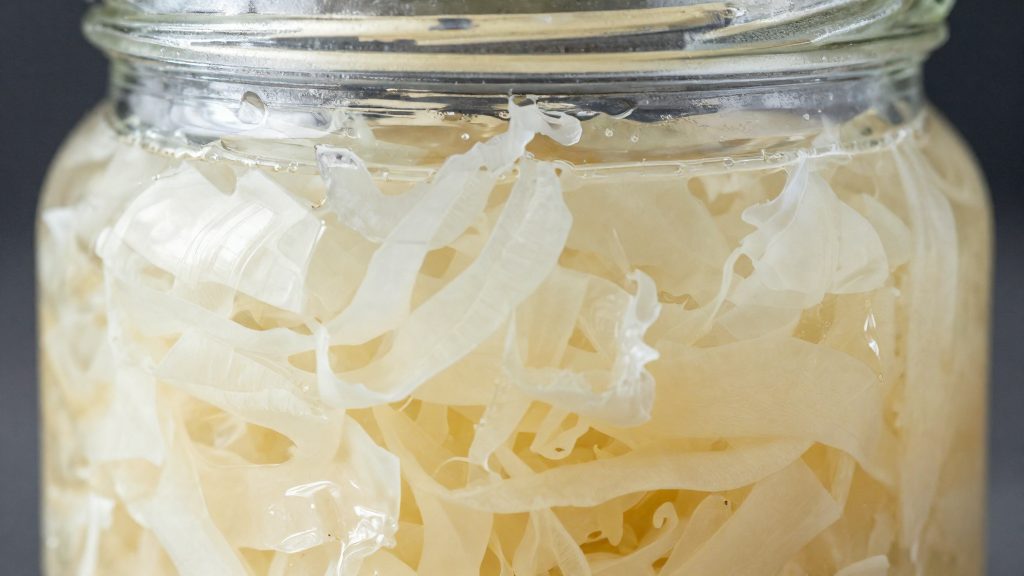
Discard the batch if you see fuzzy mold, a slimy texture, or a rotten smell. Fermenting for Foodies (Emillie Parrish, 2026-01-26) states that mold on starters, beverages, or condiments means throwing them out. University of Illinois Extension gives a general rule for uncertain cases: When in doubt, throw it out.
| Sign | Ferment type | Action |
|---|---|---|
| Fuzzy mold | Starters, beverages, condiments | Discard |
| Fuzzy mold | Salt-brined vegetables | Discard unless brine is at least 2% salt and food stayed fully submerged (see below) |
| Slimy texture | Any fermented food | Discard |
| Rotten or spoiled smell | Any fermented food | Discard |
| White layer you cannot classify | Any ferment | Discard |
Conditional salvage for mold on brined vegetables
Fermenting for Foodies (Emillie Parrish, 2026-01-26) says mold on a salt-brined vegetable ferment may be salvageable only if two conditions are both met: the brine is at least 2% salt, and the food stayed fully submerged throughout fermentation. Discarding remains the safer choice whenever either condition is unmet or uncertain. If you are unsure whether the vegetables were fully submerged, treat the batch as spoiled.
Using pH to judge a kahm yeast batch
A white film is not automatically a discard signal. Mountain Feed & Farm Supply states that kahm yeast is safe to eat only if no mold is present and the ferment tests at pH 4 or lower. It also notes that kahm yeast can signal a problem such as headspace, brine overflow or evaporation breaking the seal, so inspect the vessel before deciding whether to keep the batch.
How to prevent kahm yeast
Kahm yeast forms on the surface of a ferment that is exposed to air, so prevention focuses on three habits: starting each batch with clean equipment, storing the ferment in a cool place, and keeping the vegetables under the brine. University of Illinois Extension notes that kahm yeast is common on vegetable ferments, which makes these habits worth building into every batch rather than adding after a film appears.
Start each batch with clean equipment
Yeast can reach the brine from any surface that touches the food, so the vessel is only part of the job. Wash clean vessels, lids and utensils before each batch with hot soapy water, rinse them thoroughly, and let them air-dry before use. Check the rim of the jar, the underside of the lid and any weights, since residue in those spots can transfer into the brine when the ferment is handled. Use a clean spoon or tongs each time you open the vessel, and never return a utensil that has touched your mouth or another food to the ferment. Melissa Norris (2023-11-27) lists clean vessels and clean utensils among the core prevention steps.
Store the ferment in a cool spot
Temperature is the second variable you control directly. Place the ferment in a cool area away from stoves, heaters and direct sun, and keep it at 20°C (68°F) or below. Melissa Norris (2023-11-27) gives this threshold as the prevention target, so treat it as a ceiling rather than a midpoint. Check the storage spot at different times of the day, because a shelf that feels cool in the morning can warm up by afternoon.
Keep vegetables fully submerged
Any vegetable that rises above the brine gives yeast an exposed surface to colonize. Hold the pieces under the brine with a weight or follower for the whole ferment. Fermenting for Foodies (Emillie Parrish, 2026-01-26) makes full submersion a condition for salvaging mold on brined vegetables, which ties this practice to food safety.
| Habit | Concrete step | Source |
|---|---|---|
| Clean equipment | Wash, rinse and air-dry vessels, lids and utensils before each batch | Melissa Norris (2023-11-27) |
| Cool storage | Keep the ferment at 68°F (20°C) or below | Melissa Norris (2023-11-27) |
| Full submersion | Hold vegetables under the brine with a weight for the entire ferment | Fermenting for Foodies (2026-01-26), salvage condition |
Salt, pH and airlocks: simple checks
Three measurable checks confirm whether a vegetable ferment is on track: brine strength, acidity, and the seal of the lid. Each one maps to a benchmark. Brine should be at least 2% salt. A ferment that tests at pH 4 or lower meets the acidity benchmark. An intact airlock or seal protects the ferment from air; keeping the food under the brine is a separate check.
Brine strength is the first check, and it should be set before the vegetables go into the vessel. Fermenting for Foodies (2026-01-26) makes a brine of at least 2% salt a condition for salvaging mold on a salt-brined ferment. To hit that target, weigh the salt and the water on a kitchen scale rather than measuring by volume, because salt grain size changes how much fits in each spoonful.
Acidity is checked with a pH meter or pH test strips. A reading above 4 means the ferment has not yet reached the benchmark, so it should not be treated as safe on the basis of appearance alone.
Airlock and headspace seal is the third check. An airlock lid lets carbon dioxide escape while blocking air. Mountain Feed & Farm Supply warns that a broken seal can be a sign of a problem: headspace, brine overflow, or evaporation can break the seal and allow air in. Inspect the lid and the water-lock channel each time you check the vessel, and top up the airlock water when it drops.
| Check | Benchmark | What a failure suggests |
|---|---|---|
| Brine salt | At least 2% | Below the minimum used for prevention and mold salvage |
| Acidity | pH 4 or lower | Ferment not yet acidified enough to pass the safety test |
| Seal | Lid sealed, food submerged | Headspace, overflow or evaporation has broken the seal |
Frequently asked questions
Can I eat a ferment that has kahm yeast on top?
Only if the ferment shows no mold and tests at pH 4 or lower, according to Mountain Feed & Farm Supply (undated). University of Illinois Extension describes a white film on vegetable ferments that is neither fuzzy nor in round patches as kahm yeast, which is common on vegetables and safe to eat.
What if I cannot tell kahm yeast from mold?
Discard the ferment. Colour does not settle the question, because both growths are described as white. University of Illinois Extension advises “When in doubt, throw it out,” and Fermenting for Foodies (Emillie Parrish, 2026) says mold on starters, beverages or condiments means throwing them out.
Does skimming the film make the ferment safe to keep?
Skimming removes the film but does not change the pH or mold conditions that determine whether the ferment is safe to eat. Fermenting for Foodies (Emillie Parrish, 2026) advises skimming and then refrigerating the ferment, since kahm yeast is not harmful but is not ideal. Refrigeration slows fermentation without stopping it.