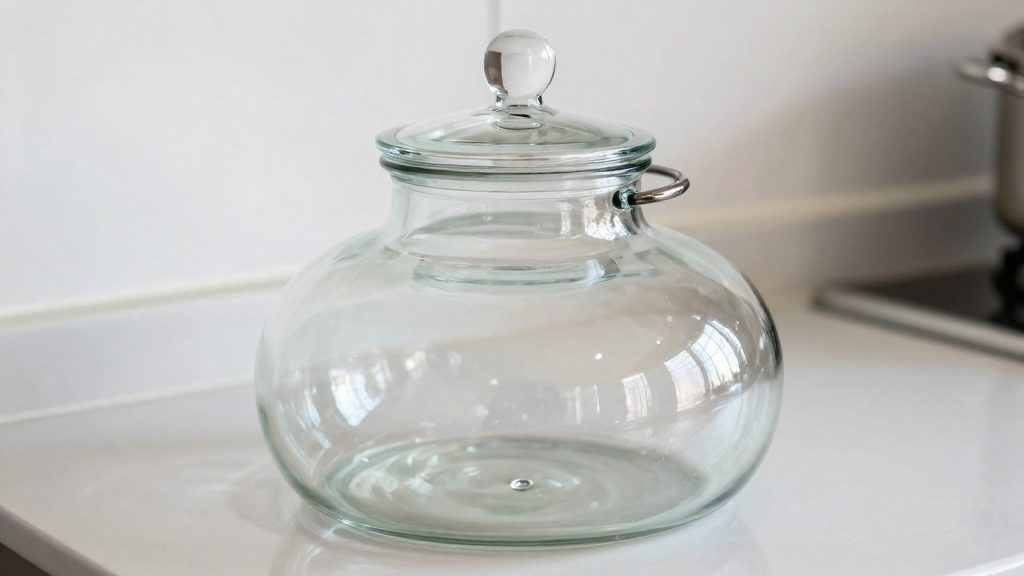
Airlocks are optional for lacto-fermentation. According to Mother Earth News (2026-10-23), an open-top crock with a weight and a towel works, and the right choice depends on what the fermenter is comfortable managing. The decision therefore turns on the batch, the vessel, and how much surface exposure you accept.
Do you need an airlock for lacto fermentation?
Many sauerkraut batches ferment well without one. MakeSauerkraut.com (2024-10-05) states that you do not have to use an airlock, and that many batches can be fermented without one.
The same source adds a caveat. Its author believes results are most likely better with an airlock but has no lab tests to confirm it. Treat that as a practical preference from experience, not measured evidence.
Setups compared
| Setup | What it offers | Source |
|---|---|---|
| Open-top crock with weight and towel | Works for lacto-fermentation without an airlock | Mother Earth News (2026-10-23) |
| Airlock | Lets CO2 escape while keeping air out; reported to help reduce surface yeasts, molds and scummy kraut | Mother Earth News (2026-10-23) |
| Loosely screwed lid | Allows CO2 release during the active stage | MakeSauerkraut.com (2024-10-05) |
What an airlock actually does
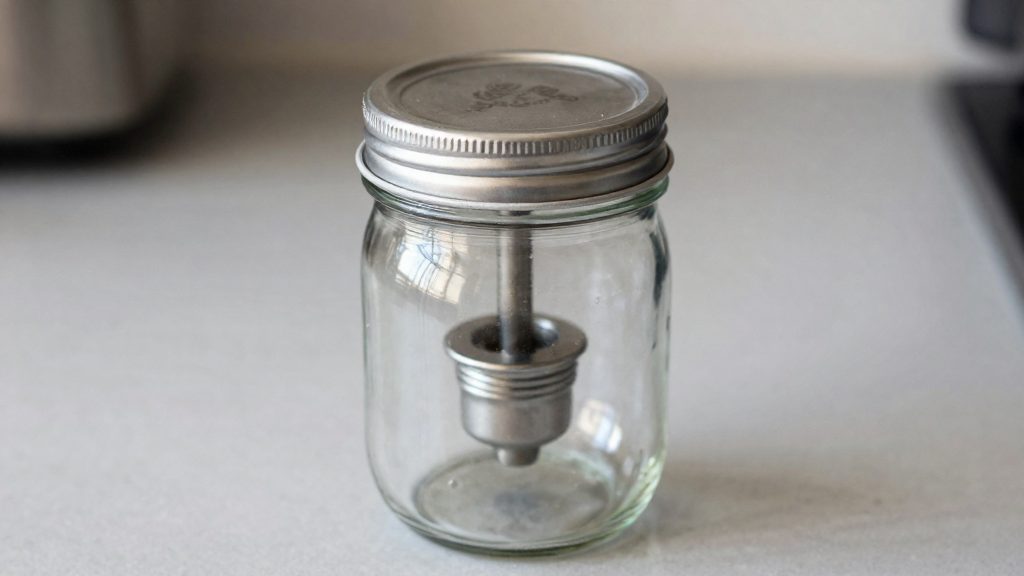
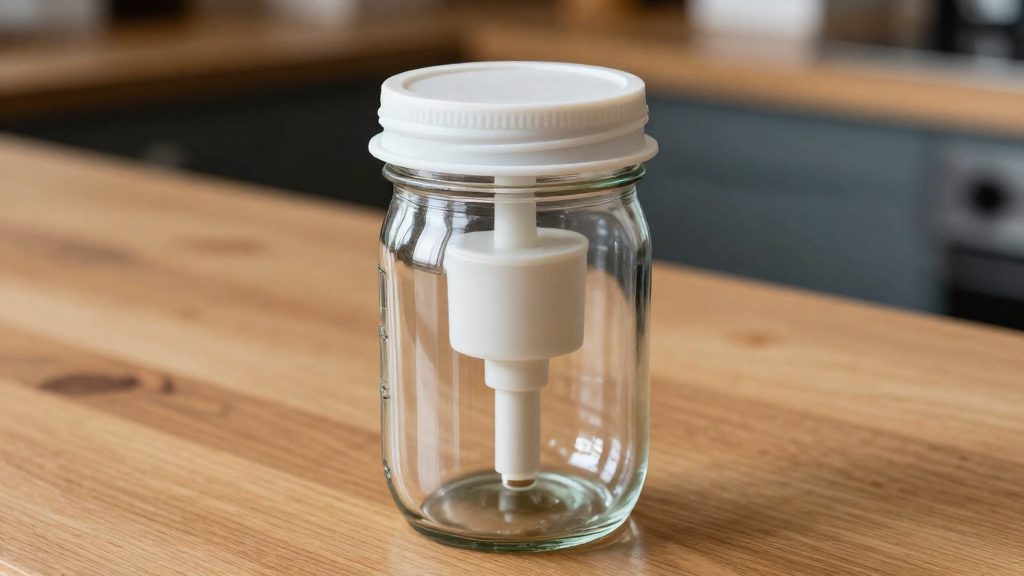
An airlock is a one-way valve fitted to the jar lid. Lactic acid bacteria produce carbon dioxide as they work through the sugars in the vegetables, and the valve lets that CO2 escape while blocking air from flowing back in. According to Mother Earth News (2026-10-23), airlock-style systems let CO2 leave without letting air in. Because the gas has a controlled exit, the lid can stay closed for the whole active stage instead of being opened to release pressure.
The main practical effect concerns what stays out of the jar. Mother Earth News (2026-10-23) reports that these systems help reduce surface yeasts and molds and discoloured or scummy kraut. Limiting air contact at the brine surface makes it harder for these organisms to establish themselves. FarmSteady (2019-01-16) describes the same principle: gases escape while outside material is kept out.
The options differ mainly in how gas leaves the jar and how much air contact remains:
| Lid setup | How CO2 leaves | Air contact |
|---|---|---|
| Airlock (one-way valve) | Vents through the valve | Blocked from re-entering |
| Loosely screwed lid | Vents through the gap in the lid | Reduced, not sealed |
| Open-top crock with weight and towel | Escapes at the open surface | Open to air |
Fermenting without an airlock: jars, crocks and burping
Without a valve, you manage carbon dioxide (CO2) by hand or with a loose lid, and you accept a higher risk of surface problems.
Hand burping during the active stage
Without an airlock, the jar must be burped by hand to release CO2. Lift the towel or loosen the lid, let the gas escape, then recover the vegetables. Burping matters most during the active stage, when gas production is strongest. Mother Earth News (2026-10-23) is the source for this requirement.
Loosely screwed lid as an airlock substitute
A loosely screwed lid lets gas pass while staying closed enough to limit air contact. MakeSauerkraut.com (2024-10-05) recommends an airlock or a loosely screwed lid during the active stage, usually the first 7 days. This makes a standard lid a practical stand-in for an airlock, though it does not block surface microbes as an airlock does.
Managing the first seven days
The first seven days are the window that needs gas control. Set a routine for that period: check the jar, release gas by hand or confirm the lid is loose, and keep the vegetables covered. After the active stage, the gas management demands drop, so the lid can be treated more like a simple cover.
Why keeping vegetables under the brine matters
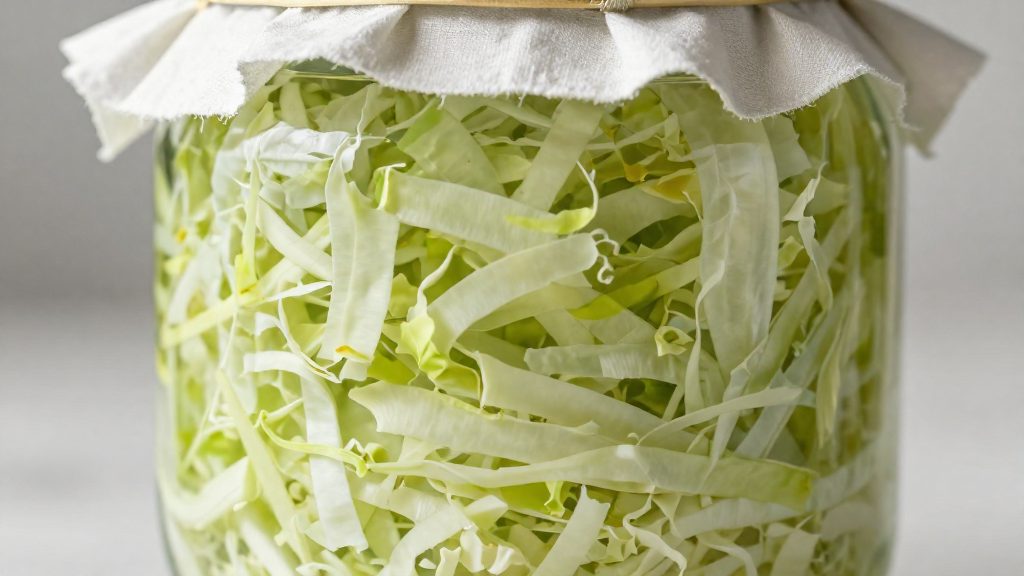
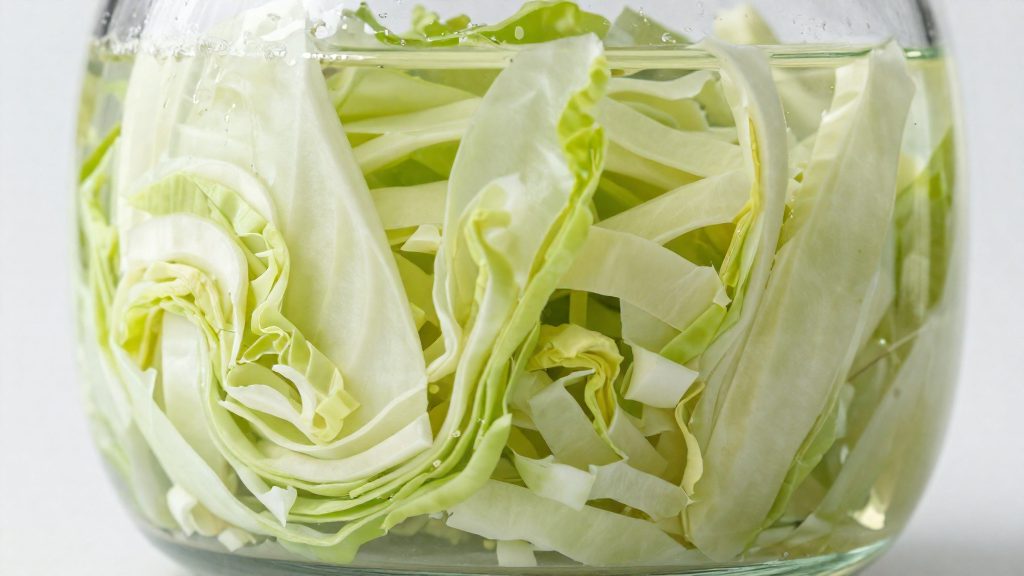
Keeping vegetables submerged is the main protective step in lacto-fermentation, and it applies whether or not you use an airlock. According to MakeSauerkraut.com (2024-10-05), the way to reduce air exposure is to keep the vegetables below the brine with a weight and to cover the jar. Any piece that stays above the liquid remains in contact with air, so the weight’s job is to hold every piece down for the whole active stage.
Fermentation releases CO2, and that gas creates a second problem. Mother Earth News (2026-10-23) reports that gas pockets can push brine out of the jar. Once brine escapes, the pieces that were underneath can rise into the headspace and lose their protective layer. The remedy is to press the vegetables back under the brine as soon as you notice them shifting, rather than waiting for the gas to settle on its own.
Repressing is still needed when an airlock is fitted. Mother Earth News (2026-10-23) states that the vegetables should be pressed back under the brine even with airlock systems. An airlock lets gas leave, but it does not hold solids down, so a fermenter who relies on the valve alone can end up with exposed pieces. MakeSauerkraut.com (2024-10-05) makes the same point: sauerkraut still needs a weight when an airlock is used.
FarmSteady (2019-01-16) frames the core requirement as covering the vegetables with enough brine to protect them from air. In practice, check the jar regularly during the active stage, and repress any pieces that have surfaced.
| Situation | Effect on vegetables | Response |
|---|---|---|
| Weight holds vegetables below the brine | Limits air exposure | Keep the weight in place (MakeSauerkraut.com, 2024-10-05) |
| Gas pocket forms under the vegetables | Pushes brine out of the jar | Press vegetables back under the brine (Mother Earth News, 2026-10-23) |
| Airlock fitted | Lets CO2 escape but does not hold solids down | Repress vegetables under the brine anyway (Mother Earth News, 2026-10-23) |
Brine strength: how much salt to use
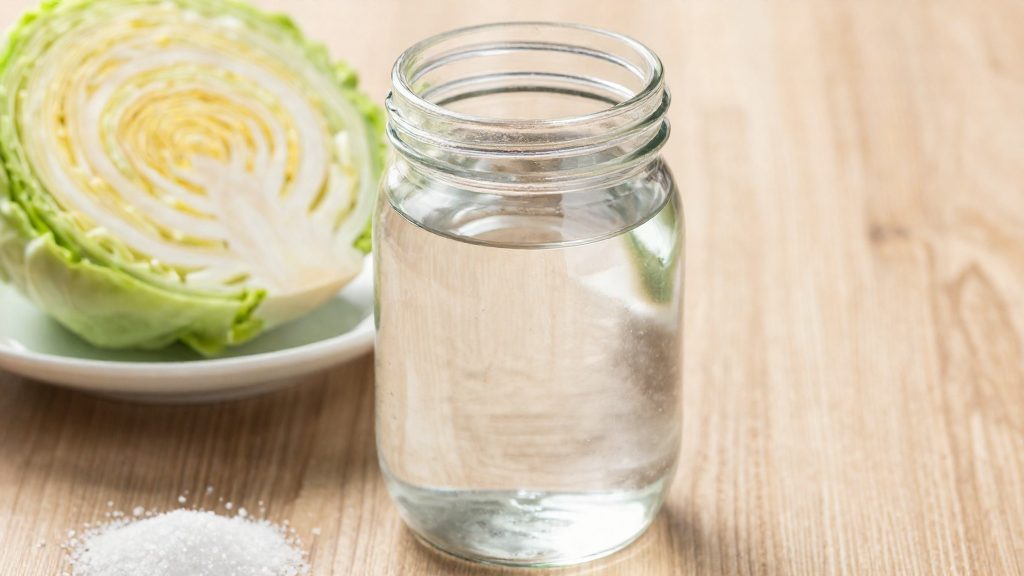
Brine strength is the amount of salt dissolved in the water, expressed as a percentage of weight. According to MakeSauerkraut.com (2024-10-05), the site’s author states, in a reply to a reader comment, that bacteria need 2.0 to 2.5 percent salinity to multiply and grow. According to that reply, this range is what bacteria need to grow, so it is a practical starting point for a brine rather than a food-safety standard. The figure comes from a comment reply rather than a laboratory study, so treat it as a practical guideline.
How the percentage is calculated
Salt percentage is the weight of the salt divided by the weight of the water, multiplied by 100:
salinity (%) = salt weight (g) / water weight (g) × 100
Only the water is the reference weight. Measure the salt on a kitchen scale in grams rather than by volume, because a teaspoon of fine salt and a teaspoon of coarse salt weigh different amounts.
Converting percentages into grams
Since one litre of water weighs about 1,000 g, the conversion is direct. The table below applies the 2.0 and 2.5 percent targets to two common batch sizes:
| Target salinity | Salt per 1 litre of water | Salt per 500 ml of water |
|---|---|---|
| 2.0% | 20 g | 10 g |
| 2.5% | 25 g | 12.5 g |
To prepare a brine by weight:
- Weigh the water in grams, or pour it into a container placed on the scale.
- Multiply the water weight by 0.020 for 2.0 percent, or by 0.025 for 2.5 percent.
- Add the salt and stir until no crystals remain on the bottom of the container.
Mold, kahm yeast and when to discard
Growth on the surface of a ferment is not always a sign of failure, but two common types call for opposite responses. Kahm yeast forms a flat, white film that is generally considered harmless and can be skimmed off if the smell and texture of the ferment are otherwise normal. Mold forms fuzzy patches, often green, black or blue, and means the batch should be discarded. The quickest way to tell them apart is texture. Kahm yeast lies flat on the brine and lifts off as a thin sheet. Mold grows as raised, fuzzy spots, often on the vegetables themselves.
Reading the signs
| Sign | Most likely cause | Action |
|---|---|---|
| Flat, white, smooth film that lifts off in one sheet | Kahm yeast | Skim it off and keep the batch |
| Fuzzy or raised spots in green, black, blue or white | Mold | Discard the whole batch |
| Slimy or mushy vegetables throughout | Spoilage | Discard the batch |
| Rotten, putrid or strongly off smell | Spoilage | Discard the batch |
Why a partial clean-up does not work for mold
Scraping away a visible fuzzy patch and keeping the rest is not a safe fix. Mold that is visible on the surface may already have spread into the vegetables below, and you cannot see how far it reaches. The same applies to a slimy texture or a foul smell: these signal that the ferment has gone wrong, and tasting it to check is not a reliable test.
Checking before you decide
Lift the weight, skim any film, and look at the surface and the vegetables directly beneath it. Then smell the batch. A clean, sour, cabbage-like odour with a flat white film is consistent with a normal ferment. Any fuzzy growth, slime or putrid odour means the batch should go, and the jar, weight and lid should be washed before the next use.
When an airlock is worth buying
The purchase depends on three factors: what your previous batches looked like, how often and how large your batches are, and how much surface growth tolerance you have. The decision is less about whether a batch fails without an airlock and more about whether the result is acceptable for your situation.
Batches that previously developed scum or discoloration
This is the clearest case for buying one. If your earlier open-top batches developed a film or dark patches, an airlock targets that specific problem. If earlier open batches came out clean, there is little reason to change: MakeSauerkraut.com says many batches ferment well without an airlock.
Frequent or large batches where consistency matters
As batch volume and frequency increase, a ruined batch costs more, and batch consistency becomes the main criterion. For regular large batches, the reduced surface contamination is the benefit to weigh against the cost of equipment.
Occasional small jars
For a single small jar made every so often, the balance usually favours the simpler setup. An airlock used across many batches spreads its cost over time, while one used for an occasional jar adds little value. An open jar with a weight and a towel remains a valid option if you accept some surface growth.
| Batch situation | Airlock recommended? | Basis |
|---|---|---|
| Previous batches developed scum or discoloration | Worth considering, since airlocks are reported to reduce scummy kraut | Mother Earth News (2026-10-23) |
| Large or frequent batches where consistency matters | Optional; may be worth considering (author’s inference; MakeSauerkraut.com’s author believes results are likely better but has no lab tests) | MakeSauerkraut.com (2024-10-05) |
| Occasional small jar, some surface growth accepted | Optional | Mother Earth News (2026) |
Frequently asked questions
Can I make lacto-fermented vegetables in an open crock without an airlock?
Yes. According to Mother Earth News (2026-10-23), an open-top crock with a weight and a towel works, and the choice depends on how much surface exposure you are comfortable managing. Keep the vegetables submerged under the brine for the whole fermentation.
If I skip the airlock, how do I release the gas?
You release it by hand. Mother Earth News (2026-10-23) notes that without an airlock the jar must be burped to let CO2 escape. MakeSauerkraut.com (2024-10-05) adds that a loosely screwed lid also allows gas to escape during the active stage.
Does an airlock prevent brine from spilling out of the jar?
Not on its own. Mother Earth News (2026-10-23) warns that gas pockets can push brine out of the jar, so the vegetables should be pressed back under the brine. The source states this applies even when you use an airlock.