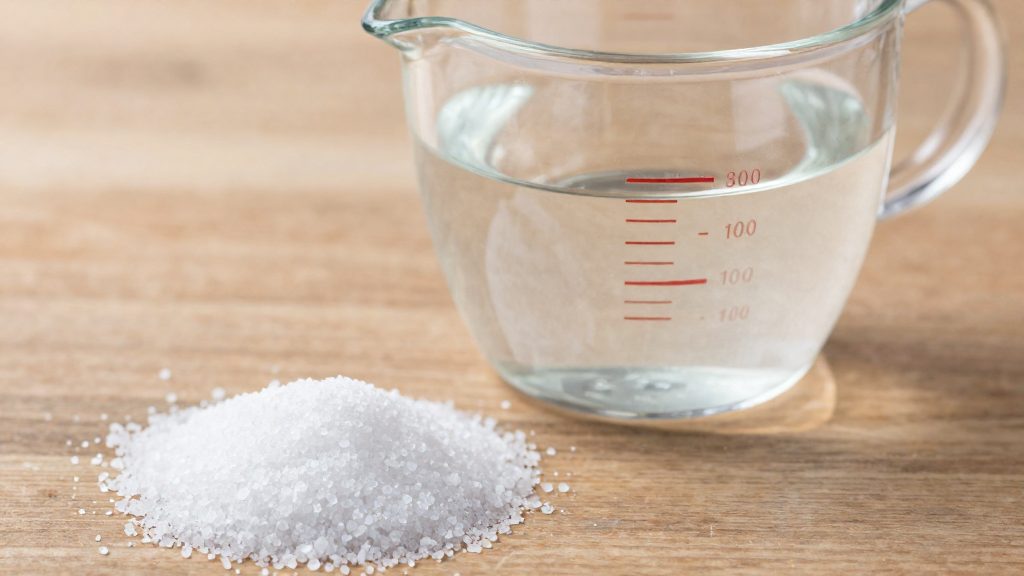
Most vegetable ferments use 2 to 3% salt. By weight, a 2% brine contains about 20 g of salt per litre of water, a 3% brine about 30 g, and a 5% brine about 50 g. These are rounded working values. Lactic acid bacteria tolerate roughly 1.5 to 5% salt, so 5% is near the upper limit for active fermentation.
Grams of salt per litre of brine: quick reference
Use this lookup table for one-litre batches of water:
| Brine strength | Salt per litre of water | Position in typical range |
|---|---|---|
| 2% | about 20 g | Lower end of the common 2 to 3% vegetable range |
| 3% | about 30 g | Upper end of the common 2 to 3% vegetable range |
| 5% | about 50 g | Upper limit of lactic acid bacteria tolerance |
Target range for lactic fermentation: Most vegetable ferments fall between 2 and 3%. Brines below 2% give less control over unwanted microbes. The table therefore marks 2 to 3% as the working zone and 5% as the ceiling.
Rounding for one-litre batches: Rounded values are good enough for home batches but not for exact recipe work. Scale the amounts linearly for other volumes. For example, 500 ml at 3% needs about 15 g of salt, half the one-litre figure.
Check that the salt has dissolved completely, so the strength you calculated is the strength the vegetables actually sit in.
How do you convert brine percentage to grams per litre?
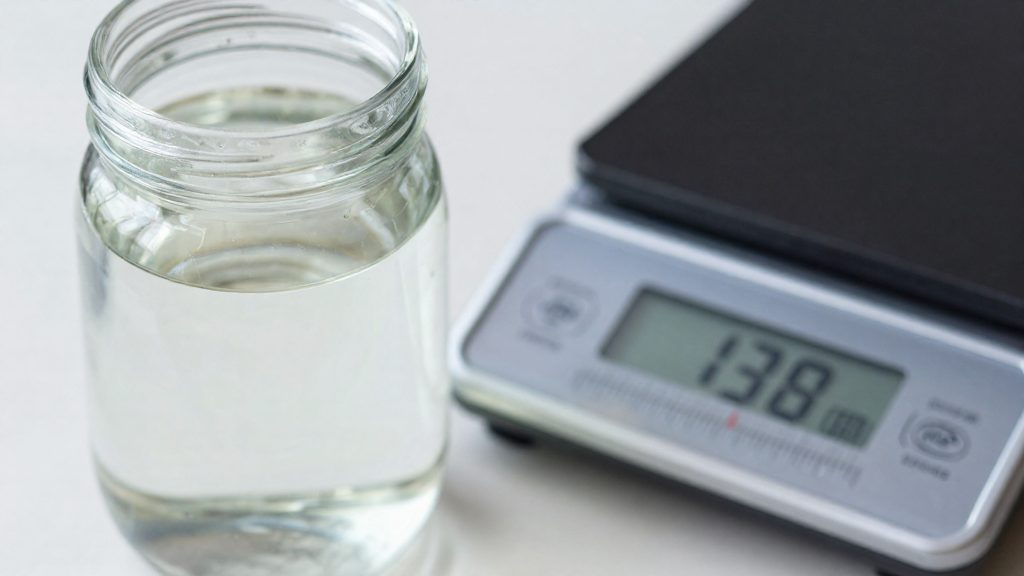
A brine percentage is usually a weight-for-weight figure. In home fermentation it is calculated as grams of salt per 100 g of water, which slightly overstates the strength of the finished solution. To convert it to grams per litre, you multiply the percentage by the mass of the water, then divide by 100. According to the American Homebrewers Association (Brewers Association), a 2% brine made with 1 US quart (about 1 L) of water contains 20 g of salt.
Step-by-step arithmetic
- Convert the water volume to mass. Multiply litres by 1 kg/L. For 1 L, the water mass is 1,000 g.
- Multiply by the target percentage. For 2%: 1,000 × 2 = 2,000.
- Divide by 100. 2,000 ÷ 100 = 20 g of salt per litre of water.
For a larger batch, repeat the same steps with the new water mass. Scaling is linear: doubling the water doubles the salt.
The density assumption
The method treats 1 g of water as 1 mL. This holds only approximately, because water density changes slightly with temperature. For crock brine and most vegetable ferments, the difference is too small to matter.
The error from salt volume
Dissolved salt adds volume to the liquid, so the finished brine occupies slightly more than the water you measured. The 20 g per litre figure is therefore calculated against the water volume, not the final volume. Expressed per litre of finished brine, the concentration is marginally lower than the calculated value. The effect is small at fermentation concentrations, but it is the reason the standard method uses water mass as its base.
Brine versus dry-salting: which method for which vegetable?
The choice between a brine and dry-salting depends on two properties of the vegetable: its density and how much water it releases once salt touches it. Dry-salting suits vegetables that release their own liquid. A brine suits whole or firm pieces that must stay submerged for the whole fermentation. Both methods use salt to draw out moisture and create conditions where salt-tolerant lactic acid bacteria can dominate. The method changes how the salt reaches the vegetable, not the goal.
Dry-salting for vegetables that release their own water
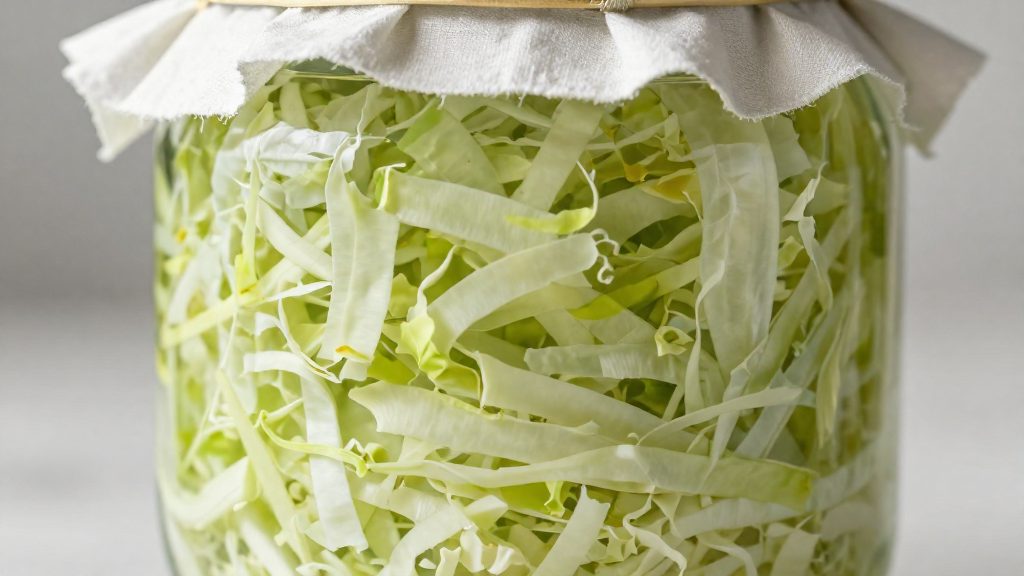
Dry-salting means tossing or rubbing cut vegetables with salt, then massaging or pressing them until they soften and release liquid. This works for finely cut or shredded vegetables with high water content, because the released liquid becomes the cover for the packed mass. If the liquid does not cover the pieces after packing, add a prepared brine to top it up.
Brine for whole or fully submerged vegetables
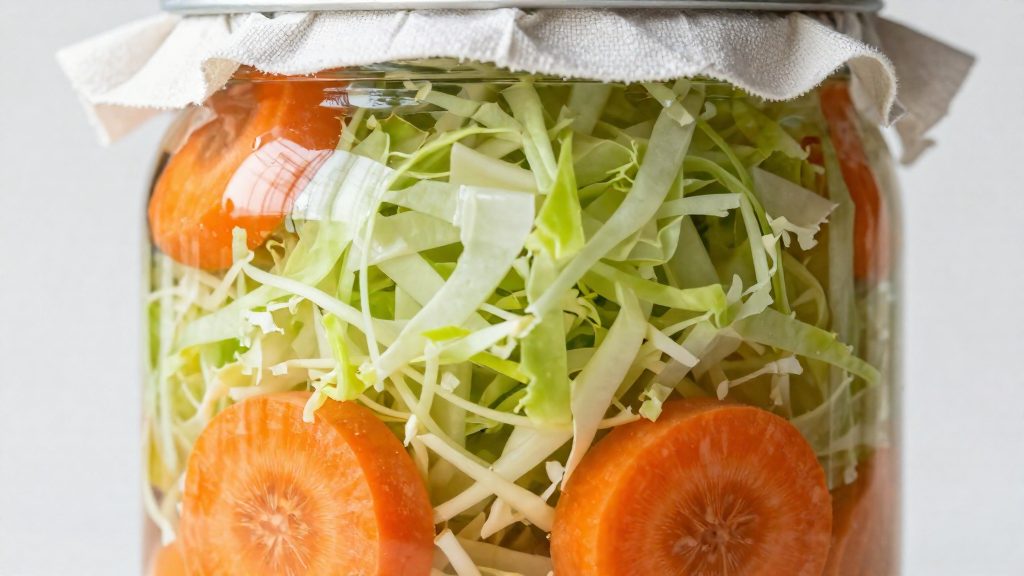
Whole vegetables cannot be evenly coated with dry salt, so their surfaces receive uneven contact. A prepared brine reaches every surface at once. Pour the brine over the vegetables, then weigh them down so no piece rises above the liquid. Pieces left exposed to air are more prone to surface spoilage, which is why full submersion matters for whole items.
Choosing the method by texture and shape
| Vegetable form | Method | Reason |
|---|---|---|
| Shredded or finely sliced, high water content | Dry-salting | Releases enough liquid to cover the packed mass |
| Whole vegetables | Brine | Salt cannot reach all surfaces evenly |
| Thick or dense pieces, low water content | Brine | Releases little liquid on its own and needs a cover |
Texture indicates water release, and shape indicates how evenly salt can reach the surface. Check the vegetable before choosing: if it is juicy and cut small, dry-salt it; if it is whole or dense, prepare a brine.
Sauerkraut and kimchi: salt levels
Set salt for cabbage ferments by weight of the cabbage, not by volume. Weigh the trimmed, shredded cabbage, then multiply that weight by the chosen salt percentage. At 2%, 1,000 g of cabbage takes 20 g of salt. Weighing keeps the ratio accurate regardless of head size or moisture.
Salting, massaging and resting follow a sequence:
| Stage | Action | Sign it is done |
|---|---|---|
| Salting | Toss shredded cabbage with the weighed salt | Salt is spread evenly across the leaves |
| Massaging | Squeeze and knead by hand | Cabbage softens and releases its liquid |
| Resting | Cover and leave before packing | Leaves bend without cracking |
| Packing | Press firmly into jar or crock | Packed tightly, no loose leaves above the surface |
Resting time depends on the cabbage and the room temperature, so judge it by the leaf test rather than the clock.
Kimchi brine soak and rinse
Kimchi cabbage is usually salted as halves or quarters by soaking in a salt brine, not by massaging alone. Soak until the thickest part of the stem bends easily.
After soaking:
- Rinse each piece two or three times in cool water to remove surface salt.
- Drain cut side down so excess water runs off before seasoning.
- Taste a small piece of the rinsed stem to check saltiness before adding the seasoning paste.
Inner leaves keep the salt absorbed during soaking. Skipping the rinse leaves the finished kimchi noticeably salty.
Fermented hot sauces and pickles: brine strength
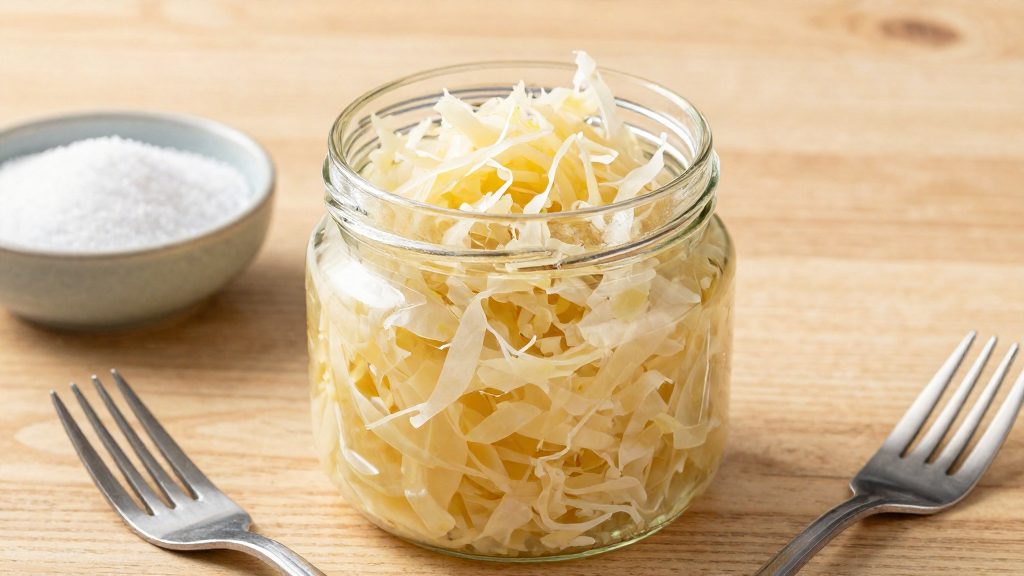
Brine strength is set by mass: grams per litre of salt dissolved in water.
| Brine strength | Salt per 1 L of water |
|---|---|
| 2% | about 20 g |
| 3% | about 30 g |
| 3.5% | 35 g |
| 5% | 50 g |
Fermented pepper mashes
For fermented hot sauces, weigh the salt against the total mash mass instead of dissolving it in water first. Weigh the peppers and any garlic or onion, weigh the salt, mix thoroughly, then pack the mash into the jar and press it down until it releases liquid. Take the salt-to-weight ratio for pepper mash from your recipe rather than assuming one.
Cucumber pickles: brine strength and souring speed
Brine strength affects two things: how quickly lactic acid bacteria start producing acid, and how firm the cucumbers stay. Brines near the low end of the tolerance range favour faster souring. Judge texture by tasting over the fermentation period rather than targeting a number.
Adjusting brine after packing
If the level drops or pieces float, add brine made at the original strength. Adding plain water dilutes the salt and changes the fermentation pace. Adding dry salt to the surface leaves the strength uneven and unknown.
Is too little or too much salt unsafe?
Salt is a safety control as well as a flavour input. Inside the tolerance window, the batch can favour acid-producing bacteria over spoilage organisms. Below it, salt no longer suppresses unwanted microbes effectively. Above it, the lactic bacteria themselves slow down.
Low salt and mould risk
When salt falls toward the bottom of the tolerated range, the brine becomes less selective. Yeasts and moulds can establish on the surface or on exposed vegetables before enough lactic acid builds up to protect the batch. A ferment made with too little salt is therefore more likely to develop surface mould and a soft, spoiled texture.
High salt and slowed fermentation
At the upper end of the range, lactic acid bacteria ferment more slowly, so acidification takes longer. The batch stays less acidic for longer, which is the period when it is most open to problems. Over-salted vegetables also tend to remain firm and taste harsh. A slow start is not automatically a fault, so judge the batch by its smell, texture and surface over the following days rather than on the first day.
Spoilage versus normal fermentation
| Observation | Normal fermentation | Spoilage |
|---|---|---|
| Surface | Thin, flat, white film (likely yeast, judge together with smell and texture) | Fuzzy or raised growth, often coloured (mould) |
| Smell | Sour, tangy, yeasty | Putrid or rotten |
| Texture | Crisp to tender, vegetables submerged | Slimy or mushy, vegetables exposed |
Salt types, weights and crocks
Table, kosher and sea salt
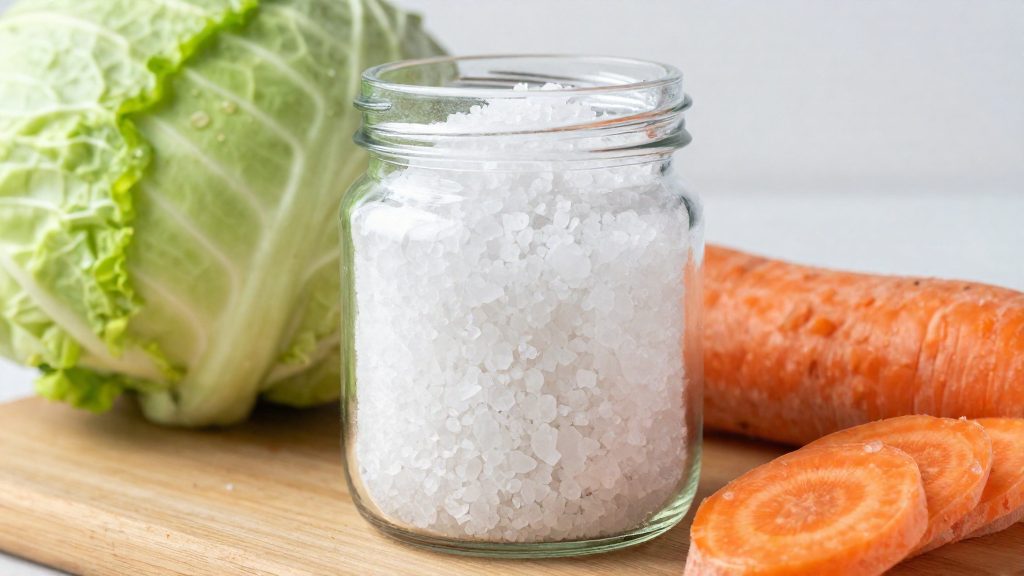
Grain size and crystal shape change how much salt fits in a given volume. Two grams of fine table salt and two grams of coarse flaky salt can fill very different spoons.
- Table salt packs densely. Small spoonfuls carry more mass.
- Kosher salt has larger, irregular flakes. The same spoon holds less mass, and brands differ.
- Sea salt varies most, from fine to coarse.
Measuring salt by weight
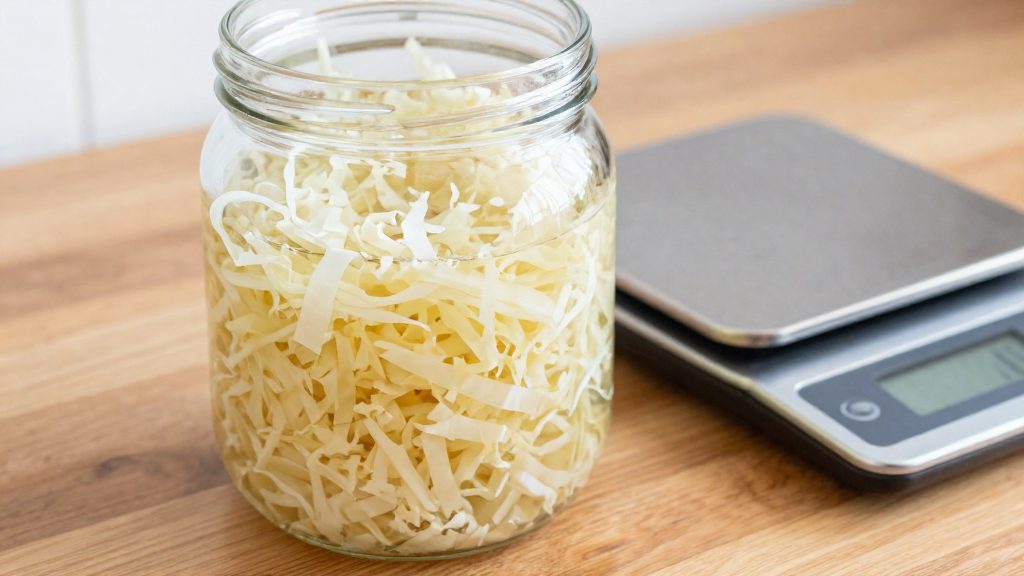
Place a container on a kitchen scale, zero it, then add salt until the target mass is reached. Use the same scale for water so both values share a method. Record the mass of salt and the mass of water in your fermentation log so the ratio can be reproduced.
Crock volume and brine quantity
A crock’s labelled capacity is not the amount of brine it needs. Vegetables, weights and headspace all displace liquid, so the water you add is always less than the full volume. Convert a planned water volume into a mass to weigh:
| Planned water volume | Approximate water mass |
|---|---|
| 1 L | about 1,000 g |
| 2 L | about 2,000 g |
| 5 L | about 5,000 g |
To size the brine, fill the crock with your vegetables and weights, measure the water needed to cover them, and weigh that water.
Frequently asked questions
How many grams of salt do I need per litre of brine for vegetables?
For most vegetable ferments, use about 20 g of salt per litre for a 2% brine or about 30 g for a 3% brine. Weigh the salt rather than measuring it by volume, because the grams per spoonful vary with the salt type.
Does the salt change the volume of the brine?
Yes, but only slightly. The grams-per-litre figures assume the water mass is the main factor, so they ignore the small volume the dissolved salt adds. For home batches this approximation is accurate enough.
Can I use a 3.5% brine for fermenting vegetables?
A 3.5% brine contains about 35 g of salt per litre of water, which sits between the common 2 to 3% range and the 5% ceiling for lactic acid bacteria. Stay at 3% or below if you want to follow the typical vegetable range.