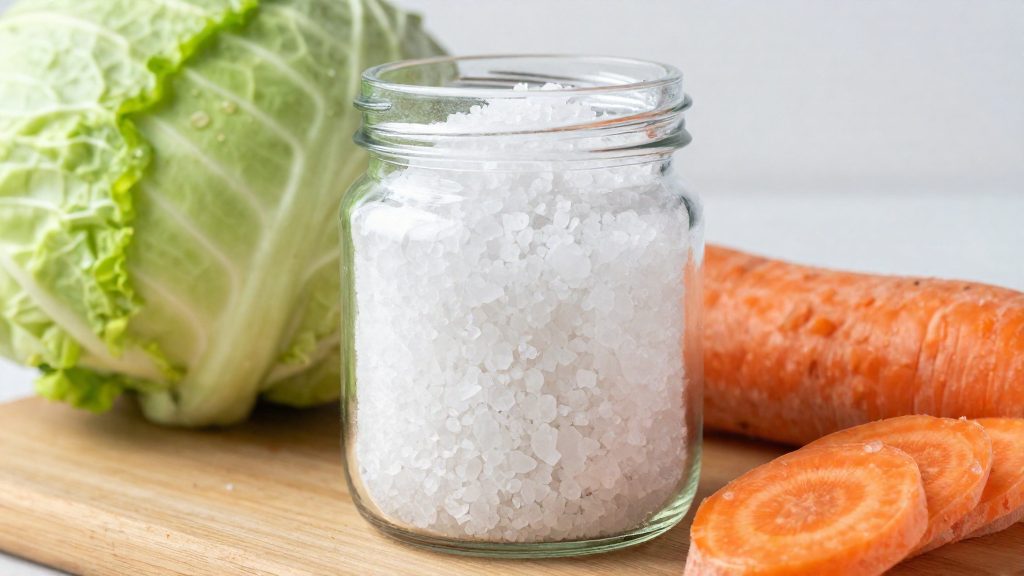
Why do recipes call for non-iodized salt?
Recipes call for non-iodized salt because the salt should dissolve cleanly into the brine and leave nothing else in the jar. The sections below look at additives other than iodine, and at what the sources do and do not say about their effects on the brine and the vegetables.
Anti-caking agents and brine clarity
Anti-caking agents are added to table salt so it pours freely. They are not part of a basic brine, and Cultures for Health advises avoiding them. Any additive that does not fully dissolve can remain suspended in the liquid, which can make the brine look cloudy. To judge the effect, compare a batch made with pickling salt against one made with table salt.
Discoloration of cut surfaces
To check whether salt additives affect colour, ferment a small batch with a single salt type, keep the vegetables fully submerged, and note the colour of the exposed cut faces over the fermentation period.
Texture of the vegetables
The practical step is consistency: use the same salt type across batches so that any difference in crunch or softness comes from the vegetable, the temperature, or the timing, rather than from the salt.
Does iodized salt really ruin ferments?
One peer-reviewed study on cucumbers found no negative effect from iodized salt, which conflicts with a common warning, but it does not settle the question for other vegetables. A common warning holds that iodized table salt inhibits fermentation. A peer-reviewed study on fermented cucumbers, published in Food Microbiology in 2020, concluded that iodized table salt does not negatively affect fermentation.
What the cucumber study found
- Salt concentration shaped both the fermentation process and the microbiota.
- Iodine diffused into the cucumbers, so iodide from the brine moved into the vegetables.
- The conclusion applies to cucumbers, not necessarily to cabbage, carrots, or kimchi mixtures.
Where the inhibition warning comes from
Cultures for Health (2026) advises against iodized table salt for vegetable fermentation, stating that iodine tends to inhibit beneficial bacteria. The warning is qualitative.
Comparing the two positions
| Source | Year | Finding on iodized salt |
|---|---|---|
| Food Microbiology study (cucumbers) | 2020 | Does not negatively affect fermentation; iodine diffused into the cucumbers |
| Cultures for Health | 2026 | Advised against; iodine tends to inhibit beneficial bacteria |
How to test the claim at home
To check the warning on your own vegetables, split one batch of cut vegetables into two identical jars. Use the same brine, the same container, and the same storage temperature. Add iodized salt to one jar and pickling salt to the other. Compare texture, smell, and acidity over the same period. Record each result so the two jars can be compared directly.
What does Canadian law say about iodized salt?
In Canada, salt and sea salt sold for table or general household use must contain 0.01% potassium iodide, and the iodide must be shown on the principal display panel. Non-iodized salt is not banned altogether. It cannot be sold for household or table use, but it can be sold under a use-specific name or for further processing, and it is permitted as a food ingredient. The iodide rule is set in section B.17.003 of the Food and Drug Regulations, according to the Justice Laws Website, Government of Canada (2024-12-18).
The 0.01% potassium iodide requirement
The 0.01% potassium iodide requirement covers table salt and sea salt intended for general household use. The regulation states it as a required content, so a product sold for table use must contain that level of potassium iodide.
Principal display panel disclosure
Presence of iodide is a labelling obligation as well as a composition rule. The iodide must be shown on the principal display panel of the package, so the declaration cannot appear only in the ingredient list or on a side panel (Justice Laws Website, Government of Canada, 2024-12-18).
Non-iodized salt under use-specific names
Salt that is not iodized cannot be sold for household or table use. Canadian Food Inspection Agency (2026) states that it can instead be sold under a use-specific name, such as salt for pickling, or for further processing. The same source confirms that non-iodized salt is permitted as a food ingredient.
| Salt category | Iodide status | Sale for table or household use | Other permitted sale |
|---|---|---|---|
| Table or general household salt, including sea salt | Must contain 0.01% potassium iodide, shown on the principal display panel | Permitted | Not stated |
| Non-iodized salt | No iodide | Not permitted | Sold under a use-specific name, or for further processing; permitted as a food ingredient |
Which non-iodized salts work for fermenting?
Non-iodized salt is the category to look for when fermenting vegetables. Shoppers in Canada should look for salt labelled for pickling or canning, and then confirm on the label that no iodide or anti-caking agent is listed.
| Salt type | Potassium iodide | Anti-caking agents | Source |
|---|---|---|---|
| Pickling salt | None | None | Cultures for Health (2026) |
Pickling salt
Pickling salt is the most direct match for fermentation. Cultures for Health states that it works because it contains no iodine or anti-caking agents (Cultures for Health, 2026). Check the label for both before buying.
Canning salt and kosher salt
Read the ingredient panel on any product you buy. If it lists an anti-caking agent or iodine, it does not match the guidance above, whatever the product name.
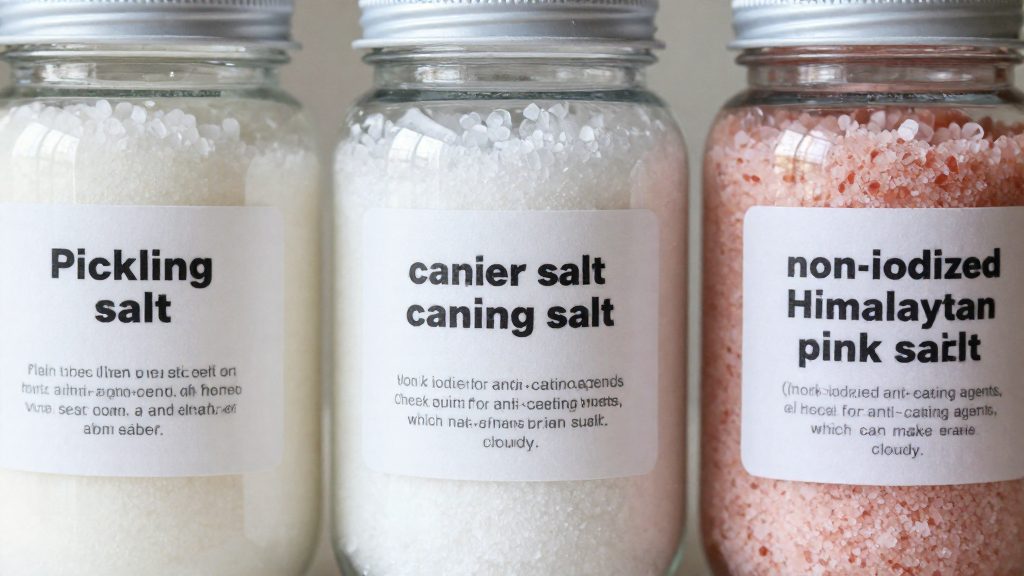
How to read a salt label in Canada
A Canadian salt label can be checked in three places: the principal display panel, the ingredient list, and the net quantity. For vegetable fermentation, the front panel is the first place to look.
| Check | Where to find it | What it tells you |
|---|---|---|
| Use-specific name | Principal display panel | Wording such as “pickling” or “canning” marks salt sold for a non-table use |
| Ingredient list | Back or side panel | Shows any additives in the product |
| Net quantity | Principal display panel | The weight used to calculate unit price |
Ingredient list terms that signal additives
Read the ingredient list after the front panel. A suitable product lists salt as its only ingredient. Check the list for the general term for anti-caking agents and for any additive not listed as salt.
Net quantity and unit price comparison
The net quantity is printed on the principal display panel, usually in grams or kilograms. To compare two bags, divide the shelf price by the net weight in grams to get a price per gram, then compare those figures. The same method works for any pack size. Compare only bags of the same type, since a pickling-labelled bag and a table-labelled bag are not interchangeable at the same price.
How much salt should you use in a brine?
Brine strength is set by weight, not volume. Weigh the water that goes into the jar, multiply that mass by your chosen brine percentage, and weigh out the salt. Volume measures fail because the vegetables displace water, so the same jar holds different amounts of liquid depending on how tightly it is packed. The formula needs a brine percentage, and this article gives no verified figure for one. Take the percentage from a tested recipe, since too little salt can compromise the safety of a vegetable ferment, and apply it consistently.
The weight-based formula
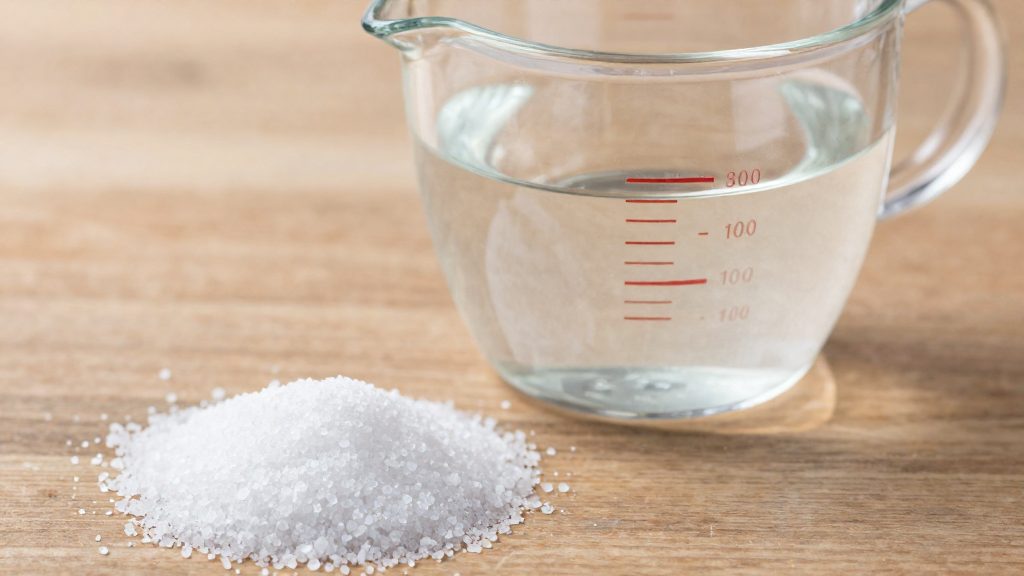
Use this formula with water mass in grams:
Salt weight (g) = water weight (g) × brine percentage ÷ 100
Weigh the water alone, before any salt is added. Dissolve the salt completely in that water before pouring the brine over the vegetables.
Scaling to jar volume and weight
Scaling is proportional. Measure the water for each jar separately rather than estimating from the jar’s labelled capacity, then apply the same percentage. Record the water weight and salt weight on the jar, so the batch can be repeated or compared later.
Typical strength by vegetable type
Use one percentage per batch and keep it fixed across the batch, so any difference in results can be traced to the vegetable or the temperature, not to an inconsistent recipe.
Is Himalayan or sea salt better than pickling salt?
Neither is better in every case. Pickling salt, unrefined sea salt and Himalayan salt can all be used for fermenting vegetables, provided they contain no iodine and no anti-caking agents. Cultures for Health (2026) recommends unrefined sea salt or Himalayan salt as alternatives. The practical difference lies in what else each salt contains and in how easily you can source it.
| Salt type | Cultures for Health position (2026) |
|---|---|
| Unrefined sea salt | Recommended |
| Himalayan salt | Recommended |
Purity and mineral content
Unrefined salts are recommended by Cultures for Health as alternatives to pickling salt. In Canada, sea salt sold for table or household use must contain potassium iodide, so check that the label lists no iodide or anti-caking agent. The trade-off is that they may carry trace minerals, while pickling salt is the more predictable, uniform option.
Cost and availability
Compare the price per kilogram at your local suppliers before buying in bulk, and choose the salt type you can source consistently, since batch-to-batch variation in your ferment is easier to control with a stable product.
Frequently asked questions
Does iodized salt really stop a ferment from working?
The evidence is mixed. A 2020 study in Food Microbiology (Stoll et al.) found that iodized table salt did not harm fermentation in cucumbers, and that iodine moved into the vegetables. That result applies to cucumbers only, so Cultures for Health’s advice to avoid iodine in vegetable ferments still stands for other vegetables.
How do I check whether a salt is iodine-free in Canada?
In Canada, salt and sea salt sold for table or household use must contain 0.01% potassium iodide, which must appear on the principal display panel. A product called “sea salt” is therefore not automatically free of iodine. Look for a use-specific name such as “pickling salt” or “canning salt”, which Canadian rules allow for non-iodized salt.
Which salt should I buy for my first batch of sauerkraut?
Cultures for Health recommends pickling salt, which contains no iodine or anti-caking agents. It also names unrefined sea salt and Himalayan salt as alternatives. Check the label of any unrefined salt for added iodide if you are in a region where iodization is required.