Store-bought hot sauces generally keep a year or more in the refrigerator after opening, according to PepperGeek (2026). Homemade batches often keep for less time than commercial bottles, and the official sources consulted do not give a homemade timeline. Plan storage for a home-fermented sauce around its own condition and its bottling date, not around the label on a store-bought bottle.
How long does fermented hot sauce last in the fridge?
Store-bought bottles after opening
Commercial fermented hot sauces are the only category with a published refrigerated benchmark in the consulted sources. According to PepperGeek (2026), they generally keep a year or more once opened and refrigerated. That figure applies to opened bottles kept cold. It does not describe unopened stock or sauce left at room temperature.
Compare a bottle’s opening date with the one-year mark to decide whether it is still within the typical range.
Homemade batches
PepperGeek (2026) states that homemade sauces often do not last as long as store-bought ones. The source does not quantify the difference, so no homemade number can be drawn from it. Treat the commercial one-year figure as an upper reference that a home batch may not reach, not as a target.
Homemade batches vary widely because ingredients, salt levels, vinegar content, and batch size differ from one cook to the next. Those differences make a single timeline unreliable for every batch, which is one reason a per-batch approach works better.
Why no official homemade timeline exists
The official sources consulted do not specify a shelf life for homemade fermented hot sauce. Because no official figure exists, the only published benchmark comes from commercial products. Keep a written record for each homemade batch, including the bottling date and the recipe used, so you can judge its age against your own notes rather than an assumed period.
| Sauce type | Refrigerated shelf life benchmark | Source |
|---|---|---|
| Store-bought, opened | A year or more | PepperGeek (2026) |
| Homemade fermented | Often shorter than store-bought; no figure given | PepperGeek (2026) |
| Homemade fermented, official timeline | Not specified by the official sources consulted | Official sources consulted |

What affects the shelf life of fermented hot sauce?
Acidity is the shelf-life factor the consulted sources describe most directly. According to PepperGeek (2026), acidity from vinegar or fermentation inhibits bacteria. The variables below mark where a home batch can gain or lose keeping time.
Acidity from vinegar and fermentation
A fermented hot sauce gets its acidity from two sources: vinegar added to the recipe and acids produced during fermentation. You control both at the recipe stage, through the amount of vinegar and the point at which you stop fermenting. The acidity a sauce has when it goes into cold storage therefore sets the starting point for its keeping time, and it keeps changing afterward, just more slowly.
Moisture and solids in the ingredient mix
The consulted sources do not specify how moisture or solid content affects keeping time, so no threshold can be given here. The variable you control is the ratio of solids (peppers, garlic, other vegetables) to liquid, and how thoroughly they are blended. Record the ratio for each batch. Without written notes, you cannot tell which version kept longest.
Clean bottles and handling during filling
The consulted sources do not specify bottle sterilisation methods or timings. General practice is to start with clean, dry bottles and utensils, and to keep the sauce uncovered for as little time as possible while filling. Each opening of a bottle exposes the sauce to air and to handling.
Does fermentation continue after bottling?
Yes. According to PepperGeek (2026), fermentation continues in the fridge, only much more slowly. Bottling therefore does not stop the process. It changes the pace. Live cultures stay active inside sealed bottles, so the sauce can keep changing in acidity, flavour and texture after it is capped. The moment you bottle a sauce is not the moment it is finished.
Why the sauce keeps changing
Fermentation is driven by living microorganisms that convert sugars into acids and gases. Capping a bottle limits oxygen exchange, but it does not kill these organisms. The sauce continues to ferment at whatever temperature it is stored at. In the fridge the change is much slower, and the sauce may fizz when opened.
Refrigerate once the target level is reached
Decide on your target before bottling. Taste the sauce at intervals during fermentation and note when it reaches the acidity and flavour you want. PepperGeek (2026) advises refrigerating the sauce at that point.
Gas buildup and pressure risk
Fermentation produces carbon dioxide, and in a sealed bottle this gas accumulates. The official sources consulted do not specify pressure thresholds, bottle types or safe fill levels, so this section gives no figures. As a general precaution, leave headspace at the top of each bottle rather than filling it fully, and open bottles slowly, especially those that have been fermenting at warmer temperatures.
How to check the pH of a homemade hot sauce
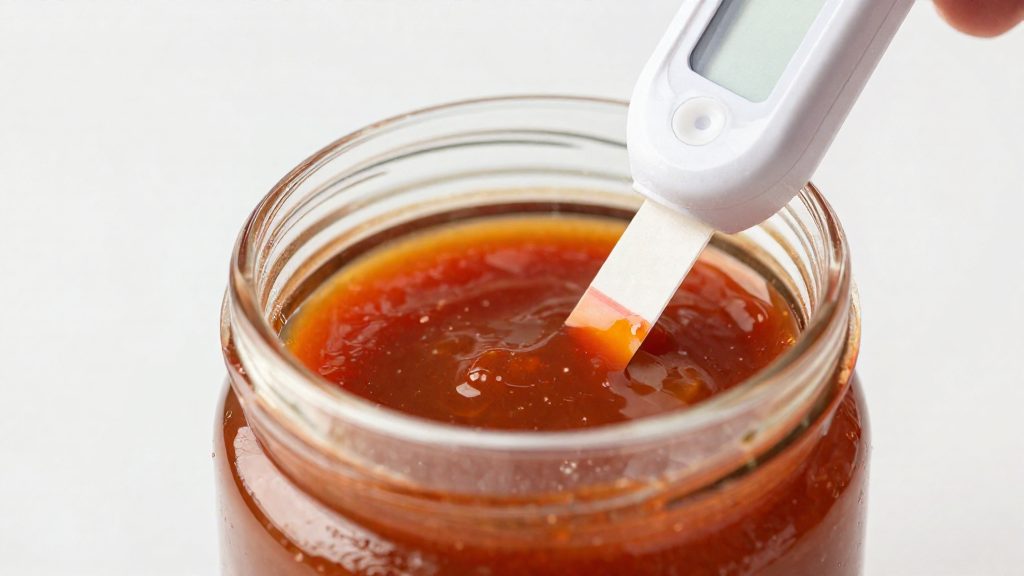
A pH meter is the most direct way to confirm that a fermented hot sauce has reached the acidity its recipe intends. Taste and appearance cannot measure acidity reliably, so a measured reading is the practical check before bottling or eating homemade sauce. PepperGeek (2026) recommends a good-quality pH meter for checking homemade fermented sauce.
Choosing a meter
Look for these features when buying:
- Replaceable probe: the glass electrode wears out and must be swapped periodically.
- Two-point calibration: lets you calibrate with two buffer solutions that bracket the range you expect to test.
- Automatic temperature compensation: keeps readings accurate as the sauce warms or cools during testing.
- Fine resolution: a meter that reads in tenths or hundredths of a pH unit gives a more useful result than a strip-style estimate.
Calibrating with buffer solutions
Calibrate before each testing session, not only when the meter is new. The general sequence is:
| Step | Action |
|---|---|
| 1 | Rinse the probe with distilled water and blot it gently. |
| 2 | Immerse it in the first buffer solution and wait for the reading to stabilise. |
| 3 | Adjust the meter to the buffer’s labelled value, following the manufacturer’s instructions. |
| 4 | Rinse again, then repeat with the second buffer. |
| 5 | Keep the probe in its storage solution when not in use. |
Check the meter’s manual for the exact adjustment procedure, since calibration steps differ between models.
Measuring the sauce
- Blend the sauce fully before testing, so the reading reflects the whole batch.
- Measure after all acidic ingredients have been added and mixed.
- Record readings over time if you are tracking a ferment, so changes between sessions are visible.
The FDA pH threshold
The sources consulted give no pH target for fermented hot sauce. For a Canadian kitchen, check current Health Canada guidance on acidified foods before relying on a specific target value for your sauce.
Signs your hot sauce has spoiled
Spoilage in fermented hot sauce shows up through sight, smell and taste, and each sign points to a different decision. Three of the signs call for discarding the bottle: mold, a sour or rotten odour, and a slimy texture or unusual taste. The fourth, browning, is usually a harmless change in colour. Check all three before deciding, because a sauce can darken without being spoiled and can look normal while something is wrong.
Start with the surface. Fuzzy mold is the clearest sign of spoilage and means the sauce should be thrown out. Look at the surface of the sauce, around the rim of the jar, and on the underside of the lid or cap, since growth often starts in those places. Mold appears as fuzzy patches. If you are unsure whether a film or speck on the surface is mold, do not taste the sauce; discard it.
Next, smell the sauce. A sour or rotten odour is a reason to discard it. Fermented hot sauce normally smells sharp, vinegary or fruity, depending on the peppers and ingredients. An odour that is rotten, or that is clearly off compared with the same sauce earlier, is a warning sign, not a flavour you should accept.
Texture and taste come next. A slimy texture or an unusual taste means the sauce should be discarded. Slime is a change in consistency that you can feel when you stir or pour the sauce. An unusual taste is any flavour that differs clearly from the batch as you normally know it. Do not keep a sauce to see whether the taste settles.
Browning is the change that most often causes unnecessary discarding. Darkening from oxidation is usually harmless. It happens when air reaches the sauce at the surface, and it changes colour without, by itself, indicating that the sauce has gone bad. If a darkened sauce passes the smell, texture and mold checks above, the browning alone is not a reason to throw it out.
| Sign | Likely meaning | Action |
|---|---|---|
| Fuzzy mold | Spoilage | Discard |
| Sour or rotten odour | Spoilage | Discard |
| Slimy or unusual texture or taste | Spoilage | Discard |
| Browning from oxidation, with normal smell, texture and taste | Usually harmless oxidation | Keep, if the other checks are clear |
Can you store fermented hot sauce at room temperature?
The official sources consulted do not specify a safe room-temperature shelf life for fermented hot sauce, so no duration can be given from them. What the available guidance does establish is that warmth speeds up fermentation, so a sauce left on the counter keeps changing faster than one that is chilled.
Why warmth changes the outcome
Warm conditions accelerate the microbial activity that drives fermentation, so a sauce reaches its final flavour and acidity sooner and continues past that point sooner. Unrefrigerated storage makes these changes harder to predict, since the rate depends on the temperature of the room.
Commercial and homemade sauces differ
The sources consulted do not compare room-temperature limits for commercial and homemade sauces. A home batch has no manufacturer label or processing history, so its stability depends on the recipe, salt and acid levels, and how it was handled.
Practical approach at room temperature
- Ferment the sauce at a stable room temperature.
Tips for storing homemade hot sauce in Canada
Storing homemade hot sauce in a Canadian kitchen depends on three habits: keeping the fridge at a known temperature, labelling each bottle with dates, and choosing a stable shelf position. Each one is simple, but all three are easy to skip when a batch is bottled in a hurry.
Check the fridge temperature
Health Canada recommends keeping the fridge at 4°C (40°F) or colder.
Fridge dials are often inaccurate, so use an appliance thermometer placed on a middle shelf and read it over several days. Adjust the dial until the reading stays at or below the target.
Label every bottle with two dates
Write the filling and opening dates on each bottle. The filling date records when the batch was bottled, and the opening date records when the sauce was first exposed to air. Use a waterproof marker or a removable label, because condensation in the fridge can smear ink on glass.
Use the same format on every bottle, such as batch name plus both dates. Consistent labels make it easier to see which bottles are oldest and should be used first.
Store bottles upright on an interior shelf
Stand bottles upright so the cap seals properly and sauce does not seep down the threads. Place them on an interior shelf rather than the door. The door is the warmest part of the fridge and is exposed to the largest temperature swings each time it opens, which makes it the least stable place for a fermented product.
Frequently asked questions
Does a homemade fermented hot sauce stop fermenting once it is in the fridge?
Cold storage slows fermentation but does not stop it, so the sauce keeps changing slowly even when refrigerated. PepperGeek (2026) recommends refrigerating once the sauce reaches the level of fermentation you want, which lets you control how sour it becomes.
How can I tell when a fermented hot sauce has spoiled?
Throw the sauce out if you see fuzzy mold, notice a sour or rotten smell, or taste something slimy or unusual. PepperGeek (2026) notes that oxidation browning on the surface is usually harmless, so a darker color alone is not a reason to discard it.
Does a pH meter tell me how long my sauce will last?
A pH meter cannot give a shelf-life date, but PepperGeek (2026) recommends a good-quality pH meter for homemade fermented sauce. Acidity from vinegar or fermentation is what inhibits bacteria, and the official sources consulted do not give a target pH for fermented hot sauce.