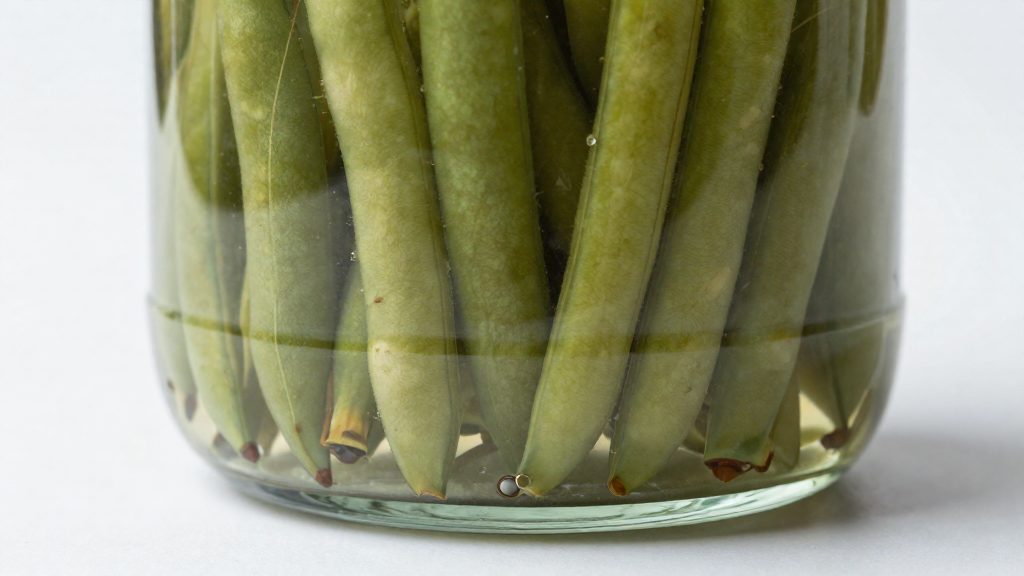
There is no tested home-fermentation guidance for green beans, so no verified brine ratio, timing or temperature exists for them. The Oregon State University Extension Service publication PNW 355 covers pickles and sauerkraut, not green beans. Because green beans are a low-acid vegetable with little tested fermentation guidance, a home green bean ferment is an unvalidated experiment, not a documented method.
Can you ferment green beans at home?
Lacto-fermentation versus vinegar pickling
Both methods produce tart “pickled” beans, but only one is fermentation.
| Feature | Lacto-fermentation | Vinegar pickling |
|---|---|---|
| Source of acid | Lactic acid made by bacteria feeding on the vegetable’s own sugars | Acetic acid added directly as vinegar |
| Role of salt | Brine favours lactic acid bacteria over spoilage microbes | Not needed to create acidity |
| Living microbes | Active during the process | None; the acid is supplied, not produced |
| Flavour source | Sourness developed during fermentation | Sharpness from the vinegar itself |
Why green beans are a difficult case
In lacto-fermentation, the acid produced is the main barrier against harmful microbes. Vegetables with less natural acidity give the bacteria less to work with, and the margin of safety is harder to judge. Because the PNW 355 guidance does not address beans, there is no published basis for assuming that a cucumber or cabbage schedule will protect a green bean ferment.
Suitability of green beans for brine-only fermentation
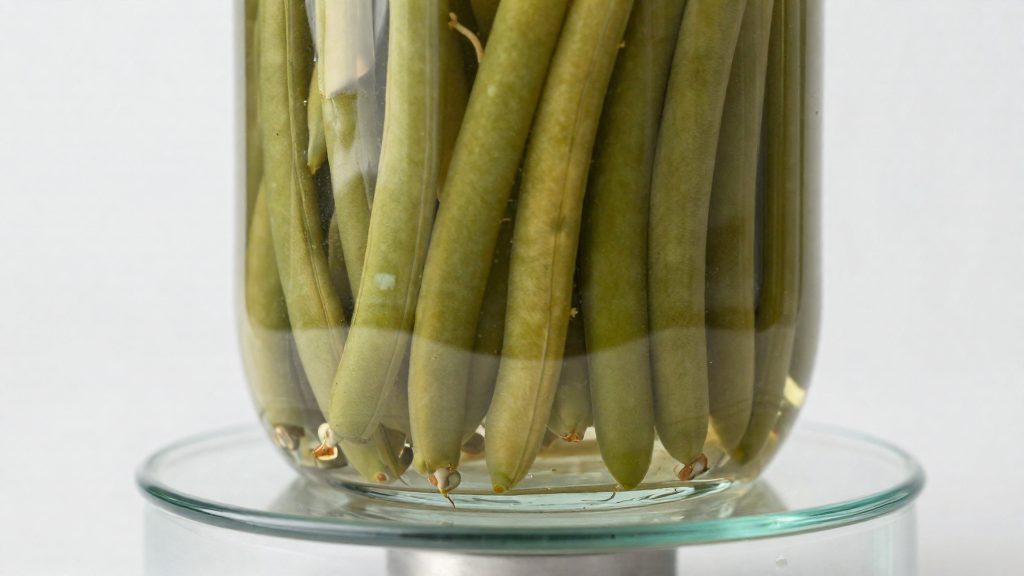
If you choose to try brine-only fermentation, the general principle from the sauerkraut and pickle guidance applies: keep the beans submerged, 1 to 2 inches under the brine, using weights and a clean towel, and check the container regularly.
What equipment do you need?
The main equipment decision for a green bean ferment is the vessel and how the beans are held under the brine. The Oregon State University Extension Service (PNW 355) publication is applied here by analogy.
Container capacity and headspace
Choose a food-grade vessel large enough to hold the beans fully under the liquid, with room above the brine for the beans to be packed and the weights to sit. Size the vessel to your batch.
Weights and covers
Airlock types
A towel-covered, weighted setup is an alternative. If you use an airlock, confirm it is made for food fermentation.
What brine ratio works best?
The closest reference in PNW 355, a US publication, is the sauerkraut method, which sets salt by container volume and by the volume of top-up water, not by weight. It uses US gallons and quarts, which differ from imperial measures, so convert carefully to metric. It is not Canadian guidance.
Reference values for sauerkraut (Oregon State University Extension Service, PNW 355):
| Use | Salt amount | Measured against |
|---|---|---|
| Initial salting of shredded cabbage | 3 tablespoons canning or pickling salt | Each gallon of container capacity |
| Top-up brine, when the vegetable’s own juice does not cover it | 1½ tablespoons salt | Each quart of water |
The publication gives no salt percentage by weight for either method, so a weight-based bean ratio cannot be derived from it. Measuring by volume against the container’s capacity is the method the source describes, and it should be treated as a starting reference for beans, not a validated recipe.
If you borrow the sauerkraut top-up method, remember it is unvalidated for beans. It dissolves the salt in the exact water volume you add, rather than relying on an estimate of how much liquid the container will hold. Calculating from the water you actually use keeps the strength tied to the batch, rather than to an estimate of how much liquid the container will hold.
How to ferment green beans step by step
Fermenting green beans uses the same physical workflow as other lacto-fermented vegetables: trim and prepare the beans, then pack them with any aromatics. The steps below describe handling technique only.
Step 1: Trim and choose a packing method
Snap off both stem ends of each bean, then rinse them. Choose one of two approaches before packing:
| Method | What you do | Trade-off |
|---|---|---|
| Raw packing | Pack trimmed, washed beans directly into the vessel | No heat step; beans keep their raw texture |
| Blanching | Briefly boil the beans, then cool them in cold water before packing | Partly cooks the beans and changes their texture |
Cut beans to uniform length if you want them to pack evenly.
Step 2: Pack with garlic, dill or spices
Common additions include garlic cloves, dill heads or fronds, and whole spices such as mustard seed or peppercorns. Distribute them between layers of beans rather than placing them in a single pocket, so the flavour reaches the whole batch. Pack the beans upright or stacked snugly, leaving space at the top of the vessel so the liquid does not overflow.
Step 3: Keep the beans submerged
Green beans are dense but can still float or shift as gas forms. If beans rise above the liquid, top up with brine so they are covered again.
Step 4: Run routine checks
Inspect the vessel several times a week, as the Oregon State University Extension Service recommends for fermenting vegetables. At each check, confirm the beans are still submerged. If you see any surface growth that you cannot identify with certainty as a thin, flat film, or any fuzzy, raised or coloured growth, discard the batch. Lift the towel and weight gently so debris does not fall into the liquid, then return both to their positions.
How long do fermented green beans take?
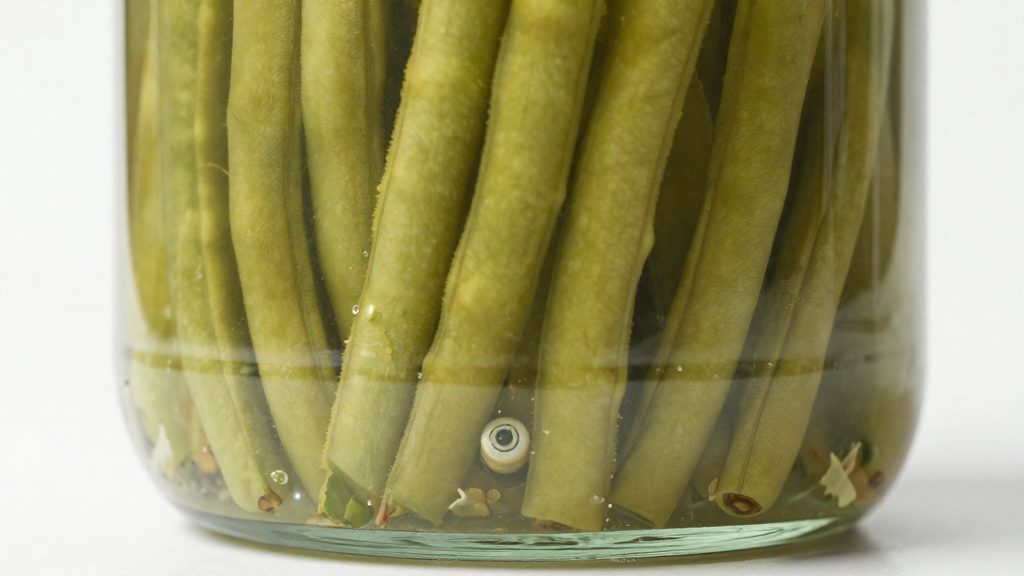
The closest reference is sauerkraut, which takes about 3–4 weeks at 70–75°F (about 21–24°C). Do not treat that figure as valid for beans, because their pace may differ.
Temperature is the main variable. The publication gives these limits for brined vegetables:
| Temperature | Effect stated for pickles or sauerkraut |
|---|---|
| Below 60°F (15.5°C) | Sauerkraut may not ferment |
| 70–75°F (21–24°C) | Ideal range; sauerkraut takes about 3–4 weeks |
| Above 75°F (24°C) | Sauerkraut may turn soft |
| Above 80°F (27°C) | Pickles become too soft |
A cooler room slows fermentation and a warmer room speeds it up, but the publication does not give a conversion for how much faster beans would finish at a given temperature.
Deciding when to stop with taste tests
Taste testing is the practical way to decide when to stop. Remove a small portion with a clean utensil and taste it. Look for a clear sour, tangy flavor and a softening of the raw vegetable taste. Stop when the flavor suits you, then move the beans to cold storage.
How do you know they are safe to eat?
Discard fermented vegetables that become soft or slimy, or that smell bad. This is the rule the Oregon State University Extension Service (PNW 355) gives for pickles and sauerkraut. Passing a look-and-smell check does not prove a low-acid green bean ferment is safe, because harmful bacteria cannot be ruled out by sight or smell. If you are unsure, discard the batch. This is the rule the Oregon State University Extension Service (PNW 355) gives for pickles and sauerkraut. The checks below apply general fermentation practice.
Normal fermentation signs
A healthy green bean ferment usually shows:
- Cloudy brine that becomes murky as lactic acid bacteria multiply.
- Small bubbles rising through the liquid or along the sides of the jar.
- A sour, tangy aroma, similar to vinegar or yogurt.
These signs appear early and are expected. They do not, on their own, indicate spoilage.
Spoilage signs
| Sign | Normal ferment | Spoilage |
|---|---|---|
| Texture | Firm, crisp beans | Soft, limp, or slimy beans |
| Odour | Sour and tangy | Rotten, putrid, or strongly unpleasant |
| Surface growth | None, or a thin film | Fuzzy, raised, coloured growth |
Surface mould versus kahm yeast
Surface growth is the most common point of confusion.
- Kahm yeast forms a thin, flat, white or cream film that may look wrinkled. It is a yeast, not a mould, but a flat film can be hard to tell apart from early mould, and no guidance covers green beans. If you cannot identify the growth with certainty, discard the batch. It can, however, affect flavour, so skim it off promptly.
- Surface mould is fuzzy and raised. It may be green, blue, black, or white, and it often grows in patches. Mould means discard the batch rather than skimming it.
Storage and troubleshooting
Removing surface scum and mould
Skim only if you can identify the growth with certainty as a thin, flat film: use a clean spoon to lift off the material on top, without disturbing the beans beneath, then press the beans back under the brine. If you have any doubt, or if the growth is fuzzy, raised or coloured, treat it as mould and discard the whole batch rather than skimming it.
Fixing floating beans
Beans that rise above the liquid are exposed to air. Reposition them under the brine and hold them there with a weight. Once the beans are submerged again, leave the container undisturbed. Re-check at the next inspection to confirm they have stayed under.
Soft texture and temperature
The temperature limits linked to softening apply to cabbage and cucumber, not green beans, so they indicate a pattern to watch rather than a verified limit for this vegetable.
Cloudy batches
Note the change when it appears, and record whether it occurs alongside scum, floating, or softening, since these observations together give a clearer picture of the batch than any one sign alone.
Frequently asked questions
Can I use the sauerkraut salt ratio for green beans?
No. The Oregon State University Extension Service (PNW 355) tested its salt amounts on cabbage and pickles, not beans, so those figures do not transfer. Any bean brine built from them is an unvalidated guess.
How do I know if the film on my beans is safe to skim?
Skim only when you can identify the growth with certainty as a thin, flat film, lift it off with a clean spoon, and keep the beans submerged. If you cannot be certain, or the growth is fuzzy, raised or coloured, discard the whole batch.
Does a sour smell and firm texture mean the beans are safe to eat?
No. PNW 355 advises discarding pickles and sauerkraut that turn soft, slimy or smell bad, but it does not cover green beans, and harmful bacteria cannot be ruled out by sight, smell or taste alone. Because no validated acidity target exists for beans, a pleasant flavour is not evidence of safety, so discard the batch whenever you have doubt.