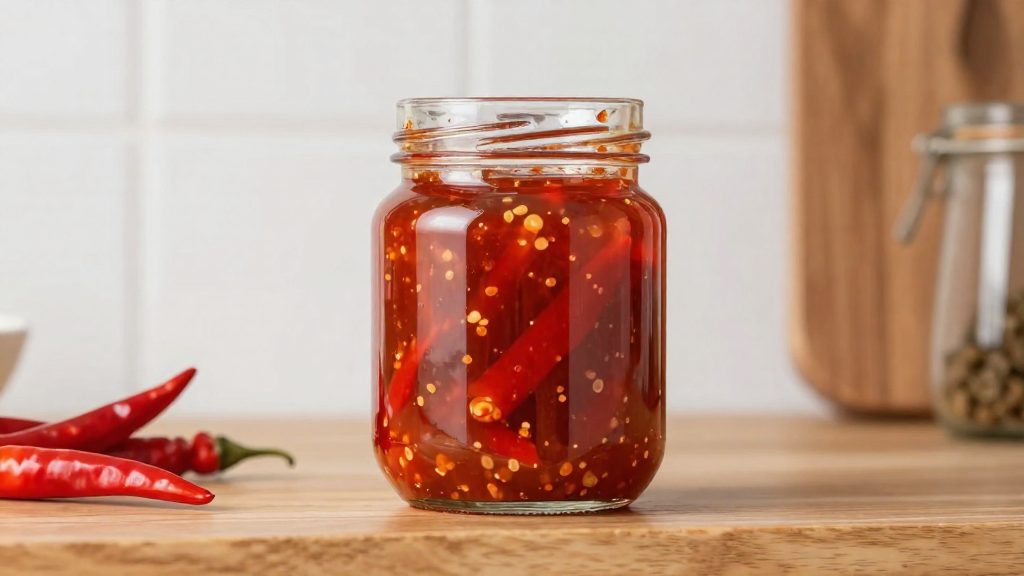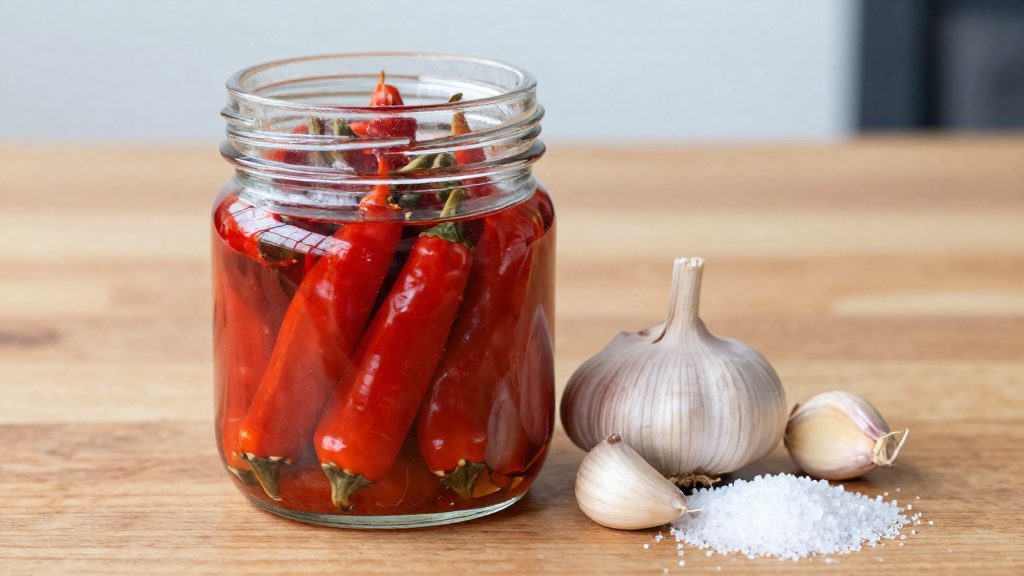
Fermented hot sauce is a sauce made from a lacto-fermented pepper mash: chopped hot peppers, salt and often garlic, left to ferment so that naturally present bacteria produce acid. That acid preserves the mash and gives the finished sauce its tang. Because the acidity comes from fermentation rather than from added vinegar, the sauce tastes rounder and more complex than a pepper sauce made by stirring vinegar into the peppers.
What is fermented hot sauce?
A fermented hot sauce starts with whole or chopped peppers packed with salt. The salt draws out liquid and creates conditions where salt-tolerant lactic acid bacteria can grow while many spoilage organisms struggle. The mash is then blended, strained and bottled.
How lactic acid bacteria work
Lactic acid bacteria live naturally on fresh produce. Once the peppers are kept largely free of air, these bacteria metabolise the sugars in the peppers and garlic and release lactic acid as their main product. As acid builds up, the mash becomes less hospitable to competing microbes, and this is the basic mechanism that preserves the sauce. Lactic acid is a milder acid than the acetic acid in vinegar, so the sourness of a fermented sauce is softer and less sharp.
Fermented versus vinegar-based sauces
| Feature | Fermented hot sauce | Vinegar-based hot sauce |
|---|---|---|
| Acid source | Lactic acid produced by bacteria during fermentation | Vinegar added directly to the recipe |
| Time before blending | Several days of fermentation | No fermentation step, so the sauce can be made in one session |
| Flavour profile | Sour, rounded, with funky and savoury notes | Sharp, bright and uniform |
| Live bacteria | May remain if the sauce is not heat-treated | Not part of the process, because there is no fermentation step |
The key difference is the process. A vinegar sauce is a blend of ingredients, while a fermented sauce is a biological process that changes the ingredients over time.
Why fermented sauces taste sour and funky
The sourness comes mainly from lactic acid, which accumulates the longer the mash ferments. The funk comes from the wider range of compounds that bacteria and yeasts create while they work on the peppers, which add aromas beyond simple tartness. A young ferment tastes mostly sharp and vegetal, while a longer ferment becomes deeper and more savoury. The result is why fermented hot sauces are often described as sour and complex rather than simply hot.
Which peppers and ingredients work best?
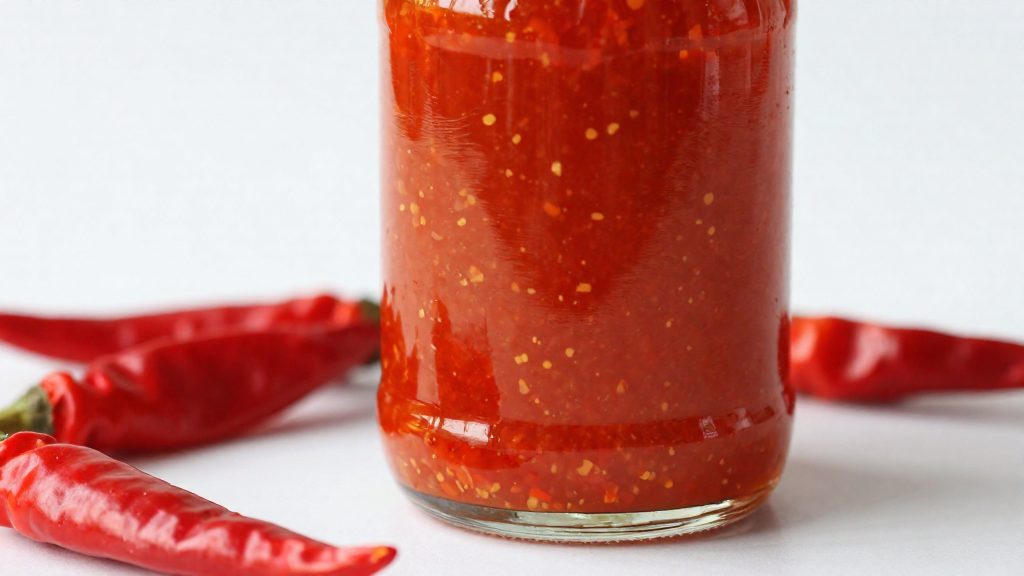
A fermented hot sauce is built from three parts: hot peppers, a small amount of garlic, and a larger portion of chopped vegetables and/or fruit. A reference recipe from Fermenting for Foodies uses about 3½ cups of chopped vegetables and/or fruit, 4 to 12 hot peppers and 3 garlic cloves. The pepper count mainly sets the heat, while the vegetable and fruit portion sets the body, sweetness and colour of the finished sauce.
Pepper types and relative heat
This table ranks the peppers by relative heat only. Heat varies between cultivars and growing conditions, so the same variety can taste milder or hotter from one harvest to the next.
| Pepper | Relative heat | Practical note for fermentation |
|---|---|---|
| Jalapeño | Mild to medium | Thick flesh and a grassy flavour; a practical choice for a first batch |
| Serrano | Medium to hot | Thinner flesh than jalapeño and a noticeable step up in heat |
| Habanero | Hot | Strong fruity aroma; a few peppers go a long way |
Because the reference range is 4 to 12 peppers, you can build heat by adding peppers within a batch, or by mixing milder and hotter varieties. Changing only one variable at a time makes the results easier to compare.
Vegetable and fruit additions
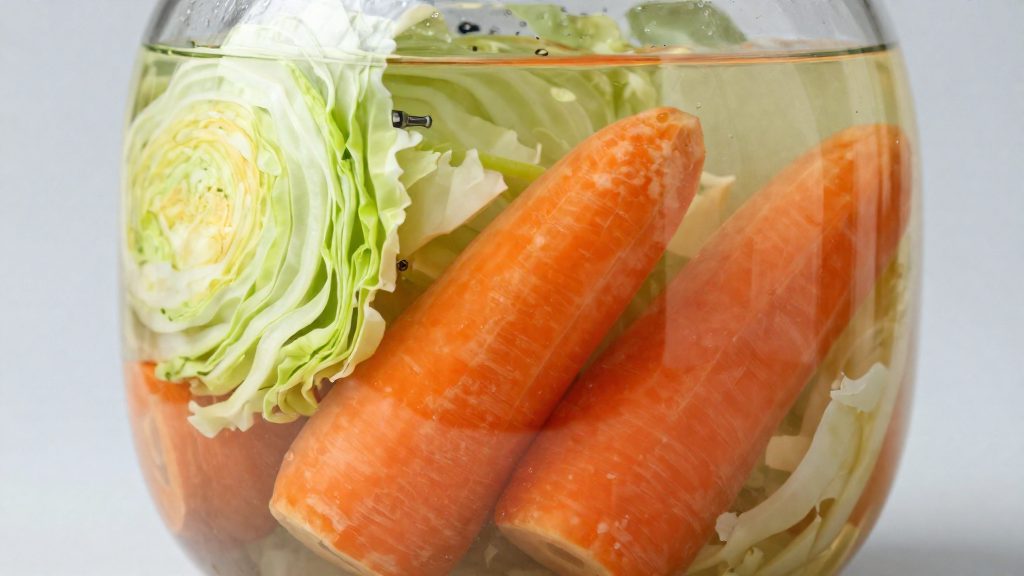
The recipe allows vegetables, fruit or both, so you can ferment a sauce with only carrots, only mango, or a combination. Carrots are a common vegetable base. They add bulk and a mild sweetness, and they give the sauce an orange colour. Mango is a common fruit addition. Its sweetness and fruity notes balance the sharpness of hot peppers. Test small batches before scaling up.
Garlic and water
The reference recipe calls for 3 garlic cloves per batch. Garlic contributes a pungent, savoury note that supports the peppers rather than dominating them. Peel and chop or crush the cloves so their flavour is released into the brine. The same recipe calls for chlorine-free water, which should be used for the brine alongside the other ingredients.
How much salt should you use?
Salt is the one ingredient in a pepper ferment you can control precisely, and the amount you add shapes the batch from the first day. The reference recipe in Fermenting for Foodies calls for 1 tablespoon of non-iodized salt. Because a tablespoon is a volume measure, the amount of salt in the jar depends on how finely the salt is ground and how tightly it is packed.
Why weigh instead of measuring by volume
A tablespoon of salt does not weigh a fixed amount. Fine table salt packs far denser than coarse or flaky salt, so two tablespoons can differ noticeably in grams. A kitchen scale removes that variable and lets you repeat the same ratio from batch to batch.
- Set the scale to grams and tare the bowl before adding salt.
- Record the weight of your first batch and reuse that figure.
- Weigh the total ingredient mass if you want to express salt as a percentage of weight.
Common salt-by-weight targets
Ferments are often described by salt-by-weight, meaning salt weight divided by the weight of the ingredients. Start from the recipe quantity, weigh the result, and write it down so you can compare batches and adjust deliberately.
Converting tablespoons to grams
Weigh one level tablespoon of the salt you actually use, record the result, and apply that figure to future batches. A conversion taken from a different brand or grind will not carry over reliably.
Why salt type matters
The recipe specifies non-iodized salt, and that is the ingredient this guide follows. Check the ingredient label before weighing, and use a salt with a single listed ingredient so the batch matches your recorded figure.
Why measurement supports safety
Health Canada (Government of Canada, 2024-06-10) notes that botulism does not change a food’s colour, smell or taste, so appearance cannot confirm a batch is safe. Weighing and logging salt makes a recipe repeatable, but it does not make a batch safe. Only a pH reading below 4.6 shows that a batch is acidic enough, so measure it as well.
How to ferment peppers step by step
Fermenting hot peppers for sauce follows four physical steps: chop, pack, submerge and weight, then hold in a dark spot.
Chopping and packing
- Wash the hot peppers and garlic cloves, then remove stems and any damaged parts.
- Chop the peppers and garlic into pieces of roughly even size. Even pieces settle more evenly and are easier to keep under brine.
- Pack the pieces into a clean jar or crock, pressing down as you add them so the mass is dense and has no large air pockets.
Submerging under brine
Dissolve the 1 tablespoon of non-iodized salt in chlorine-free water to make the brine. The recipe source does not give a water volume, so make just enough to cover the packed peppers, record the amount, and pour it over the peppers until everything is submerged. Peppers that stay exposed to air above the liquid are the main point of failure in this stage, so check that the brine reaches the top of the mixture before you move on.
Weighting the ferment
Place a fermentation weight, a small clean glass or a sealed bag of brine on top of the peppers to hold them below the surface. Peppers that rise back above the brine during the ferment need to be pressed down again. Check the jar daily, and re-weight whenever pieces float up.
Dark placement and the 5 to 7 day timeline
Keep the jar in a dark spot for 5 to 7 days. The recipe source gives this 5 to 7 day window; it does not describe what changes on each individual day. Judge flavour by taste and the state of the brine, then measure the pH with a meter or test strips before blending and bottling, because taste cannot confirm that the batch is below 4.6.
How do you know if it is safe?
Safety in a fermented hot sauce depends on two checks: whether the mixture is acidic enough to block botulism, and whether the batch shows spoilage you can detect with your senses. According to Health Canada (2024), very acidic foods have a pH below 4.6 and can be processed in boiling water, while foods above pH 4.6 are low-acid. The 4.6 threshold is the main dividing line, and you cannot judge it by looking or smelling.
Why color and smell do not prove safety
The main risk is Clostridium botulinum. According to Health Canada (2024), this bacterium grows in moist, oxygen-free conditions and does not change the food’s color, smell or taste. A jar can look and smell normal and still be unsafe, so visual and smell checks only catch visible or odorous spoilage. They do not rule out botulism.
Sensory signs of spoilage
Your senses still help you reject clearly bad batches. Discard any ferment with a putrid, rotten or fecal odor, or with a slimy or mushy texture that is not part of the original vegetables. A sour, vinegary or yeasty smell is part of normal fermentation and does not by itself indicate a problem.
Measuring acidity
A pH meter or pH test strips can show whether a batch is below 4.6. Estimating acidity by taste or by how long the jar has fermented does not give that confirmation. Only a measurement shows where the batch sits relative to the threshold.
| Check | What it indicates | What it cannot confirm |
|---|---|---|
| Putrid or rotten smell | Spoilage | Presence or absence of botulism |
| Slimy or mushy texture | Spoilage | Presence or absence of botulism |
| pH below 4.6 | Acidic food | Nothing else; it must be measured |
| pH above 4.6 | Low-acid food | Nothing else; it must be measured |
When in doubt, throw it out
Health Canada’s guidance for botulism is “when in doubt, throw it out.” Apply this rule when a pH reading is at or above 4.6, when you cannot confirm the batch is below 4.6, or when the smell or texture seems wrong. Keeping an unverified batch carries a risk that no visual or smell check can remove.
Kahm yeast or mold?
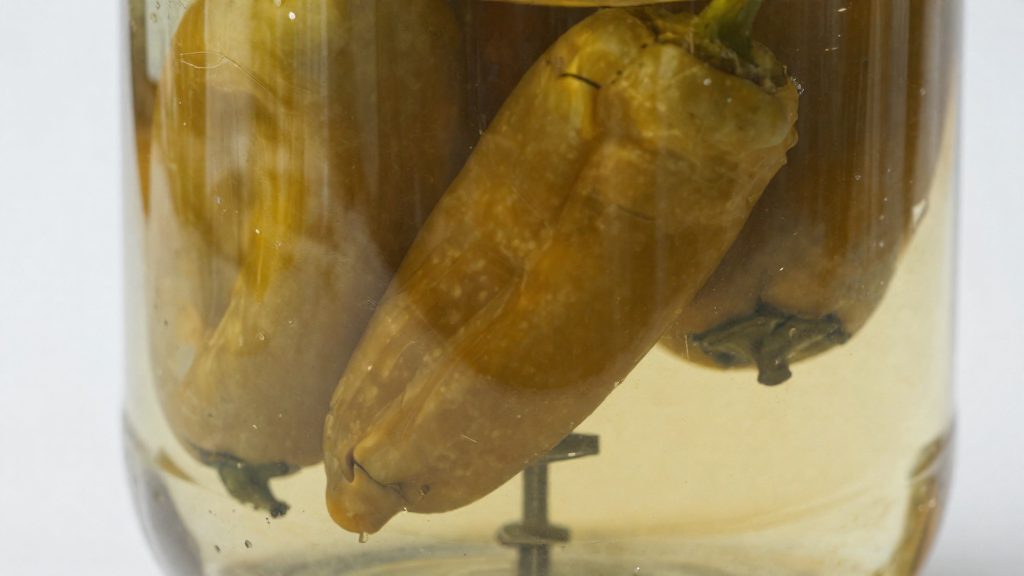
On a fermenting pepper mash, the surface growth you will see is usually one of two things: kahm yeast, a harmless film, or mold, which means the batch should be discarded. According to Fermenting for Foodies, kahm yeast is common on hot sauce ferments and is harmless, but you still need to confirm that the growth is not mold. The two look different, so check the surface before you decide what to do.
Flat white film versus fuzzy tufts
Kahm yeast usually forms a thin, flat, wrinkled layer that spreads across the brine. It is typically white to cream-coloured and looks more like a skin or bloom than a growth on top of the mash.
Mold tends to look like raised, fuzzy or powdery tufts. Common colours include green, blue, grey or black, and white mold can also appear as distinct fuzzy spots rather than an even film. If you see any coloured or raised growth, treat it as mold.
Skimming kahm yeast without disturbing the brine
If the surface shows only a flat film, you can remove it:
- Use a clean, dry spoon or skimmer, not a hand or a previously used utensil.
- Lift the film gently from the edge toward the centre, rather than stirring the jar.
- Avoid shaking or pushing the vegetables, because that can bring air and surface contaminants into the brine.
What to do with each
| Surface observation | Likely identity | Action |
|---|---|---|
| Thin, flat, wrinkled white to cream film | Kahm yeast | Skim gently and keep the mash submerged |
| Fuzzy, raised or coloured tufts (green, blue, grey, black) | Mold | Discard the batch; do not skim it off |
If you are unsure which one you are seeing, the safer choice is to discard the batch, since mold can grow in areas you cannot see from the surface.
How to blend, bottle and store the sauce
Once the peppers have finished fermenting, the sauce is ready to be blended. Add the fermented vegetables and their liquid to a blender, and process until smooth. The final texture depends mainly on how much liquid you add back.
Straining solids and adjusting consistency
Strain the blended mash through a fine sieve, pressing the solids to recover as much liquid as possible. Keep the solids for another use or discard them. If the sauce is too thick for pouring, thin it gradually with a small amount of the strained brine, stirring after each addition, until it reaches the consistency you want. Thinning in small steps prevents the sauce from becoming watery, which is hard to reverse.
Bottle materials and cap types
This guide does not specify which bottle materials or cap types suit fermented sauces. Choose clean, dry bottles with caps that seal firmly, and fill them so the sauce sits close to the cap without overflowing. Label each bottle with the date it was strained so you can track its usage window.
Refrigerated storage and the one-month window
After straining, refrigerate the sauce immediately. Fermenting for Foodies advises using the sauce within about 1 month. Keep the bottles refrigerated throughout that period, and check each time you open one for changes in appearance or smell.
| Stage | Action | Timing |
|---|---|---|
| Blending | Blend ferment and liquid until smooth | After the ferment is complete |
| Straining | Press out liquid through a fine sieve | Immediately after blending |
| Storage | Refrigerate in sealed bottles | Use within about 1 month |
Frequently asked questions
How can I tell whether my fermented hot sauce is safe to eat?
Health Canada (2024) notes that foods with a pH below 4.6 are very acidic and can be processed in boiling water, while foods above pH 4.6 are low-acid. Botulism-causing Clostridium botulinum does not change a food’s colour, smell or taste, so Health Canada’s rule is “when in doubt, throw it out.”
What quantities does a standard fermented hot sauce batch use?
A reference recipe from Fermenting for Foodies uses about 3½ cups of chopped vegetables and/or fruit, 4 to 12 hot peppers, 3 garlic cloves and 1 tablespoon of non-iodized salt. It calls for chlorine-free water and a 5 to 7 day ferment in a dark spot.
I see a white film on top of my sauce. Is it mold?
That film may be kahm yeast, which Fermenting for Foodies describes as common on hot sauce ferments and harmless. You still need to confirm that the growth is not mold, and once the sauce is strained, refrigerate it and use it within about 1 month.