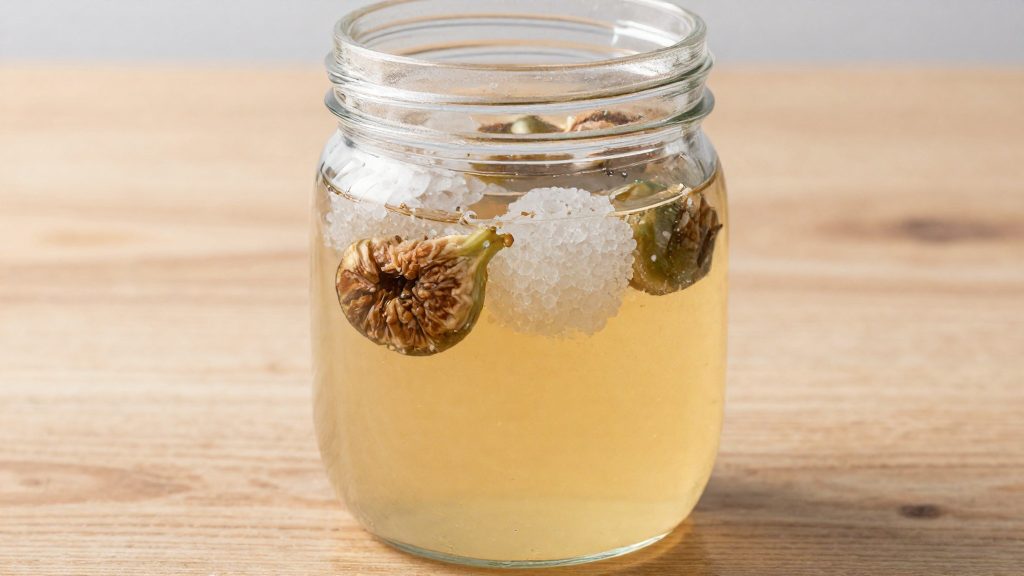
Water kefir grains can stop multiplying for several reasons. One of them is running short of food after repeated fermentation that runs too long. Kefirko (2026-08-13) notes that repeatedly fermenting too long can leave the grains short of food, and Freshly Fermented (2026-06-28) lists over-fermentation as a cause of stress. Once the sugar is used up before the next feed, the grains stop growing and can weaken over several batches.
Why are my water kefir grains not growing?
How depletion stalls growth
Healthy water kefir grains typically multiply by 40–100% in 2 days, according to Starter Cultures (2025). If a batch shows no increase, check the feeding schedule first. Slower growth can still be normal, so one slow batch is not proof of depletion. A pattern of slow growth across several consecutive batches is the more useful signal.
Signs to check
| Observation | What the sources say |
|---|---|
| Grains kept unfed in the fridge for weeks | Listed as a cause of stress (Freshly Fermented, 2026-06-28) |
| Mould appears, or grains turn to mush | Discard the grains (Freshly Fermented, 2026-06-28) |
Recovering depleted grains
According to Freshly Fermented (2026-06-28), a depleted culture can be rebuilt in a few steps:
- Strain the grains and rinse them once.
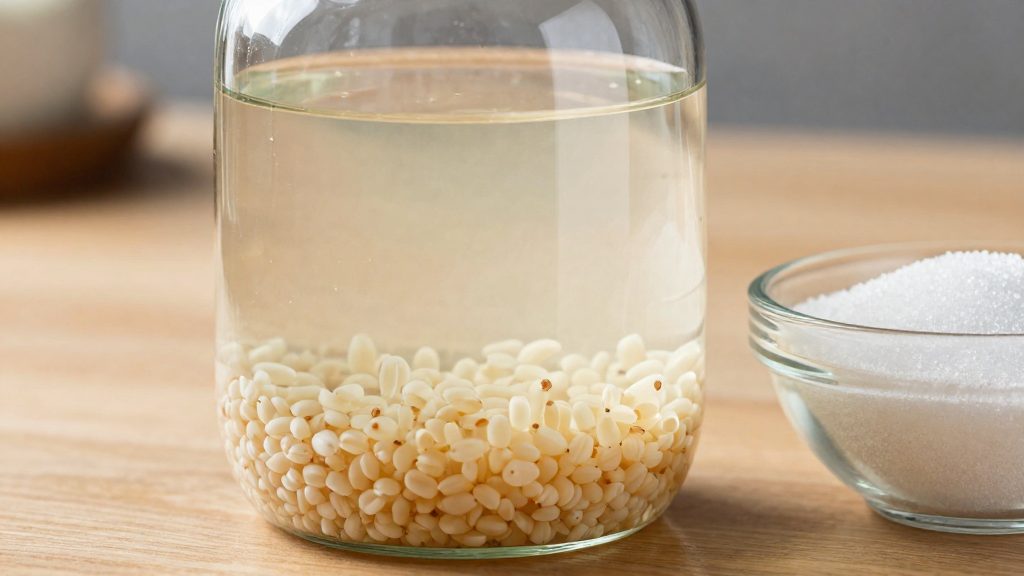
- Place them in about 100 ml of sugar water, made with about 1 tablespoon of sugar per 100 ml.
- Change the sugar water daily for 3–5 days at 20–24 °C.
- Scale up the batch size gradually once growth resumes.
The grains are then ready for normal brewing again.
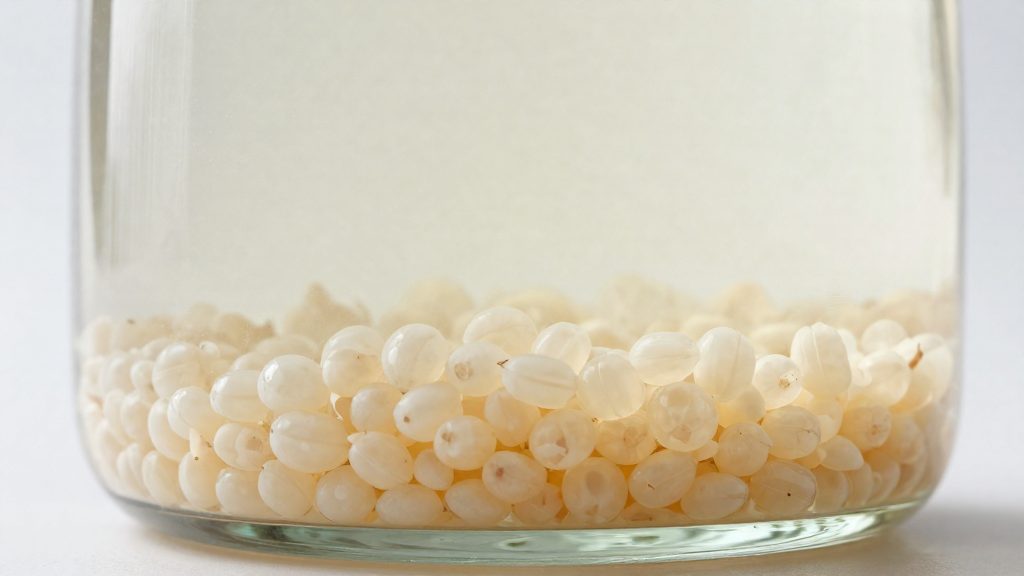
Is it normal for water kefir grains to grow slowly?
Slow growth is not always a problem. Growth should be judged over a two-day period, not against a single day or a visual impression. A batch that grows slowly at a cooler room temperature may simply be following the expected pace.
Measuring growth against the benchmark
To check whether your grains fall within the range, weigh them at the start of a batch and again after two days, once they have been strained and rinsed:
- Growth (%) = (grains after two days − grains at start) ÷ grains at start × 100
- Example: 50 g of grains that weigh 70 g after two days have grown by 40%, the lower end of the benchmark.
Weigh the grains in the same way each time, with the same rinse, so the comparison is consistent.
| Attribute | Sourced standard | Status |
|---|---|---|
| Growth over two days | 40–100% (Starter Cultures, 2025) | Sourced benchmark |
| Colour | None | No sourced standard |
| Size | None | No sourced standard |
| Texture | None | No sourced standard |
| Gas activity | None | Practical observation only |
What the sources do not establish
Descriptions of colour, size and texture in home guides are practical observations, not measured reference values. The same applies to gas activity. Many brewers look for steady bubbling and grains that rise and sink during fermentation; treat this pattern as a rough sign of activity rather than a pass or fail test.
Water quality: chlorine and minerals
Water makes up most of the brew, so its composition affects how quickly water kefir grains multiply. Two problems stand out: water that contains disinfectants, and water that has been stripped of minerals. Both can slow growth, and natural spring water is the recommended option.
Chlorinated water inhibits the grains. Starter Cultures (2025) states this directly, and Kefirko (2026-08-13) lists chlorinated water among the factors that hold back growth. If your supply is chlorinated, sluggish grains can have a water cause even when feeding and temperature are correct.
Mineral-poor water is the opposite problem. Starter Cultures (2025) notes that water with too few minerals starves the grains. Kefirko (2026-08-13) names very filtered, mineral-poor water as a cause of slowed growth. Freshly Fermented (2026-06-28) adds distilled, reverse-osmosis, heavily filtered and softened water to the types that can stress grains over repeated batches.
This creates a trade-off. Water that has been heavily filtered, distilled, run through reverse osmosis or softened is reported to stress grains, so treating water is not automatically an improvement.
| Water type | Reported effect on grains | Source |
|---|---|---|
| Chlorinated tap water | Inhibits growth | Starter Cultures (2025); Kefirko (2026-08-13) |
| Distilled or reverse-osmosis water | Stresses grains | Freshly Fermented (2026-06-28) |
| Heavily filtered or softened water | Stresses grains and can hold back growth | Freshly Fermented (2026-06-28); Kefirko (2026-08-13) |
| Natural spring water | Recommended choice | Starter Cultures (2025) |
Best sugar for healthy grains
The sugar you choose for water kefir grains does two jobs: it is the carbohydrate the grains ferment, and it can supply some of the minerals they need. Starter Cultures (2025) recommends organic cane sugar for this reason, noting that it still contains minerals. Freshly Fermented (2026-06-28) reports that refined white sugar, used alone over many batches, can stress the grains. Both sources point the same way: use a less-processed cane sugar rather than refined white sugar as the only food source.
Why cane sugar keeps minerals
Refining strips most of the mineral content from cane juice. Organic cane sugar undergoes less processing, so some residual minerals remain. Treat this as a general quality difference rather than a measured nutrient supply.
Sugar types compared
| Sugar type | Stated characteristic | Effect on grains |
|---|---|---|
| Organic cane sugar | Still contains minerals (Starter Cultures, 2025) | Recommended option; supplies sugar and some minerals |
| Refined white sugar | Lower mineral content than cane sugar | Can stress grains when used alone over many batches (Freshly Fermented, 2026-06-28) |
Sugar as the grains’ main food
During fermentation, the grains convert sugar into the acids and gases that define the drink, so sugar serves as their main food supply. The grains depend on it to stay active, which is why the sugar you feed them matters as much as the water. Dissolve the sugar fully in the water before adding the grains, so they meet a uniform sugar solution rather than undissolved crystals.
Temperature and brew time
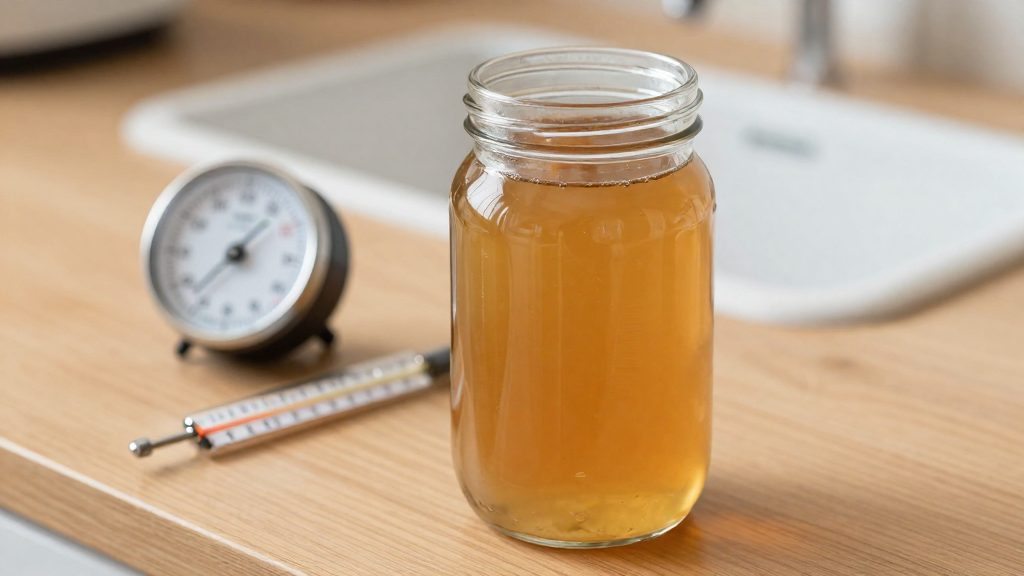
Water kefir grains ferment most predictably at 20–24 °C (68–75 °F). Starter Cultures (2025) gives this as the recommended range, with a first fermentation of about 24–48 hours. Kefirko (2026-08-13) uses the same 20–24 °C window and 24–48-hour timing as its standard brewing figures, so the two sources agree on the baseline.
Temperature changes the timing more than the method. Freshly Fermented (2026-06-28) gives these approximate first-fermentation times by temperature:
| Temperature | First fermentation | Source |
|---|---|---|
| 18–20 °C | 36–48 hours | Freshly Fermented (2026-06-28) |
| 20–22 °C | 24–36 hours | Freshly Fermented (2026-06-28) |
| 20–24 °C (68–75 °F) | about 24–48 hours | Starter Cultures (2025) |
| 24–28 °C | 12–24 hours | Freshly Fermented (2026-06-28) |
Warmer brews finish sooner, and cooler brews take longer. Within the 20–24 °C window, a brew in the upper part will usually reach the end of its cycle earlier than one in the lower part. Expect a batch at 18–20 °C to need close to the full 48 hours, and a batch at 24–28 °C to be ready in as little as 12 hours.
How cold slows grain growth
Starter Cultures (2025) states that cold slows both fermentation and grain growth. A kitchen that drops below the 20 °C lower bound, or a brew left near a cold window, will show a slower acidification rate and slower multiplication. Kefirko (2026-08-13) lists cold among the common reasons for sluggish growth.
Practical timing check
- Set the jar in a spot where the temperature stays inside 20–24 °C, away from radiators, sunny windows and drafts.
- Note the start time and check the brew at the 24-hour mark.
- If the grains are still in the 36–48 hour range at a cooler temperature, that matches the timing in the table above.
- Strain only once the brew has reached the time that fits its temperature, so the grains are not moved mid-cycle.
Ratios of grains, sugar and water
The reference ratio for water kefir is about 100 g of grains per litre of water, according to Starter Cultures (2025). The same source suggests 50–100 g of sugar per litre. Kefirko (2026-08-13) uses a smaller batch of the same grain load: 30 g of grains to 300 ml of water. Dividing 30 g by 0.3 litres gives 100 g per litre, so the two published figures agree.
| Source | Grains | Water | Grains per litre |
|---|---|---|---|
| Starter Cultures (2025) | about 100 g | 1 litre | about 100 g |
| Kefirko (2026-08-13) | 30 g | 300 ml | 100 g |
Sugar scales with water volume at the same per-litre range. The table below applies the 50–100 g per litre figure to common batch sizes:
| Water volume | Water kefir grains | Sugar (50–100 g per litre) |
|---|---|---|
| 300 ml | 30 g | 15–30 g |
| 500 ml | 50 g | 25–50 g |
| 1 litre | 100 g | 50–100 g |
Keep the grains-to-water ratio fixed across batches. Changing the grain weight without changing the water volume alters the feed available to each gram of grains, which is why the ratio, not the volume alone, is the reference.
Recovery mix
The source does not give a gram weight for the tablespoon measure, so it cannot be converted to the per-litre figures above.
How do I revive stressed or dried grains?
Dried water kefir grains do not recover in one brew. According to Starter Cultures (2025), dried grains need several days to rehydrate, and their activity returns in stages. The figures below are the reference points for judging whether a recovery is on track.
Rehydration timeline and activity levels
| Stage | Reported activity | Source |
|---|---|---|
| Around day 4 | About 60–80% | Starter Cultures (2025) |
| Within 1–2 weeks | 100% (full activity) | Starter Cultures (2025) |
At around day 4, the grains are partly active, so a visible but incomplete response is expected. For days 1 to 3, judge early progress by the overall trend rather than a daily percentage. Full activity is reported within one to two weeks, which means a recovering batch should be assessed over that window, not after a single brew.
At around day 4 the grains are only partly active, so keep the recovery routine going and assess progress over the full one to two weeks before returning to normal brewing. Full activity, which the sources place within one to two weeks, is the signal that the grains are back to their usual performance.
When to discard grains
Discarding is the last step, not the first. Slow growth alone is not a discard condition. Starter Cultures (2025) notes that slower growth can still be normal.
Telling stressed grains from unrecoverable grains
Stressed grains usually keep their shape and stay firm, but they multiply slowly or not at all. Unrecoverable grains show structural breakdown: they lose shape, go soft, or carry mould. Firmness and gas activity are practical observations, not measured thresholds.
Deciding when to wait versus replace
For depleted grains, wait for the full 3–5 day recovery cycle before deciding. For dried grains, allow one to two weeks. Grains that are firm and intact at the end should be scaled up, not replaced.
If grains show no improvement after the cycle, the sources do not set a further threshold. Replacing them at that point is a practical judgement, not a sourced rule.
Practical signs suggesting replacement
| Observation | Likely status | Action |
|---|---|---|
| Firm, intact grains that stay slow through the 3–5 day cycle | Stressed | Keep feeding and scale up gradually once growth resumes |
| Grains kept unfed in the fridge for weeks | Stressed; a listed cause of decline | Run the full recovery cycle before judging |