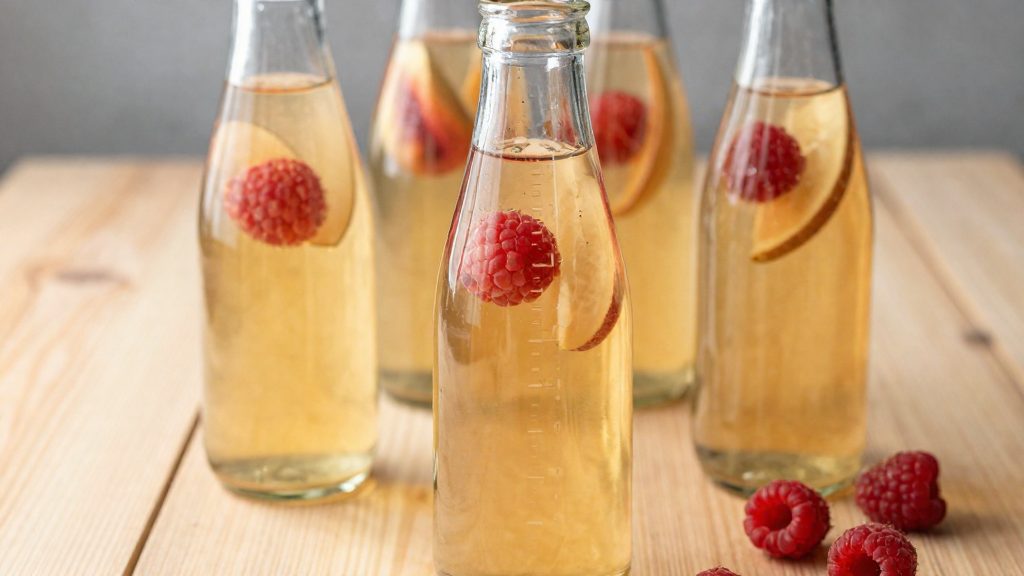
What is a water kefir second ferment?
Sugar and CO2 inside a sealed bottle
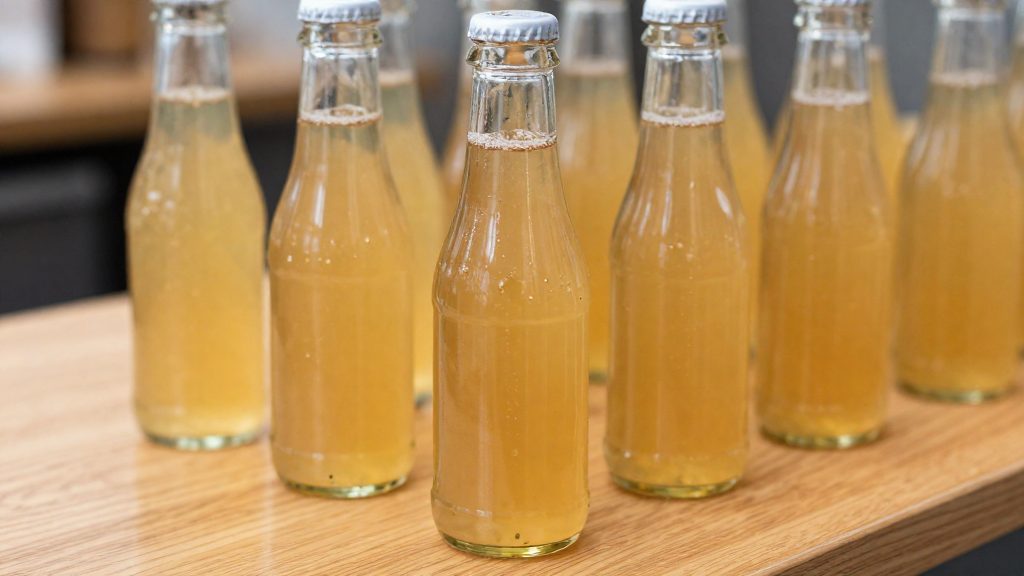
Kefirko (2025) describes the basic method: strained kefir is poured into a sealable bottle, the flavourings are added, and the bottle is left at room temperature. Because the vessel is closed, the CO2 produced during this step cannot escape freely, so it builds up as fizz.
Grain culture versus second ferment
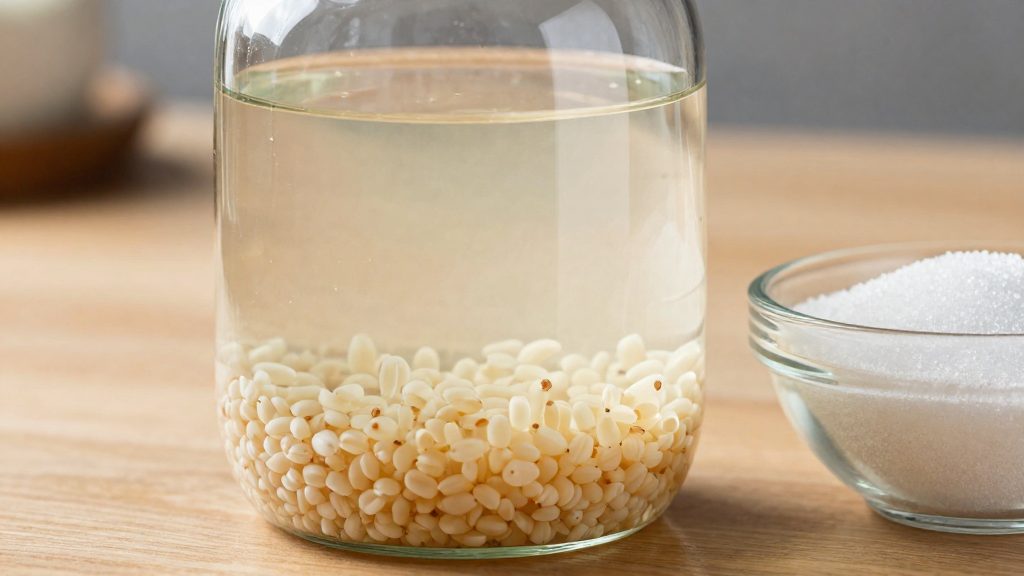
The grain culture is the set of kefir grains that ferments the sugar in the original batch. The grains are removed before the second ferment begins, so the second ferment works only with the strained liquid and whatever has been added to it. It is a separate step, not a continuation of the grain fermentation, and it uses its own ingredients and its own sealed container.
Quantities per bottle
Sources give different reference sizes, so the amounts below are shown as published:
| Source | Bottle or batch | Added ingredients |
|---|---|---|
| Revolution Fermentation (2025) | 750 ml bottle | About 125 ml juice or tea, or 15 to 30 ml syrup, or 4 to 5 strawberries |
| Kefirko (2025) | 1 L kefir | 150 ml grapefruit juice with 2 tbsp sugar |
| Kefirko (2025) | 1 L kefir | 100 ml lemon juice, 1 tbsp grated ginger, 50 g sugar |
| Cultured Food Life (2025) | 16 oz (about 475 ml) bottle | 2 oz (about 60 ml) bottled juice, up to 1/4 cup (about 60 ml) fruit, or 1 to 2 Tbsp homemade syrup |
Why flavour develops in the bottle
Flavour comes from the ingredients added before sealing. Kefirko (2025) gives a mint version using a handful of blended mint with 3 tbsp sugar per 1 L of kefir, showing that a single herb can be the main flavour when sugar is kept in the mix.
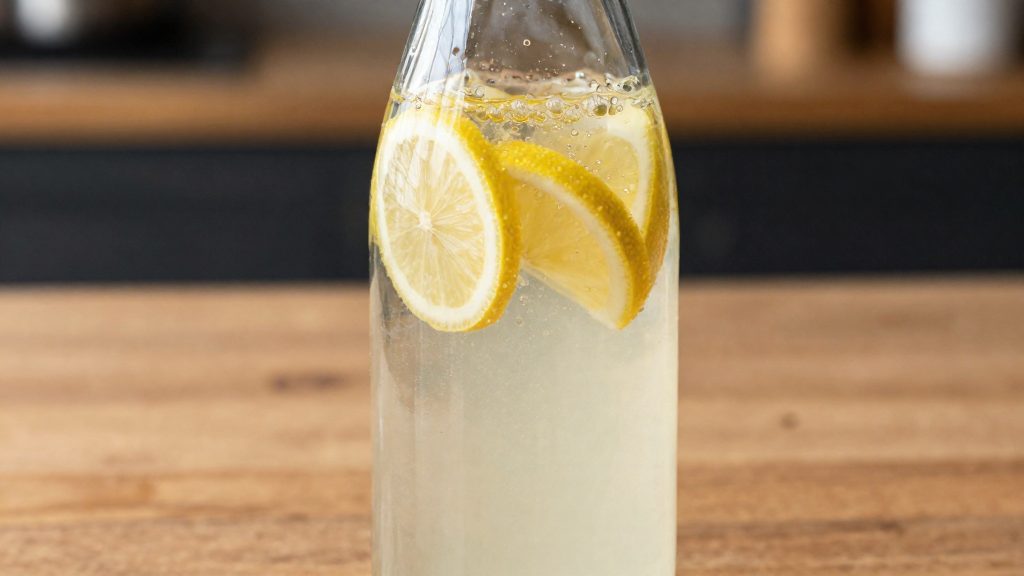
How do you flavour water kefir safely?
Three physical limits apply before you choose any flavouring: remove the grains, cap the volume of added ingredients, and use a bottle that can hold pressure. These rules apply to every recipe in this article, so check them first.
Strain out the grains first. Flavourings should be added only after the water kefir grains have been removed. Grains left in the bottle with added ingredients continue to ferment the mixture, which makes the result hard to control. Straining first keeps the live culture in your starter jar, where it can be reused.
Cap the added ingredients. According to Revolution Fermentation (2025), flavourings should not exceed 20% of the total volume, which equals no more than 200 ml per litre. This limit includes juice, fruit, syrup and any other additions. Going past it leaves less room for the liquid and gas that build up during the second ferment.
Leave headspace and use pressure-resistant bottles. Kefirko (2025) recommends a sealable bottle with a few centimetres of headspace. Revolution Fermentation (2025) advises pressure-resistant bottles, because sugary juice, fruit and syrup raise pressure quickly. A bottle built for pressure gives you a safer margin than a standard drinking bottle or a jar with a loose lid.
| Limit | Value | Source |
|---|---|---|
| Grain removal | Before any flavouring is added | Revolution Fermentation (2025) |
| Added ingredients | Maximum 20% of total volume (200 ml per litre) | Revolution Fermentation (2025) |
| Headspace | A few centimetres | Kefirko (2025) |
| Bottle type | Pressure-resistant, sealable | Revolution Fermentation (2025) |
Fruit and juice flavour ideas
Juice and whole fruit are the most common second-ferment flavourings, and concrete doses are given for three bases. Kefirko and Revolution Fermentation publish these doses for kefir, so use them as starting points for water kefir and adjust after tasting.
Juice dosing per litre
Dose juice by the litre of liquid, and tie any added sugar to that same volume.
| Base | Dose | Sugar stated | Source |
|---|---|---|---|
| Grapefruit juice | 150 ml per 1 L | 2 tbsp per litre | Kefirko (2025) |
| Mango or kiwi juice | 100 ml per 900 ml | Not given in source | Kefirko (2025) |
Grapefruit (2 tbsp sugar per litre) and lemon with ginger (50 g sugar per litre) are the juice bases here with a stated sugar amount; the mango or kiwi dose gives none. The 100 ml mango or kiwi dose is calculated against 900 ml of kefir, so scale it to the volume of kefir in your bottle and keep the headspace.
Whole-fruit dosing per bottle
For fresh fruit, the dose is counted per 750 ml bottle rather than per litre.
- Strawberries: 4 to 5 whole berries per 750 ml bottle (Revolution Fermentation, 2025).
- Revolution Fermentation’s guidance for the same bottle size also suggests about 125 ml of juice, which is a separate dose from the whole-fruit amount, so do not combine them in one bottle without reducing one of them.
Herbs, teas and spice combinations
Teas, herbs and spices give water kefir a second-ferment flavour without requiring many ingredients. A basic rule for tea is to brew it stronger than usual and cool it before it goes in. A few pairings are well documented, and each one suits a different flavour profile.
Brewing tea for flavouring
Tea used for flavouring should be brewed 2 to 4 times stronger than a normal cup, then cooled (Revolution Fermentation, 2025). Strong tea ensures the flavour remains noticeable once it is mixed into the water kefir. Because the tea is added at room temperature, cooling it first is part of the method, not an optional step.
For a 750 ml bottle, the suggested amount is about 125 ml of tea (Revolution Fermentation, 2025). Use the same measure when you adapt the recipe to other tea types.
Proven pairings
The following combinations are named in the sources. Each row lists the ingredients and the specific amounts given for them.
| Pairing | Ingredients | Amount and reference |
|---|---|---|
| Ginger, turmeric and orange | Ginger, turmeric, orange | Named as a suggested blend (Revolution Fermentation, 2025) |
| Lime and mint | Lime, mint | Named as a suggested blend (Revolution Fermentation, 2025) |
| Apple and cinnamon | Apple, cinnamon | Named as a suggested blend (Revolution Fermentation, 2025) |
| Mint with sugar | Blended mint, sugar | A handful of mint with 3 tbsp sugar per 1 L of kefir (Kefirko, 2025) |
| Ginger with citrus | Grated ginger, lemon juice, sugar | 1 tbsp grated ginger, 100 ml lemon juice and 50 g sugar per 1 L (Kefirko, 2025) |
The mint and ginger rows come from Kefirko recipes and give amounts per 1 L of kefir; the first three rows name only the ingredients, without amounts.
Choosing a pairing
Ginger with turmeric and orange is the most complex of the named blends, combining a warm root with a bright citrus. Lime with mint gives a cooler, sharper profile, while apple with cinnamon is milder and sweeter.
How long should the second ferment last?
Most water kefir second ferments run about 24 hours at room temperature, after which the bottle goes into the refrigerator and is drunk within a few days. The total second ferment is limited to 1 to 3 days, and the exact window depends on the flavouring added. Kefirko (2025) describes the basic method, and Cultured Food Life (2025) gives per-ingredient windows.
The room-temperature stage
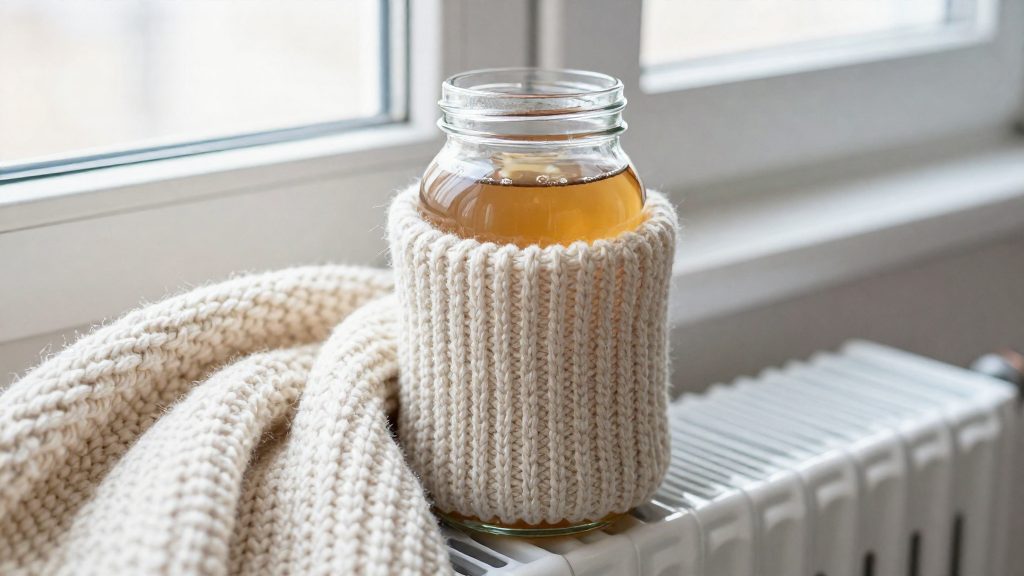
The room-temperature stage is the active part of the second ferment. Kefirko (2025) recommends fermenting for about 24 hours at room temperature, then refrigerating the bottle. This is the reference point for most flavour additions, and Cultured Food Life (2025) gives longer windows of 1 to 3 days depending on the addition, so the two sources differ. Check the bottle at about 24 hours and refrigerate it once it is fizzy enough.
Window by ingredient type
Cultured Food Life (2025) lists these windows per 16 oz bottle:
| Addition (per 16 oz bottle) | Second ferment window |
|---|---|
| 2 oz bottled juice | 1 to 3 days |
| Up to 1/4 cup fruit | About 1 day |
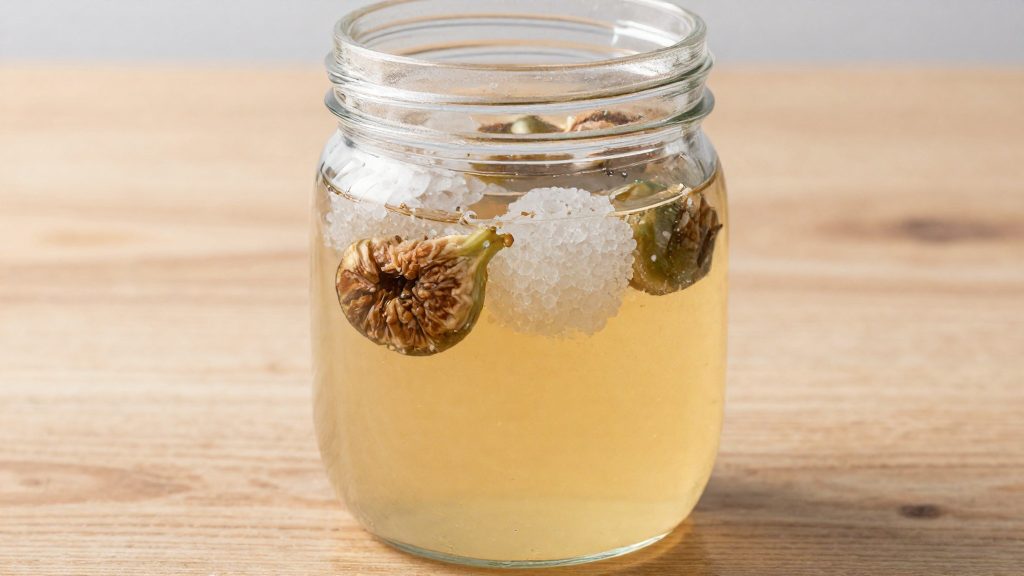
| 1 Tbsp dried fruit (figs, dates, raisins or cranberries) | 1 to 2 days |
| 1 to 2 Tbsp homemade syrup | 2 to 3 days |
The ingredient-based window shows that fresh fruit and dried fruit do not behave the same way. Bottled juice has the widest range (1 to 3 days), while syrup has the longest minimum (2 to 3 days); both reach a maximum of 3 days. Treating the shortest listed window as the limit is a cautious reading.
Cold storage and drinking
Once the bottle has finished fermenting, refrigerate it and drink it within a few days (Kefirko, 2025). Cold storage slows further fermentation, which keeps the flavour from shifting while the drink is consumed. The 1 to 3 day figure from Cultured Food Life (2025) measures the second ferment itself, not how long the finished drink can be kept, so the two timings should be tracked separately.
How do you recognise and vent an over-carbonated bottle?
Over-carbonation shows up before a bottle actually fails, and the signs are easy to read once you know what to look for. Sugary liquids drive the second ferment, so flavoured bottles need closer attention than plain kefir. Catching the early signals and releasing gas in a controlled way keeps a flavoured batch intact.
Recognising over-carbonation
Three signs show that pressure is building faster than the bottle can hold it:
| Sign | What it indicates | Action |
|---|---|---|
| Foam at the neck when the cap is loosened | Gas has dissolved heavily and is coming out of solution | Vent over a sink before drinking |
| Hiss when the cap is turned | Pressure is escaping past the seal | Vent slowly, then recheck |
| Gushing (liquid spraying out on opening) | Pressure has exceeded what the liquid can hold | Expect loss; open only over a sink |
The three signs form a progression. A bottle that foams on opening is already near its limit. A bottle that only hisses is not necessarily safe: pressure keeps building in a sealed sugary bottle, so vent it over a sink, refrigerate it, and keep handling it with care.
How to vent a bottle
- Check bottles when the second ferment is due.
- Hold the bottle upright over a sink, with the cap pointing away from you.
- Loosen the cap a quarter turn, let the gas escape in short bursts, then retighten.
- Recheck after a few minutes. Pressure can rebuild quickly in a sugary bottle.
- Open fully only once the hiss has stopped.
Why a gushing bottle loses so much
Gushing is a sudden release. The dissolved gas rushes out and carries liquid through the neck, and the foam expands far faster than it can be contained. A bottle that has already gushed often holds much less drink than it started with, and the loss happens in seconds. Venting at the foam or hiss stage is the most effective way to avoid it.
Easy flavour pairings to try first
For a first batch of water kefir second ferment flavour ideas, start with one ingredient, keep the sugar low, and change only one variable at a time. The options below are ordered from easiest to hardest, so a beginner can get a clean result before adding complexity. Each pairing is a common reference, not a tested recipe for every water kefir.
| Order | Flavouring | Why it is easier to start with | Source |
|---|---|---|---|
| 1 | Low-sugar fruit with about 1/2 tsp sugar | Needs minimal added sugar, so the ferment has fewer variables | Cultured Food Life (2025) |
| 2 | Lime with mint | Two ingredients with one clear flavour profile | Revolution Fermentation (2025) |
| 3 | Apple with cinnamon | Mild, familiar pairing | Revolution Fermentation (2025) |
| 4 | Ginger with turmeric and orange | Three ingredients with stronger flavours, so harder to judge | Revolution Fermentation (2025) |
Start with low-sugar fruit
Low-sugar fruit is the most forgiving starting point. According to Cultured Food Life (2025), low-sugar fruit can take about 1/2 tsp of sugar in the second ferment. Stick to that amount for the first batch. Adding more sugar to a fruit that is already sweet makes the result harder to interpret.
Test one flavour per bottle
Use the same base kefir for every bottle and add only one flavouring to each. Strain the kefir and pour 1 L into a sealable bottle, as described by Kefirko (2025). Keep one bottle plain as a control. Comparing it with the flavoured bottles shows exactly what each ingredient contributed.
Keep a dated log
Record each batch in a simple log with the date, the single flavouring, the fermentation time, and a short tasting note. Over several batches, the log shows which pairings work and which ones need less time or a different flavouring.
Frequently asked questions
How much juice or fruit can I add to a bottle without over-pressurising it?
Revolution Fermentation (2025) advises keeping flavourings to 20% of the total volume, which is no more than 200 ml per litre. Sugary juice, fruit and syrup build pressure quickly, so use bottles rated for pressure.
How long should the bottle sit at room temperature?
Kefirko (2025) describes about 24 hours at room temperature before refrigerating, while Cultured Food Life (2025) allows 1 to 3 days per 16 oz bottle, depending on the ingredient. The two sources differ, so check the bottle’s pressure and fizz during this window rather than relying on a single timing.
Which flavour pairings are worth trying first?
Revolution Fermentation (2025) suggests lime with mint, apple with cinnamon, and ginger with turmeric and orange, but these are suggested combinations, not tested recipes. Kefirko (2025) also lists mango or kiwi juice at 100 ml per 900 ml of kefir, with no sugar amount given.