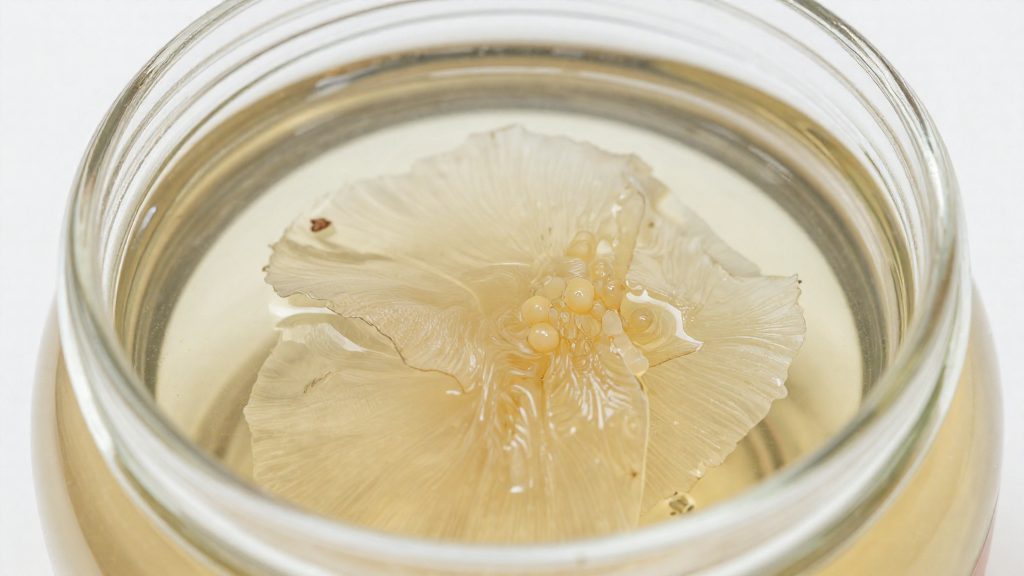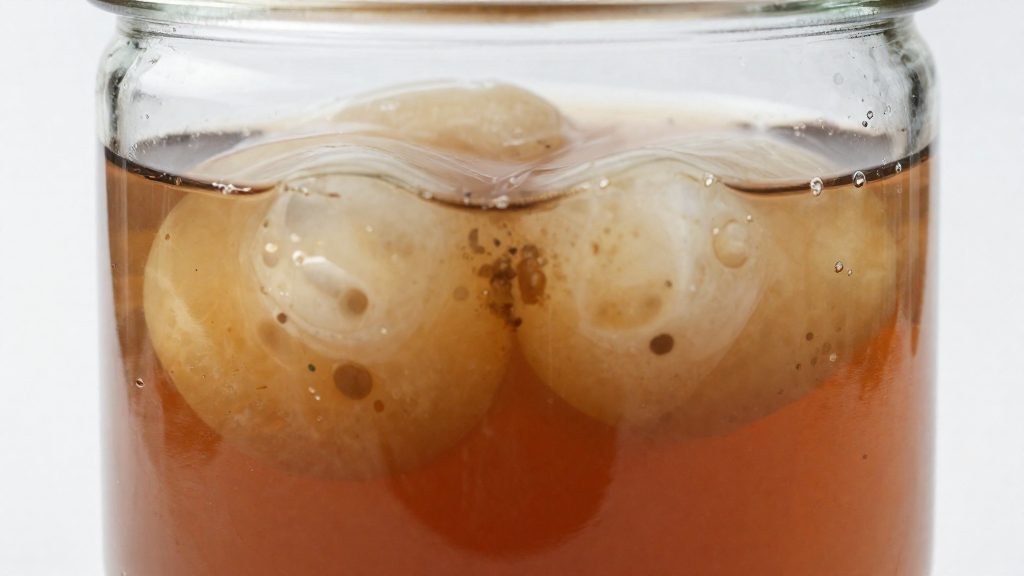
A vinegar mother is a biofilm of cellulose, yeast and bacteria that forms on fermenting alcoholic liquids such as wine or cider. According to Wikipedia (2026), it helps convert alcohol into acetic acid, the process that turns a fermenting liquid into vinegar. Revolution Fermentation (2026) describes it as mainly bacterial cellulose, which places it neither among algae nor fungi.
What is mother of vinegar?
The biofilm on the liquid
The vinegar mother is a biofilm, a layer that microbes build from cellulose as they grow. Its visible form is a veil that floats on the liquid’s surface. The biofilm is mainly bacterial cellulose, which is why it forms a cohesive layer.
How ethanol becomes acetic acid
The biofilm’s core role is to convert ethanol into acetic acid. As the biofilm works through it, the liquid’s acidity rises, and the result is vinegar.
| Stage | What happens |
|---|---|
| Alcohol base | Wine or cider has already fermented, so ethanol is present |
| Mother added | The biofilm is introduced to the alcohol |
| Conversion | Ethanol is converted into acetic acid |
| Acidity rises | The liquid becomes vinegar as acetic acid accumulates |
Adding a mother to alcohol
Revolution Fermentation (2026) states that a vinegar mother must be added to alcohol that has already fermented. It does not start a fermentation from sweet tea. The practical step is therefore to choose a finished alcoholic base first and then introduce the mother to it. Follow a tested recipe for exact timings and volumes.
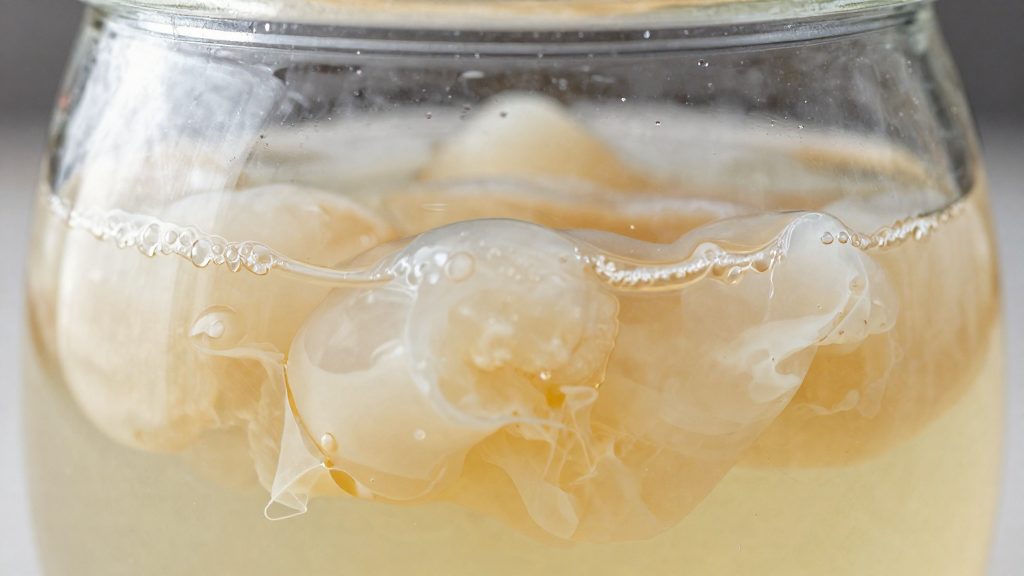
What is the mother in kombucha?
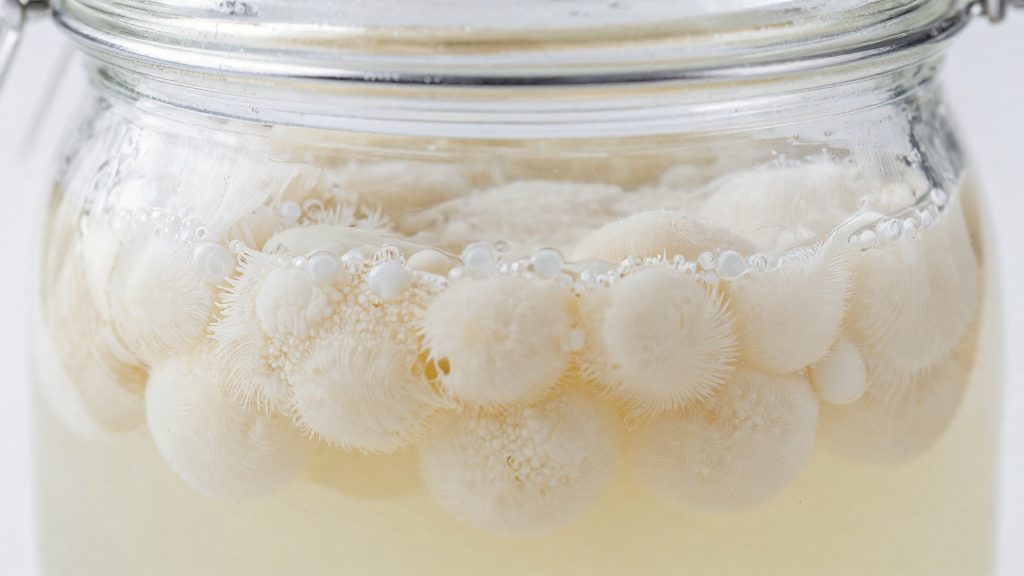
The mother in kombucha is the SCOBY, an acronym for symbiotic culture of bacteria and yeast. It is a rubbery, living mass that grows in sweetened tea and drives the fermentation. According to Revolution Fermentation (2026), a kombucha SCOBY works in sweet tea, so sweetened tea is the medium it needs. The name describes the partnership: bacteria and yeast live together in one colony and each contributes to the same brew.
The term “mother” is used for two different cultures. The kombucha mother (SCOBY) is built around sweet tea, while the vinegar mother is built around alcohol that has already fermented, so the word “mother” alone does not identify which culture is meant.
Growth as a surface pellicle
In a brew, the SCOBY develops as a surface pellicle, a layer that forms at the top of the liquid. Over the fermentation period it thickens and becomes a stable disc. In general practice, a SCOBY together with some finished kombucha (starter liquid) is added to each fresh batch of sweetened tea to give the new brew a starting population of the culture. Use a tested recipe for exact quantities.
Yeast and bacteria acting on tea sugar
During brewing, the yeast and bacteria act on the sugar dissolved in the tea. Sugar quantities, temperatures and brewing durations should be checked against a specific recipe. The general principle is that the sugar is the substrate both organisms use, and the resulting metabolic activity changes the flavour and acidity of the liquid over time.
Mother of vinegar vs kombucha SCOBY
The main difference between a vinegar mother and a kombucha SCOBY is acetic acid tolerance. According to Wikipedia (2026), vinegar is more acidic than kombucha, so the microbes in a vinegar mother must survive higher acetic acid levels than the microbes in a kombucha SCOBY. Both cultures produce acid, but they work in different chemical conditions. The comparison below is qualitative.
Why the acid level differs
The acidity of each finished liquid follows from what each culture is built to do:
- Kombucha is a sweet tea fermentation. The SCOBY ferments the sugar and produces acid gradually, so the liquid stays less acidic than vinegar.
- Vinegar is the more acidic result, because the vinegar mother converts its alcohol into acetic acid.
Organisms that cannot withstand high acetic acid levels will not establish themselves in a vinegar mother.
Acidity comparison
| Factor | Kombucha SCOBY | Vinegar mother |
|---|---|---|
| Starting liquid | Sweet tea | Alcohol that has already fermented |
| Final acidity | Lower than vinegar | Higher than kombucha |
| Acid tolerance required | Lower | Higher |
| Main role of microbes | Ferment sugar in tea | Convert alcohol into acetic acid |
What this means in practice
The two should not be treated as interchangeable, and a culture adapted to one liquid is not automatically suited to the other.
What is the mother made of?
A vinegar mother is a biofilm, a layered mat of microorganisms held together by a cellulose matrix. Its composition is mainly bacterial, and the bacterial share is the part that matters most when comparing it with a kombucha SCOBY.
The living core is made of acetic acid bacteria. According to Wikipedia (2026), these bacteria are the main component of a vinegar mother. Yeast is also listed among the organisms in the biofilm.
At the genus level, the two mothers overlap and differ:
| Component | Reported detail | Source |
|---|---|---|
| Bacterial cellulose | Structural matrix; not algae or fungus | Revolution Fermentation (2026) |
| Acetic acid bacteria | Main component of the vinegar mother | Wikipedia (2026) |
| Acetobacter | Major genus in both vinegar mothers and kombucha mothers | Wikipedia (2026) |
| Gluconobacter | Present in kombucha mothers specifically | Wikipedia (2026) |
| Yeast | Part of the biofilm; genera not specified | Wikipedia (2026) |
Acetobacter is therefore the shared anchor genus, while Gluconobacter is the marker that appears in kombucha mothers. Because a vinegar mother is mainly bacteria, its composition differs from that of a kombucha SCOBY, a symbiotic culture of bacteria and yeast.
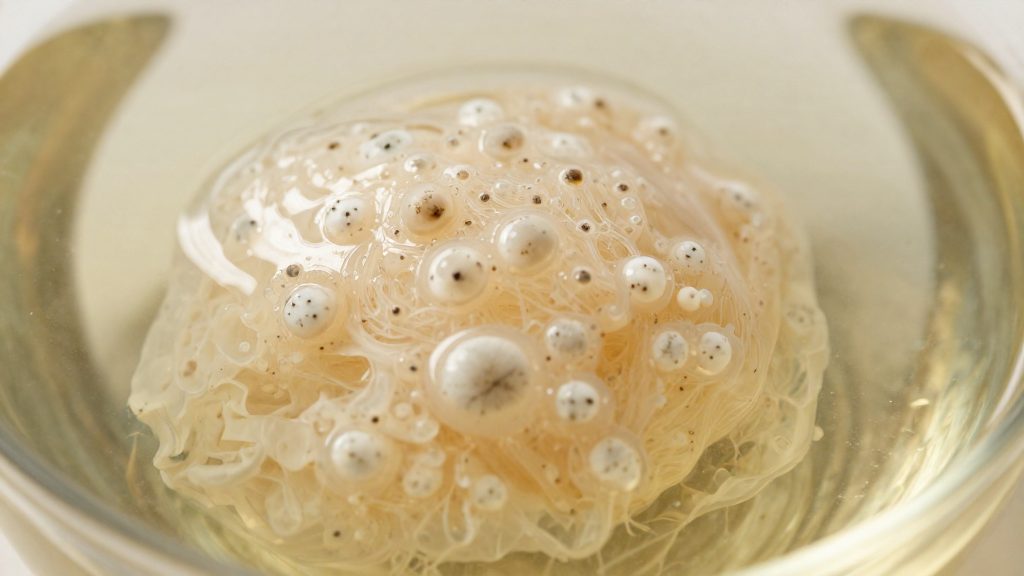
Is the mother safe? How to spot mould
The vinegar mother veil is described as nontoxic, and store-bought vinegar that contains a mother is considered harmless (Wikipedia, 2026). This applies to the mother itself, not to mould. Mould is a fungus and is not harmless, so the practical task is to tell which kind of growth you are looking at.
Why a veil shows up more often in some vinegars
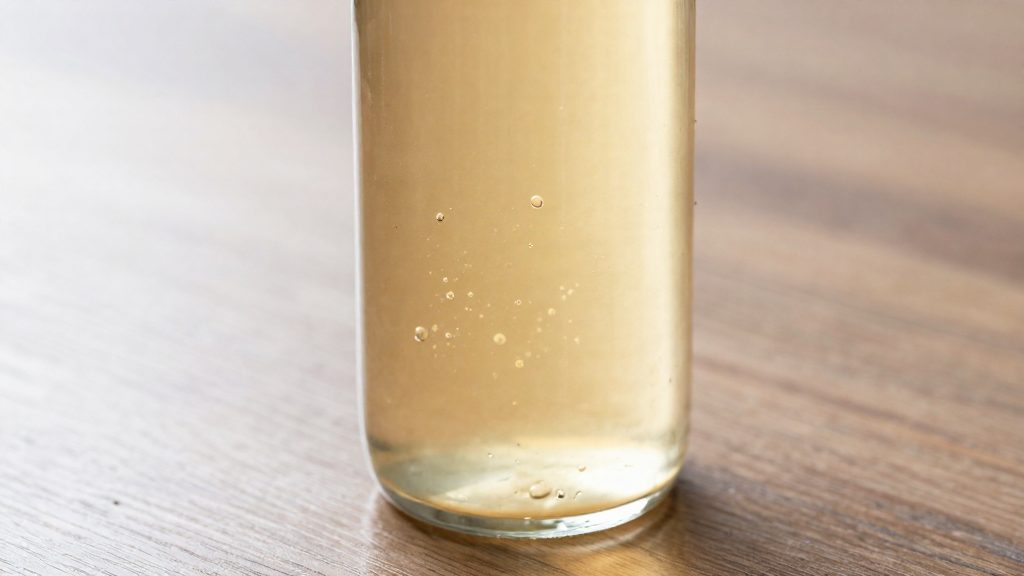
Wikipedia (2026) states that the mother is more common in unpasteurized vinegar. A veil in an unpasteurized product is therefore a normal feature of that category, not a warning sign. A clear bottle with no veil does not indicate spoilage either.
Checking a suspect growth
The following checks are general practice:
- Look at the pattern. A mother usually forms a continuous, smooth film across the surface, whereas mould often appears as separate spots or tufts. This is only a hint, not proof: mould can also spread across the surface, so never rely on this check alone.
- Check texture and colour. Fuzzy, raised or coloured patches, such as green, blue, black or pink, are a reason to discard.
- Smell the liquid. A putrid or unusual odour alongside a visual change is another reason to discard.
- Decide when unsure. If you cannot confidently identify the growth, discard the batch rather than keep it.
Can you use vinegar mother to brew kombucha?
No. A vinegar mother cannot start a batch of kombucha. The relationship only runs one way: according to Revolution Fermentation (2026), a kombucha SCOBY can turn alcohol into vinegar, but a vinegar mother cannot make kombucha.
Why sweet tea does not work with a vinegar mother
The acetic acid bacteria of a vinegar mother are its main component, so it has no starting population suited to sugar and tea. Unlike a kombucha SCOBY, it lacks the symbiotic yeast-and-bacteria balance used to ferment sweet tea.
Adding a vinegar mother to fermented alcohol
Pour the fermented liquid, such as wine or cider, into a suitable vessel and add the vinegar mother to it. Follow a tested recipe with metric measures. The mother then develops on the surface of the liquid and carries out the conversion of alcohol to acetic acid.
Comparing the two cultures
Both cultures contain Acetobacter, a major genus in each, but they differ in their other microbes. Kombucha mothers also contain Gluconobacter (Wikipedia, 2026).
| Feature | Kombucha SCOBY | Vinegar mother |
|---|---|---|
| Starting liquid | Sweet tea | Fermented alcohol (e.g., wine or cider) |
| Main composition | Symbiotic bacteria and yeast | Mainly acetic acid bacteria |
| Genera named in sources | Acetobacter, Gluconobacter | Acetobacter |
| Can it make the other product? | Yes, it can turn alcohol into vinegar | No, it cannot make kombucha |
What to do with extra SCOBYs
Surplus cultures are commonly handled in three ways: storing them submerged in starter liquid, sharing them with other brewers, or drying them for long-term storage. Discard any culture that shows mould, fuzzy or coloured patches or an off smell. Each option suits a different timeline. Choose based on how soon you plan to brew again and whether the culture needs to travel.
| Option | Best for | Key requirement |
|---|---|---|
| Storage in starter liquid | Keeping a spare ready for the next batch | Culture fully submerged in its own starter liquid |
| Sharing or gifting | Passing cultures to other brewers | Packed moist in a clean, sealed container |
| Drying | Long-term storage | Fully dry before storing in a sealed container |
Storing surplus SCOBYs in starter liquid
Place the spare culture in a clean glass jar and cover it with starter liquid taken from a previous batch, so the culture stays fully submerged. Cover the jar with a breathable cloth or a loose lid to keep dust and insects out, and store it in a cool spot away from direct sunlight. Check the jar periodically for any changes in the culture’s appearance.
Sharing or gifting cultures
Transfer the culture with a generous amount of its starter liquid into a clean, sealed container so it arrives moist. Label the container with the date and the batch it came from.
Drying SCOBYs for long-term storage
Drying preserves a culture without liquid. Rinse off any loose starter liquid, then lay the culture flat on a clean, non-reactive surface such as a mesh rack or a plate lined with a clean cloth. Leave it at room temperature, away from direct sunlight, until it is completely dry and stiff. Once dry, store it in an airtight bag or jar in a cool, dark place. To revive it, place the dried culture in fresh starter liquid and allow it to rehydrate. Monitor the first batch closely after rehydrating.
Frequently asked questions
Can a vinegar mother be used to make kombucha?
No. According to Revolution Fermentation (2026), a vinegar mother cannot make kombucha, because it needs alcohol that has already fermented. Kombucha needs sweet tea, which is the medium a SCOBY grows in. A kombucha SCOBY can, however, turn alcohol into vinegar.
Is the mother in kombucha the same microbe as a vinegar mother?
They share some organisms but are not identical. Acetobacter is a major genus in both, while kombucha mothers also contain Gluconobacter, according to Wikipedia (2026). Vinegar is more acidic, so its microbes must tolerate higher acetic acid levels than the microbes in kombucha.
What should I do if my vinegar mother has mould on it?
Wikipedia (2026) describes the vinegar mother veil as nontoxic, but that does not apply to mould, which is a fungus. If mould appears, the batch should be discarded.