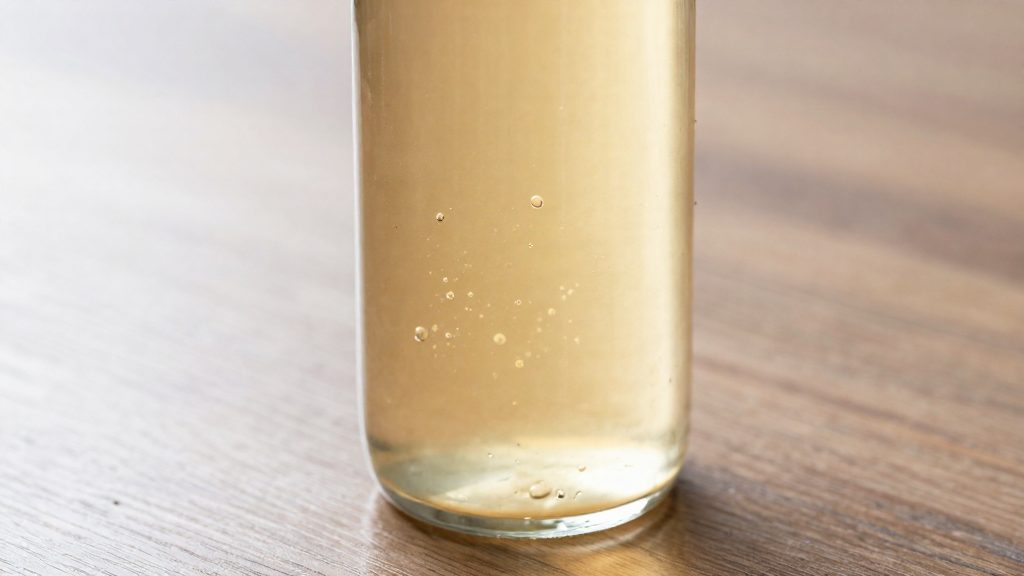
Most flat kombucha comes from one of two causes: the bottle never got a second fermentation with added sugar, or the sugar was used up or the gas escaped during storage. To find out which, check whether sugar was added at bottling, how old the batch is, and how the bottle was stored. Then compare what you see and hear when you open it.
Why is my kombucha not fizzy?
Check whether a bottling step with added sugar happened
Fizz comes from a second fermentation inside a sealed bottle. The yeast needs sugar to produce carbon dioxide. If the brew was fermented until nearly all its sugar was used up and no fresh sugar or juice went into the bottle, there may be nothing left to ferment.
Ask yourself these questions:
- Did you add fruit juice, sugar, or other fermentable material before sealing the bottle?
- Was the bottle capped tightly, or did it sit loosely closed? (See the seal checks below.)
- Did you bottle from a brew that had already been left to finish fermenting in the vessel?
If the answer to the first question is no, a flat result is possible, especially if the batch was brewed until its sugar was used up. Residual sugar may still allow some fizz.
Batch age and bottle storage history
Storage changes what a bottle contains. Sugar left in an unrefrigerated bottle can keep fermenting, which builds pressure and raises the alcohol content (UBC, 2021).
Track the bottle’s timeline: when it was sealed, where it was stored, and how often it was opened. Opening a bottle repeatedly releases gas, so a bottle that was once fizzy can read as flat after several uses.
Symptoms that separate flat from naturally still
| What you observe | What it suggests |
|---|---|
| Hiss on opening, bubbles rising in the glass | The batch is carbonated; a flat pour alone is not proof of failure |
| No hiss, no bubbles, sediment settles | No second fermentation occurred, or gas escaped |
| Bottle bulging or cap pressing outward | Sugar is still fermenting in storage (UBC, 2021); pressure is high, so chill the bottle and open it slowly over a sink |
| Sharper or more alcoholic taste with no bubbles | Fermentation may have continued while gas escaped through a leaking closure |
| Sweet taste, no bubbles, no pressure | Sugar present but not converted into carbonation at bottling |
Use the table in combination with the questions above. A batch with no pressure and no added sugar may simply have had no fuel left, while a batch that was once pressurised but is now flat on opening points to a leaking or poorly sealed closure.
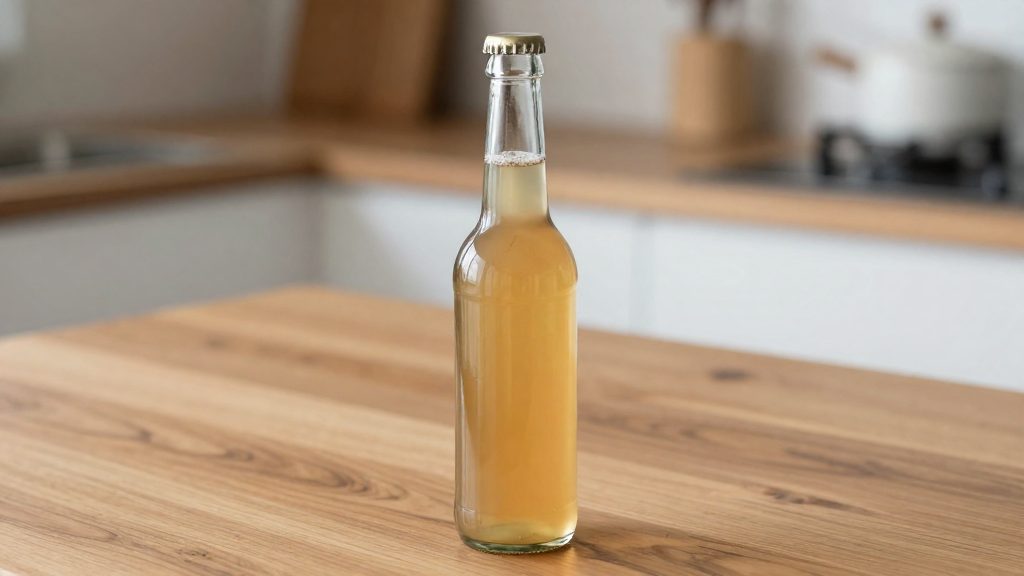
How carbonation forms in a sealed bottle
Carbonation is a physical result of yeast activity. Yeast consume the sugar left in the liquid and release carbon dioxide (CO2) as a by-product. In an open vessel the gas escapes into the air. In a sealed bottle it has nowhere to go, so it dissolves into the liquid and builds pressure in the space above it. The fizz you see when a bottle is opened is dissolved gas coming back out of solution.
Yeast output and dissolved gas
- Dissolved CO2 stays in the liquid only while the pressure above it holds.
- If the seal leaks, pressure drops and the gas that was dissolved leaves the liquid, so the drink goes flat.
- A bottle that never builds pressure has either lost its gas through a leak or had too little fermentable sugar left to produce it.
Seal integrity checks
A leaking closure is one common cause of flat bottles, alongside a lack of fermentable sugar. Check these points before sealing:
| Check | What to look for | Why it matters |
|---|---|---|
| Bottle rim | Chips, cracks, dried residue | Gas escapes through any gap at the seal |
| Flip-top or swing-top gasket | Stiffness, cracks, sticky film | Worn rubber lets pressure leak past it |
| Screw cap liner | Intact liner, cap tightened fully | A loose cap lets CO2 out |
| Headspace | Visible air gap above the liquid | Sets how quickly pressure builds |
Headspace and gas retention
The headspace is the air layer between the liquid and the closure. It holds the gas that comes out of solution. A larger headspace stores more gas at lower pressure, so the drink carbonates more slowly. A smaller headspace reaches pressure faster. Because the headspace stores gas, a bottle with a large, sealed air gap can still carbonate if the seal holds, though carbonation is generally expected to be less intense than with a smaller gap.
Sugar and fruit for second fermentation
Sugar is the fuel for carbonation. During second fermentation, the culture in a bottle consumes the sugar still present in the liquid and produces carbon dioxide. The amount of sugar left at bottling therefore sets how much gas the batch can produce. A 2025 study of home-brewed kombucha tested 26, 53 and 80 g/L of sugar with a commercial SCOBY (Food Protection Trends (IAFP), 2025). Those levels describe the starting brew, not a bottling target.
Residual sugar at bottling
The fizz depends on residual sugar, meaning sugar the culture has not yet converted. A batch that still contains sugar when bottled has fuel for a second fermentation. A batch without it does not.
| Sugar state at bottling | Effect on second fermentation |
|---|---|
| Residual sugar present | The culture can ferment it in the bottle and produce carbon dioxide |
| Sugar fully consumed | Nothing left to ferment; no further carbonation from the brew itself |
Fermentation that continues inside the bottle is the mechanism behind carbonation, so the sugar remaining at the moment of sealing is what matters.
Brewed-out batches
A kombucha brewed until all its sugar is used up cannot re-ferment (University of British Columbia course wiki, 2021). Bottling such a batch without adding anything produces little or no new fizz. Because the culture has no fuel, the only way to restart carbonation is to add sugar before bottling. The added amount, not the brew’s history, determines whether the bottle has fuel.
Fruit juice as a sugar source
Fruit juice adds sugars that the culture can ferment, so it works as a second sugar source alongside any sugar added directly. To account for the juice’s contribution, compare the juice’s sugar content on its label or from a reliable nutrition database with the total sugar you intend to leave in the batch. Sweet juices contribute more fermentable sugar per millilitre than dilute ones, and the amount added should be counted together with any sugar already present in the brew.
Does temperature affect fizz?
Yes. Temperature sets how fast the yeast and bacteria in a kombucha culture work, so the room where a bottle sits controls how quickly carbonation builds. The University of British Columbia course wiki (2021) gives 20–21°C as the optimal kombucha fermentation temperature. Staying in that range gives the most predictable culture activity. Commercial brewing runs warmer: Food In Canada describes a brew lasting about 7 to 30 days at about 27°C (80°F). Do not treat that as a home bottling target. That figure applies to the brewing stage in a production setting, not to home bottling.
| Condition | Effect on the culture |
|---|---|
| 20–21°C | Optimal fermentation range (UBC, 2021) |
| About 27°C (80°F) | Commercial brew temperature, about 7 to 30 days (Food In Canada) |
| Direct sunlight | Excessive, uneven heat that inhibits the culture (UBC, 2021) |
Cold rooms slow the second fermentation in sealed bottles. A kitchen or basement well below the optimal range makes carbonation take longer, so bottles may stay flat well past the point where a warmer room would have produced fizz. Judge progress by the bottle itself. Firm sides and an audible release when opening show that gas is forming. If bottles stay flat in a cool space, moving them to a warmer spot inside the optimal range is the first adjustment to test.
Uneven heat is the less obvious risk. Direct sunlight on a jar or bottle can create excessive, uneven heat, and UBC (2021) notes that this inhibits the culture. When one side of a vessel runs hotter than the other, parts of the same batch ferment at different speeds, so carbonation can vary from bottle to bottle on a sunny windowsill. Keep batches out of direct sun and away from other heat sources such as ovens and radiators.
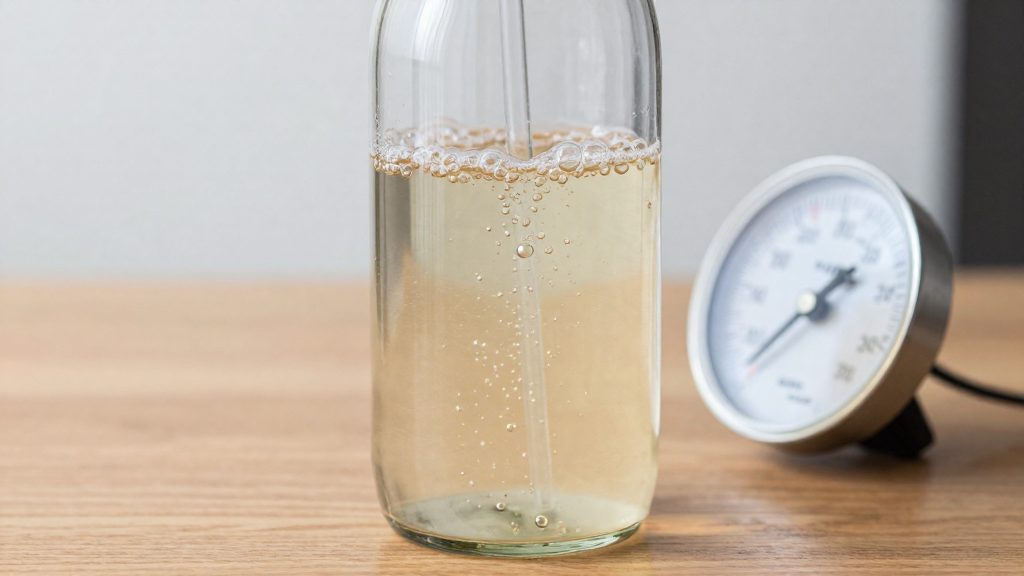
Is flat kombucha still safe to drink?
Flatness alone does not tell you whether a kombucha is safe or unsafe. Carbonation comes from the yeast fermenting sugar inside a sealed bottle, so a lack of fizz tells you the second fermentation was weak or incomplete. It does not, on its own, tell you whether the drink has spoiled or whether harmful microbes are present. Safety depends on the brewing conditions that produced the drink, including how acidic the brew became.
Why fizz and safety are separate questions
Carbonation and microbial safety are controlled by different things. Fizz depends on residual sugar and yeast activity after bottling. Safety depends on how acidic the brew became during the primary fermentation. A batch can be flat and acidic, or fizzy and poorly acidified, so you need to check the acidity side separately.
Acidity as the main safety variable
Kombucha is never boiled or pasteurized, so it has no heat step that kills pathogens. Acidity is an important safeguard. One industry producer, cited by Food In Canada, states that a pH below 4.2 is needed for safety. This is that producer’s claim, not a regulatory standard. This figure is one producer’s claim, not a guideline for home brewers. Do not treat any single pH reading as proof that a batch is safe; if you are unsure, discard the batch.
Fermentation typically runs about 7 to 30 days at about 27°C (80°F), according to Food In Canada. That range describes a commercial brewing setting, so timing alone does not confirm that a home batch reached a safe pH.
What a 2025 home-brew study measured
The Food Protection Trends (IAFP) study (2025) tested home-brewed kombucha with a commercial SCOBY and measured how well it reduced surrogate organisms, which are harmless stand-ins for pathogens. The pH fell significantly between day 0 and day 14.
| Surrogate organism | Average log reduction |
|---|---|
| E. coli K12 | about 5.02 |
| Salmonella Typhimurium LT2 | about 5.86 |
| Listeria innocua | about 4.26 |
A log reduction of 5 means the population fell by a factor of about 100,000. These are surrogate organisms, so the results do not prove a home batch is safe. The study covered specific sugar levels (26, 53 and 80 g/L), so these results apply to that setup and should not be assumed for every home recipe.
How to fix a flat batch
A flat batch can mean the second ferment never built enough pressure, for example because the bottles had too little fermentable sugar or were sealed too loosely to hold gas. The fix is to give the kombucha fresh fuel and a container that can hold pressure, then let it ferment again in a warm spot.
Re-dosing sugar into flat bottles
Start by checking whether the kombucha still has sugar. A batch brewed until nearly all its sugar was consumed has little left to ferment, so adding a small amount of sugar gives the yeast something to work with. A flat batch that still tastes sweet is a better candidate for re-dosing than one that tastes sharp and dry.
- Dissolve a small amount of sugar in a little of the flat kombucha or in boiled, cooled water, then stir it in. Too much sugar can build pressure quickly, so check the bottles often.
- Use plain cane sugar or a similar simple sugar. Avoid sweeteners that yeast cannot consume.
- Work in small batches so you can test a few bottles before treating the whole brew.
- If you add fruit juice to a bottle, open it slowly over a sink first, add the small amount, and reseal it in a pressure-rated bottle. Do not reseal into a bottle with a worn gasket or cracked rim.
Rebottling into pressure-rated containers
Flat bottles are often sealed poorly or are too old to hold pressure. Transfer the kombucha into bottles designed for carbonated drinks, with intact threads or swing-top gaskets, and fill them with some headspace. Replace any cracked or worn seals before you start.
Burping and reopening stuck bottles safely
Once the second ferment is under way, the bottles build pressure that can make opening them forceful. Check each bottle regularly. A firm, bulging bottle or a cap pressing outward means pressure is high, so chill the bottle before opening it. Release pressure gradually:
- Open each bottle slowly over a sink, holding the cap or stopper with a cloth.
- Release the gas in short bursts, then reseal.
- Keep the bottles upright and away from direct sun while they ferment.
Bottle safety and refrigeration
Refrigeration is the main way to control pressure in a bottled kombucha after the second fermentation. Cold slows yeast activity, so a sealed bottle stops gaining carbonation and alcohol at a point you choose. Without it, the sugar left in the liquid keeps feeding the yeast inside the bottle.
Residual sugar keeps fermenting
According to the University of British Columbia course wiki (2021), sugar left in an unrefrigerated bottle can keep fermenting, which builds pressure and raises the alcohol content. How a bottle behaves therefore depends on how much sugar remained at bottling, and that amount is not visible from outside the bottle.
Refrigeration window
The same UBC source states that homemade kombucha keeps refrigerated for up to 3 weeks. The sequence below applies that limit to a typical bottle.
| Stage | Action | Reason |
|---|---|---|
| Bottled, carbonation not yet reached | Keep sealed at room temperature | Yeast is still active and producing carbon dioxide |
| Desired fizz reached | Move the bottle to the refrigerator | Cold slows yeast activity and halts further buildup |
| Stored cold | Consume within up to 3 weeks | Homemade kombucha keeps refrigerated for up to 3 weeks (UBC, 2021) |
Pressure build-up and bottle choice
Carbon dioxide accumulates in a sealed bottle, so the container must withstand that pressure. Use bottles designed for carbonated liquids, such as swing-top glass bottles with a rubber gasket, and discard any with cracks or chipped rims. If you use a plastic bottle as a test bottle alongside glass ones, its firmness can give a rough idea of pressure building in the batch.
Frequently asked questions
Does kombucha need added sugar to become fizzy?
Usually, yes. Yeast inside a sealed bottle turns fermentable sugar into carbon dioxide, so a brew that has used up nearly all its sugar has little left to make gas. A finished brew with some residual sugar may still carbonate without additions.
Could a loose cap be why my kombucha is flat?
Yes. A bottle that lets gas escape cannot hold the pressure that the second fermentation produces, even if the brew had enough fuel. If a bottle was pressurised but is flat when opened, check the closure seal before you reseal or re-dose it.
Is a flat kombucha safe to drink?
Fizz tells you little about whether a batch is safe. Acidity matters. Taste is not a reliable test, so if you are unsure about a batch’s acidity or handling, discard it.