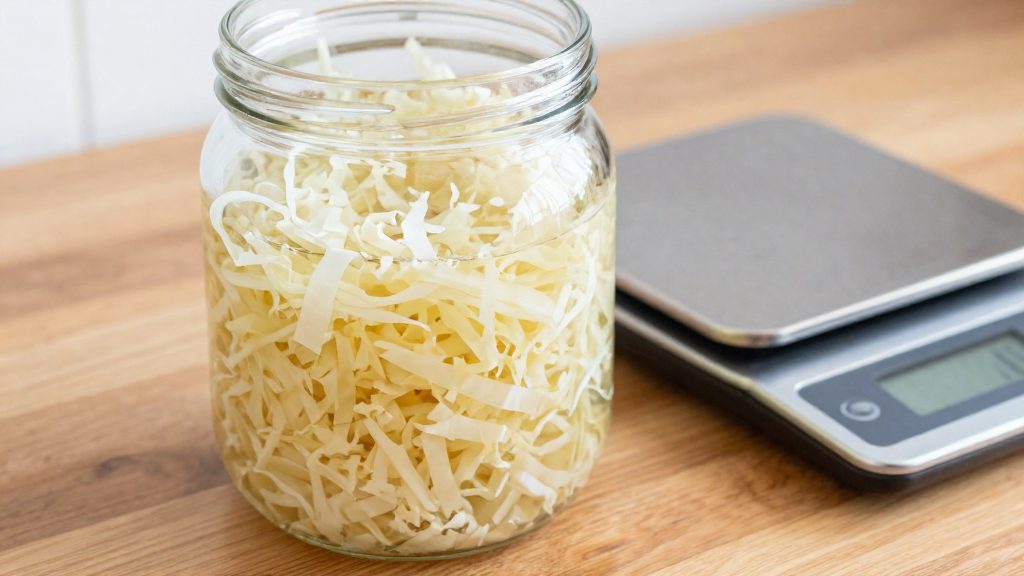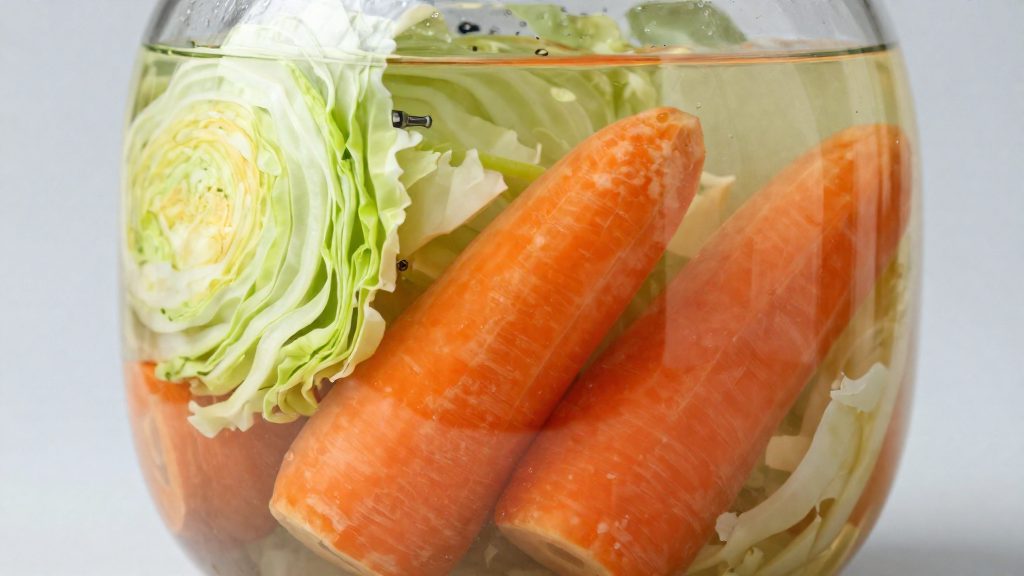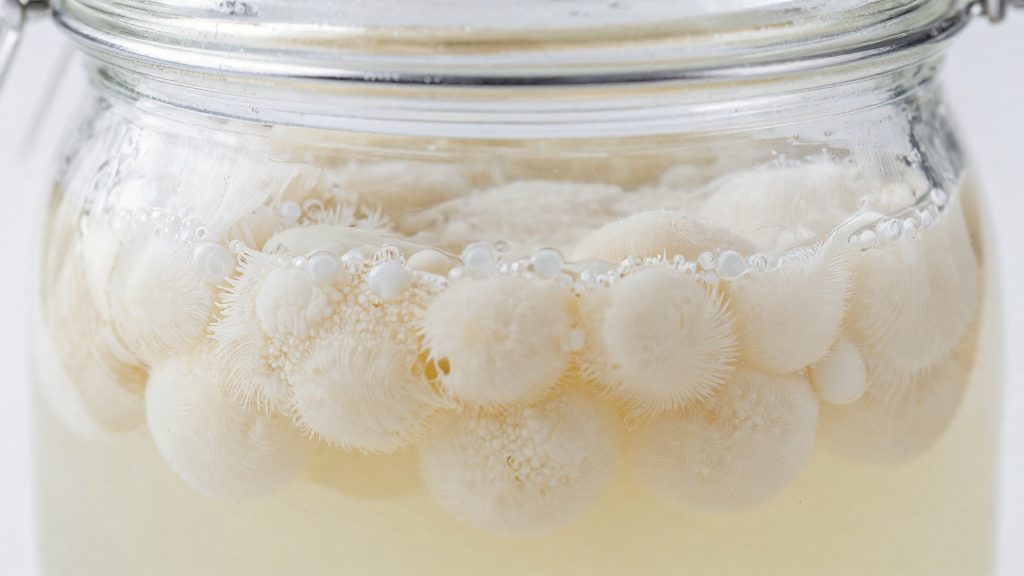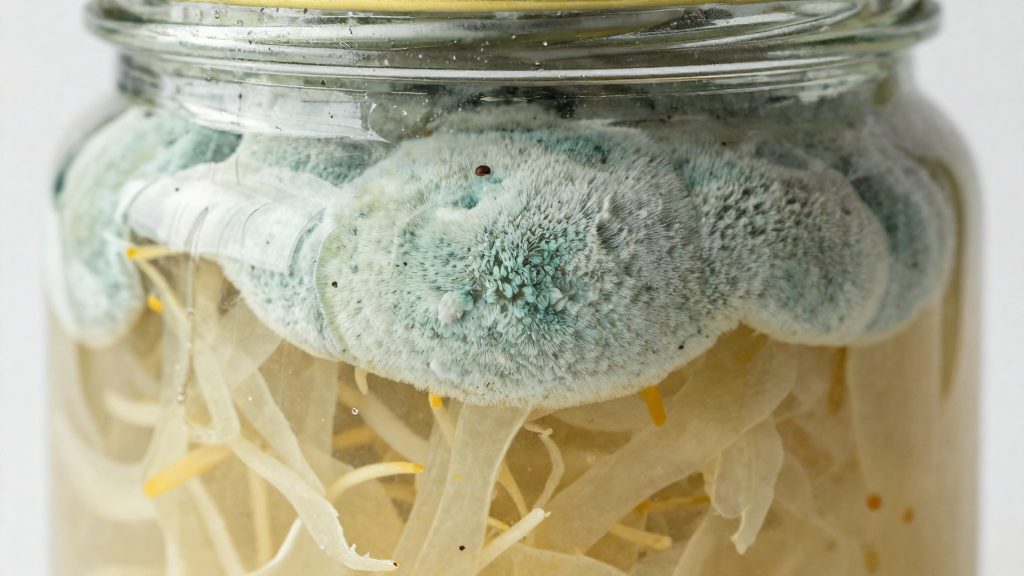
A slimy layer on top of sauerkraut is usually a different problem from the surface growth that forms on many ferments. Surface growth falls into three outcome types: white scum, kahm yeast and mold. Slime is a texture problem in the brine. Sorting the surface problem first tells you which part of the jar to examine.
Why is my sauerkraut slimy on top?
Sorting the surface outcomes
Surface growth can be told apart mainly by texture and by how it lies on the cabbage.
| Outcome | Appearance | Cause named in the sources |
|---|---|---|
| White scum | Film that can be skimmed off | A weight that does not keep enough liquid over the cabbage to exclude air (Oregon State University Extension, 2026) |
| Kahm yeast | Flat, thin white-to-cream film | Slow acid formation, warmth, sweet vegetables or too little salt (MakeSauerkraut.com, 2026) |
| Mold | Raised, fuzzy patches in white, black, blue, green or pink | Warm fermentation or kraut not covered tightly (Oregon State University Extension, 2026) |
Flat films point to white scum or kahm yeast. Raised, fuzzy growth points to mold. Kahm yeast is described as harmless but able to add yeasty or cheesy off-flavours, so its presence alone does not mean the batch has failed.
How slime differs from surface growth
Slime is not a film that sits on top. The texture runs through the liquid rather than forming a skimmable or fuzzy layer.
To separate slime from surface growth:
- Lift a piece of cabbage and check whether the liquid stretches into strings. Stringy brine indicates slime.
- Check whether the growth is a flat film or a raised, fuzzy patch. Those indicate scum, kahm yeast or mold.
Dextran-producing bacteria are the defining cause of slime, and the sources connect them to fermentation temperature and sugary vegetables. The next sections cover those causes in detail.
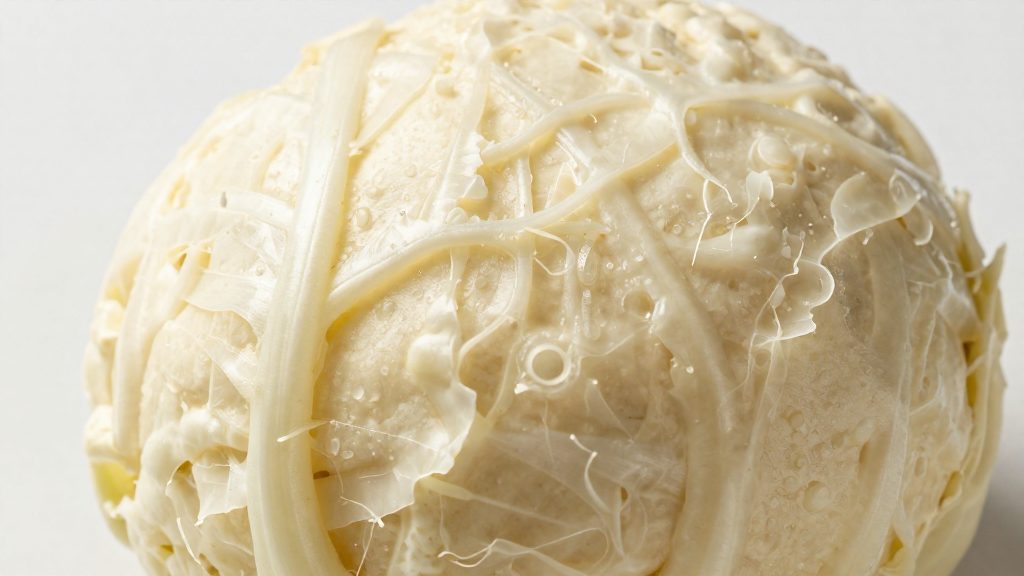
Kahm yeast or mold: how to tell
Kahm yeast and mold both appear as white or colored growth on the brine surface, but they differ in texture, color range, and what they mean for your batch. According to MakeSauerkraut.com (2026), kahm yeast is harmless. Mold grows as a raised, fuzzy layer that can be white, black, blue, green, or pink.
Texture and appearance
Lift a small section of the surface with a clean spoon and look at its profile:
- Kahm yeast: a smooth, flat sheet that lies on the brine and breaks into thin wrinkles or patches when stirred.
- Mold: a raised, fuzzy or cottony growth that stands above the surface and holds its shape.
If the growth is flat, thin, and white to cream, it matches the kahm yeast description. If it is raised and fuzzy, treat it as mold.
Mold colours
MakeSauerkraut.com (2026) lists five mold colours: white, black, blue, green, and pink. Any colored growth, such as green, blue, black, or pink, should be treated as mold.
Smell as a kahm marker
Kahm yeast is associated with a yeasty or cheesy odour that appears as an off-flavour (MakeSauerkraut.com, 2026). A cheesy or yeasty smell alongside a flat film points to kahm yeast. The sources do not describe a mold odour, so a normal smell does not prove the growth is safe.
Signs that mean discarding
Discard the batch if the brine is stringy, or if mold is widespread. Small mold patches can be skimmed, as described in the last section.
What makes sauerkraut slimy?
Ropy, stringy brine comes from dextran-producing bacteria. These microbes convert the sugars in the vegetable into dextran, a long-chain polysaccharide that thickens the liquid and makes it pull into strands when you stir or lift the cabbage. The usual suspects are lactic acid bacteria of the genus Leuconostoc, which are active early in many vegetable ferments. The texture reflects bacterial activity in the brine, not a defect in the cabbage itself.
Because these bacteria depend on sugar, the vegetables in the crock affect the outcome. Plain cabbage contains less fermentable sugar than mixed batches, so adding sweeter produce gives dextran producers more to work with. MakeSauerkraut.com (2026) identifies three vegetables that raise this risk:
- Carrots
- Beets
- Sweet peppers
Why warmth accelerates dextran production
Temperature is one of the two factors the source ties to these bacteria, alongside sugary vegetables. Warmth speeds up bacterial metabolism, so dextran accumulates faster while sugars remain available. Sugary vegetables and warm conditions compound each other: a batch with beets kept warm carries more risk than either factor alone would create.
The table below summarises how each condition affects the likelihood of stringy brine.
| Condition | Effect on dextran risk |
|---|---|
| Carrots, beets or sweet peppers added | Supplies extra sugar for dextran-producing bacteria |
| High fermentation temperature | Makes stringy brine more likely |
| Cooler fermentation at 18–21°C | Suggested by MakeSauerkraut.com (2026) to reduce dextran production |
Is slimy sauerkraut safe to eat?
Slimy sauerkraut is spoiled and should be thrown away. Oregon State University Extension (2026) classifies slime as a spoilage sign, so the batch is discarded rather than salvaged. The texture is a sign of microbial activity that has gone wrong, not a flavour defect, so cutting away the slimy part and eating the rest is not a recommended option.
Checking the kraut beneath the surface
Slime on top does not tell you how far it extends, so inspect the full batch before deciding:
- Remove the top layer of cabbage with a clean utensil, not bare hands.
- Look through the packed cabbage at several depths, including the area near the container walls.
- If slime appears anywhere in the container, treat the whole batch as spoiled.
Keep the container covered during inspection to limit further contamination.
Why not taste slimy kraut
Tasting is not a valid test for spoilage. A sample taste gives no reliable information about whether the rest of the batch is safe. A normal taste or smell does not change that, so the batch should be discarded whatever it tastes like.
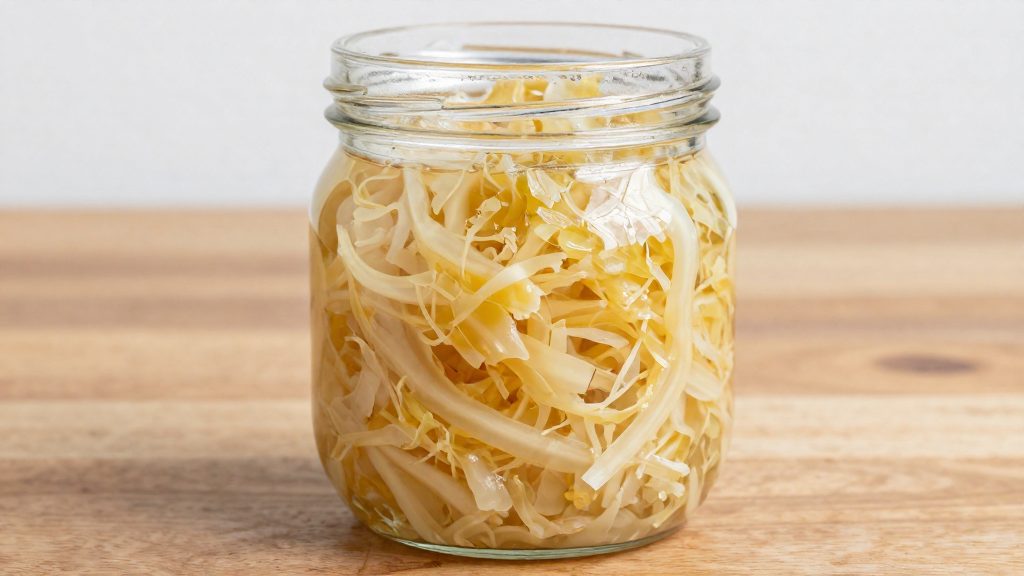
Right salt ratio and brine level
Salt strength and submersion depth are the two settings that keep sauerkraut stable. Oregon State University Extension (2026) lists too little salt as one of the two main causes of slimy sauerkraut, and gives the household measure of 3 tablespoons of canning salt per 5 lb (about 2.3 kg) of cabbage. Measure the salt against the weight of the cabbage, then confirm that the packed vegetables sit under liquid.
Salt measure
| Measure | Value | Source |
|---|---|---|
| Canning salt per 5 lb of cabbage | 3 tablespoons | Oregon State University Extension (2026) |
| Standard brine, by weight | 2% salt (16 g per 800 g of vegetables) | MakeSauerkraut.com (2026) |
| Warm-weather brine, by weight | About 2.5% salt | MakeSauerkraut.com (2026) |
Weigh the cabbage when you can, because a percentage is more repeatable than a volume. Canning salt is the type named in the Oregon State guidance. The 2.5% figure is the adjustment MakeSauerkraut.com suggests for warm weather, when salt is used to reduce kahm yeast and mold.
Submersion depth
Keep the packed cabbage 1 to 2 inches (about 2.5 to 5 cm) under the brine. University of Illinois Extension (2026) links this depth to mold control. Weights or brine-filled food-grade bags can hold the vegetables below the surface. Oregon State University Extension (2026) notes that a weight which does not keep enough liquid over the cabbage lets air reach the surface, so the weight must be sized to the jar and the batch.
Checking the brine level
Check the brine level during the ferment, not only at packing. Look for these signs:
- Brine level dropping below the 1 to 2 inch band, which means the cabbage has risen or the liquid has been reduced.
- Exposed cabbage at the surface, which needs to be pressed back under the brine.
- Weight shifting out of position, so it no longer covers the vegetables.
Check the brine regularly, and adjust the interval to the jar and your kitchen.
Best temperature and weights for fermenting
Temperature and submersion control most of the surface problems in a crock. Oregon State University Extension (2026) names 70–75°F (about 21–24°C) as the temperature to keep sauerkraut at, and says that fermenting too warm is one of two causes of slimy kraut. University of Illinois Extension (2026) advises fermenting at 70–75°F for 3 to 4 weeks.
Temperature window and duration
| Parameter | Value | Source |
|---|---|---|
| Fermentation temperature | 70–75°F (21–24°C) | Oregon State University Extension (2026) |
| Fermentation duration | 3 to 4 weeks | University of Illinois Extension (2026) |
Keeping the cabbage submerged
Oregon State University Extension (2026) lists the tools that hold it there:
| Tool | Use | Source |
|---|---|---|
| Plate | Presses the cabbage under the brine | Oregon State University Extension (2026) |
| Weighted device | Keeps small batches submerged | Oregon State University Extension (2026) |
| Brine-filled food-grade bag | Keeps the cabbage submerged | University of Illinois Extension (2026) |
A brine-filled food-grade bag is a sealed bag of brine placed on top of the cabbage. It adds weight without introducing a solid object that can scrape the surface.
When to scrape it off and when to toss it
The right response to a surface film depends on what it is and how much of it there is. Oregon State University Extension (2026) states that white scum on sauerkraut can be skimmed off, and that small mold patches can also be skimmed. A large amount of mold means discarding the batch. The Extension does not give a numeric threshold for “small” or “large,” so the decision rests on the area covered and how far the growth extends across the surface.
| Surface condition | Action | Source |
|---|---|---|
| White scum on the brine | Skim it off | Oregon State University Extension (2026) |
| Small mold patch | Skim it off | Oregon State University Extension (2026) |
| Widespread mold | Discard the batch | Oregon State University Extension (2026) |
Skimming white scum
Skimming is a surface job. Lift the film in one pass, without pushing it down into the crock. Then check the cabbage underneath.
Removing a small mold patch
A small mold patch is handled the same way as white scum. Remove the patch and inspect the surrounding cabbage. Only skim patches that are confined to one area. Once you have removed the growth, return the weight to its position so the cabbage stays submerged for the rest of the fermentation.
Discarding the batch
A large growth changes the decision. Skimming removes only what is visible on the surface, and the Extension recommends discarding the entire batch when mold is widespread. Do not try to salvage the rest of the crock by removing the top layer. Clean the vessel and weights before starting a new batch.
Frequently asked questions
Is slimy sauerkraut safe to eat?
Oregon State University Extension (2026) treats slimy sauerkraut as spoilage, so the batch should be discarded rather than rinsed and eaten. Rinsing the cabbage does not remove the cause, which sits in the brine.
Can I skim the slime off and keep the rest?
Skimming works for a flat film that sits on the surface. Slime is spread through the liquid, so a clean-looking top does not mean the brine is sound.
What should I change before the next batch?
Ferment in a cooler spot, since MakeSauerkraut.com (2026) links the slime-producing bacteria to high temperatures and suggests 18–21°C. Be careful with sugary vegetables such as carrots, beets and sweet peppers, which also raise the risk. Keep the salt at 2% of the vegetable weight, which is 16 g per 800 g.